
LEGACY & INSIGHTS: MUSIC STREAMING FRAUD
The Fake Songs, Phantom Listeners and $8 Million Royalty Scheme
Music streaming fraud turned AI songs and bot listeners into more than $8 million in royalties, and the case still leaves questions for working musicians.
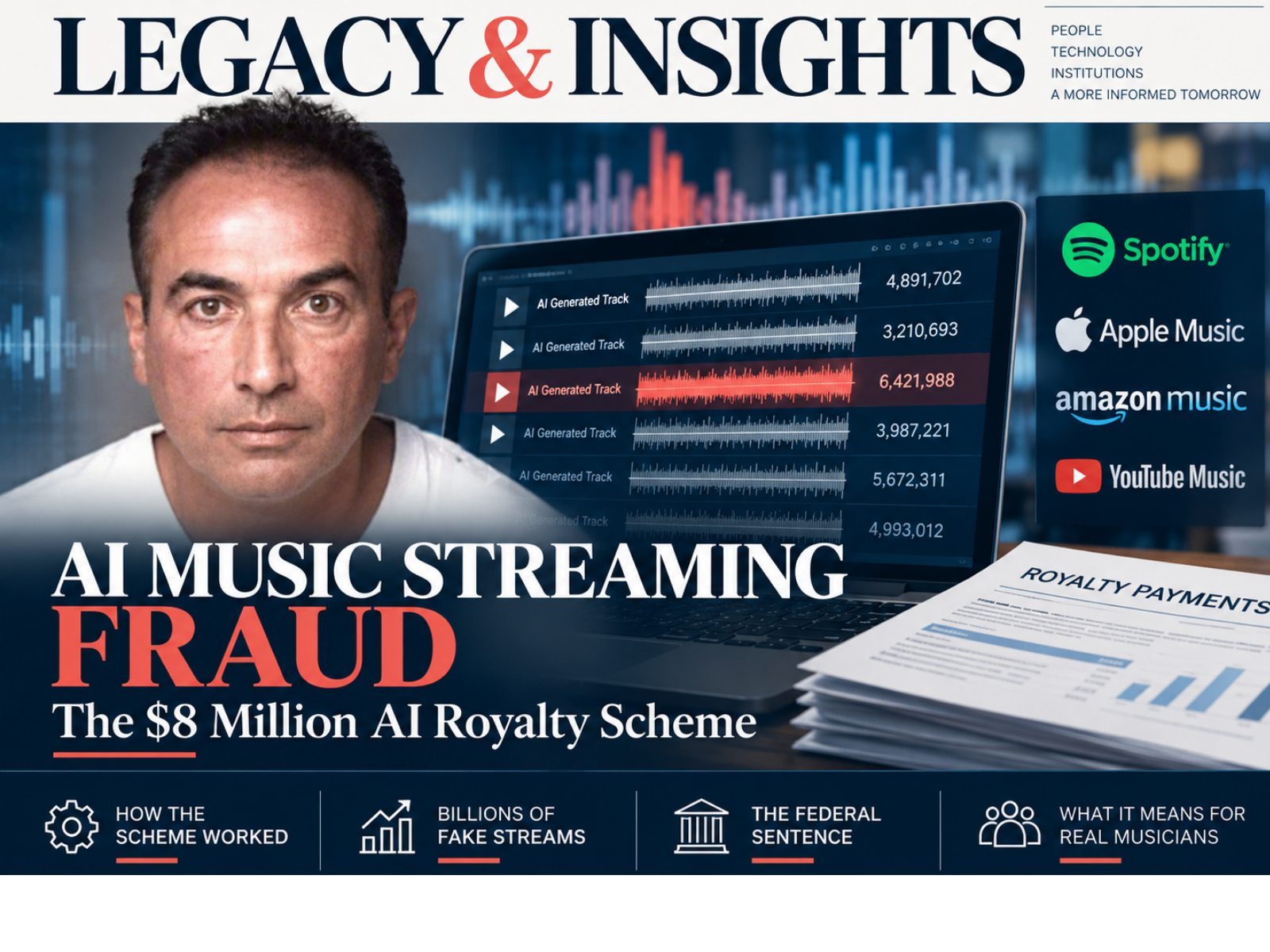
Music streaming fraud usually means bots replaying a handful of songs. The Michael Smith case worked differently. The Justice Department says Smith, 54, of Cornelius, North Carolina, used hundreds of thousands of AI-generated tracks and thousands of automated accounts to collect more than $8 million in royalties between 2017 and 2024. A federal judge sentenced him on October 6 to 18 months in prison. The conviction concerns fraud, not AI-generated music, yet it raises a harder question: when automated listeners generate millions in royalties, who pays the economic price, and why did the scheme last so long?
How the Music Streaming Fraud Machine Worked
Prosecutors say the scheme ran against Amazon Music, Apple Music, Spotify and YouTube Music. Smith first opened thousands of accounts with false email addresses and fraudulently obtained debit cards, according to the sentencing announcement. At times as many as 10,000 of them streamed his songs at once. Because AI tools supplied the catalog, the accounts never ran short of material: hundreds of thousands of tracks, played billions of times.
The indictment describes the machinery, but every detail in it is an allegation. It says Smith favored cheaper family plans, ran many virtual computers through cloud services and masked where the accounts logged in. The 2024 announcement also says he gave songs randomized titles and artist names so they looked human-made. Smith then pleaded guilty on March 19, 2026, to one count of conspiracy to commit wire fraud. The sentencing announcement states the accounts, the AI catalog and the royalty total as the facts of the case, while the specific methods above remain the indictment’s account.

How Thousands of Songs Hid Music Streaming Fraud
A billion plays on one song would draw attention. Smith allegedly understood that, so in an October 2018 email quoted in the indictment he wrote that he needed “a TON of content with small amounts of Streams.” Because the plays were spread across thousands of tracks, no single title drew notice. Because of that, music streaming fraud of this kind hid in the catalog, not on the charts.
Even so, the totals stood out. The Justice Department cites April 2023 figures that attribute 80.9 million family-plan streams on YouTube Music to Smith’s accounts, against 9.3 million for Taylor Swift’s catalog in the same comparison. Those numbers describe those accounts and that month. They say nothing, for example, about YouTube Music as a whole or the industry.
The Warnings Before the Music Streaming Fraud Case
Suspicion instead built in stages. A distributor told Smith in March 2018, according to the indictment, that a song fit criteria “usually linked to store end streaming abuse.” Smith replied, “We have no intentions of committing streaming fraud.” Then, in October, the distributor cited “multiple reports of streaming abuse.”
The Mechanical Licensing Collective halted payments in March and April 2023, the indictment says. Written denials then followed on March 17, March 23 and April 27, and the indictment calls them false. Prosecutors say a lawyer told the MLC in March 2023 that none of Smith’s works were computer-generated, per Music Business Worldwide. Smith says the lawyer advised him that civil penalties were the worst outcome. The accounts conflict.
The timeline answers part of the question of how the scheme lasted. Warnings appear in 2018, but payments halt only in 2023, and charges arrive in 2024. WIRED examined the case in May 2025. The Justice Department’s releases credit the FBI with the investigation but do not say what first drew investigators’ attention. The MLC’s payment halt and the federal inquiry are separate threads, since the releases do not connect them.
WBTV News Charlotte reports on the federal indictment of Michael Smith in the music streaming fraud case.

Music Streaming Fraud Totals: $10 Million Alleged, $8 Million Forfeited
The 2024 indictment alleged more than $10 million in royalties, but the sentencing announcement puts the figure at more than $8 million and sets forfeiture at $8,091,843.64. Yet the numbers measure different things. Music Business Worldwide reports that the agreed loss figure subtracts royalties from legitimate streams and money Smith paid back into royalty pools, and that prosecutors say he received more than $14 million from royalty-paying entities. The forfeiture is not a fine, and his lawyers argue it exceeds what he kept. The sentence also includes two years of supervised release.
Music Streaming Fraud and the Cost to Working Artists
Where a service divides royalties from a shared pool, fake plays can claim money that real rights holders would otherwise receive. Services use different formulas, so the effect varies by platform. Prosecutors say “every penny of loss was diverted to the defendant.” The Justice Department’s accounting is aggregate: it does not put a dollar figure on what any one musician, songwriter or spoken-word creator lost.
Spotify told MBW in 2024 that its safeguards limited Smith’s earnings from its platform to about $60,000. That is Spotify’s own statement, not an audited total, so it cannot show how the $8 million divided across services. For independent artists the mechanism matters more than any single number, because a larger share of the pool going to fake plays means a smaller share for real ones.
The Industry’s Response to Music Streaming Fraud
Smith’s lawyers argued in court that using AI to create songs is not “inherently unlawful,” while Spotify said in September 2025 that “all music is treated equally, regardless of the tools used to make it.” The Music Fights Fraud Alliance wrote that this sentence would be “the first real signal” of the legal consequences, and IFPI pointed to its Streaming Integrity Initiative.
Denmark offers a comparison. A Danish executive convicted in 2024 saw his sentence rise from 18 months to two years in February 2025, according to CMU, but the Danish prosecution service says only three months are to be served immediately. In the United States, the Copyright Office published a notice of inquiry on music streaming fraud on October 7, with comments due November 23.
Signal Breakdown
Not every music streaming fraud detail below is proven.
Confirmed by the Justice Department
- Sentence. 18 months and two years of supervised release (Oct 6).
- Plea. One count of conspiracy to commit wire fraud (Mar 19).
- Forfeiture. $8,091,843.64.
Alleged in the Indictment
- Accounts. Fake identities and family plans.
- Payments. The MLC halted payments in 2023.
- Original figure. More than $10 million.
Disputed or Attributed
- Lawyer. What Smith’s lawyer told the MLC (MBW).
- Spotify. About $60,000 reached Smith from its platform (Spotify to MBW).
- Forfeiture. The defense says it exceeds what he kept.
Not Established
- how the investigation began
- harm to any one musician
- whether any platform knew

The Questions the Music Streaming Fraud Sentence Leaves Behind
Music streaming fraud in the Smith case turned manufactured listening into real payments, but the record does not show how much any working musician lost, how the investigation began or whether faster detection could have ended the scheme sooner. The next test is whether services explain publicly how they detect fake plays, and the Copyright Office inquiry, open for comment until November 23, is one place to watch.
Sourcing: this report draws on the Justice Department releases, the indictment, the Federal Register notice and reporting by Music Business Worldwide and CMU. Allegations are identified as allegations throughout, and no advertiser on this page is named in the article.

CREATOR & INSTITUTIONAL INFRASTRUCTURE

RADAR / WHAT TO WATCH


KMOB1003 SELECTS
Music, style, tools, art and objects worth your attention.


FROM KMOB1003