

LEGACY & INSIGHTS: WORKERS TRAINING ROBOTS
The Workers Training Their Replacements: Inside the Global Race to Turn Human Skills Into Robot Intelligence
Workers training robots are recording their skills for pay, and the cases show wide gaps in what they earn and in what they are told.
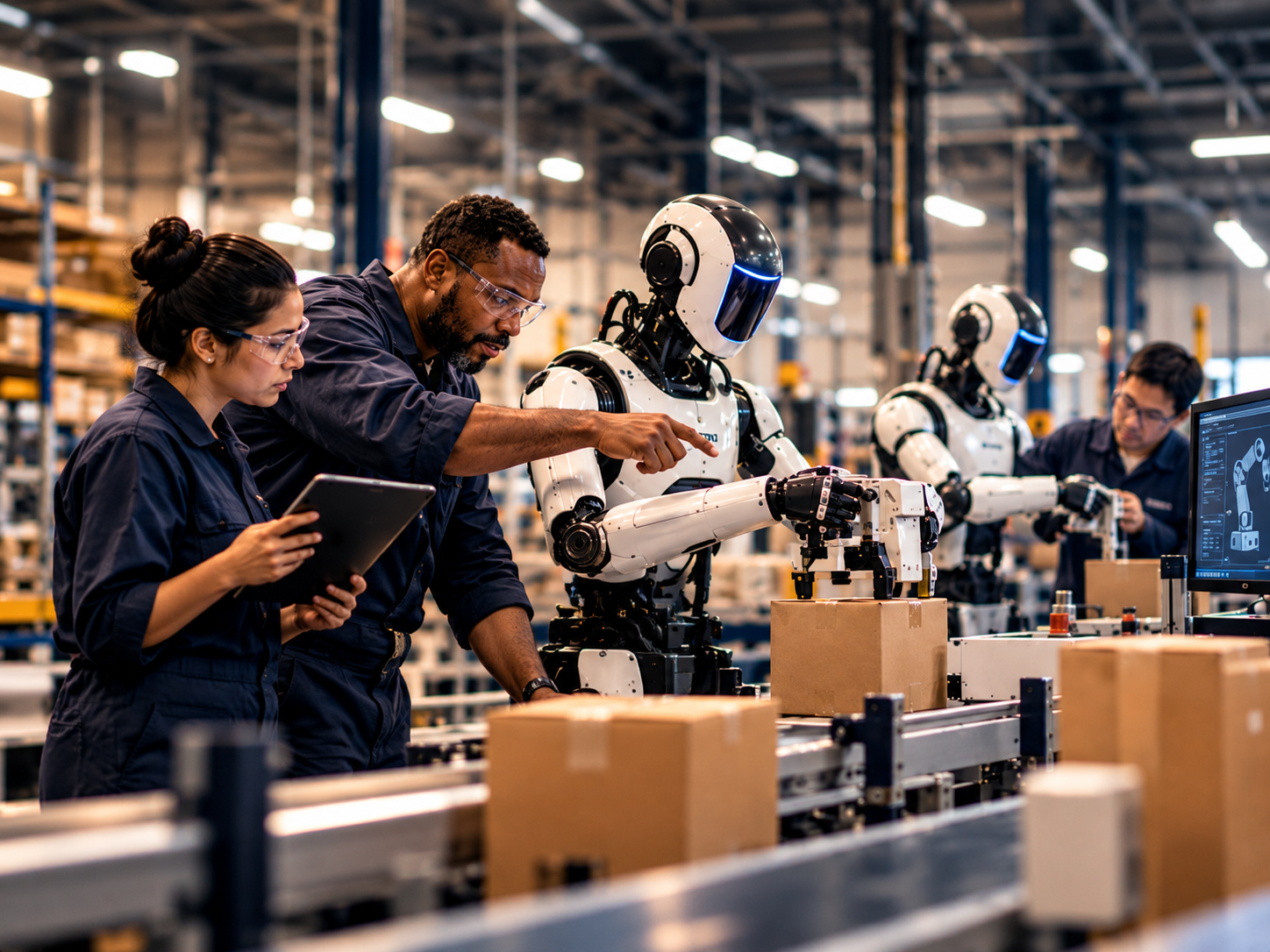
Workers training robots wear the camera, do the job and hand over the footage. In a textile factory in Karur, India, Shoba Kirubakaran, 40, makes $90 a month after 10 years on the floor. She wore a GoPro at work. When NPR explained what the footage was for, she answered, “Nobody told me anything about it.” Robot makers want footage like hers because machines learn from examples, and recordings of skilled hands at real work are hard to find. Whether this will cost anyone a job is still unproven. The deal itself is not: someone pays for the footage, someone keeps it, and at least one worker says she was never told.
How Workers Training Robots Became a Market
Chatbots learned from text. Robots need examples of physical work. Developers want egocentric data most: video from the worker’s own point of view, shot from head, chest and wrist cameras. Workers training robots supply exactly that.
The buyers are not hiding. In June, the marketplace Instawork announced Instacore, a five-camera wearable, and says it collects hundreds of thousands of hours of task data each month. In October, HUMXN began paying for plumbing, electrical and HVAC appointments in Minneapolis, Chicago and Miami in exchange for footage of technicians at work. Homepros reports about $20 for each hour of footage. HUMXN’s release does not say what the technicians receive or what homeowners agree to.

Workers Training Robots Earn Very Different Paychecks
Abroad, the same demand meets lower wages. In Karur, Kannagi Periyasaamy, 42, earns about $2.60 an hour to record herself, according to NPR, which does not name who pays her. Unlike Kirubakaran, she knows the purpose. “I’m proud I can teach it to do a good job,” she said. She expects a robot to take over her work someday, and she is “thinking about taking up farming.”
China builds the idea at scale. Rest of World reported that JD.com and the city of Suqian aim to generate 10 million hours of training data in two years. A stay-at-home mother filming household chores earns 20 yuan, about $3, an hour.
In South Korea, the Associated Press described David Park, a nine-year Lotte Hotel Seoul employee recorded with cameras on his head, chest and hands. The startup RLWRLD also records logistics and convenience-store staff, and Korea has launched a $33 million project to capture master technicians’ skills.
Low pay alone does not prove harm, because local wages differ. Astha Kapoor of the Aapti Institute put it bluntly: “Call it what it is, which is exploitation of labor.” The pay gap is only half the question. The other half is whether the worker knew what the company was buying.

What Workers Training Robots Are Told
Companies describe fair dealing. Instawork says it compensates participating businesses for every hour of data captured. HUMXN says it removes names, addresses and phone numbers from footage.
Workers training robots describe a patchier picture. Micro1 pays contractors in more than 50 countries, according to MIT Technology Review. The recorders interviewed did not know how the company would store or share their footage, and Micro1 declined to say whether it deletes data.
Here is what we have not seen. We have not reviewed one consent form or contractor agreement, and KMOB1003 did not interview workers or request comment from companies. We do not know whether any program tells workers that their footage could help automate their own jobs, or whether refusing carries a penalty. India’s data protection law lists employment as a legitimate use that does not need consent. That section and the notice and consent rules do not take effect until May 13, 2027, and the use covers employment purposes. We found no ruling on whether recording for robot training qualifies.
Video on workers training robots, starting at 0:51.

What Workers Training Robots Have and Have Not Taught Machines
Four different things get blurred. Machines can assist people, or people can operate them remotely. Systems can learn from examples, or act on their own. Learning a task, reaching a workplace and costing jobs are separate steps, and so far the first is the slow one.
The AP reported that robots need hours to clean a hotel room that staff finish in about 40 minutes. Lotte Hotel hopes for robot help by 2029. Alan Fern of Oregon State called JD.com’s approach “very unproven.” Ken Goldberg told MIT Technology Review it is “going to take longer than people think.” A July Technology.org review found Figure AI and Agility Robotics have the best-documented deployments, though published unit counts conflict.
The job-loss evidence comes from older machines. Economists Acemoglu and Restrepo found that each industrial robot added in exposed US labor markets from 1990 to 2007 coincided with roughly three to six lost jobs. A 2025 meta-analysis of 33 studies found small effects that varied widely. Neither covers humanoids trained on worker video, and we found no documented layoff tied to workers training robots this way. Even Ravi Shankar, chief executive of the data company Objectways, told NPR: “I don’t think it’s going to be cheaper.”
Who Profits From Workers Training Robots?
Follow the price, then follow the clock. Micro1’s chief executive, Ali Ansari, told MIT Technology Review that robotics companies spend more than $100 million a year on this data. The company pays $15 an hour in Nigeria. Homepros reports that Columbia economist Suresh Naidu told the New York Times that companies are paying far less than the data is worth. Once they have the data on how to do a job, he said, they no longer need the worker.
HUMXN’s founder, Thomas Unise, sees a window closing. He told Homepros the market will be “ultra-saturated in like a year and a half,” and the data then “worthless.” He also says contractors could earn an extra $1,500 a month per technician. Together, those claims describe a price that may expire for workers training robots.
What Workers Training Robots Can Ask Before Saying Yes
This summarizes public information and is not legal advice. Ask for written answers to six questions. What does the camera record? Who owns the footage? Who can see it? How long does the company keep it? Can you withdraw? Can the company use it to build automation? Contractors should read the license language, because reuse rights hold the commercial value.
The legal footing varies. California workers at covered employers have had rights since 2023 under the state privacy law. They can see what employers collect, correct it, request deletion with exceptions and opt out of sale or sharing. European Union rules require transparency and a stated purpose, and the AI Act bars systems that infer workers’ emotions, except for medical or safety reasons.
South Korea’s privacy law allows several grounds besides consent, and consent must be informed. Japan requires a business to specify its purpose and notify or publish it, and to get consent before going beyond it. In the United States, the labor board’s general counsel rescinded a 2022 monitoring memo in February 2025. Such memos are nonbinding, but they signal enforcement priorities. No jurisdiction we reviewed gives workers an unconditional right to refuse recording, delete data or collect royalties.
Labor groups in South Korea have already raised job-loss concerns, according to the AP. Workers training robots as a group can ask for terms on monitoring, retraining and pay that one worker cannot.
Signal Breakdown
Not every detail about workers training robots is proven.
Confirmed by Primary Records
- Instacore. Announced June 9 by Instawork (company release).
- HUMXN program. Paid home-service footage announced October 6 (company release).
- Study. Acemoglu and Restrepo on industrial robots, 1990 to 2007 (NBER).
Reported and Attributed
- Karur. Pay and consent accounts (NPR).
- Korea. Lotte, CJ and Lawson recordings (AP).
- China. A 10 million hour target (Rest of World).
Second-Hand or Conflicting
- $20 an hour. HUMXN rate (Homepros only).
- Naidu. New York Times remarks, relayed by Homepros; original unverified.
- Deployments. Published unit counts conflict.
Not Established
- whether any worker lost a job to a robot trained this way
- what HUMXN technicians or Micro1 contractors sign
- whether any program discloses automation as the goal

Workers Training Robots Deserve the Answer First
Teaching has always been an act of trust. You show someone the shortcut, the trick with the wrist, the thing the manual never mentions, and you expect credit for knowing it. A camera takes the lesson without the credit. A file never retires. Companies can copy it, license it and reuse it long after the shift ends.
Nobody can say yet whether these robots will learn the work. Nobody can say yet whether the work will go. What we can say is smaller and firmer. The workers training robots in five countries should hear, in plain words, what the footage is for, what it is worth and what they can refuse.
Whatever these machines learn, the skill was the worker’s first. The worker should get to decide what it is worth.

CREATOR & INSTITUTIONAL INFRASTRUCTURE

RADAR / WHAT TO WATCH


KMOB1003 SELECTS
Music, style, tools, art and objects worth your attention.




FROM KMOB1003