LEGACY & INSIGHTS
It Replicated the Style. Then It Put Someone Else’s Name on It.
ChatGPT New Yorker cartoons have carried real artists’ signatures, turning a dispute over style into one about attribution, licensing and livelihood.
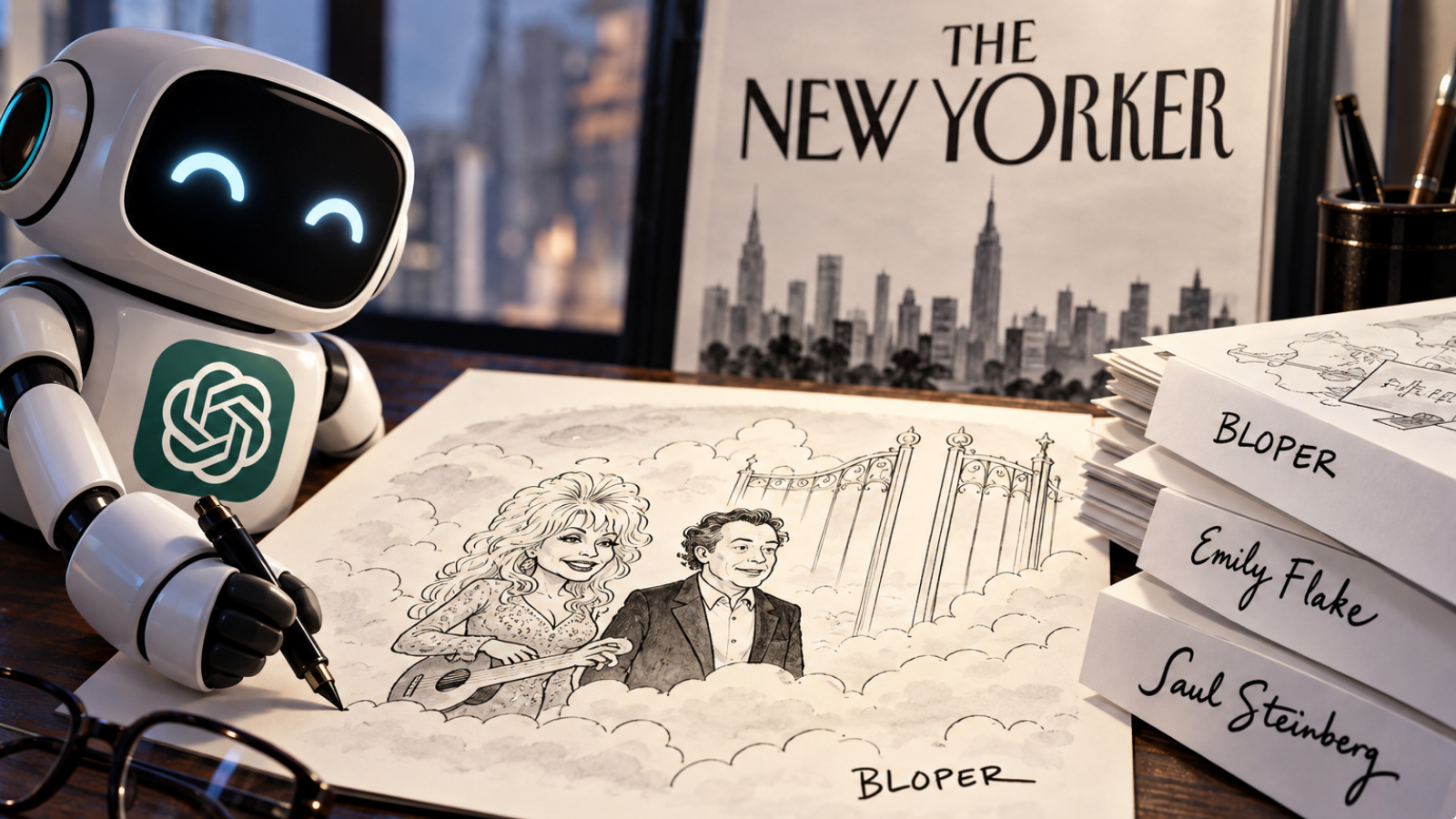
Illustration: KMOB1003 Global Media.
ChatGPT New Yorker cartoons have begun circulating with a detail that changes their meaning: the signatures of artists who never drew them. One viral example, a cartoon of Dolly Parton and Tim Curry at heaven’s gates, carried “BLOPER.” That is the signature of New Yorker contributor Brendan Loper.
The Cartoon That Carried Someone Else’s Name
Loper told Nieman Lab that people contacted him believing he had created the image. In fact, he had not. Andrew Deck’s October 5 investigation then widened the frame. It found more than 15 New Yorker cartoonists whose signatures appeared on ChatGPT-generated cartoons without permission or compensation.
The distinction is the story. A cartoon that looks like an artist’s work borrows a manner, but a signature claims authorship. In Nieman Lab’s reporting, Emily Flake separated drawings that resemble a mixture of cartoonists’ styles from a signature viewers can tie specifically to her. Loper put it more simply: “The signature for me is the certificate of authenticity.”
ADVERTISEMENT
One Attribution Problem Across ChatGPT New Yorker Cartoons
Deck names Emily Flake, Harry Bliss, Joe Dator, Pat Byrnes, Peter Vey and Jason Adam Katzenstein among the artists whose signatures appeared in examples shared online. His own tests also produced output signed with the names of George Booth, Liza Donnelly, Ellis Rosen and Saul Steinberg.
The results were not uniform. Some cartoons carried real signatures, some carried nonsensical names and others carried none. The reporting therefore does not show that every prompt produces the same behavior. Meanwhile, OpenAI acknowledged the reports as unintended behavior and said it appreciated users flagging problems. After Nieman Lab made contact, Deck encountered a warning about similarity to third-party content. Even so, some cartoons still carried real signatures as of publication. On October 12, Creative Bloq returned to the subject with the headline “Now AI isn’t just faking art, it’s faking artists’ signatures as well.”
WATCH / CARTOONIST SIGNATURES AND AI
A video briefing on ChatGPT-generated cartoons carrying the signatures of real New Yorker artists. Video: Tech Brew Ride Home / YouTube.
ADVERTISEMENT

The Publisher Deal Behind ChatGPT New Yorker Cartoons
In 2024, Condé Nast, which publishes The New Yorker, entered a multiyear content agreement with OpenAI. A New Yorker spokesperson told Nieman Lab that the company had never granted an AI developer permission to train models on its cartoons. The spokesperson also said reproducing its logo is not allowed in any of its AI deals.
Deck also reviewed standard cartoonist agreements. He reported that contributors generally retained copyright in their work, and that none of the agreements he reviewed permitted licensing for AI training. A corporate content deal, however, does not establish that freelance cartoons or signatures were part of what was granted. Still, the private terms of the Condé Nast agreement are not public. For ChatGPT New Yorker cartoons, then, the licensing question is a gap, not a finding.
ADVERTISEMENT

A Signature on ChatGPT New Yorker Cartoons Is More Than a Mark
For a working cartoonist, a signature is professional identity. It tells an audience whose judgment and reputation stand behind a drawing. Attached to an image the artist never made, however, it can send credit, criticism and commissions to the wrong person. That risk grows once people share the image without context. Flake, for example, framed the harm as speech: it is “like somebody attributed a quote to me that I didn’t say.”
But whether the law treats that as a wrong is a separate question. Cornell law professor James Grimmelmann told Nieman Lab that a signature indicates authenticity, but attribution is only a small part of the fair-use inquiry. He also said cartoonists could have grounds for a right-of-publicity claim. Such a claim would require proof that someone used the cartoons for a commercial purpose, not just as a joke or gag. No ruling finds OpenAI liable for these signatures, and whether any specific cartoon is actionable is unsettled.
So that gap is the real tension. The professional and reputational harm of a false signature is easy to recognize, because people can blame an artist for work never made. Yet the remedy is harder to name, because the legal tests Grimmelmann describes turn on fair use and commercial purpose, not on whose name appears. Even so, harm of the kind Flake describes does not wait for either test.
CREATOR & INSTITUTIONAL INFRASTRUCTURE
Rights do not pass automatically from one box to the next. A publisher’s agreement does not by itself settle what a freelance artist owns.
ADVERTISEMENT
The Economic Stakes Behind ChatGPT New Yorker Cartoons
In fact, none of the contributors Deck spoke to said they could support themselves on magazine commissions alone. He also reported that work for the magazine opens doors to commercial work, book illustrations and other gigs. A recognizable name, in other words, carries economic weight. Nieman Lab also reported that The Baltimore Sun dismissed longtime cartoonist Kevin Kallaugher in 2025 and published AI-generated editorial cartoons in 2026.
That shows newsroom adoption of AI illustration. However, it is not proof that false signatures caused his dismissal, and The New Yorker was not reported to have replaced its cartoonists. Nobody has verified any lost revenue from the viral cartoon. Deck found no evidence that these cartoons are being bought or sold, which is not proof that no sale has occurred. So the open question is what happens to the human creative economy when professional identity becomes reproducible at scale. ChatGPT New Yorker cartoons raise it even if they do not answer it.
FROM KMOB1003
Unanswered Questions About ChatGPT New Yorker Cartoons
Much remains unknown. No source establishes where the models learned each signature or whether a particular New Yorker cartoon archive was ingested in training. Moreover, OpenAI declined to tell Deck how its models might have ingested the signatures. The permissions granted, and any remedy if a false attribution spreads widely, are not public. Nor is it clear how often OpenAI’s warning now stops a real signature from appearing, because no one has reported a success rate after October 5.
OpenAI’s public position is that the behavior was unintended, and it points to its stated commitment to human creativity. But that statement is not an admission of infringement, and nothing shows the problem is permanently resolved. So the test that matters is plain. A name on a drawing is a claim of authorship. The companies and publishers that build and license these tools should be able to show the claim is true before the audience has to guess.
Signal Breakdown
Confirmed / Documented
- The false attribution. Nieman Lab’s Andrew Deck (Oct. 5, 2026) documented more than 15 New Yorker cartoonists whose signatures appeared on ChatGPT-generated cartoons without their permission or compensation, including “BLOPER,” Brendan Loper’s signature, on a viral Dolly Parton and Tim Curry cartoon he did not draw.
- Results varied: some cartoons carried real signatures, some carried nonsensical names and some carried none.
- The licensing gap. A New Yorker spokesperson told Nieman Lab that Condé Nast had never granted an AI developer permission to train models on its cartoons, and that reproducing the logo is not allowed in any of its AI deals.
- Deck reviewed standard cartoonist agreements and reported that contributors generally retained copyright and that the agreements reviewed did not authorize AI training licenses.
Reported / Attributed
- OpenAI acknowledged the reports as unintended behavior, said it appreciated users flagging problems and pointed to its stated commitment to human creativity. After Nieman Lab made contact, Deck encountered a warning about similarity to third-party content, and some cartoons still carried real signatures as of publication.
- In 2024, Condé Nast entered a multiyear content agreement with OpenAI. Its private terms are not public.
- Cornell law professor James Grimmelmann told Nieman Lab that a signature indicates authenticity but attribution is only a small part of the fair-use inquiry, and that a right-of-publicity claim would require proof of commercial use.
- The creator economy. Nieman Lab reported that none of the contributors Deck spoke to could support themselves on magazine commissions alone, that the work opens doors to commercial work and book illustrations, and that The Baltimore Sun dismissed cartoonist Kevin Kallaugher in 2025 and published AI-generated editorial cartoons in 2026. Nothing shows false signatures caused the dismissal.
- Creative Bloq (Tom May, Oct. 12, 2026) followed up on the signature reports.
Not Established
Available evidence does not establish:
- where the models learned each signature, or whether a particular New Yorker cartoon archive was ingested in training
- the private terms of the Condé Nast and OpenAI agreement
- that any specific cartoon is actionable copyright infringement, false attribution or trademark misuse, or any ruling finding OpenAI liable
- revenue losses from the viral cartoon; Deck found no evidence the cartoons are being sold, which does not rule out a sale
- how OpenAI’s models might have ingested the signatures; OpenAI declined to tell Deck
- the date of any OpenAI safeguard, or how often signatures still appear after October 5
RADAR / WHAT TO WATCH
KMOB1003 SELECTS
Music, style, tools, art and objects worth your attention.