
LEGACY & INSIGHTS
Microsoft’s Green Card Freeze Raises a Question the Numbers Cannot Answer
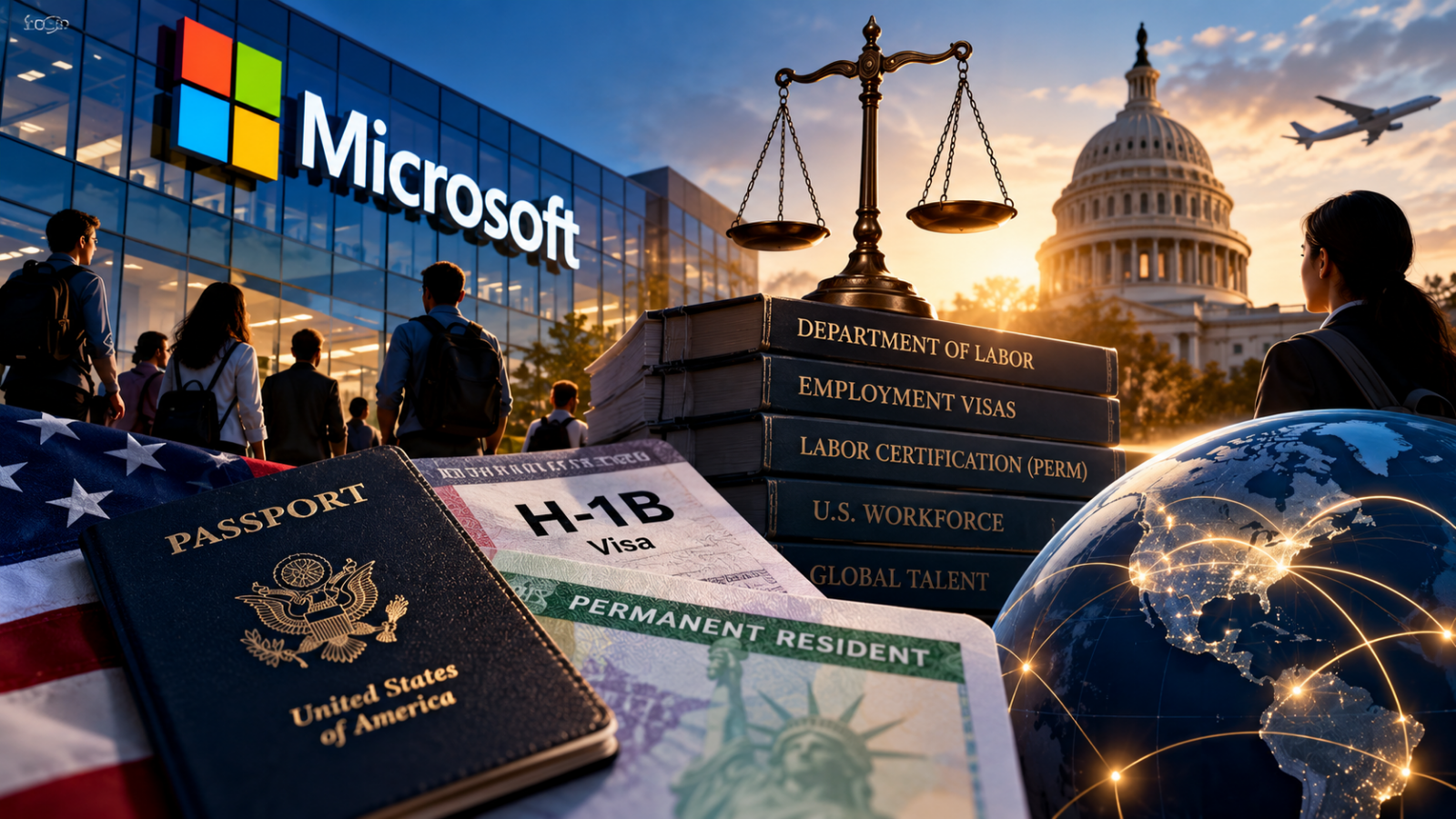
Microsoft green card suspension is, at heart, a dispute over arithmetic. On Thursday, Vice President JD Vance said Microsoft laid off 6,000 American workers in the past year while benefiting from 6,300 H-1B visas and nearly 3,000 green cards. (New York Times) Microsoft says most of its roughly 6,000 H-1B filings covered people it already employed. (TechCrunch) The two accounts count different things.
The Labor Department said it would stop accepting new permanent labor certification applications involving eight companies, and stop processing pending ones: Microsoft, Adobe, Infosys, Tata Consultancy Services, Wipro, Cognizant, HCL Technologies and Capgemini. (Reuters, via Investing.com) The administration says the action targets fraud and the loss of American jobs.
What the Government Did, and What It Has Shown
Vance told reporters that Microsoft is “a great American company” that needs to hire American workers. (Reuters) The Times reported he said an investigation had found Microsoft misused the program. Reuters reported that the freeze does not appear to directly affect current H-1B holders. It reaches the step before a green card, not the visa a worker already holds.
Under the Labor Department’s regulation, officials may suspend processing for an employer under investigation for possible fraud. (20 CFR § 656.31) One immigration law firm reads the rule as allowing an initial 180 days, extendable. (Wolfsdorf) A suspension is a pause, not a finding of fraud. Vance said this one will run as long as needed. The Times noted that the administration has not always provided evidence to match its fraud claims. We did not see the Labor Department’s written notices or an appeal route, and no specific Microsoft filing has been identified as false.
Why a Green Card Starts With the Employer
For most employer-sponsored green cards, the first step is a labor certification, known as PERM. The employer must show that hiring the foreign worker will not harm the wages, working conditions or job opportunities of U.S. workers. (Reuters) That includes recruiting in the U.S. market first. (20 CFR § 656.17) Critics argue the recruitment can become a formality when the employer already intends to keep its worker. Defenders say the rules require the test and the department can audit it. Thursday’s announcement settles neither.
USCIS reported roughly 52,700 unique employers registering for the fiscal 2025 H-1B cap lottery. (law-firm summary of USCIS data) That counts lottery registrants, not employers who sponsor green cards. Reuters, citing the Permtrack tracker of Labor Department data, called Microsoft the largest PERM filer.
WATCH / THE SUSPENSION IN THE NEWS
News report from KIRO 7 News on the suspension of Microsoft’s use of the green card program.
Two Numbers Behind the Microsoft Green Card Suspension
Vance said that in the past year Microsoft laid off 6,000 American workers while benefiting from 6,300 H-1B visas and nearly 3,000 green cards, according to the New York Times, Axios and Quartz. In Quartz’s account, he called the replacements “foreign indentured servants.” The Times adds that he said the visa holders were paid a fraction of American wages.
Microsoft responded that of roughly 6,000 H-1B applications last fiscal year, 80% were to extend or change the status of existing employees. The rest were for people already legally in the U.S., equal to 1% of its U.S. workforce. “They are not new arrivals to our country,” the company said, adding that its pay is among the highest in tech. (TechCrunch)
Vance’s figure combines layoffs, H-1B visas and green cards. Microsoft’s counts H-1B applications. The government’s action concerns a third thing, PERM. Both sides use 6,000, for different things. We could not establish which twelve months Vance’s figures cover or what the layoffs figure counts, and we found no match between specific layoffs and specific hires. Microsoft’s breakdown is the company’s own.
The People in the Middle of the Microsoft Green Card Suspension
Consider a software engineer on an H-1B visa. The employer files PERM and, once it is certified, an immigration petition called an I-140. The worker waits for a visa number, which for many nationalities takes years, then applies for a green card inside the U.S. or through a consulate abroad.
The suspension stops the first step for these eight employers and, by the Labor Secretary’s description, pending applications too. H-1B status is not canceled. But a case that never advances sits at the start of a line that was already long. Under a provision known as AC21, a pending labor certification or I-140 can support H-1B extensions beyond six years. The reporting we reviewed did not address how the suspension affects that, so affected workers should ask an immigration attorney. No reporting suggests the workers themselves are accused of anything.
Where Washington and Microsoft Disagree
The administration’s position, as reported, is that program abuse is widespread and that companies should not dismiss Americans while sponsoring foreign workers. Rep. Pramila Jayapal, a Democrat and former H-1B holder, said you do not fix a broken system by taking a hammer to legal immigration. (Axios) Microsoft disputes the numbers and offers the administration more information.
Economists, the Times notes, have maintained that visa holders boost American productivity and raise wages. The administration counters that companies hire at lower pay than Americans would earn. Microsoft says its pay is among the highest in tech. None of this has been shown for Microsoft’s filings.
ADVERTISEMENT

Seven Other Companies, Fewer Answers
Reuters reported that Adobe, Cognizant, Infosys, HCL Technologies, Wipro and Capgemini did not immediately respond to requests for comment, and that Tata Consultancy Services declined to comment. (Reuters) From USCIS data, Reuters also reported that Amazon was the largest employer of approved H-1B beneficiaries in fiscal 2026, followed by Tata Consultancy Services, Infosys, Apple and Microsoft. Amazon and Apple are not among the eight. The reporting does not say why, or which of the seven are accused of what Vance described.
A Contrast That Raises More Questions
Hours after the announcement, the Times reported, President Trump awarded Microsoft chief executive Satya Nadella the National Medal of Technology and Innovation. Trump said it was “so well deserved.” (New York Times) Nadella came to the U.S. for graduate school and, the Times reports, wrote in his memoir that he traded his permanent residency for an H-1B in 1994 so his wife could join him. Both later became citizens. A company can be honored and investigated in the same week. No reporting we reviewed explains the timing, and we have no basis to say it is political.
What About Americans Working Abroad?
If skilled workers are harder to bring here, some employers may hire them abroad, move the work, or hire more Americans. Those are predictions, not findings. Data on the foreign affiliates of U.S. companies counts the people those affiliates employ, mostly local hires. It is not a count of Americans working overseas, and we found no source that provides one.
ADVERTISEMENT

What Would Settle the Microsoft Green Card Suspension Dispute
Five records would do most of the work: the Labor Department’s written notices to each company (legal basis, length, appeal route); the evidence behind the statement that an investigation found abuse; the definitions behind Vance’s figures; Microsoft’s recruitment records for the affected roles, including how many U.S. applicants there were and why they were not hired; and what happens to pending cases when the review ends.
The Microsoft green card suspension is documented. The allegation that Microsoft replaced laid-off Americans with foreign hires is the administration’s claim. The company disputes it, and the numbers offered so far do not measure the same thing.
The people most affected are not at the podium. They are the workers waiting for a decision, the Americans who want an honest shot at the same jobs, and the employers trying to follow the rules. All of them are served by a clear public record.
ADVERTISEMENT

Signal Breakdown
Confirmed / Documented
- On October 8, 2026, the Labor Department announced it would stop accepting new PERM applications and stop processing pending ones involving Microsoft, Adobe, Infosys, Tata Consultancy Services, Wipro, Cognizant, HCL Technologies and Capgemini.
- The action was announced by Labor Secretary Keith Sonderling and Vice President JD Vance (Reuters, New York Times, TechCrunch).
- Microsoft publicly disputed Vance’s characterization (TechCrunch, New York Times).
- Federal regulation lets the Labor Department suspend processing during an investigation for possible fraud; a suspension is not a finding of fraud (20 CFR § 656.31).
Reported / Attributed
- Vance said Microsoft laid off 6,000 American workers in the past year while benefiting from 6,300 H-1B visas and nearly 3,000 green cards (New York Times; Axios; Quartz).
- Vance said an investigation found Microsoft abused the program and that the suspension will last as long as needed (New York Times).
- Microsoft said about 6,000 H-1B applications last fiscal year, 80% for existing employees, the rest equal to 1% of its U.S. workforce (TechCrunch; New York Times).
- Reuters reported the freeze does not appear to directly affect current H-1B holders and that Amazon, not named in the action, was the largest approved H-1B employer in fiscal 2026.
- The Times reported Trump awarded Satya Nadella a national technology medal hours after the announcement, and that economists have maintained visa holders raise productivity and wages.
Disputed
- Whether Microsoft replaced laid-off American workers with foreign hires.
- Whether its H-1B filings reflect new hiring or mostly existing employees.
- Whether H-1B pay at Microsoft is a fraction of American wages (Vance) or among the highest in tech (Microsoft).
Not Established
The available evidence does not establish:
- The Labor Department’s written notices: length, legal basis and appeal route.
- Which Microsoft filings, if any, contained false statements.
- The time period and definitions behind Vance’s figures, and any match between specific layoffs and hires.
- Which of the seven other companies are accused of what Vance described.
- How the suspension affects H-1B extensions for workers with pending cases.
- A count of Americans working abroad, and why the action came when it did.

KMOB1003 SELECTS
Music, style, tools, art and objects worth your attention.