
LEGACY & INSIGHTS
The Ocean Reached Long Beach Homes. The Barrier Was Already Damaged.
Long Beach storm surge, as many call it, meant waves, swell and high water reaching Peninsula homes, and the bulkhead protecting them was already damaged.
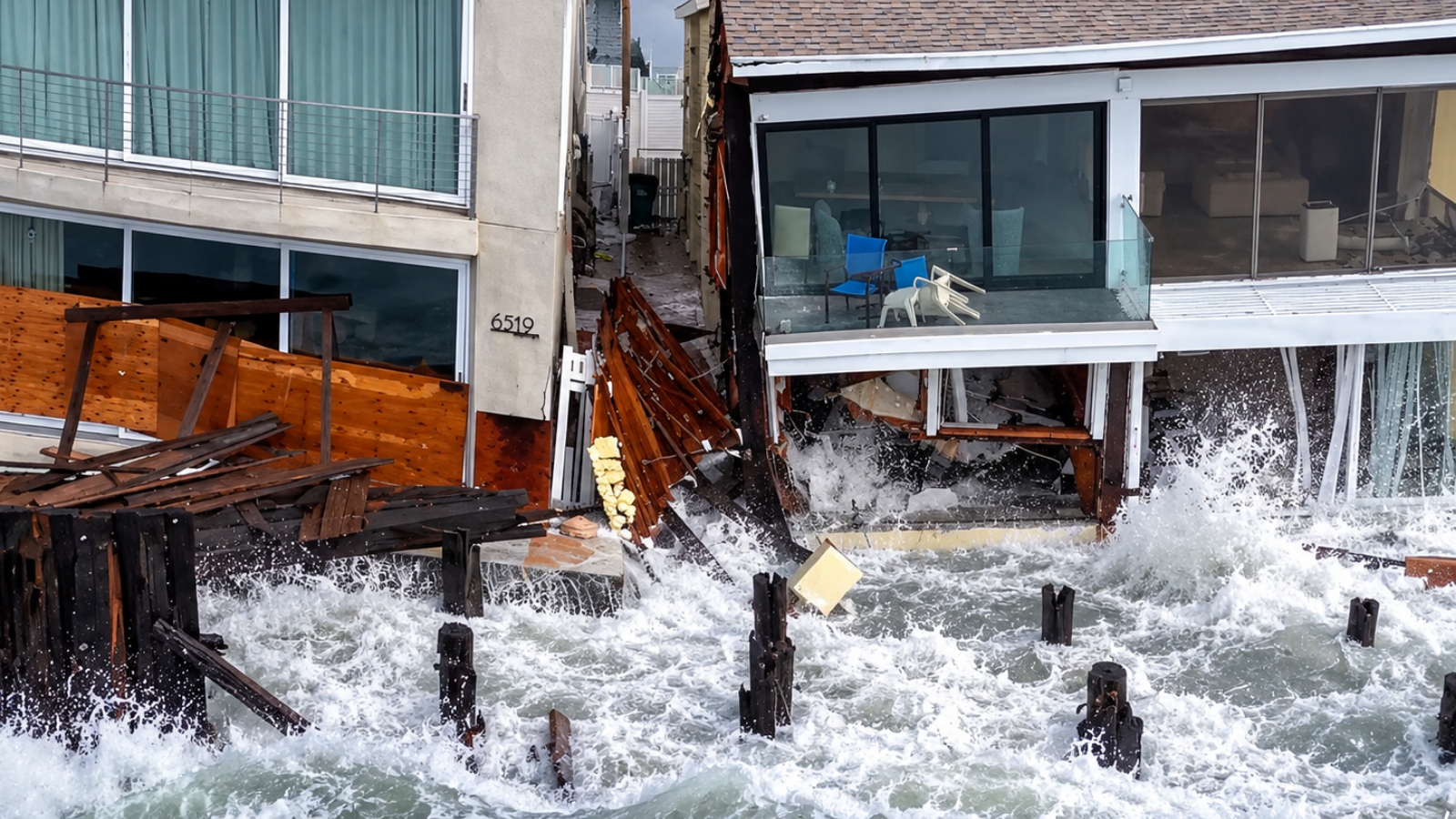
Illustration (not a photograph): KMOB1003 Global Media.
Long Beach storm surge is the phrase many readers are searching, but what reached the Peninsula was not necessarily a conventional storm surge, the sea-level rise a hurricane’s winds push ashore. The National Hurricane Center’s final discussion of Rachel’s remnants pointed instead to storm-generated waves, a long-period southerly swell and water levels running as much as 1.5 feet above predictions.
By Sunday afternoon, that combination had also emptied some homes. The Long Beach Post reported that inspectors had red-tagged nine buildings containing 13 addresses, meaning they are unsafe to enter, with one more building yellow-tagged. A mandatory evacuation for homes between 64th and 66th places runs through noon Tuesday, October 13, and 39 more residences are under an evacuation warning. Those are the Post’s Sunday figures, and they may change.
ADVERTISEMENT

A Bulkhead Weakened Before the Long Beach Storm Surge
The barrier is a timber bulkhead and boardwalk along Seaside Walk. After Hurricane Marie stripped the sand around it, the fire department evacuated about 20 homes in late September after finding cracks and a compromised seawall and boardwalk, according to the Post and the Los Angeles Times.
When Rachel’s surf arrived Friday, waves topped the bulkhead and tore apart a section of boardwalk, the Post reported. Why it failed is not established: no source reviewed offers an engineering finding or shows a maintenance lapse. Some residents told the Post they wished the city had acted sooner, and city spokesman Laath Martin said life safety is the priority. National Weather Service meteorologist Kristan Lund said peak swell, high tide and wind direction never lined up, which kept conditions from being worse.
WATCH / LONG BEACH COASTAL DAMAGE
Footage published by Moneycontrol showing powerful waves and damage to beachfront homes in Long Beach, California. Video: Moneycontrol / YouTube.
ADVERTISEMENT

Long Beach Storm Surge Aftermath: Standing Homes, Locked Doors
A red tag does not mean a house has fallen. It means no one may go in. A yellow tag allows brief entry for belongings, the Post reported Friday, and the city calls tags preliminary, open to downgrade after repairs and inspection.
For families, that means waiting outside homes that are still standing. Assistant Fire Chief Jake Heflin said many want to retrieve belongings, but firefighters cannot send anyone into a building that could be near collapse. One home in the 6500 block appeared close to collapse Friday, the Post reported. No report reviewed describes a collapse, and none rule one out. Homeowner VR Venkataraman told the Post his family evacuated and he returns at high tide to check supports he helped crews build.
ADVERTISEMENT

Long Beach Storm Surge Response: What the City Is Doing, and What Stays Open
Crews are bracing the bulkhead with lumber beams and plan to place about 30 sandbags, roughly 3,000 pounds each, by crane on 65th Place, the Post reported. The city has spent more than $1 million from its Tidelands emergency reserves.
Responsibility is already dividing. The city is seeking state help for public work, while cleanup and demolition of private homes fall to owners, it says, who should call their insurers. Whether any policy will respond is not established.
Long-term protection after the Long Beach storm surge is unresolved. City officials expect erosion and damage to worsen through the El Niño season. The checkpoints are concrete: Tuesday’s noon evacuation deadline, full dredging starting the week of October 19, and the next tag decisions. They will show whether the defense is rebuilt before the next large swell.
ADVERTISEMENT

Signal Breakdown
Confirmed / Documented
- The National Hurricane Center’s final discussion on the remnants of Rachel (Oct. 11, 2026) says waves generated by Rachel and an incoming long-period southerly swell would produce life-threatening surf along Southern California coasts, with observed water levels as much as 1.5 feet above predictions.
- The same discussion expects coastal flooding and erosion to worsen as the highest waves coincide with high tides, and says Rachel had dissipated over the southwestern United States.
Reported / Attributed
- The Long Beach Post (Oct. 11) reports nine red-tagged buildings across 13 addresses and one yellow-tagged building, a mandatory evacuation between 64th and 66th places through noon Tuesday, Oct. 13, and 39 more residences under an evacuation warning. NBC Los Angeles reported eight structures across 13 addresses on Saturday. The two counts differ and neither outlet explains why.
- The Post reports that waves topped the bulkhead and tore apart a section of boardwalk on Friday, that about 1,000 sandbags were placed that day, and that crews are bracing the bulkhead with lumber beams and plan to place about 30 sandbags of roughly 3,000 pounds each by crane on 65th Place.
- The Post and the Los Angeles Times reported that the fire department evacuated about 20 homes in late September after cracks were found and the seawall and boardwalk were found to be compromised.
- The Post reports that one home in the 6500 block of Seaside Walk appeared close to collapse on Friday, and later reporting describes several structures creaking and sagging as waves hit.
- Assistant Fire Chief Jake Heflin said firefighters cannot send anyone into a building that could be near collapse. City spokesman Craig Nakano said tags are preliminary and inspectors recheck twice a day.
- National Weather Service meteorologist Kristan Lund said peak swell, high tide and wind direction never lined up. The Post attributes water levels 1 to 1.8 feet above predicted tides to El Niño-related thermal expansion, a Kelvin wave and elevated astronomical tides.
- The city says it has spent more than $1 million from Tidelands emergency reserves, is in talks with the governor’s Office of Emergency Services about reimbursement for public work, and that demolition and cleanup of private homes are the owners’ responsibility.
Not Established
Available evidence does not establish:
- why the bulkhead failed, or that any engineering flaw or maintenance lapse caused it
- whether any building collapsed, or that none did; nine red tags do not mean nine failures
- that all damage came from a single wave event
- whether insurance will cover any specific loss
- the length or exact location of the breach
- whether the sandbags prevented additional damage

KMOB1003 SELECTS
Music, style, tools, art and objects worth your attention.