
Founders · Governance · Public Knowledge · Platforms · Legacy & Insights · June 2026
When the Founder Can No Longer Correct the Machine
Larry Sanger helped build Wikipedia. This year, the encyclopedia he helped name voted to lock him out of it — and the real story is bigger than one block.
In June 2026, Wikipedia co-founder Larry Sanger was indefinitely blocked from editing the encyclopedia he helped name. The rule used to remove him is, in part, a rule he helped write. That is not irony. That is architecture — and architecture does not care who laid the first stone. Read past the moderation headline and this is a founder story, a governance story, and a public-knowledge infrastructure story. It is the same story underneath every institution that outgrows the person who built it: the moment the system stops recognizing its architect as exempt from its own logic.
What This Article Is Actually About
KMOB1003 is reading the architecture underneath the headline — not who was right, not who was wronged, but what happens when an institution becomes powerful enough to govern its own founder, and whether any creator of a platform, a media brand, a movement, or a knowledge system can build something that will still recognize their original intent when they are no longer the loudest voice in the room. That question is not about Wikipedia. It is about every room any of us has ever tried to build.
Signal One
A founder, blocked by his own architecture
Sanger co-founded Wikipedia and drafted its earliest neutrality and open-contribution rules. In June 2026, the community he built voted to lock him out indefinitely.
Signal Two
The charge was process, not politics
Editors say Sanger violated the “canvassing” rule by promoting an internal discussion to his outside followers — a process violation, by the community’s own account.
Signal Three
This is bigger than one site
Every founder who builds something that outlives their direct control eventually meets this same governance question — Wikipedia is simply where it became visible this year.
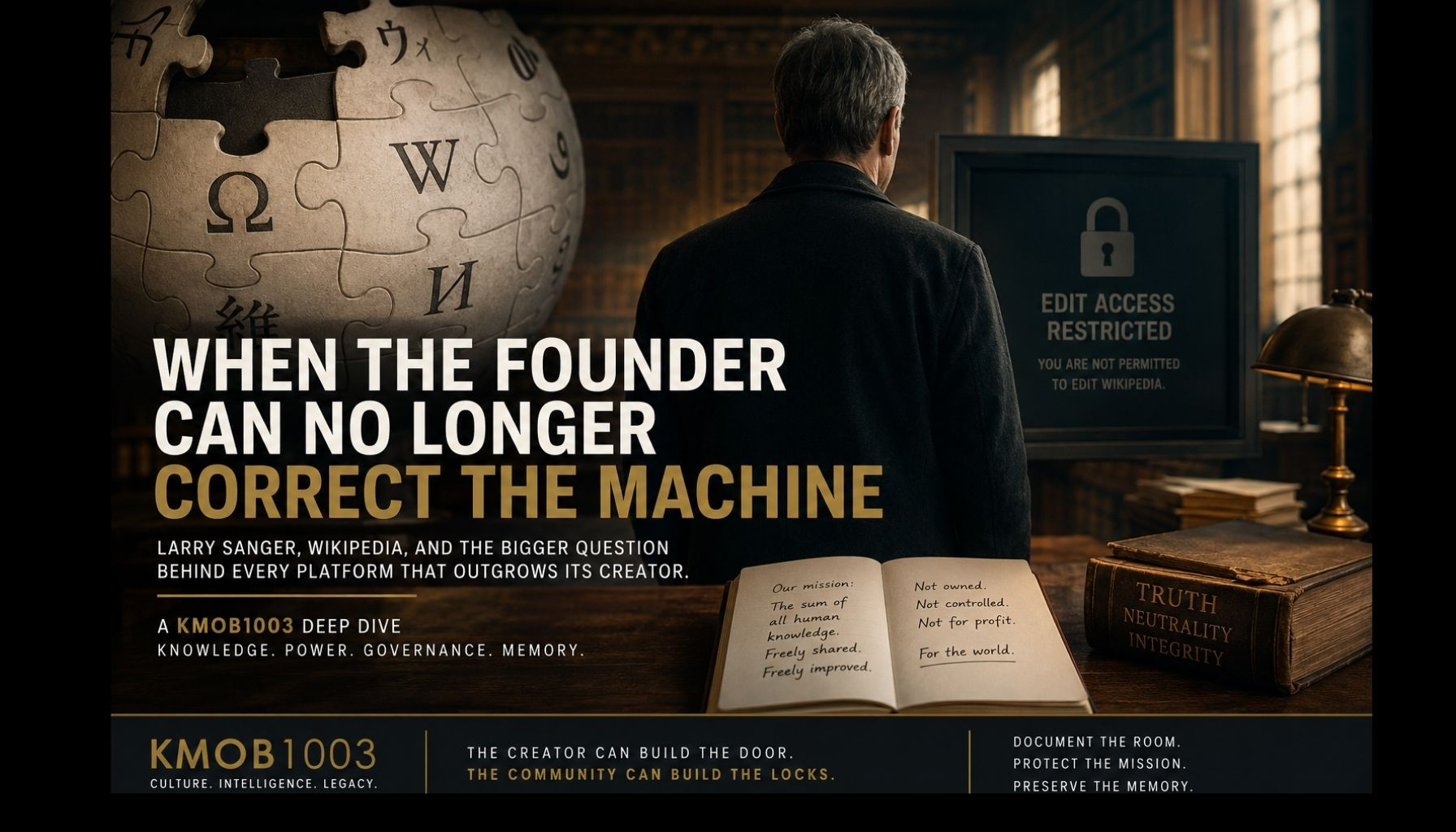
I. The Platform Became the Power
Larry Sanger co-founded Wikipedia with Jimmy Wales in 2001, and Wikipedia’s own record confirms he coined its name and drafted the earliest versions of its founding policies, including “neutral point of view” and “ignore all rules.” He left the project in 2002 and spent the next two decades as one of its most persistent critics, arguing since 2020 that the site had developed a left-leaning ideological bias. None of that history is in dispute. What changed this year is that the architecture he helped design was used, by a community he no longer controls, to remove him from it.
That is the quiet irony sitting underneath the headlines: the rules that locked him out are, in part, the rules he helped write. The platform did not betray its design. It followed it.
II. When Correction Gets Called Disruption
Sanger’s stated goal was narrow: a proposed “WikiProject Intellectual Diversity” intended to bring more varied viewpoints into Wikipedia’s editorial process. The move that ended his access was a post to his roughly 91,000 followers on X, directing them toward the internal Wikipedia discussion about whether the project should exist. 404 Media reported that editors flagged it as “canvassing” — Wikipedia’s term for recruiting outside pressure to influence an internal consensus. An administrators’ noticeboard discussion closed with what participants described as clear agreement to block him. The charge was process, not politics. The result was permanent.
From the inside, this reads as enforcement of a neutral rule. From the founder’s chair, it can read as correction being treated as disruption. Both readings can be true of the same event, depending on where you are standing when the door closes.
III. Founders Do Not Always Own the Future
A Wikimedia Foundation spokesperson told Gizmodo that Wikipedia “is governed by a community of volunteer editors around the world” and that the Foundation itself “does not make editorial or content decisions.” That sentence is the entire governance question in miniature: the organization built around Sanger’s original architecture has structurally removed itself from the authority to override the community’s verdict — including a verdict about the man who designed the architecture.
The creator can build the door. The community can build the locks.
IV. The Wikipedia Question Is Really a Governance Question
Strip away the specific players and the structure repeats everywhere institutions outlive their founders: a newsroom that no longer answers to the editor who set its standards, a company whose board overrules the visionary who built it, a religious institution that disciplines the reformer who founded its order. Wikipedia’s case is unusually visible because the rules are public and the discussion happened in the open — most institutions have this same argument behind closed doors.
A platform without doctrine becomes whatever the loudest room says it is. A platform with doctrine has memory. Wikipedia’s doctrine — neutrality, consensus, “ignore all rules” — was Sanger’s own contribution. The doctrine survived. It simply stopped recognizing its author as exempt from it.
V. What Do You Do When Your Creation Drifts?
The question every founder eventually faces is what to do when the thing you built starts moving away from you. Sanger’s answer was public correction: essays, a list of “Nine Theses” proposing structural reform, interviews, and finally a project meant to recruit allies back into the room. Each escalation moved him further from the inside track and closer to the outside one — until the system’s own rules had no mechanism to distinguish a founding member trying to correct course from an external actor trying to apply pressure. The system does not make that distinction. It makes the other one: inside or outside, following process or disrupting it.
There is a lesson in that sequence that has nothing to do with who was right: the moment a founder begins building leverage outside the room, they hand the room the evidence it needs to reclassify them. The outside move can restore influence. It can also be the event the system was waiting for — the one that finally makes the founder’s removal look like process rather than politics.

VI. The Lesson for Founders, Creators, and Operators
Sanger did not fail to build governance. He built governance without building himself an exception to it — which is, depending on how you read the outcome, either the founding error or the founding success. The rules he wrote in 2001 were designed to protect the encyclopedia from any single person’s authority, including the editors who disagreed with him, and including himself. That the system later used those same rules against him without technically breaking them is not a malfunction. It is the system working precisely as designed by the man it just removed.
This is what makes the lesson difficult to carry: the architecture that protects an institution from capture is the same architecture that will eventually protect it from its founder. There is no version of “build it to last” that also guarantees “build it to always recognize you.” The founder who writes rules that cannot be overridden by sentiment, loyalty, or legacy is the founder who writes rules that will someday be applied to them. The only structural alternative is a permanent exception — and a permanent exception for the founder is a governance failure waiting to be named.
Founder / Governance Reading Room
Some stories are not only about the headline. They are about the architecture underneath it: who built the system, who governs it now, what happens when the original mission begins to drift, and how public knowledge gets managed in the age of platforms and AI.


KMOB1003 may earn a commission from qualifying Amazon purchases.
VII. The Final Read
The Wikipedia story is proximate. The larger story is what happens when institutions stop being communities of people enforcing shared norms and become systems enforcing encoded ones — when the rule is no longer interpreted by a room that might recognize a founding member, but executed by a process that cannot. Every major platform is moving in this direction. The moderation systems, the content standards, the community guidelines that determine what gets amplified and what disappears — these are increasingly automated, encoded, and beyond the reach of any individual, including the individuals who designed them. Wikipedia’s governance is still human. That is why this dispute can be argued in public at all. The next generation of public knowledge infrastructure may not offer the same opening. When an AI system manages the archive, there is no administrators’ noticeboard. There is only the model, and the model does not remember who built the room.
What is not in dispute is the architecture lesson: the creator can build the door. The community can build the locks. Every founder building something meant to outlive them — a platform, an archive, a station, an institution — is making that trade the moment the first stranger walks through the door they built. The only question is whether they built it knowing that.
Disclosure: KMOB1003 may earn a commission from qualifying purchases through select partner links, including Amazon. Editorial coverage is produced independently.
KMOB1003 Intelligence Rail



KMOB1003 Global Media
Cultural infrastructure analysis. Operator intelligence. Human signal reporting.
