
Technology · Surveillance · Civil Liberties · Public Safety · AM · June 2026
America’s Roads Are Becoming a Searchable Database
Flock cameras began as license plate readers. Now AI vehicle-surveillance systems are turning ordinary movement across the United States into searchable public infrastructure.
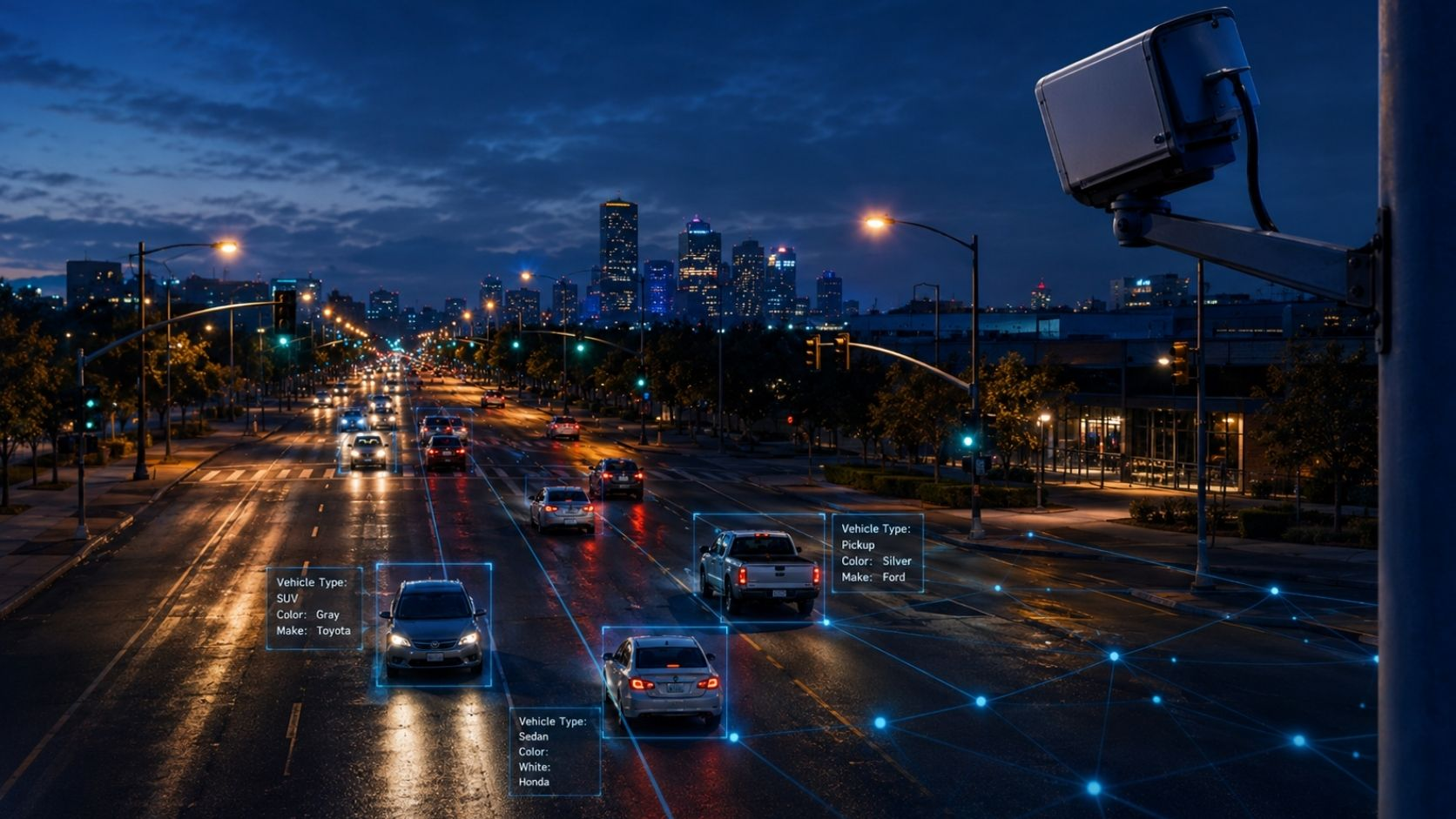
A car used to disappear into traffic. Now it can become a record: plate, color, make, model, roof rack, bumper sticker, location, timestamp, direction of travel. That is the quiet shift behind the rapid spread of AI-powered license plate reader networks across the United States. The camera does not only see the road. It teaches the road how to remember.
What This Article Is Actually About
This is not an argument against public-safety technology. Police departments have real reasons for using license plate readers — stolen vehicles, Amber Alerts, hit-and-runs, violent crime leads. This is about what happens when a tool built for those cases also becomes a networked, searchable record of where ordinary people who are not suspected of anything have driven. The public-safety case is real. So is the governance problem.
Signal One
A national network, not a local camera
Flock Safety operates in thousands of U.S. communities across most states, performing billions of vehicle scans a month — a single private-public network, not a one-city story.
Signal Two
The “vehicle fingerprint” is real
The company’s own technology can search by make, color, and visible features like a roof rack — with or without a readable plate.
Signal Three
The backlash crosses every region
Dozens of cities — from Ohio to Arizona to Massachusetts to Wisconsin — have canceled, paused, or rejected contracts since the network’s reach became clear.
I. The Camera Is Not Just a Camera
Automated license plate readers began as a simple idea: photograph a plate, compare it against a database of stolen or wanted vehicles, and alert an officer. That is still the core function. But the newer generation of cameras, led by the company Flock Safety, does something the plate alone cannot. Flock Safety describes its technology as capable of identifying a vehicle’s make, color, body type, and visible features — a roof rack, a bumper sticker, aftermarket wheels — even when no plate is visible at all. The company calls this a “vehicle fingerprint.” In plain English: a license plate identifies the car by number. A vehicle fingerprint describes the car by appearance, searchable the same way a name is searchable in a directory.
That distinction matters because it changes what the system can find. A plate reader needs a plate. A fingerprint system needs only a description — which means the database becomes searchable even for cars that were never clearly identified to begin with.
II. The Car Becomes a Proxy for the Person
None of this requires facial recognition to matter. A car reveals where someone works, worships, shops, receives medical care, drops off children, attends meetings, protests, or simply rests. Movement data is sensitive precisely because it does not need a face attached to it. The car does not need to be a face to become a biography.
A single sighting tells an investigator little. Thousands of sightings over weeks tell a much fuller story — and that story can be pulled up by anyone with access to the search bar, for reasons that may have nothing to do with the case that justified the camera’s installation.
III. The Public-Safety Case Is Real
Be fair about why this technology spread in the first place. Many crimes involve stolen vehicles, swapped plates, temporary tags, or cars that do not clearly belong to the person driving them. Police departments around the country credit these systems with recovering stolen vehicles, supporting Amber and Silver Alerts, and turning dead-end hit-and-run cases into actionable leads. Berkeley police reported dozens of arrests this year — including for burglaries, robberies, and a homicide — that they directly credit to the camera network. That is not a small thing, and KMOB1003 is not going to pretend otherwise.
The question is not whether police should have tools to find stolen cars. The question is what happens when the tool built for that case becomes a broad, searchable movement network that also captures everyone who was never suspected of anything.
IV. The Network Is the New Power
One camera at one intersection is local surveillance, with a local answer if a community decides it does not want it. Thousands of cameras connected across jurisdictions, sharing data through a single private company’s servers, are something else entirely. Reporting describes a system deployed across more than 12,000 communities, built to aggregate plate reads, vehicle profiles, and other data into one searchable layer that connects agencies that have never met each other. The story here is not really the camera. It is the network underneath it: data-sharing defaults, cross-agency access, retention windows, and scale.
A camera at one intersection is surveillance. A network across thousands of roads is infrastructure.

V. The Backlash Is National
This is not one political lane. NPR reported that Flagstaff, Arizona ended its contract this year after residents packed council meetings over privacy concerns, despite police calling the technology valuable. In Staunton, Virginia, a town of about 25,000, the city moved to terminate its contract after the company’s own chief executive sent the police chief an email accusing critics of “coordinated attack” — language city officials said did not reflect their values. Cambridge, Massachusetts paused its cameras, then canceled the contract outright after learning two additional cameras had been installed without the city’s knowledge. Cleveland’s safety committee voted against renewing its contract this June. Oshkosh, Wisconsin reversed an approval within 24 hours after officials said they had relied on information from the company that proved false.
The concerns repeat across these places: data shared with federal agencies without local knowledge, searches run for reasons outside a city’s own policy, and a private network that local officials discovered they could not fully see inside.
VI. The Oversight Has Not Caught Up
Strip away the politics and what is left is a set of plain governance questions nobody has fully answered. Who can search the data, and is a warrant required? Can an outside agency, or a federal one, query a city’s cameras without that city’s knowledge? How long is the data kept, and can a resident ever audit who looked up their plate, and why? What happens after a misuse is discovered — and who is accountable when it is? Can a homeowners’ association or a private business feed its own cameras into the same searchable network a police department uses, under a different set of rules entirely? Can a city that wants out actually get out cleanly, or do privately owned cameras keep running regardless of what City Hall decides?
These are not rhetorical questions. They are the actual governance gap that every canceled contract this year has been pointing at. Public safety tools need public rules.
VII. The Real Choice
This is not safety or privacy. Framing it that way is how the harder conversation gets avoided. The real choice is whether public-safety tools should be allowed to become mass movement infrastructure without clear rules, public consent, and accountability that holds up after something goes wrong — not just when a journalist or a council member happens to ask the right question.
The road used to carry traffic. Now it can carry memory. The question is not whether cities should care about crime. They should. The question is whether a country can build a searchable map of ordinary movement and still pretend the only thing being watched is a license plate.
Disclosure: KMOB1003 may earn a commission from qualifying purchases through select partner links. Editorial coverage is produced independently.


KMOB1003 Global Media
Cultural infrastructure analysis. Operator intelligence. Human signal reporting.
