
KMOB1003
KMOB1003 Global · Music · AI · Creative Ownership · Tuesday PM · June 16, 2026
AI music is not only a copyright question. It is a question about memory, tradition, provenance, and who gets compensated when culture becomes training material.
The problem is not that machines are learning music. The problem is that they are learning from people who were already underpaid for teaching the world how to feel.
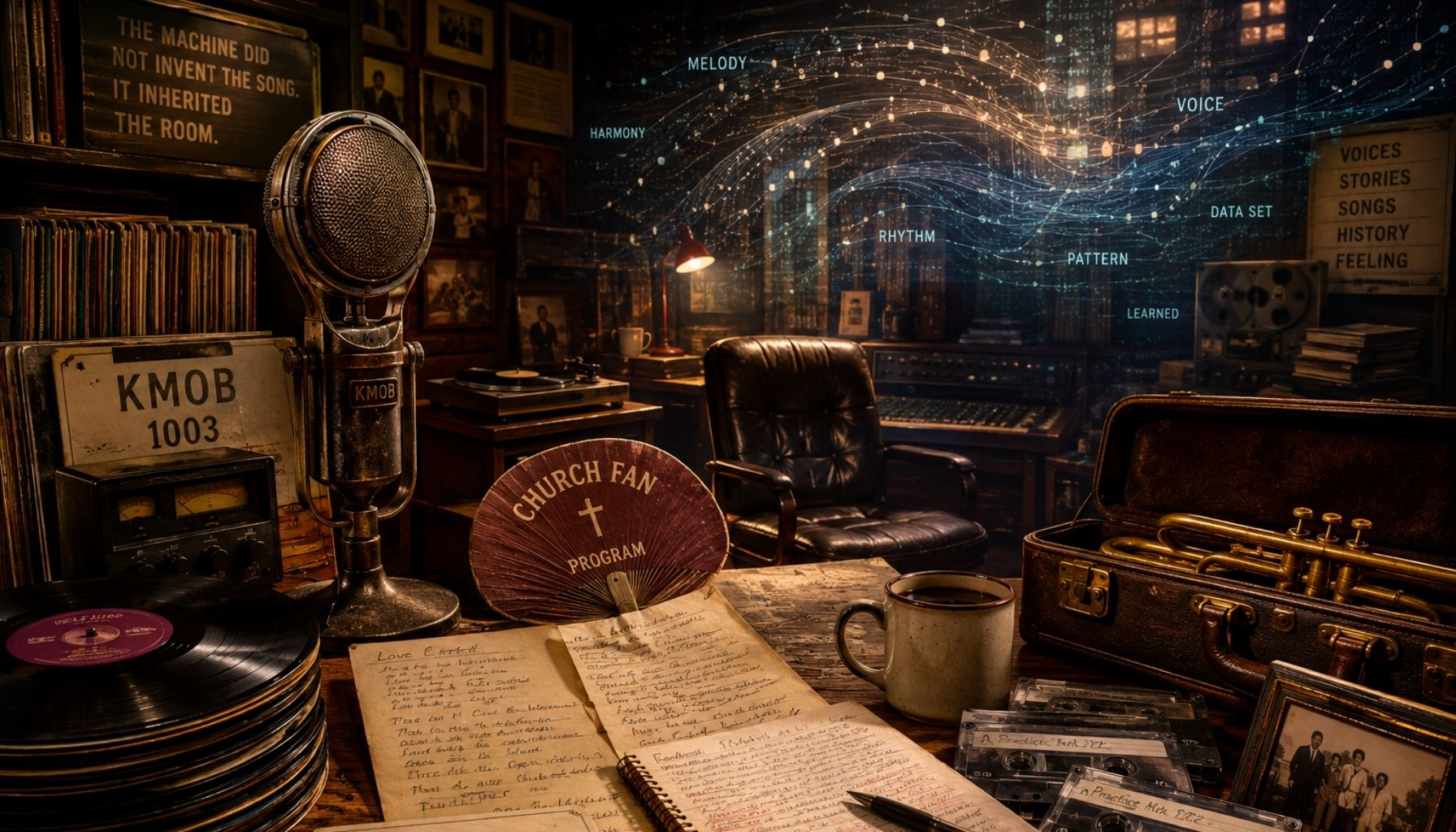
A song is never just a sound. It is a room. Before the file, there was breath. Before the chorus, there was a church basement, a studio couch, a kitchen, a block party, a DJ, a grandmother, a producer, an engineer, a singer waiting for the line to hurt correctly. The song carries all of it — the memory, the labor, the accent, the grief, the specific rooms where the music was made by people whose names did not always make the paperwork. Engadget reported on The Atlantic’s investigation into AI music training data — four searchable databases shared within the AI development community, with 12 million tracks in one collection and 9 million in another, covering copyrighted work from artists across every genre. The machine ingested all of it. And the people whose music taught the machine how to sound human were, in most cases, never asked and never paid. That asymmetry is not a technical problem. It is the same problem the music industry has been producing for a hundred years, wearing a new interface.
What This Article Is Actually About
Why the AI music debate is not only about copyright. It is about memory, tradition, provenance, and the long history of extracting culture from the people who created it without compensating them. KMOB1003 reads what the lawsuits, settlements, and databases reveal about who owns the room the machine walked into.
The Labels
They Hold the Masters
Universal, Sony, Warner hold master recordings and can negotiate training licenses. They have. Warner settled with Suno. UMG settled with Udio. The frameworks exist — but they flow to the label, not necessarily the artist.
The Songwriters
Mostly Excluded
Songwriters and composers hold publishing rights through PROs like ASCAP and BMI. Most were excluded from label licensing negotiations. Unless their publishing administrator negotiated independently — most did not — they receive nothing.
The Independents
Under 4% Recovery Path
Independent artists whose recordings were scraped into training datasets have almost no practical recovery under current class-action structures. Expected per-artist payouts typically below 5% of original master royalty value.
The Originators
No Contract, No Protection
The blues, the gospel, the spoken word, the field holler, the tradition that taught the world what feeling sounds like — protected by no contract. The machine learned from the deepest cultural roots. The deepest cultural roots get the least protection.
The machine did not invent the song. It inherited the room someone else built and was never paid for. — KMOB1003 Global Media · June 2026
What AI music companies see when they look at a song is pattern, structure, tempo, lyrical format, vocal register, genre signature, and market fit. They see training data. They see an input that, aggregated with millions of similar inputs, produces an output that the market will accept. The Atlantic made this concrete — searchable databases of what the models actually ingested, millions of tracks including recordings that artists made in their bedrooms and studios and living rooms and did not agree to donate to a machine’s education. The databases confirm what the music industry has argued and AI companies have deflected: the U.S. Copyright Office stated in 2025 that AI-generated music often cannot itself be copyrighted without sufficient human authorship — and courts are still working out whether training on copyrighted recordings constitutes fair use. The AI companies argue it does. The labels argue it does not. The question is not settled, but the direction of the litigation has not been kind to platforms built on unlicensed data.
What culture knows that the training database does not capture is provenance — where the sound came from, who made it, what room it was made inside, and what that room cost the people who built it. Music carries churches and block parties and Detroit basements and Atlanta studios and New Orleans brass lines and gospel choirs and DJs who stayed up all night to find the right sample. It carries the specific pain of Memphis and the specific joy of a Caribbean sound system and the specific authority of a Black woman who waited until she found the line that hurt correctly before she let it go on tape. A model can learn the pattern of all of that. It cannot learn the meaning. Universal Music Group settled with Udio in October 2025. Warner Music Group settled with Udio in November 2025 and with Suno shortly after — becoming the first major to resolve both cases through licensing. Those frameworks flow to the label, not necessarily the artist. Songwriters were largely excluded. The settlement money, where it exists, favors the institution over the individual. The musician who spent twenty years developing the sound a model now generates on demand gets, in most cases, nothing at all.
Archive Layer · Preserve What the Machine Cannot Replicate
A model can generate a song that sounds like something. It cannot generate the specific memory of where you first heard the real thing — the room, the year, the feeling that attached to the record. The physical archive is the part of music that no training data can absorb. RareVinyl exists for the version of music history that belongs to the people who actually lived inside it.
Preserve What the Moment Carried →
Affiliate link · KMOB1003 may earn a commission from qualifying purchases.
Warner settled with Suno in November 2025. UMG settled with Udio in October 2025 — creating what has been called the first major-label licensing template for AI music generation. Sony has settled with neither Suno nor Udio — its fair-use cases remain active in federal court. And in January 2026, UMG, Concord, and ABKCO filed what has become the largest non-class-action copyright case in U.S. history against Anthropic, alleging it torrented song lyrics from pirate libraries to train its models and seeking over $3 billion in damages covering more than 20,000 songs. The cases are at different stages, with different defendants, different legal theories, and different stakes. But they share a common underlying question: is training a generative AI model on copyrighted music transformative fair use — or is it infringement at industrial scale? A ruling on that question, scheduled for July 2026 in the Suno case, is one of the most consequential decisions pending in the history of music copyright law.
What the lawsuits cannot do — even if they win — is reach the deeper injustice underneath the copyright question. Under current class-action structures, under 4% of independent artists whose recordings were likely scraped into AI training datasets have any practical recovery path, with expected per-artist payouts typically below 5% of original master royalty value. The lawsuit protects the catalogue. It does not protect the creator. The artist whose sound shaped a generation, who built a following in small rooms and self-released records and never signed a major-label deal, is the least protected person in a legal framework designed around institutional ownership.
Voice Layer · Own the Sound Before It Belongs to the Model
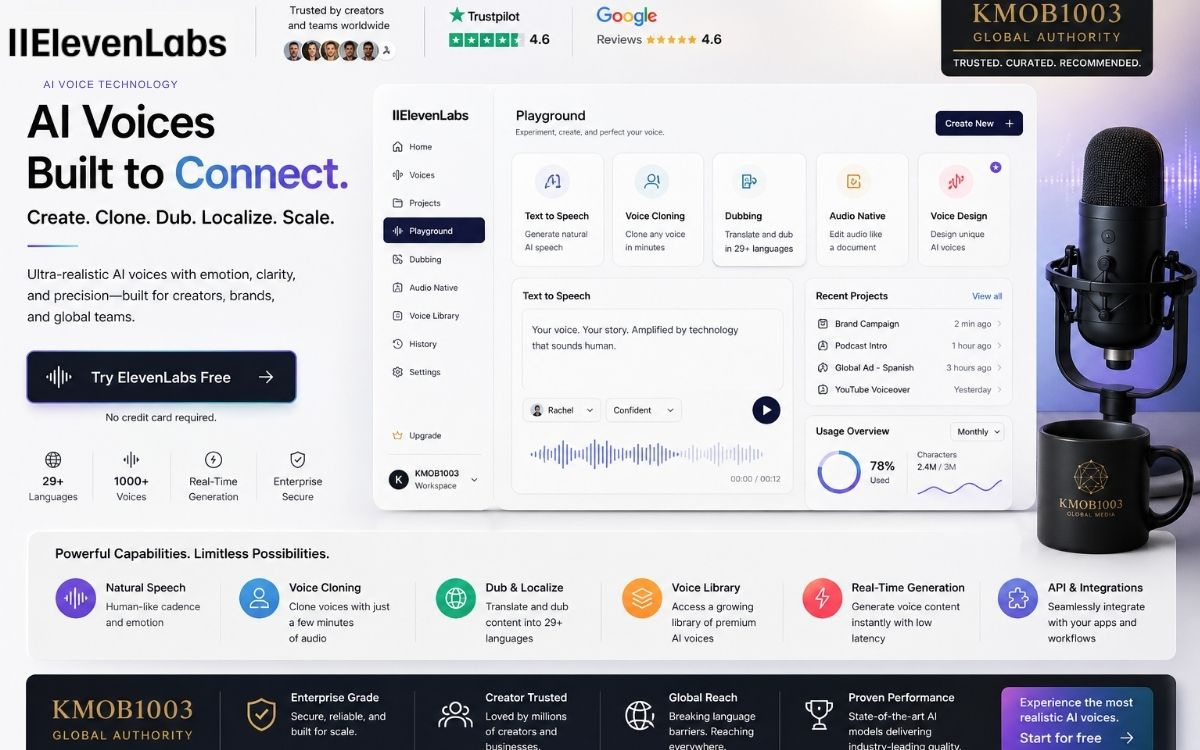
Before the model learns from your voice, own the version of it you made on purpose. ElevenLabs gives you the tools to produce, own, and direct your sound — consent-based, artist-controlled, the opposite of what the lawsuits are about.
Affiliate link · KMOB1003 may earn a commission from qualifying purchases.
The fair use ruling expected in the Suno case this summer is the decision everyone in the music industry is watching. If the court finds that training a generative model on copyrighted music is not fair use, the economics of AI music change overnight. Every platform that built its model on unlicensed recordings will need a licensing deal or a different dataset. The price of access to music training data will rise. The gatekeepers — the labels, the PROs, the publishing administrators — will be in a stronger position. Artists signed to major labels will benefit modestly. Independent artists will benefit almost not at all, because their leverage is structural, not legal, and the legal framework was not built with them in mind. The ruling matters. But it will not solve the problem it exposes — only the surface of it.
Human provenance is not a technical detail. It is the proof of the work. It is the answer to: where did this come from, who paid for it with their time and talent and life, and what do they deserve for having built the room the machine walked into? The history of American popular music is a history of this question being answered badly. Blues, jazz, gospel, R&B, hip-hop: each tradition built a vocabulary of feeling that was adopted, adapted, packaged, and profited from at scale — with the originators receiving a fraction of what their influence generated, and sometimes nothing at all. The machine did not invent the song. It inherited that room too. And now the question of ownership is being resolved through the same legal frameworks that undercompensated the originators in the first place. The lawsuit protects the catalogue. It does not protect the culture that built it.
KMOB1003 was built in part on spoken word — the live, performed, human tradition of poetry and voice and cultural transmission that predates every platform and will outlast every model. That tradition has always known something the AI debate is only now catching up to: the song carries more than the notes. It carries the room where it was made, the people who made it, the pain and the joy and the specific human experience that no training dataset can fully absorb. The machine can generate a song in that tradition’s style. It cannot generate what the tradition means. That meaning belongs to the people who built it — and the question of whether they will be compensated for it is the most important creative-economy question of this decade.
The question KMOB1003 carries into this moment is not whether AI music can be made ethically — it can, and is being made ethically by artists who use these tools intentionally, with full awareness of provenance and ownership. The question is whether the industry being rebuilt around AI-generated music will correct the historical pattern of extraction, or repeat it at a faster pace with better lawyers. The settlement money flowing from Warner and UMG to Suno and Udio establishes frameworks. It does not establish justice. Justice would require that the songwriter who built the style, the session musician who laid down the feel, and the independent artist who spent a decade perfecting the sound that a model can now generate in four seconds all receive something proportional to what they contributed. The framework for that does not exist yet. Building it is the most important creative-economy project of this decade — more important than any individual lawsuit, more consequential than any single settlement, and more urgent than the industry has so far been willing to admit.
The machine did not invent the song. It inherited the room — the room that generations of musicians built, often without contracts, often without credit, often without anything except the music itself and the knowledge that it mattered. The least the industry can do, now that the room is worth billions, is make sure the people who built it are in the negotiation.
Some links in this article are affiliate links. KMOB1003 may earn a commission from qualifying purchases at no additional cost to you. All affiliate partnerships are editorially independent.
