KMOB1003
KMOB1003 Global · AI · Work · Operator Intelligence · Wednesday AM · June 17, 2026
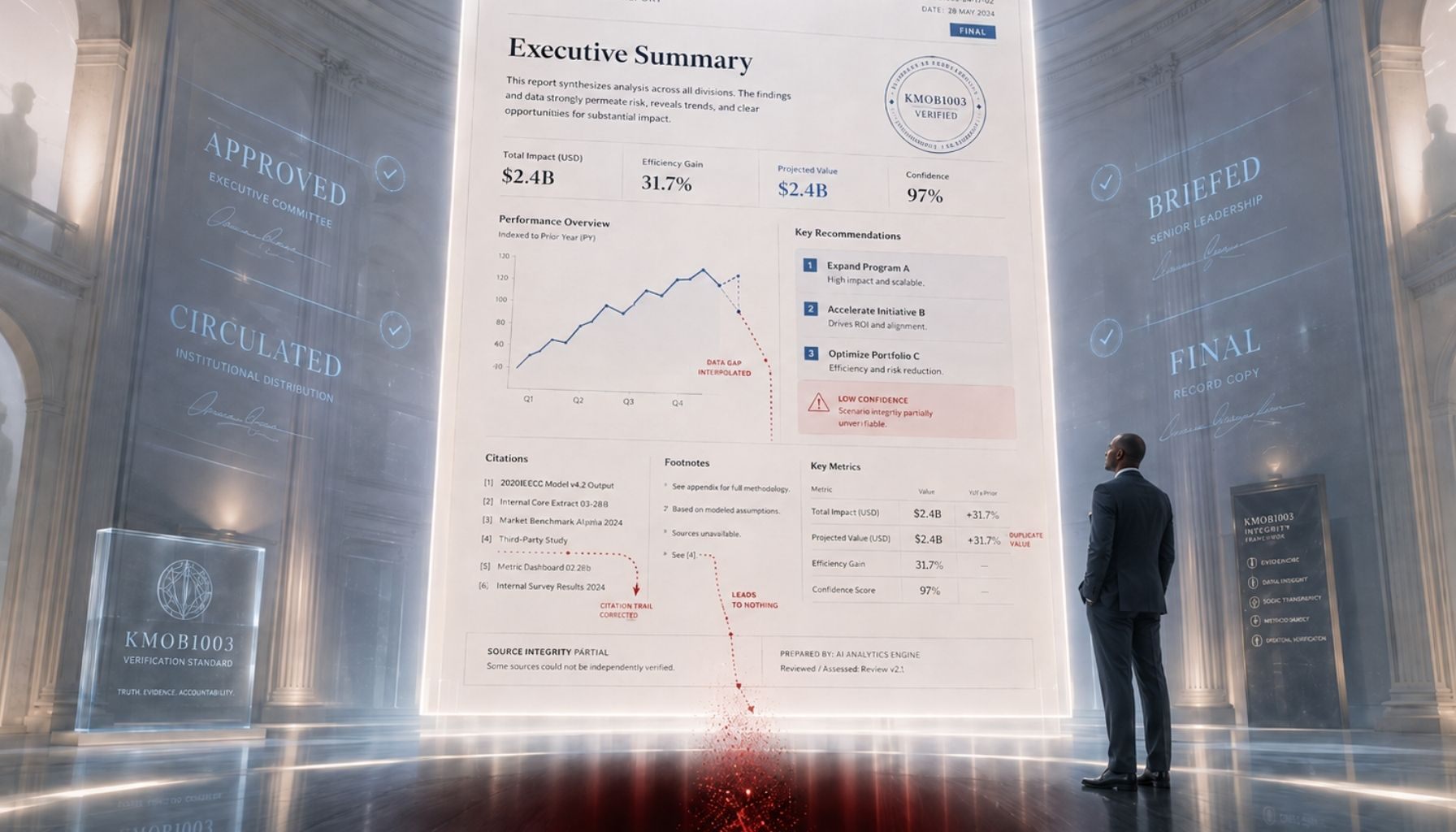
The problem is not only that AI can make things up. The problem is that once the error arrives inside a polished report, a clean dashboard, or a confident summary, the room may treat it like truth.
A hallucination is easier to challenge when it looks messy. It becomes dangerous when it arrives formatted.
Picture the moment before you notice something is wrong. The document is open. It looks exactly the way a credible report is supposed to look — structured headings, numbered citations, confident executive language, a clean summary on page one. Nothing about the format signals danger. The format signals the opposite: that someone has done the work, checked the facts, and delivered an answer. That is the moment AI hallucination becomes most dangerous. Not when it looks wrong. When it looks finished. In July 2025, Deloitte delivered a 237-page report to the Australian government worth AU$440,000. A Sydney University researcher started reading it and found up to 20 errors — fictional citations, fabricated court quotes, invented academic papers — none of them caught by a single internal review stage. Deloitte agreed to a partial refund of approximately $290,000 USD. The reputational damage was harder to price. The report looked official. That did not make it true.
What This Article Is Actually About
This article is about the new trust problem inside AI-assisted work. Reports, summaries, dashboards, briefs, and recommendations now move faster than verification. KMOB1003 reads the risk not as a software bug, but as an authority problem: the room may believe the shape of the report before it checks the substance of the facts.
KMOB1003 Global Collection · Father’s Day Picks
Gifts for the man who made the room feel possible.
Affiliate link · KMOB1003 may earn a commission from qualifying purchases.
The room does not only trust information. It trusts format, confidence, and institutional packaging.
The Output
Polished Before Correct
AI can produce summaries, reports, charts, briefs, and recommendations that look complete before they are correct. The formatting arrives faster than the verification.
The Room
Format Carries Authority
People trust formatted work because it resembles institutional authority — especially when time is short and the answer confirms what the room already wants to hear.
The Risk
The Mistake Goes Institutional
A hallucinated source, number, quote, policy, or recommendation can shape decisions before anyone knows it is false. The cost is not the hallucination. It is what the hallucination authorizes.
The Operator
Verification Is the New Skill
The new executive skill is not just prompting. It is verification, judgment, source discipline, and knowing when the room is moving too fast toward a formatted answer.
The report looking official does not mean the report is true. — KMOB1003 Global Media · June 2026
The Deloitte report is the cleanest example of the problem because it happened at the highest level of institutional credibility. A major consultancy. A government client. A document that cleared every standard review process. And still — twenty fabricated references, fictional court quotes, invented academic papers, none of it caught until a subject-matter expert happened to read it carefully enough to notice. Research compiled by Financial Poise found that across a broad range of LLM tests, models can hallucinate at meaningful rates on complex queries — even as top frontier models have reduced factual errors on simpler tasks. A separate MIT study from January 2025 found that when AI models hallucinate, they use more confident language than when providing accurate information, 34% more likely to use phrases like “definitely,” “certainly,” and “without doubt” when generating incorrect content. The model does not know it is wrong. It produces the wrong answer with the confidence of the right one. That is the specific danger: not that the AI is careless, but that it is fluent.
AI hallucination is not new, and it is not confined to chatbots. It enters legal briefs, research summaries, HR recommendations, financial analyses, market assessments, compliance documents, and strategy decks — anywhere AI is used to accelerate the production of professional content. A 2024 Deloitte survey found that 38% of business executives reported making incorrect decisions based on hallucinated AI outputs — a finding circulated across multiple AI governance research reviews. Cost estimates for AI hallucination errors vary widely, but industry analysts have cited figures in the tens of billions annually when accounting for labor, legal, and strategic consequences. With enterprise AI adoption accelerating rapidly, more decisions than ever are flowing through systems that can produce confident, polished, wrong answers. The scale of the exposure is not theoretical. It is already running through the meeting rooms.
Think about the last time someone put a finished-looking document in front of a room and the room nodded. Not because anyone checked it. Because it looked checked. The headings were clean. The data was formatted. The conclusion was clear. Formatted documents carry a specific kind of authority that rough notes and first drafts do not — and that authority is social, not factual. It is the signal that someone has already done the work of verification, so the room does not have to. AI can now produce every component of that signal — the structure, the citations, the confident executive summary, the exact language of a document that has been through a review process — without the underlying verification that gives the signal its meaning.
Reporting on McKinsey’s AI governance research, Infomineo notes that inaccuracy is among the most cited AI risks among leaders with direct responsibility for AI governance, risk management, or investment decisions. And yet inaccuracy is hardest to catch precisely when it arrives in the shape of accuracy. The room is trained to respect the finished document. Senior leaders want answers, not uncertainty. Teams want clarity, not caveats. The official-looking object becomes a shortcut for truth — and AI makes that shortcut dangerous because it can generate the shape of certainty without the substance behind it. A human typo makes people pause. A polished AI report makes people nod.
Consider what a single hallucinated fact can authorize. A wrong market size shifts a budget allocation. An invented policy changes an HR decision. A fabricated legal precedent shapes a compliance conversation. A misread contract term creates exposure. A false competitive claim enters a strategy presentation. A hallucinated academic citation becomes the footnote a decision-maker quotes in the next meeting. AI hallucinations cause the most damage in financial analysis and legal research. In legal settings, studies including research from Stanford RegLab have documented that large language models hallucinate on legal-specific queries at rates that make unsupervised use actively dangerous — with some evaluations finding error rates well above 50% on case-specific research. Financial exposure to AI errors is harder to aggregate precisely, but industry analysts have flagged the financial sector as among the highest-risk environments for consequential hallucination. The cost is not the hallucination itself. The cost is what the hallucination authorizes before anyone catches it — and the harder-to-measure cost of what the room carries forward as “what the report said.”
The Deloitte case did not end when the errors were identified. It continued in the institutional damage — the questions about every other AI-assisted deliverable the firm had produced, the internal policy reviews, the client relationships that had to be rebuilt around a new layer of doubt. Separately, in late 2025, a major law firm was sanctioned for filing court documents containing case citations generated by AI that were entirely fabricated — continuing a pattern that has now been documented in more than 1,200 legal proceedings worldwide. The pattern is not one firm, one industry, or one model. It is structural. And it will continue as long as the speed of AI output outpaces the discipline of human verification.
The future belongs to operators who can use AI without surrendering judgment. That distinction is the whole game. AI can draft, organize, summarize, compare, research, and accelerate — and it should. The question is not whether to use it. The question is whether the person using it has maintained their own relationship with the facts. Can they name the primary source? Can they identify the claim that would matter most if it were wrong? Can they slow the room down before the formatted answer becomes the institutional answer?
The operators who get this right will not be the ones who use AI the least. They will be the ones who use it with the most discipline — who understand which tasks AI can accelerate without risk and which tasks require a human to stand between the output and the decision. Summarizing a meeting transcript: low risk. Generating a legal citation: high risk. Drafting a first outline: low risk. Producing a market size figure for a board presentation: high risk. The skill is not caution for its own sake. It is calibration — knowing where the format can be trusted and where it needs to be earned. That calibration is what separates the operators who use AI well from the ones who will eventually deliver a report with twenty fictional footnotes to a government department and spend the next six months explaining how it happened.
Verification is not old-school. It is the new executive skill. In a world where AI can produce a polished report faster than a human can fact-check it, the competitive advantage belongs to the operator who builds verification into the workflow rather than assuming the output is clean. That means reading the citations. Following the sources. Asking which claim is load-bearing and checking it independently. It means treating a confident AI summary the same way a good editor treats a first draft — as a starting point, not a finished product. The room will always be tempted to trust the shape of the answer. The operator’s job is to protect the substance of the truth.
Do not let the format outrun the facts. AI can build the report. A human still has to stand behind what the report says.
Some links in this article are affiliate links. KMOB1003 may earn a commission from qualifying purchases at no additional cost to you. All affiliate partnerships are editorially independent.
