
KMOB1003
KMOB1003 Global · Tech Policy · Children · Platform Power · Tuesday AM · June 16, 2026
The UK’s under-16 social media ban is not a parenting story. It is a power story — governments finally admitting that platforms became the default childhood environment before society ever agreed to the terms.
The platforms did not ask permission to raise a generation. They simply got there first.
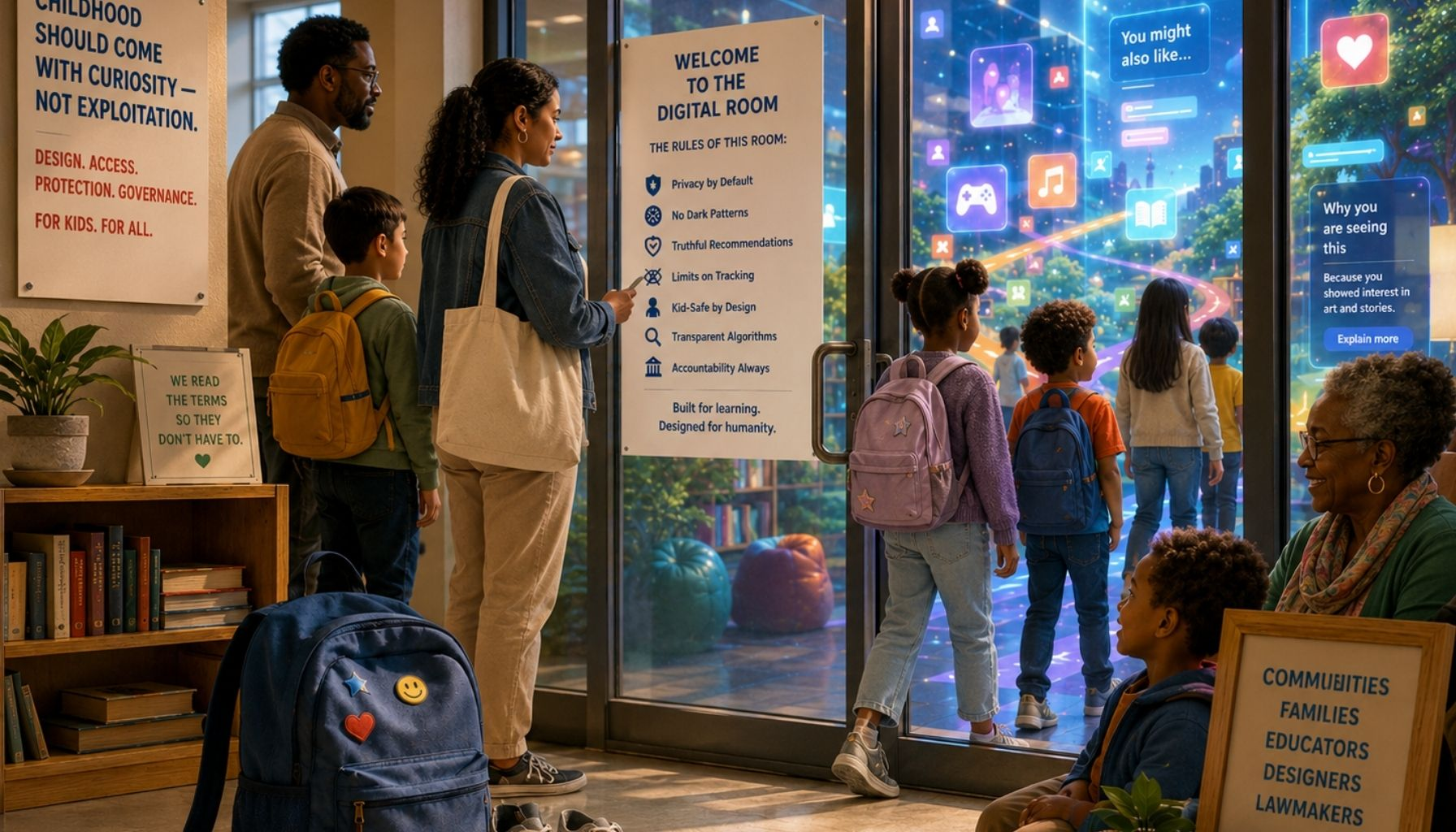
A child does not experience the internet as policy. A child experiences it as a room.
And for fifteen years, the room was already open before anyone checked the terms. The lights were bright. The feed kept moving. The rewards came fast. The social pressure was baked into the design. The companies that built the room understood attention before most children understood why they could not look away. On Monday, British Prime Minister Keir Starmer announced that the UK would ban children under 16 from social media — covering Snapchat, TikTok, YouTube, Instagram, Facebook, and X — with legislation to reach Parliament before Christmas and protections expected to come into force next spring. The announcement matters not only for what it does, but for what it finally admits: that the room was built for extraction, that children were among the most valuable users inside it, and that the adults who should have been watching the door arrived late.
What This Article Is Actually About
Why the UK’s under-16 social media ban matters beyond parenting debates. It is a power story — about who designed the childhood environment, who agreed to the terms, and what it means when governments finally decide the answer to that question is nobody that should have.
The Access Question
Who Let Them In?
Platforms did not ask governments or parents whether children should have access. They set minimum age limits, acknowledged children would lie about their age, and built the engagement architecture anyway. The admission implicit in a ban is that nobody who should have agreed to this ever did.
The Design Question
What Was Built for Them?
Infinite scroll. Push notifications. Like counts visible to peers. Algorithmic amplification of anxiety-producing content. These were not accidents. They were design decisions that maximized engagement — and children were among the most responsive users.
The Consent Question
What Did Parents Agree To?
Most parents did not read the terms of service. Most could not have anticipated what a platform optimized for engagement would do to their child’s social life, self-image, and sleep. The consultation found 83% now say risks outweigh benefits. That number is the bill coming due.
The Power Question
Who Controls the Environment Now?
A ban does not give children the internet back. It removes certain platforms from the default childhood environment and forces society to have the conversation it should have had when smartphones first entered schools. The environment is still contested. The question is who designs it next.
For years, children were treated like users before they were treated like children. — KMOB1003 Global Media · June 2026
Monday was the day a government finally said out loud what parents have been saying quietly for a decade. Starmer said at the press conference that “social media is making our children unhappy and unsafe” — and that as a parent as much as a Prime Minister, he could not let it go on. The ban will not apply to messaging services like WhatsApp and Signal — the distinction being, implicitly, that private communication between known contacts is different from the algorithmic public feed designed to maximize engagement with strangers and viral content. Ofcom, the UK communications regulator, will be charged with designing age verification plans and enforcement mechanisms, which is where the practical difficulty lives. More than 83% of parents who responded to the national consultation said the risks of social media outweigh the benefits, and 90% expressed support for a minimum age of 16. Ninety percent is not a close call. It is a generation of parents who feel they lost something and are asking for it back.
The UK is not alone. Australia introduced its ban in December 2025, becoming the first country to enforce one at scale. Canada, Brazil, and Indonesia have introduced legislation or announced age-based restrictions. The movement is not coordinated — it is parallel, arising independently in countries with different political systems, different cultural relationships to technology, and different enforcement capacities. What they share is the same underlying admission: that platforms became part of the childhood environment faster than anyone knew how to govern them, and that the default — unlimited access with a self-reported age — was not a policy. It was an absence of one. The platforms knew children were on their services. The platforms knew children were among their most engaged users. The platforms optimized for that engagement. And the regulatory frameworks that existed were either too slow, too weak, or too easily circumvented by companies with legal teams larger than most government departments. What changed is not the evidence — the evidence has been available for years, building in research papers and parliamentary hearings and parental testimonies that rarely made the front page. What changed is the political will to treat it as a crisis rather than a concern, and to place the burden of proof where it belongs: on the platforms, not the parents.
Security Layer · Control Your Own Access
As governments rewrite who gets access to what online, the question of who controls your own connection — your data, your browsing, your privacy across platforms and borders — becomes more urgent. NordVPN Complete gives you that layer of control, regardless of what any government or platform decides about access.

Affiliate link · KMOB1003 may earn a commission from qualifying purchases.
Here is what the platforms understood that most parents did not: children are not only vulnerable users. They are high-value attention markets. A twelve-year-old who opens Instagram before school and checks it between classes and lies in bed scrolling after lights-out is, from the platform’s perspective, an ideal user — high session frequency, high emotional investment, low resistance to engagement mechanics, strong social pressure to maintain presence. The product was not designed to harm children. It was designed to maximize time on platform. The harm was a consequence of the design. And the design worked exactly as intended.
Infinite scroll. Push notifications timed to separation anxiety. Like counts visible to peers at the age when peer comparison is most acute. Recommendation algorithms that learned, faster than any parent could, what each child was most vulnerable to. These were not accidents of the technology. They were features — tested, iterated, and optimized for retention by people whose job was to understand how a child’s attention worked and hold it past the point where the child would have chosen to stop. The enforcement problem the platforms now raise — that bans push children toward less-safe alternatives — is real. But it is worth noting who is raising it. The same companies that built the engagement architecture now warn that removing it will hurt children. That is a complicated argument coming from that direction. A more honest framing: the platforms are not worried about children migrating to unsafe spaces. They are worried about losing the most emotionally responsive users in their system.
The honest version of the enforcement argument is this: age verification is hard, imperfect, and will be circumvented by determined teenagers with access to a parent’s ID. Every country that has attempted platform regulation for children has faced this. The question is not whether the policy is perfect. It is whether the policy is directionally correct — whether the signal it sends to platforms, parents, and children is worth the imperfection of its enforcement. Australia’s experience since December 2025 suggests that even an imperfect ban changes the social permission structure around platform use for children. The goal, as Starmer has said throughout, is not just compliance. It is a cultural shift — the sense that growing up differently is not only allowed but actively supported by the society children are growing up inside.
What parents were handed was a supervision assignment for a product they did not design, inside an algorithm they could not see, with social consequences that followed their children home from school. The parental controls existed. They were difficult to configure, easy to circumvent, and could not touch the fundamental mechanics of a feed built to override them. Parents were asked to be the last line of defense against a product engineered by teams of behavioral scientists whose entire job was to make the app more compelling than whatever else a child could be doing. That is not a fair fight. And for years, the conversation was framed as though the problem was parenting rather than product design. The platforms were not shy about this framing. Every time a parent complained about screen time, the implicit answer was: you have the tools, you have the controls, you have the power to put the phone down. What the platforms did not say was that those controls were designed to be just difficult enough to feel like parental failure when children circumvented them. The design was the point. The parent’s guilt was a feature, not a flaw.
Taking the childhood internet back from the platforms is not nostalgia. It is governance arriving late to a room it should have helped design. The question is not whether children should live online or offline — they will live online, because that is where their world is. The question is whether childhood should be allowed to grow up inside rooms built for extraction. The goal is not a ban. The goal is permission. Permission to build a different room.
Amazon · Family Digital Room Kit
The platforms built one kind of room. Families can still build another one. These tools help bring digital culture, household rhythm, and shared expectations back into visible space — at the table, on the fridge, and outside the endless feed.

Household Governance
Hivillexun 3-Pack Magnetic Dry Erase Calendar Whiteboard Set
If the feed trained families to react in real time, the household needs a visible place to plan on purpose. This dry erase calendar set brings the month, week, and day back into view — routines, homework, screen boundaries, appointments, and family expectations written somewhere everyone can see.

Offline Culture
WHAT DO YOU MEME? Family Edition
The internet did not invent family humor. It simply moved the room onto a feed. WHAT DO YOU MEME? Family Edition brings the caption game back to the table — turning meme literacy, reaction culture, and viral language into something families can share face-to-face.
Affiliate links · KMOB1003 may earn a commission from qualifying Amazon purchases at no additional cost to you.
The platforms did not ask permission to become the default environment for childhood. They arrived, they stayed, and they optimized for engagement rather than wellbeing for long enough that a generation of parents now says — by a margin of nine to one — that the risks outweigh the benefits. The ban is not the solution. It is the admission that something needs one.
Permanence Layer · Publish the Room You Own
If platforms built the room children grew up inside, ownership is how families, educators, creators, and operators build something that lasts outside the feed. Turn the lesson, guide, framework, classroom resource, or public argument into a published asset with permanence — something no algorithm can bury the next morning.

Affiliate link · KMOB1003 may earn a commission from qualifying purchases.
Some links in this article are affiliate links. KMOB1003 may earn a commission from qualifying purchases at no additional cost to you. All affiliate partnerships are editorially independent.
