

LEGACY & INSIGHTS
Before the Holidays, Agree on What Your Family Will Do When a Familiar Voice Asks for Money
Voice cloning scams are hard to count. The FBI now tracks AI-assisted fraud as its own category, but not cloned voices. Here is the family plan to make before Thanksgiving.

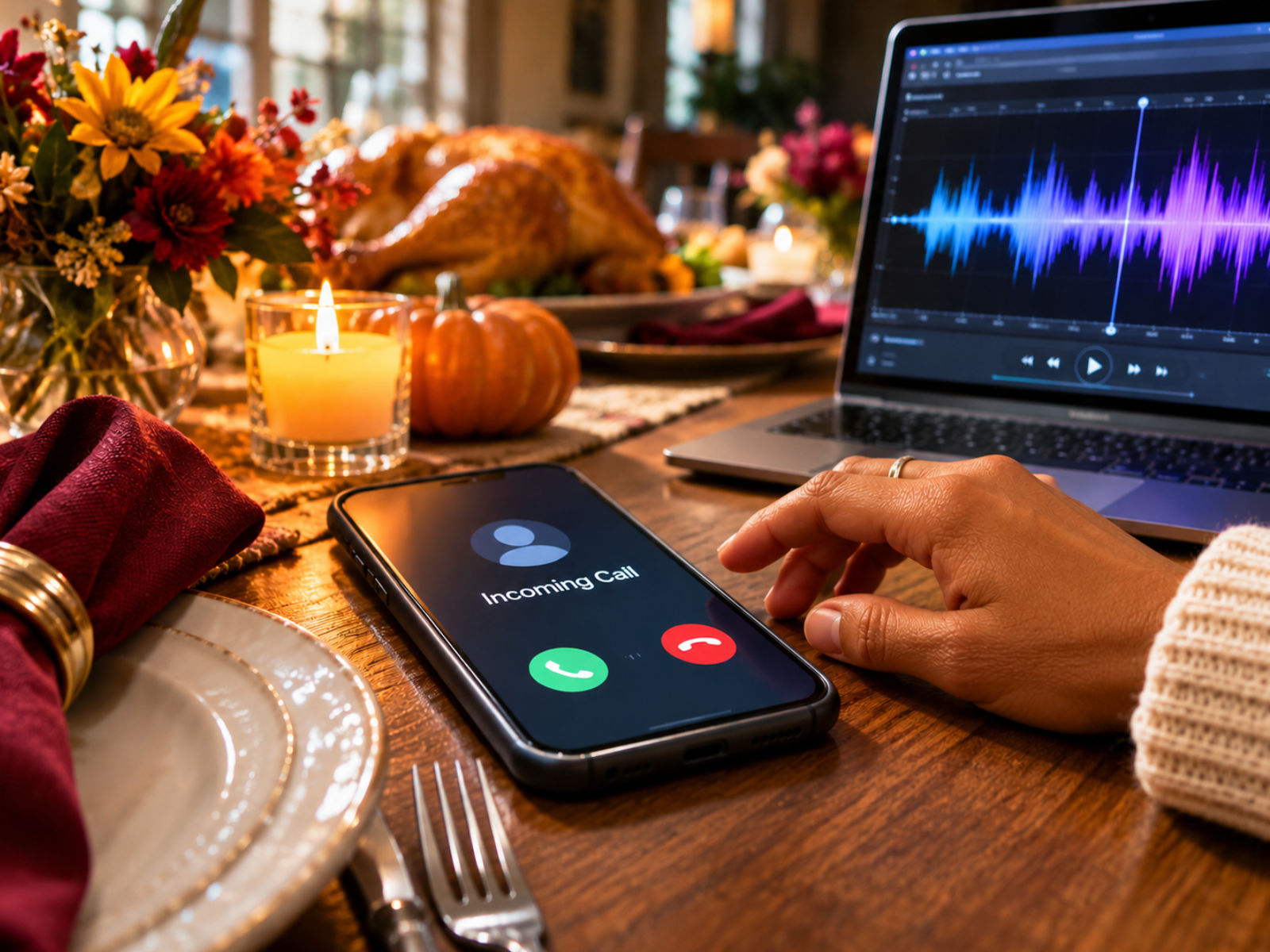
Voice cloning scams depend on easy access to a person’s audio. Four of the six voice-cloning products Consumer Reports tested would build a clone from publicly available audio, and none of those four had a technical check that the speaker had agreed, according to Axios’s account of the March 2025 assessment. Because Thanksgiving is three weeks away, the practical question for families is what to do when a familiar voice calls asking for money. The answer works best when families agree on it before the call: hang up, then call back on a number you already know is theirs.
A convincing voice is no longer proof of who is speaking.
How voice cloning scams work
Accounts differ on how little audio a clone needs, and the evidence is uneven. McAfee, a security company, reported in 2023 that three seconds of audio produced an 85 percent voice match in its own benchmarking, rising to 95 percent with more training. That is the company’s own benchmarking, and a match score does not show that a listener would fall for the clone. Consumer Reports also found that four of six products would create a clone from public audio, and four offered cloning free, as Axios reported.
However, a third account is a demonstration by American PCS, a cybersecurity firm, not a documented criminal incident. In a video, the firm says it took a low-quality cellphone clip from a publicly posted video of a nonprofit director and, in under an hour for under $100, made a clone convincing enough to fool someone. Those details are the firm’s own account and have not been independently verified, and the video does not name the tool it used. Still, none of the three accounts documents what audio criminals actually use in real fraud.

The tools are also showing up inside larger toolkits. Mashable reports that experts describe voice cloning as a feature inside broader criminal toolkits, sometimes called scam kits, which can include stolen personal data. NordVPN’s research, as reported by Mashable, found that sales pitches for voice cloning on dark web forums and Telegram channels rose roughly sevenfold over two years. That counts pitches, not scams. NordVPN’s chief technology officer, Marijus Briedis, told Mashable that cloned voices once had something slightly off that most people could hear, and that this is no longer true. When anyone can run the attack, he said, volume becomes the plan.
What has changed this year
The FBI’s annual Internet Crime Complaint Center report, released in April 2026 and covering 2025, counted AI-assisted fraud as its own category for the first time, according to iTnews. It also tallied about $893 million in AI-related losses and more than 22,000 complaints that referenced AI. The FBI said it may be undercounting those figures.
The FBI reported more than $5 million in losses from distress scams in 2025. Such scams can involve cloned voices impersonating relatives, but the report does not establish how much of that total came specifically from voice cloning. The FBI also reported more than $30 million in losses from business email compromise scams involving AI in 2025. Voice cloning scams are among the tactics criminals may use, but the report does not isolate losses caused by cloned voices.
What the big numbers do and do not say about voice cloning scams
Two figures about 2025 scam losses are circulating, and they measure different things. The Consumer Federation of America estimates Americans lost about $148.2 billion to online scams and crimes in 2025, up nearly 26 percent from 2024. That estimate builds on the FBI’s reported losses and on research into how often people report financial fraud to law enforcement. In contrast, the FBI reported about $20.9 billion, according to Help Net Security. However, neither figure isolates voice cloning.
What remains unanswered about voice cloning scams
How many of the family-emergency calls reported to the FBI involved a cloned voice, and how many involved only a frightened caller and a script? Which audio do criminals actually use? What responsibility do cloning companies bear for products that, in Consumer Reports’ testing, did not check consent? Yet the sources cited here do not answer any of these. The FBI’s distress-scam losses, more than $5 million, are small beside the year’s totals, and the FBI says its AI figures may be understated.

What to do about voice cloning scams when the call comes
However, an unexpected call alone does not establish fraud. The signal is a combination: urgency, strong emotion, and a request for money, a code, or secrecy. The Federal Trade Commission’s guidance on family emergency scams gives clear steps.
- Resist the pressure to act right away. Hang up, or say you will call back.
- Call your family member or friend at a number you already know is correct, and ask whether they are really in trouble. Do not rely on caller ID, and do not use a number the caller gives you.
- If hanging up feels impossible, ask a question only the real person could answer. The FTC’s examples are what kind of dog they have, or where they spent Thanksgiving last year.
- Call another relative or friend, even if the caller says to keep it secret.
- Treat these requests as warning signs: wiring money, sending cryptocurrency, using a payment app, or buying gift cards and reading out the numbers.
- Never read out a one-time code, password, or banking detail to someone who called you, even if the voice sounds like family.
Make the plan against voice cloning scams at the holiday table. Agree to call back anyone who phones in an emergency, on their saved number. The FBI recommends creating a secret word or phrase that family members can use to help verify one another’s identities. It should supplement a call back to a trusted number, but not replace it.
What voice cloning scams mean for businesses
In American PCS’s demonstration, the cloned voice left a voicemail for an HR manager. It claimed a grant had been awarded and asked for the name, address, date of birth, and Social Security number of everyone who had worked there in a year, to be uploaded to a link in an email from a stranger. The firm’s advice was to check unexpected requests through a second method, such as a call, text, or conversation in person. Write that step into your defenses against voice cloning scams, so no employee relies on a gut feeling under pressure.
FROM KMOB1003

If money or information has already gone out
Voice cloning scams can catch careful people. The FTC says that no matter how you paid a scammer, the sooner you act, the better.
- Contact the bank, card company, or payment service you used right away.
- Follow the FTC’s guidance on what to do if you were scammed, which explains how to try to get your money back based on how you paid.
- Report it at ReportFraud.ftc.gov and to your state attorney general. You can also file with the FBI’s Internet Crime Complaint Center at ic3.gov.
- If you shared a password or a one-time code, change the password for that account now and turn on extra sign-in protection.
- Tell the real family member or colleague, so they can warn others.
A voice can be copied. A pause cannot. Agree on the plan before the call comes.

Voice Cloning Signal Breakdown
Not every claim about voice cloning scams in this story carries the same weight.
Reported, Attributed to the Source
- FBI report. AI-assisted fraud counted as its own category for the first time: about $893 million and more than 22,000 complaints, per iTnews.
- Reported losses. About $20.9 billion in 2025, per Help Net Security.
- Consumer Reports. Four of six products would clone from public audio, per Axios.
Claims and Estimates, Labeled
- Estimate. The CFA puts 2025 losses near $148.2 billion; that is not a reported figure.
- Vendor claims. McAfee’s three-second benchmark and NordVPN’s sevenfold rise in sales pitches are the companies’ own findings.
- Demonstration. American PCS’s clone is a firm’s demonstration, not a documented crime.
Not Established Here
- how much of the FBI’s distress-scam losses came from cloned voices
- which audio criminals actually use
- what responsibility cloning companies bear for missing consent checks
Sources: Mashable, FTC, Axios, McAfee, American PCS, iTnews, Help Net Security, 9to5Mac.

VOICE CLONING / KEY FACTS
RADAR / WHAT TO WATCH

KMOB1003 SELECTS
Music, style, tools, art and objects worth your attention.





MORE FROM LEGACY & INSIGHTS




–>
