
Amazon Didn’t Just Sell the Ad. It Allegedly Controlled the Price of Being Seen.
The FTC and 22 states allege Amazon secretly rewrote the rules of its own ad auctions for seven years. This Amazon ad surcharge lawsuit is really a question about who controls the price of visibility inside a marketplace millions of businesses can’t afford to leave.
Amazon disputes the allegations. This is a pending case, not a finding.
September 1, 2026

The Amazon ad surcharge lawsuit starts with a familiar marketplace reality: a seller can list a product on Amazon, compete against thousands of nearly identical listings, and then pay Amazon again for the chance to appear where shoppers are actually looking. That’s not new. What the lawsuit alleges is that Amazon quietly changed how much that second payment cost — without telling anyone paying it.
What This Article Is Actually About
This isn’t a story about Amazon ads being expensive. The FTC and 22 states allege Amazon ran a years-long scheme to secretly inflate its advertising auctions while telling advertisers something different was happening. That’s the news. The larger question this Amazon ad surcharge lawsuit actually raises is structural. What happens when the same company operates the marketplace where a business’s customers shop, the search engine that decides what those customers see, and the auction determining what the business must pay to be seen at all? Amazon disputes the allegations, and this remains a pending case — but the structural question stands regardless of how the lawsuit resolves.
Signal One
One Company, Three Roles
Amazon simultaneously operates the marketplace, the product-discovery search, and the auction that prices visibility inside both — a structural concentration the lawsuit puts back in focus.
Signal Two
“Second Price” Allegedly Wasn’t
The FTC alleges Amazon’s own internal documents describe an “invented auction participant” and a calculated “proxy 2nd price” — converting what was marketed as a second-price auction into something closer to a first-price one.
Signal Three
Amazon Disputes It Directly
Amazon calls the suit “misguided,” says the FTC “fundamentally misunderstands how advertisers operate,” and argues advertisers saved over $8 billion from Amazon prioritizing ad relevance over pure bid price.
Inside the Amazon Ad Surcharge Lawsuit
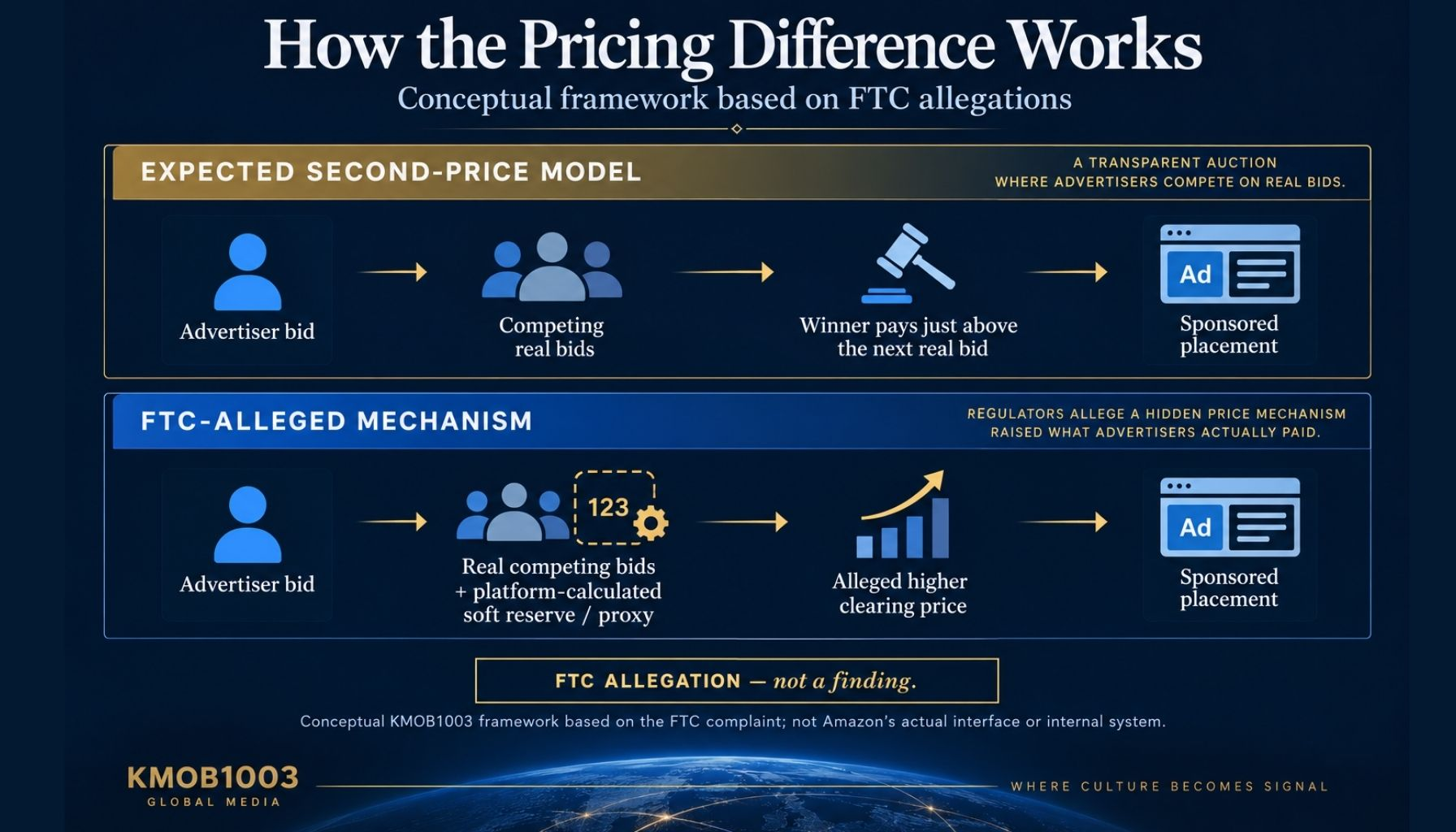
To understand what’s alleged, it helps to understand what advertisers were told. When a shopper searches a product on Amazon, businesses bid for the sponsored placements around the results — Sponsored Products, Sponsored Brands, and Display ads. For years, according to the complaint, Amazon told prospective advertisers it ran a “second price” auction: whoever bid highest would win the placement, but would only pay one cent more than the next-highest bidder. That’s a well-established, industry-standard auction design — the same logic economist William Vickrey described in a 1961 paper that gave these auctions their name. The idea is that bidders can bid honestly, without guessing exactly how much to shade their bid down. The auction itself is supposed to protect them from overpaying.
What the FTC Says Amazon Changed
According to the complaint, starting around 2019 Amazon introduced something it called internally a “soft reserve price” — without telling advertisers. The FTC alleges Amazon’s own documents describe the mechanism in strikingly direct terms: the Senior Vice President in charge of Amazon Ads is quoted explaining that the price advertisers actually paid “isn’t set by an actual bidder, but rather by” Amazon itself, in the form of a “proxy 2nd price that we calculate.” An Amazon senior scientist is quoted describing the same mechanism as an “invented auction participant representing how much Amazon thinks that particular ad slot is worth.” The complaint compares this to shill bidding — the practice of a seller planting a fake bid to drive up the price a real buyer pays.
The practical result, the FTC alleges: by 2024, Sponsored Products advertisers were charged their own full winning bid close to 80% of the time. That effectively turned a “second price” auction into a first-price one, where the discount the auction design was supposed to guarantee rarely showed up. The complaint also alleges Amazon learned about the FTC’s investigation in September 2024 and kept the pricing mechanism running anyway, including an internal discussion the day after Thanksgiving that year about raising reserves further because ad revenue had come in below plan.
Why the Difference Actually Matters
This isn’t a technicality. Auction design shapes how people bid. In a genuine second-price auction, a bidder can safely bid what a placement is actually worth to them, trusting the mechanism to protect them from paying more than necessary. The “second price” is supposed to be set by real competition. If it’s instead a number the platform itself is calculating to close that gap, the protection the auction format promised becomes theoretical. The complaint’s account of Amazon showing advertisers neither the runner-up bid nor the per-click charge compounds the problem. Verifying whether the promised protection ever applied was allegedly not something advertisers could do on their own.
Why the Amazon Ad Surcharge Lawsuit Matters to Small Businesses
The FTC’s complaint says more than one million advertisers were affected, and that more than 500,000 of them were small and midsize businesses. That distinction matters for a structural reason beyond scale. A large advertiser with dedicated ad-ops staff and outside agency support has more capacity to notice pricing anomalies, benchmark performance, and push back. A small seller running their own Amazon storefront generally doesn’t have that infrastructure. They’re relying on the platform’s own description of how the auction works, because there’s rarely an independent way to check it.
That vulnerability doesn’t mean SMBs paid the most, suffered the greatest dollar losses, or made up a majority of the affected group — the complaint doesn’t establish any of that. What the record does support is a practical reality: smaller operators typically have less ad-operations infrastructure and fewer independent ways to benchmark whether the price they’re being told is fair actually is.
What Amazon Says About the Ad Surcharge Lawsuit
Amazon disputes the case in detail, not just in tone. The company says the FTC “leans on a handful of simplified communications to allege a companywide effort to deceive.” It argues critics are misreading how advertisers actually behave: “Advertisers adjust bids based on real-world performance, not descriptions of auction mechanics.”
Amazon also makes two distinct economic arguments, and the company is careful to keep them separate: average cost-per-click for advertisers stayed roughly flat in real (inflation-adjusted) terms from 2019 through 2024, while average winning bids — a different metric — fell by roughly 50% over that period. Amazon argues that even accepting the FTC’s account of the mechanism, advertisers saved more than $8 billion from 2021 to 2025 because Amazon prioritizes ad relevance over selecting winners on bid price alone. Critically, Amazon disputes that the complaint offers evidence connecting its ad pricing to higher retail prices for consumers — a claim this article does not treat as established either way.
What the Amazon Ad Surcharge Lawsuit Reveals About Platform Power
Strip away the auction mechanics and this lawsuit is really asking an older question in new form. When a single company operates the shelf, the map to find anything on the shelf, and the toll for standing near the entrance, how much leverage does a seller actually have to say no? Most businesses named in the complaint didn’t choose to depend on Amazon out of preference. They depend on it because that’s where a meaningful share of their customers already are. That dependency is exactly what turns an advertising dispute into a platform-power story. The question isn’t only whether Amazon calculated a number correctly — it’s whether sellers ever had a real alternative to paying whatever the calculation produced.
This case, however it resolves, won’t answer that larger question on its own. But it’s a useful stress test for it — a moment where the internal language of a dominant platform became public, and businesses that depend on that platform got a rare look at how the price of being seen actually gets set.
What’s Confirmed
The Amazon ad surcharge lawsuit was filed by the FTC and attorneys general from 22 states as a 181-page civil complaint on August 31, 2026, in the U.S. District Court for the Western District of Washington (Case 2:26-cv-03097). This is not an antitrust action; it alleges unfair and deceptive practices under Section 5 of the FTC Act. The complaint alleges Amazon covertly altered its advertising auction pricing starting around 2019 and continued after learning of the FTC’s investigation in September 2024. It alleges more than one million advertisers were affected, including over 500,000 small and midsize businesses. It also alleges the conduct likely extracted tens of billions of dollars. The complaint quotes internal Amazon documents and executives describing a “proxy 2nd price” and an “invented auction participant.”
Amazon disputes the lawsuit, calling it “misguided,” and has published a substantive rebuttal disputing both the FTC’s characterization of the auction mechanism and its consumer-harm theory. Amazon states average cost-per-click stayed roughly flat in inflation-adjusted terms from 2019 through 2024, and that average winning bids fell roughly 50% over that same period. It also states advertisers saved over $8 billion from 2021–2025 under its relevance-based ranking approach. No court has ruled on these allegations. This is a pending case; nothing here is a finding, settlement, or admission.
KMOB1003 Framework
Three roles, one company
The Marketplace
Where the seller lists the product and competes against every other listing.
The Discovery Engine
The search that decides which listings a shopper actually sees first.
The Auction
The mechanism the FTC alleges Amazon quietly rewrote — deciding what sellers must pay to be seen inside the first two.
The lawsuit is about the third role. The structural question is why one company holds all three.
Operator Question
Whatever this lawsuit resolves, it’s worth every business owner asking the same four questions about their own platform dependence:
- Do you actually know what auction model the platforms you advertise on use?
- Can you independently verify what you’re bid versus what you’re actually charged?
- How much of your customer acquisition depends on one marketplace you don’t control?
- Do you have a real comparison point — an owned channel — to know whether marketplace ad economics are actually competitive?
Signal Breakdown
Signal: The FTC alleges Amazon secretly altered its advertising auction mechanism for years while representing it to advertisers as a standard, protective second-price format.
Impact: Marketplace power concentrated in one company touches search visibility, advertising cost, and small-business dependency all at once — a structural issue that outlasts this specific lawsuit’s outcome.
Watch: How Amazon’s substantive rebuttal holds up in discovery, whether other regulators or advertisers file related actions, and whether this accelerates pressure for independent auction-transparency standards across platforms, not just Amazon.
Read Deeper
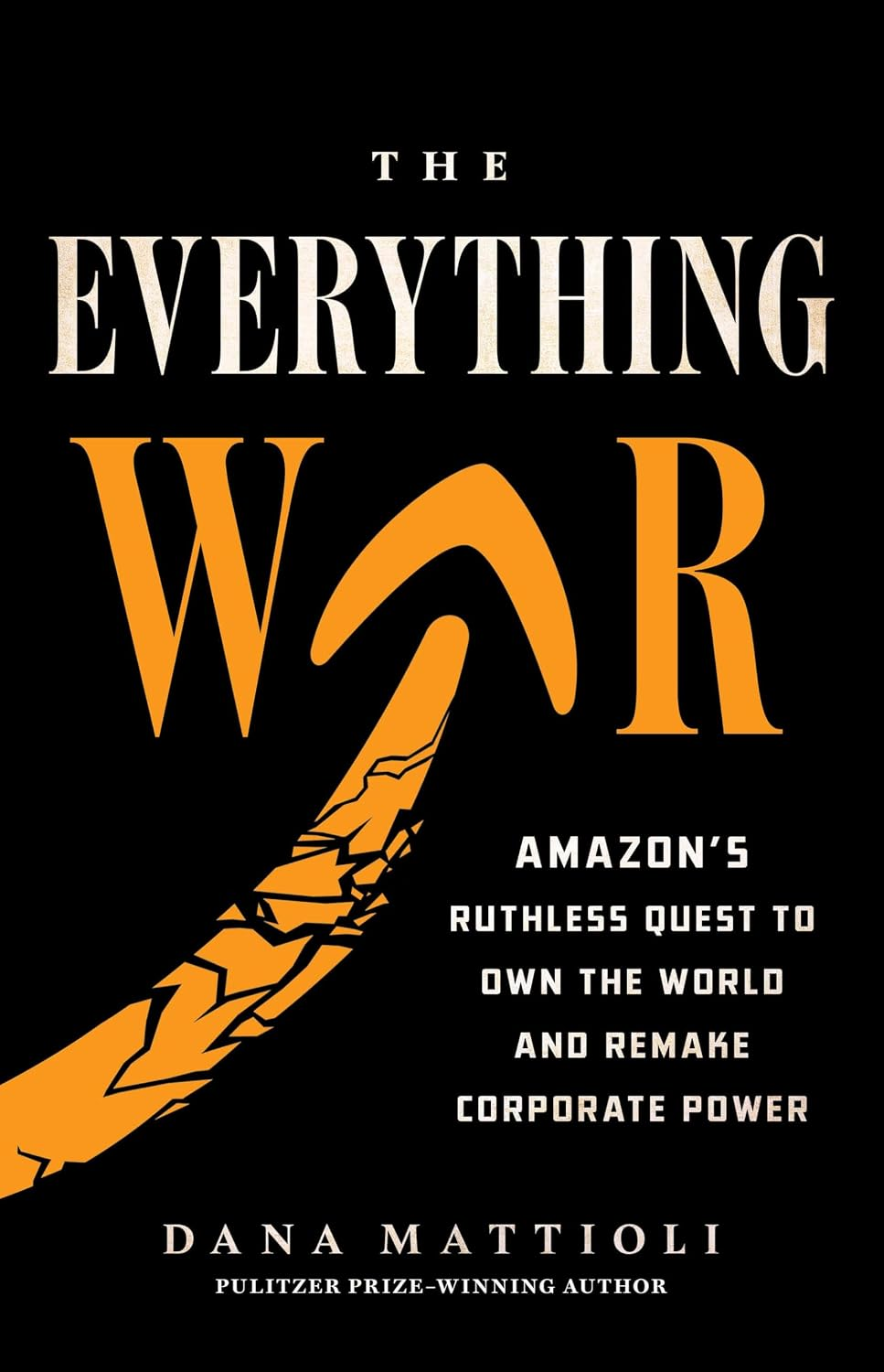
The Everything War
Dana Mattioli
Why It Matters Here
Mattioli provides the company-level context: Amazon’s expansion across commerce, competition, and marketplace infrastructure, and what dependence on that ecosystem can mean for the businesses operating inside it.
KMOB1003 Partner Spotlight
ClearCRM
Own the Relationship, Not Just the Sale
A marketplace can decide what you pay to be seen. A direct customer relationship is yours regardless of what any platform changes next. ClearCRM gives operators a structured way to build and keep the customer contact and history a marketplace never hands back.
Sponsored partner placement. KMOB1003 may earn a commission.
KMOB1003 After the Article
Continue the Signal
Choose what comes next — build your career, find something live, shop the KMOB1003 edit, or let the Culture Docent guide you.

KMOB1003 Artist Services
Artist Services
Visibility, strategy and media infrastructure for artists ready to move beyond the release link.
Put Your Release in Motion →

KMOB1003 Live Culture
Ticket Desk
Find concerts, sports, theater and live events through KMOB1003 access to Ticketmaster and StubHub.
See What’s Happening Live →

KMOB1003 Collection
The Global Collection
Curated tools, services, experiences and global partners selected for the way creators and culture builders move.
Shop What We’re Curating →

KMOB1003 Culture Docent
Culture Docent
Not sure where to go next? Start here. Tell the Culture Docent what brought you into the room and choose from six doors.
Tell Us What You’re Looking For →
Global Reach. Powerful Stories. Lasting Impact.
Whatever a court eventually decides about second prices and proxy calculations, the underlying arrangement won’t change on its own. Businesses will keep depending on the platforms where their customers already are, and those platforms will keep setting the terms of what it costs to be found. This case is a rare moment where that arrangement got described in the platform’s own words. Most of the time, it doesn’t.
Creator & Institutional Infrastructure
Building reach beyond one marketplace
None of these resolve Amazon’s auction-transparency question. They’re practical tools for operators who want marketing and sales channels that don’t run through one company’s search results.
Rewarx Studio AI
Product Creative
Turns existing product photography into campaign-ready creative for marketing beyond a single marketplace listing.
OpenArt AI
Creative Production
Broader creative production for owned websites, social campaigns, and advertising assets that don’t depend on one marketplace’s ad format.
CapCut
Short-Form Video
Moves campaign assets into short-form video and social distribution — the practical next step for reaching customers through channels a business actually controls.
Genspark
Business Research
Supports research, planning, and business workflow as operators diversify how they market and operate rather than relying on one marketplace.
Disclosure: KMOB1003 may earn a commission from qualifying purchases through these partner links. Editorial coverage is produced independently.
More From Legacy & Insights



The Operator’s Bookshelf
KMOB1003 READS
As an Amazon Associate, KMOB1003 may earn from qualifying purchases.
