
Meta Teen Safety Settlement: When Engagement Becomes a Liability
Meta’s settlement with state attorneys general puts a price on teenage attention and, for the first time at this scale, tells the product itself to stop.
When the user is a child, another minute of engagement can become a product-design responsibility.
August 27, 2026
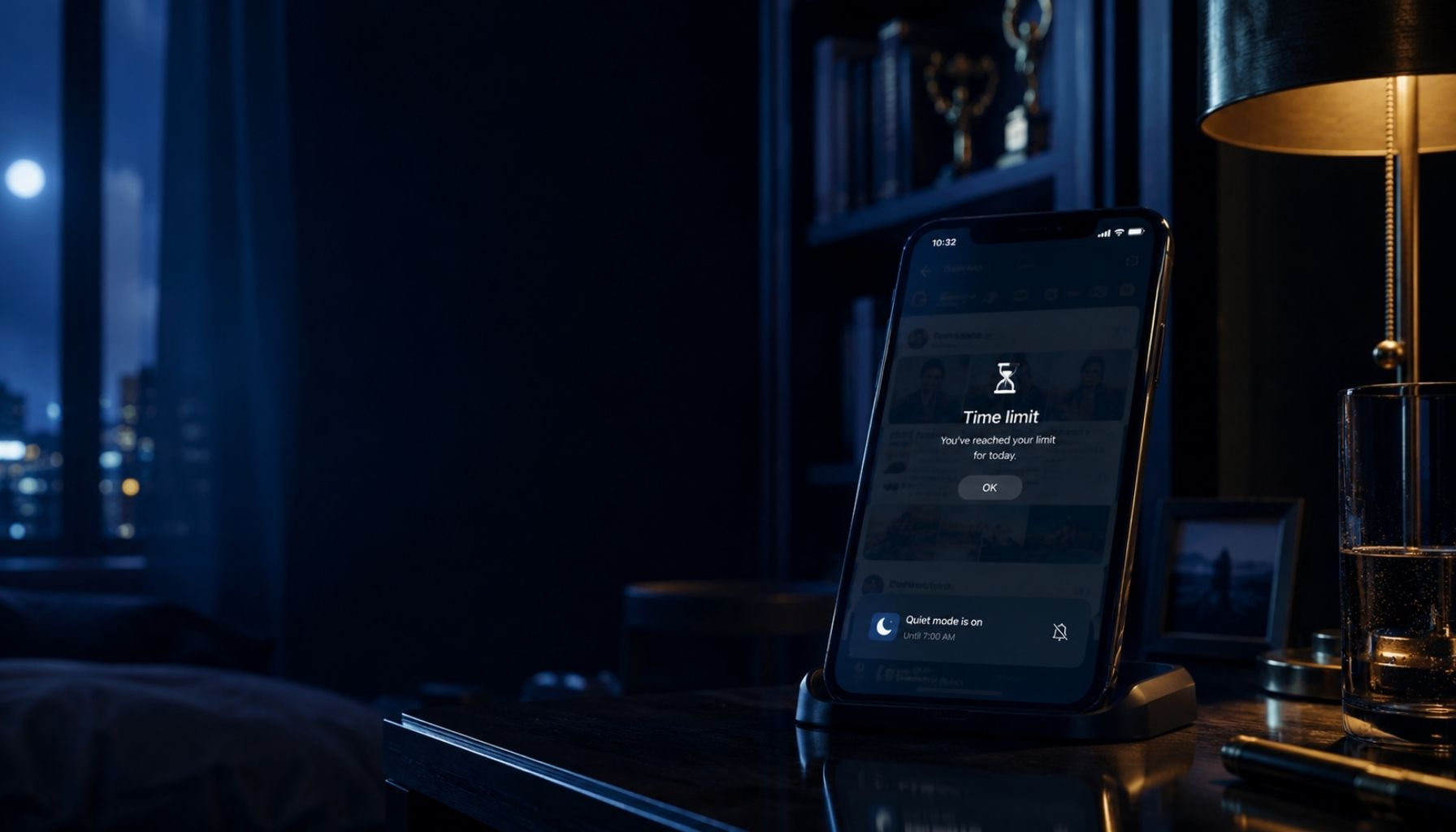
For years, social media companies had a simple way to prove a product was working: people stayed. Another scroll. Another Reel. Another notification. The vocabulary was clinical and commercially useful — engagement, retention, session length, daily active users. Meta teen safety settlement forces a different vocabulary onto some of that same behavior.
What This Article Is Actually About
This is not primarily a story about the size of the Meta teen safety settlement. It is about regulators moving deeper into product design — telling social platforms when young users should be interrupted, restricted, and protected from mechanics built to keep them engaged.
Signal One
Time Becomes a Limit
A two-hour combined daily cap turns time spent from a growth metric into an intervention threshold.
Signal Two
Nighttime Gets Friction
Midnight-to-6 a.m. restrictions and muted notifications force the product to interrupt itself.
Signal Three
Design Becomes Governance
The legal pressure reaches beyond content moderation into defaults, controls, age assurance, and product architecture.
State attorneys general describe the multistate settlement as worth up to $17.1 billion. Meta describes its broader financial commitment as approximately $18 billion. The difference reflects how various settlement components and contingent payments are counted.
More important than the size of the check is what the agreement says about the product itself: time spent can no longer be treated as an uncomplicated measure of success when the user is a child.
The Product Is Being Asked to Interrupt Itself
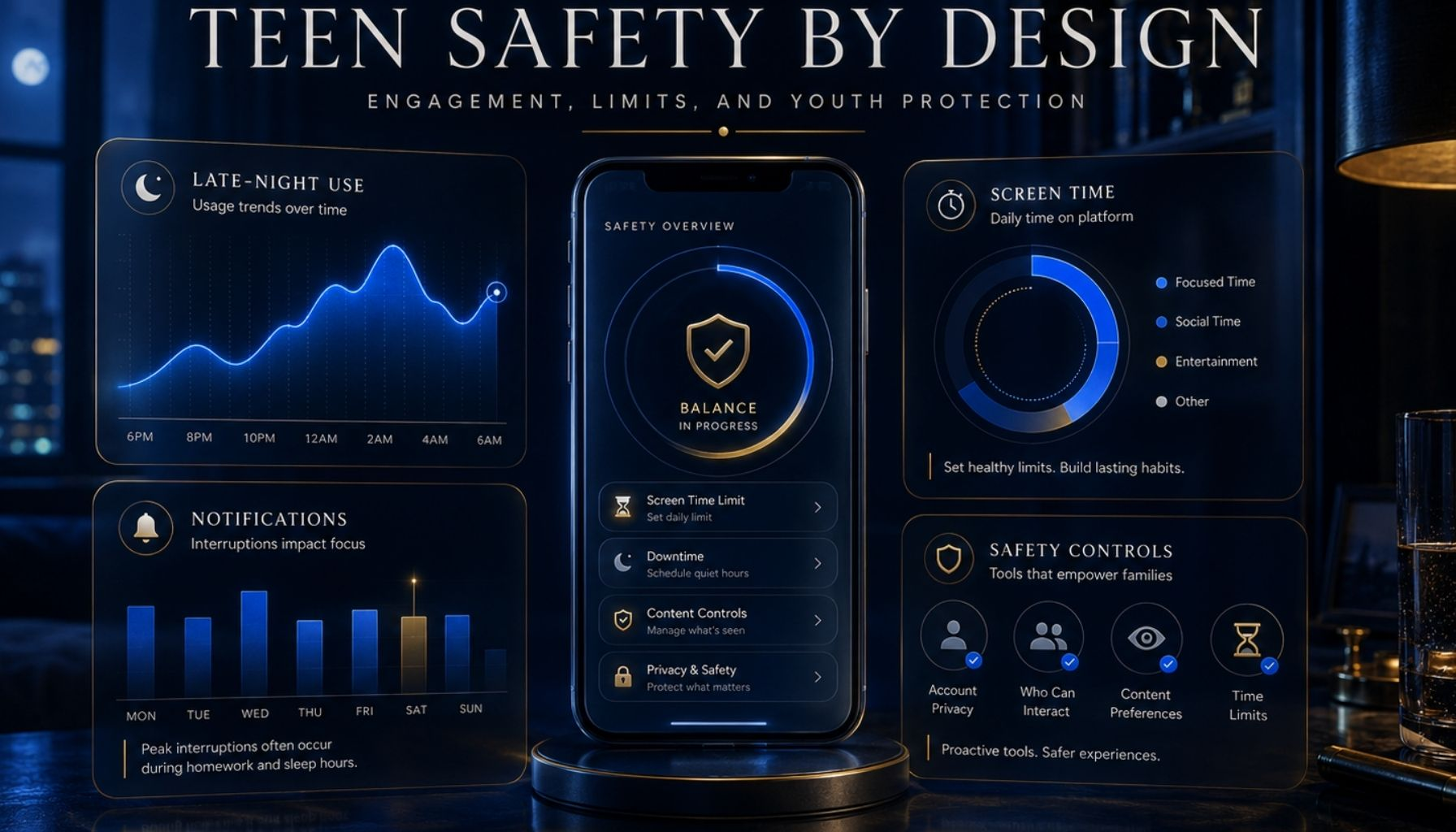
Teens will face a default two-hour daily limit, combined across Instagram and Facebook. Between midnight and 6 a.m., the apps default to a restricted state. Notifications mute during school hours. Teens get regular prompts about continuous use; parents gain more controls and visibility into account activity — including attempts to change protective settings.
That’s a reversal of how consumer technology is usually built. Digital products are historically designed to reduce friction between a user and another minute of use. Now Meta is required to introduce friction on purpose. The product has to tell a young user to stop.
When Engagement Becomes Exposure
The underlying lawsuits didn’t just argue that children spent too much time online. States alleged Meta designed features capable of encouraging compulsive use and exposed young people to serious harms while misrepresenting platform safety. Meta disputes that characterization — the settlement resolves the litigation through payments and product changes, not an admission that the states’ allegations are established fact.
That distinction matters, because the legal pressure here is aimed at the design layer, not just the content layer. A platform can moderate a post, remove an account, rewrite a policy. Regulators are increasingly asking a harder question: what if the problem isn’t only what moves through the system, but how the system is built to keep someone inside it?
What’s Confirmed
Meta agreed to a multistate settlement — state figures range $16.7B–$17.1B, Meta cites approximately $18B — requiring a two-hour combined daily limit on Instagram and Facebook for teens, a midnight–6am default lockout, and stronger parental controls. Roughly $5 billion of the payout, plus a tightening of Meta’s own limits to one hour and a longer nightly block, is contingent on rival platforms adopting matching terms. Which rivals are actually named in that contingency differs by source — Meta’s own outreach names only TikTok and YouTube; several state attorneys general also name Snapchat.
KMOB1003 Framework
Four ways the settlement reaches into product design
Time
A combined daily limit makes usage duration an enforceable product boundary.
Night
Default overnight restrictions put friction where platforms once optimized uninterrupted use.
Parents
Supervision tools move safety controls closer to the household instead of leaving them entirely with the platform.
Accountability
The central question shifts from what content appears to how the product itself is engineered.
The settlement matters because intervention is no longer only a policy statement. It is becoming a product behavior.
Signal Breakdown
Signal: Meta is legally required, for the first time at this scale, to build interruption into its own product for underage users.
Impact: Regulators reached past content moderation into product design itself — a two-hour cap, a midnight cutoff, and default parental controls are all engineering requirements, not policy language.
Watch: Whether TikTok, YouTube, or Snapchat actually join the framework, and whether the new limits change teen behavior or just add a compliance layer on top of the same underlying product.
Read Deeper
The Anxious Generation
Jonathan Haidt
Why It Matters Here
Haidt’s argument about the shift from play-based to phone-based childhood helps explain why governments are moving beyond warnings and toward structural limits on how platforms engage younger users.
KMOB1003 Partner Spotlight
Sleep Doctor
When the Screen Stops, Sleep Still Matters
Meta’s nighttime protections recognize that after-midnight hours are not simply another engagement window. Sleep Doctor offers guidance and resources focused on rest and recovery.
Sponsored partner placement. KMOB1003 may earn a commission.
KMOB1003 After the Article
Continue the Signal
Choose what comes next — build your career, find something live, shop the KMOB1003 edit, or let the Culture Docent guide you.

KMOB1003 Artist Services
Artist Services
Visibility, strategy and media infrastructure for artists ready to move beyond the release link.
Put Your Release in Motion →

KMOB1003 Live Culture
Ticket Desk
Find concerts, sports, theater and live events through KMOB1003 access to Ticketmaster and StubHub.
See What’s Happening Live →

KMOB1003 Collection
The Global Collection
Curated tools, services, experiences and global partners selected for the way creators and culture builders move.
Shop What We’re Curating →

KMOB1003 Culture Docent
Culture Docent
Not sure where to go next? Start here. Tell the Culture Docent what brought you into the room and choose from six doors.
Tell Us What You’re Looking For →
Global Reach. Powerful Stories. Lasting Impact.
How the Meta Teen Safety Settlement Could Spread Beyond Meta
There’s an unusual mechanism buried in the deal, and the coverage of it doesn’t fully agree. Meta is publicly calling on TikTok and YouTube to adopt matching protections — a one-hour daily limit, night mode, comparable payment — and roughly $5 billion of Meta’s own obligation is contingent on them doing it. If they do, Meta’s own terms tighten too: its two-hour cap drops to one hour, and the nightly block extends from a 6-hour window to a 9-hour one, running for a full decade instead of five years.
Meta’s own outreach names only TikTok and YouTube. But Connecticut’s attorney general named a third company — Snapchat — as a condition of the fuller payout, a framing echoed by Indiana’s office and in follow-up reporting from Axios and NPR. Neither Snap, TikTok, nor YouTube has confirmed publicly whether they intend to join. The disagreement over which companies are included in the contingency shows how differently Meta and some state officials are framing the same settlement.
Meta has an obvious business reason to want the whole industry operating under similar limits — teenagers move between platforms, and a rule that applies to one company alone is a competitive disadvantage. That doesn’t make the argument wrong. It does mean it’s strategy as much as safety.
The Two-Hour Limit Changes What Success Looks Like
Picture evaluating a children’s television network by how many hours a child could be persuaded to watch without turning it off. That number would be valuable to advertisers. It wouldn’t automatically be evidence of a healthy product. Social platforms blurred that line by turning time into a growth metric.
This settlement starts separating the two. For adults, a long session might still mean enjoyment or habit. For a teenager, the agreement now says: past a certain point, the platform itself should intervene. Two hours of usage stops being simply two hours of engagement — it’s also the point where the product has been told to say enough.
What Doesn’t Change
The Meta teen safety settlement gives parents more tools, but it doesn’t turn a technology company into a parent, and it shouldn’t. Age detection will still have errors. Teenagers will still find workarounds. Families will make different choices, and researchers will keep debating the relationship between specific forms of social media use and specific mental health outcomes — a question this settlement resolves legally without resolving scientifically.
None of it eliminates the business model underneath. Attention is still valuable, advertising is still valuable, recommendation systems are still powerful. The settlement changes the guardrails around that machine for younger users. It doesn’t dismantle the machine.
That’s why the real question starts after implementation: do these limits change behavior, or just change the compliance layer sitting on top of it?
The Larger Shift Behind the Meta Teen Safety Settlement
This Meta teen safety settlement isn’t important because a technology company wrote a large check — technology companies can absorb large checks. It’s important because regulators reached further into the architecture of the product than usual. A two-hour limit is product design. A midnight cutoff is product design. Reducing certain engagement signals, requiring age assurance, defaulting parental controls on — all product design.
Technology regulation has typically arrived after a product was already built: delete this content, protect this data, disclose this practice. This settlement moves closer to an earlier question — should this feature work this way in the first place? That’s a more consequential conversation, because once the design itself is accountable, “engagement” stops being a neutral word. Sometimes it means connection. Sometimes it means attention. And sometimes the most responsible thing a platform can do is stop trying to earn another minute.
More From Legacy & Insights



Creator & Institutional Infrastructure
Resources for the systems around the story
These KMOB1003 partners support research, creative production, connectivity and publishing. They are presented as practical resources, not as solutions to the youth-safety issues examined in this article.
Genspark
Research / AI Workflows
For readers who need to compare sources, organize research and build a clearer information trail around complex technology stories.
Rewarx
Creative Production
For creators and small teams turning a product image into campaign-ready creative without building an entire production stack.
Sakura Mobile
Mobile Connectivity
For readers traveling in Japan who need a practical mobile-data option for staying connected while moving between cities and devices.
Spines Hybrid
Publishing Infrastructure
For independent authors and experts who want to turn research, lived experience or institutional knowledge into a durable published work.
Disclosure: KMOB1003 may earn a commission from qualifying purchases through these partner links. Editorial coverage is produced independently.
The Operator’s Bookshelf
KMOB1003 READS

As an Amazon Associate, KMOB1003 may earn from qualifying purchases.
