
Technology & Power · Location Privacy · Civil Liberties · Legacy & Insights · August 2026
Your Phone Just Won More Privacy Than Your Car
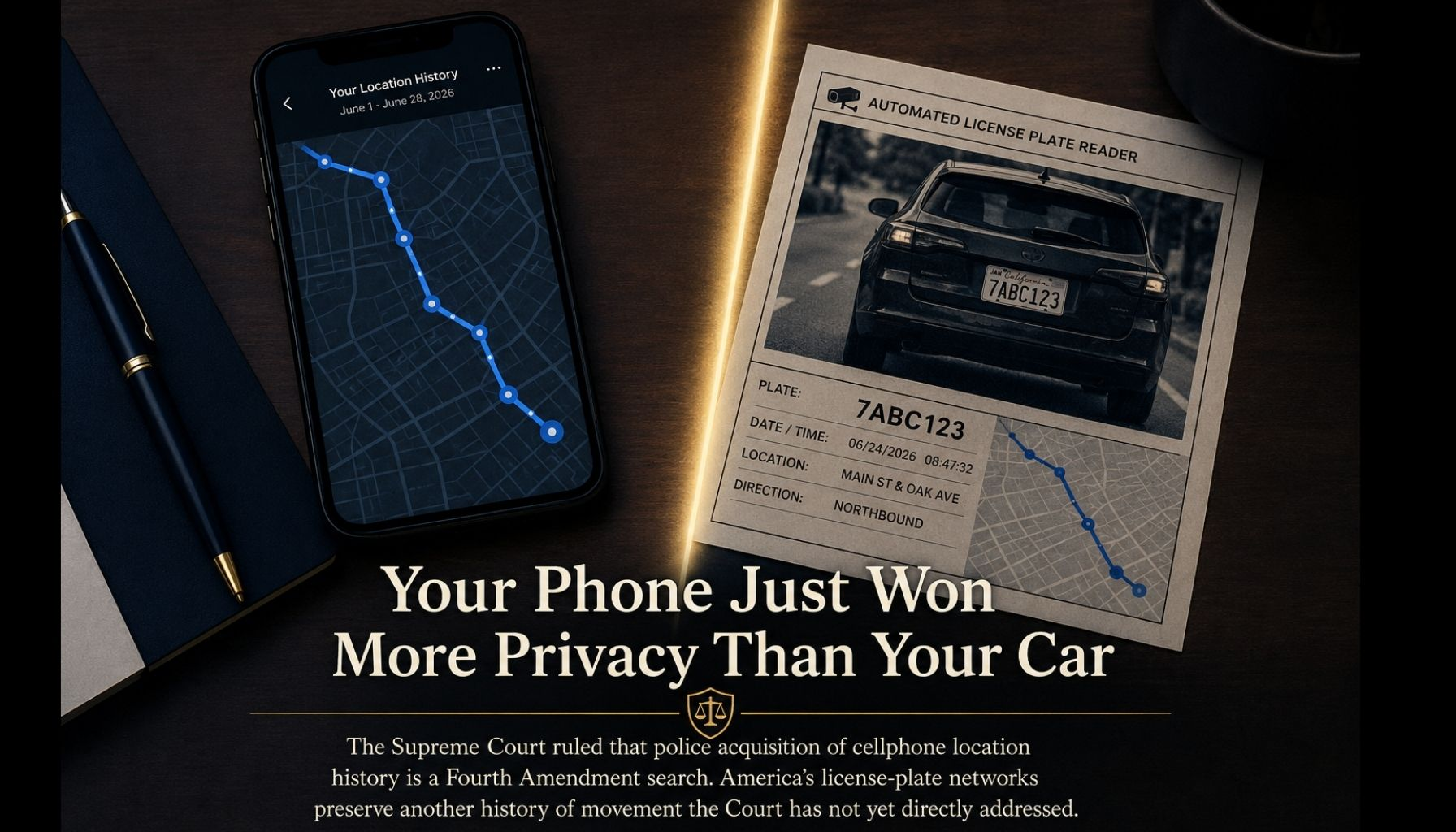
In a major location privacy ruling, the Supreme Court held that police acquisition of cellphone location history is a Fourth Amendment search. America’s license-plate networks preserve another history of movement the Court has not yet directly addressed.
One trip can become two searchable histories. The Supreme Court has now protected one of them — and left the other where it found it, on the side of the road.
One drive to work can leave two searchable records. One belongs to your phone. The other belongs to your license plate. In late June, the Supreme Court changed the constitutional status of one of them and said nothing about the other. In Chatrie v. United States, the Court held that when police obtain the location history a cellphone quietly generates, they are conducting a search under the Fourth Amendment — the most consequential ruling on digital location privacy since Carpenter in 2018. Meanwhile the cameras mounted on poles, overpasses, and patrol cars keep photographing plates and feeding the networks examined in KMOB1003's June investigation into America's searchable road network. Those systems were not before the Court. That is precisely why this decision matters more than it appears to.
One journey now produces two searchable histories of movement. As of this summer, only one of them carries the Supreme Court's direct constitutional protection.
What This Article Is Actually About
This is a constitutional analysis of an unresolved seam in American location privacy law. The Supreme Court has held that police acquisition of cellphone location history is a Fourth Amendment search. Automated license plate networks preserve a second searchable history of the same journeys — one with real investigative value and no direct ruling from the Court. This article examines that distinction, fairly and without alarm.
Signal One
The Ruling
In Chatrie v. United States, decided 6–3, the Supreme Court held that police acquisition of Google Location History is a Fourth Amendment search and remanded on reasonableness.
Signal Two
The Other Record
Automated license plate readers photograph plates with time and place, building searchable movement databases that agencies can query and share.
Signal Three
The Gap
The Court has not directly addressed whether large-scale searchable vehicle-movement archives should receive similar constitutional treatment.
I. One Trip, Two Histories
Consider an ordinary Tuesday under the system at issue in Chatrie. A driver leaves home, stops at a medical clinic, visits a church, and parks outside a union hall before returning at dusk. Her phone, running Google's Location History as it operated then, logs that route as a series of timestamped coordinates held in the company's cloud. The cameras she passes log it too: her plate, photographed at each intersection, stamped with location, date, and time, and uploaded to a database her local agencies can query and share. The two records describe the same life.
Yet what separates them is legal status. After Chatrie, the government's acquisition of the first is a Fourth Amendment search, subject to constitutional scrutiny. By contrast, the second has no direct Supreme Court rule of its own — built from photographs of a metal plate the state issued her and requires her to display, and governed by state statutes, agency policy, and vendor contracts. That is not a footnote or a technicality. It is the central unresolved question in American location privacy, and Chatrie has sharpened it rather than settled it.
II. What the Supreme Court Held About Location Privacy
Precision matters here, because the ruling is narrower than the headlines around it. Police investigating a 2019 Virginia credit union robbery used a geofence warrant to make Google produce Location History data for phones near the scene. By a 6–3 vote, in an opinion by Justice Kagan, the Court held that Mr. Chatrie had a legitimate expectation of privacy in the information Location History collects about his phone's movements, and that police invaded that expectation when they acquired it. The full opinion in Chatrie v. United States builds squarely on Carpenter v. United States, the 2018 decision protecting historical cell-site location records.
The case concerns the system Google operated in 2019. The Court noted that Google moved Location History storage to individual users' devices in July 2025 and represented that it can no longer respond to geofence warrants seeking that data. The product architecture changed before the ruling arrived. The holding still matters because the Court's reasoning addresses the privacy interest in precise retrospective location records, not merely the server on which one company stored them.
Then the Court stopped. It vacated the judgment below and remanded for consideration of whether the search was reasonable, as SCOTUSblog's case coverage records. The opinion did not declare all geofence warrants unconstitutional. Nor did it suppress the evidence in Mr. Chatrie's own case. And it said nothing at all about license plate readers. What it did was extend a principle the Court has now affirmed twice in eight years: a detailed, retrospective record of a person's movements is not forfeited merely because a third party collects and holds it. That principle is the bridge this analysis walks across — because it describes a plate database as naturally as it describes a phone.
What Chatrie Establishes — and What It Leaves Open
Decided June 29, 2026, by a 6–3 vote in an opinion by Justice Kagan, Chatrie v. United States holds that police acquisition of a user’s Google Location History is a search under the Fourth Amendment; the Court vacated the judgment below and remanded for consideration of whether that search was reasonable. The decision does not hold that every geofence warrant is unconstitutional, does not suppress the evidence in Mr. Chatrie’s own case, and does not address automated license plate readers or any vehicle-movement database. Anything this article says about the roadside archive is therefore analysis of an open question, not a description of a holding.
III. The Archive on the Roadside
The other record deserves a fair description, because it exists for reasons courts and communities have found legitimate. Automated license plate readers, as the Electronic Frontier Foundation's ALPR resource explains, capture every plate that passes, along with location, date, and time, and upload the data to central servers that agencies can choose to share with thousands of other agencies. That capability has genuine investigative value.
Agencies credit these systems with recovering stolen vehicles, locating missing children and endangered adults, and generating leads in violent-crime cases that had gone cold. Flock Safety, a major network operator, has built accountability into the product: its official transparency materials describe public portals showing each agency's policies and usage statistics, a required offense type before a search can run, and audit records of who searched what. Still, none of that is trivial, and none of it should be argued away. The constitutional question is not whether plate readers catch criminals. They do. The question is what the law should say about everyone else — the drivers suspected of nothing whose movements are recorded anyway, retained under schedules set by agencies, vendors, or state law rather than by any nationwide Supreme Court rule, and made searchable by keystroke.
IV. Why Location Privacy Law Treats the Two Records Differently
The traditional answer is the public-view doctrine: a license plate is displayed in public, an officer on a corner could always note it, and photographing what is openly visible has not required a warrant. That logic still anchors the roadside archive. Yet a second difference cuts against it. In Chatrie, the government argued that users surrendered privacy by choosing to enable Location History. The Court rejected that account of voluntariness, emphasizing the realities of ordinary smartphone use. A plate presents an even sharper problem: it is issued by the state and displayed under legal compulsion. Nothing about that display is voluntary.
For now, that archive is governed not by constitutional doctrine but by policy: retention schedules set by agencies and vendors, sharing agreements among departments, and a patchwork of state statutes that vary widely in what they require. Carpenter made aggregation central by recognizing how historical location records can reconstruct a life. Chatrie went further: the Court rejected the argument that a short period of monitoring falls outside the Fourth Amendment because constitutional protection does not turn on the quantity of information police choose to obtain.
A single glimpse reveals a moment; months of stored sightings reveal associations, worship, health care, and habit. Whether that insight reaches vehicle records is exactly what the Court has not decided. The archive is not hypothetical in its use, either: an EFF analysis published in May 2026 examined millions of police searches of Flock's network and found that, absent a warrant requirement, agencies ran queries well beyond specific criminal investigations.
V. The Location Privacy Question That Is Coming
Nothing in Chatrie forecloses the extension of its logic to vehicle movement archives, and nothing compels it. That is precisely why the next several years matter. The pressure will arrive from ordinary litigation: a suppression motion built on a months-long plate history, a civil suit over retention practices, a state supreme court reading its own constitution ahead of the federal one. It will also arrive from policy, because cities, sheriffs, and vendors set retention periods, sharing rules, and search standards long before any justice does.
At the local level, a community that requires warrants, short retention, and public audits has answered for itself a question Washington has left open. Another community that requires none of those things has also answered it. Chatrie gave both kinds of communities a signal about where the Court’s location privacy doctrine is heading. The distance between a phone’s protected location history and a car’s undecided one has never been easier to see, and constitutional questions that become this visible rarely stay unanswered indefinitely. Ultimately, the only uncertainty is which case, and which record of which ordinary life, will carry the question upward.
The Record the Constitution Has Not Reached
A driver can leave her phone at home. She cannot lawfully drive without displaying the plate the state requires. The Supreme Court has now said that government acquisition of one record of her movements is a search under the Fourth Amendment. The other keeps accumulating — lawfully, usefully, and largely unexamined by the Court that just drew a line beside it. This is not a scandal. It is a seam in the law, of the kind the American system closes slowly, case by case, on the facts of some future defendant or plaintiff. Until then, the shape of the moment is this: the Constitution now recognizes a privacy interest in the location record generated by the device you carry, and has not yet spoken directly about the archive tied to the plate the state requires you to display.
KMOB1003 Framework
How an Observation Becomes a History
Capture
A camera or sensor records a single lawful observation of a person, phone, or plate in public.
Retention
The observation is stored rather than forgotten, joining thousands of others across weeks and months.
Connection
Stored observations are linked into a pattern — a route, a routine, a reconstructed life.
Access
Who may search the pattern, on what showing, is where constitutional law finally enters the room.
A plate may be public. A reconstructed life is not the same thing as a plate.
Signal Breakdown
Signal: In Chatrie v. United States, the Supreme Court held 6–3 that police acquisition of cellphone location history is a Fourth Amendment search, and remanded for consideration of whether the search was reasonable.
Impact: One of the two searchable histories an ordinary trip produces now carries direct constitutional protection, while automated license plate networks preserve the other under state law, agency policy, and vendor practice.
Watch: How lower courts apply Chatrie’s remand, whether litigation over searchable plate databases reaches the appellate courts, and how cities and vendors set retention, sharing, and warrant standards in the meantime.
Read the Opinion Itself.
The strongest way to test this analysis is against the primary record. The Supreme Court’s opinion in Chatrie v. United States is public, readable, and shorter than most of the commentary about it.
The Operator’s Bookshelf
KMOB1003 READS

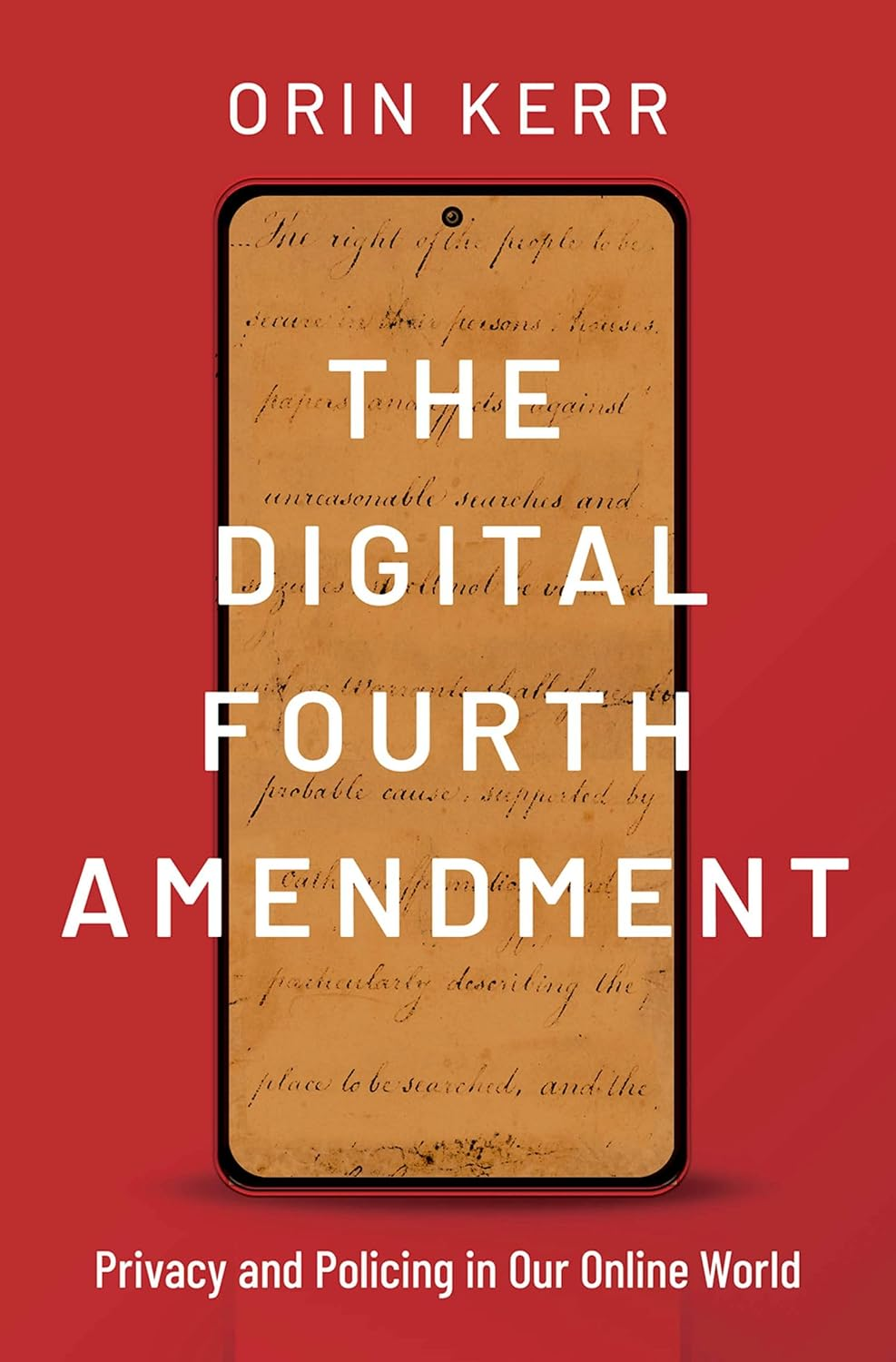
As an Amazon Associate, KMOB1003 may earn from qualifying purchases.
Disclosure: KMOB1003 may earn a commission from qualifying purchases through select partner links. Editorial coverage is produced independently.
KMOB1003 After the Article
Continue the Signal
One article is a signal. Here’s where the pattern keeps building.

Location Privacy Infrastructure
NordVPN Complete
Location privacy and secure browsing for operators who prefer their own traffic kept to themselves.
Browse Privately →

Partner Infrastructure
KMOB1003 Media Kit
Audience data, partnership inventory, editorial alignment, and monetization infrastructure for serious brand partners.
Open the Media Kit →

Guided Discovery
Culture Docent
Move through KMOB1003’s cultural intelligence, reporting, and recommendations with a guided point of entry.
Ask the Docent →

Editorial Archive
Legacy & Insights
Continue through KMOB1003’s analysis of technology, power, culture, ownership, and public life.
Enter the Archive →
Global Reach. Powerful Stories. Lasting Impact.
