
Institutions & Power · Work & Judgment · Legacy & Insights · July 2026
Nike Told Women to Just Do It. Heather Hender Did.
A former Nike engineer spent eight years challenging how the company paid and promoted her. A federal jury found that Nike discriminated against her because of her sex—and awarded at least $7.5 million in punitive damages.
Nike built extraordinary cultural power by telling women to be fearless, ambitious, and impossible to ignore. Heather Hender carried that promise into the workplace. The verdict in her discrimination case asks whether the institutions selling women empowerment are equally prepared to recognize women’s value inside their own walls.
Heather Hender spent eight years waiting for a room to tell her she was right. On a Wednesday in July, one did. After a six-day trial and a little over a day of deliberation, a federal jury in Portland found that Nike had paid the former process engineer less than her male colleagues, promoted her more slowly in part because of her sex, and willfully violated the law written to prevent exactly that. Jurors awarded her $19,739.52 in economic damages. The verdict form reflects $7.5 million more in punitive damages, with the final judgment still unresolved.
What This Article Is Actually About
This is not only a story about a pay calculation, a promotion timeline, or one employment lawsuit. It is about what happens when women are treated as a powerful consumer market but must still prove their value as workers, engineers, leaders, and institutional authorities. A company’s public values are not established by advertising alone. They are established by how work is classified, how compensation is set, how promotion decisions are made, whose expertise is recognized, how complaints are investigated, and whether accountability arrives internally or must be imposed externally. A brand promise becomes an institutional liability when employees cannot recognize that promise in the systems governing their own work.
Signal One
The Promise
Nike built cultural authority by telling women that strength, ambition, and determination belonged to them.
Signal Two
The System
The jury found that one woman inside the institution was paid less and promoted more slowly because of her sex.
Signal Three
The Reckoning
A brand’s public values become vulnerable when a courtroom must enforce what its internal systems failed to deliver.
I. Heather Hender Did What Nike Told Women to Do
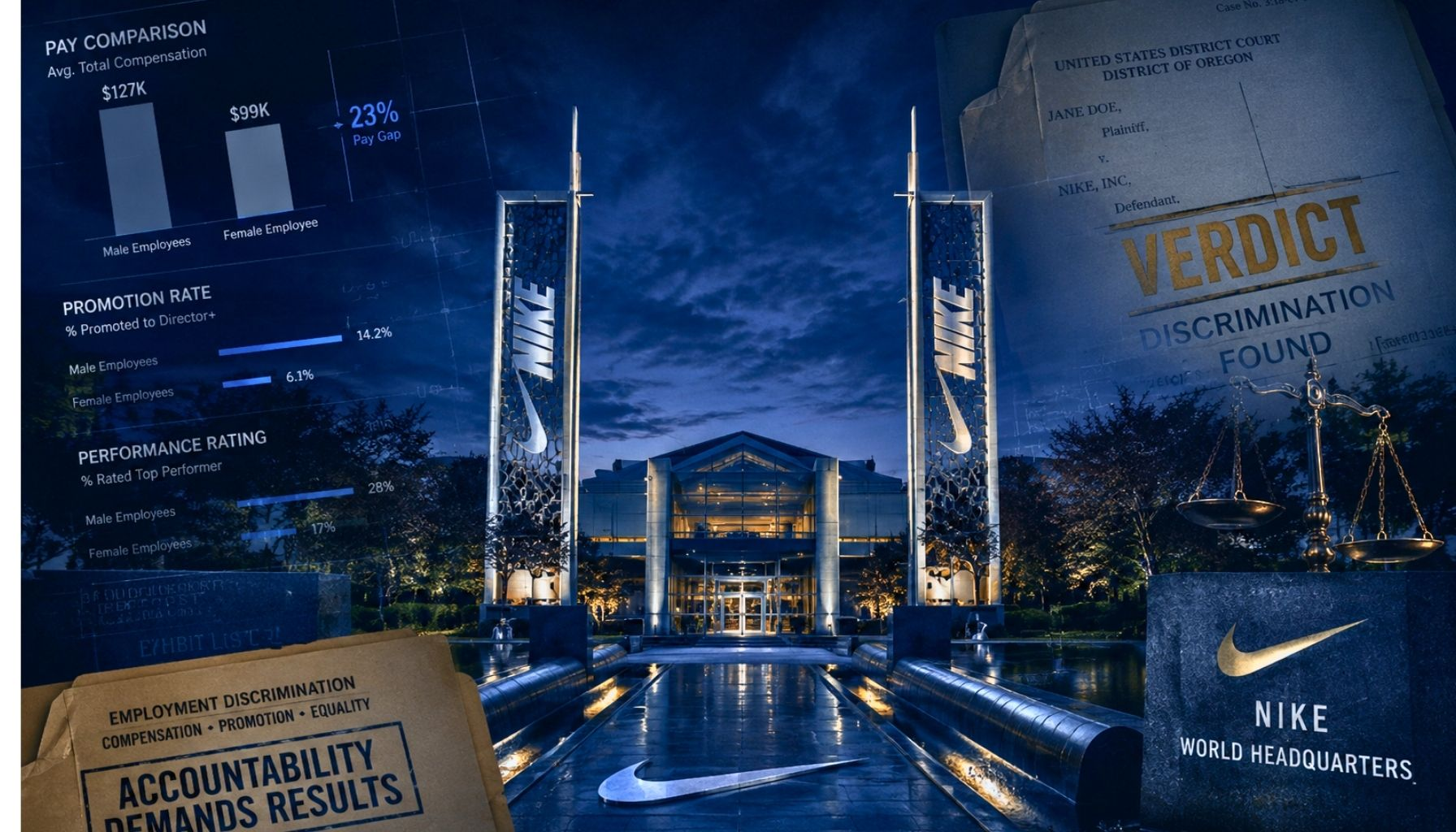
Heather Hender worked at Nike’s Beaverton, Oregon headquarters as a process engineer from 2015 to 2020. In 2018, she and three other women sued the company, alleging that Nike’s pay and promotion systems discriminated against women in violation of federal and state law. Three of the original plaintiffs settled before trial; Hender’s case went the distance. After a six-day trial in Portland and a little over a day of deliberation, an eight-person jury — one woman and seven men — ruled unanimously in her favor on every count in July 2026. Jurors found that Nike paid Hender less than comparable male colleagues, promoted her more slowly in part because of her sex, and willfully violated the federal Equal Pay Act. The verdict form reflects a $7.5 million punitive-damages award under both Oregon and federal law, and the court had not yet determined whether those amounts would be cumulative or treated as a single combined judgment. Either way, the punitive figure is far more than the $2 million her attorneys had requested in closing argument. Nike said it was disappointed in the verdict, that it respects the legal process, and that it is evaluating its next steps.
II. Women Were Valuable to the Brand
For decades, Nike has built its cultural authority by speaking directly to women’s ambition. Its campaigns have centered women athletes as symbols of power, discipline, and refusal — the message that strength was not a trait Nike was lending to women, but something women already owned. That message worked. It shaped how a generation of women thought about competition, self-belief, and their right to take up space. It also made Nike enormous amounts of money, and it made the company a reference point in broader conversations about ambition and representation well beyond athletics. None of that is in dispute, and none of it was on trial. What was on trial was a narrower and more uncomfortable question: whether the company that built its public identity on women’s strength valued the actual women building its products — designing the shoe, running the process line, managing the schedule — the same way it valued the women wearing them in a commercial.
III. But Was a Woman Equally Valuable to the Institution?
A marketing campaign is a promise made outward. An institution is proven inward — through job classifications, compensation formulas, promotion pathways, and the discretion individual managers are given to interpret all three. The jury did not evaluate Nike’s advertising. It evaluated Nike’s operating systems, and it found that those systems paid one woman less than her male peers and slowed her advancement because of her sex. That finding does not require inventing a companywide pattern the trial never measured. It requires taking seriously what a jury already measured: that the distance between a public value and an internal process does not close on its own just because the public value is sincere. A company can genuinely believe what it says about women and still build systems that do not reflect it, because compensation and promotion are rarely decided in one visible moment. They accumulate quietly across years of manager discretion, informal comparisons, and decisions that are never individually large enough to look like a pattern — until someone is willing to spend eight years proving that they were.
IV. Fix the Problem or Fight the Person
Hender’s attorney, Laura Salerno Owens, framed the case in a single line after the verdict: Nike faced a choice to “fix the problem or fight the person.” That is an advocate’s characterization, not a jury finding, and it should be read as one. But it names a pattern that shows up across institutions far beyond one athletic-wear company: when an employee raises a serious concern, the instinct many organizations reach for first is to evaluate the employee as the risk, rather than the system she is describing. That instinct is expensive. It converts a correctable process problem into a multi-year legal one. It replaces early internal learning with years of discovery, depositions, and reputational exposure. And it quietly shifts the entire cost of identifying a structural gap onto the one person willing to name it.
What the Jury Found—and What It Did Not Decide
The jury found: Nike discriminated against Hender in pay; Nike promoted her more slowly in part because of her sex; Nike willfully violated the federal Equal Pay Act; Hender was entitled to economic and punitive damages, with the verdict form reflecting a $7.5 million punitive award under both Oregon and federal law. The verdict did not establish: the experience of every woman at Nike; every allegation in the original 2018 lawsuit; a certified companywide class claim; a final appellate outcome; or whether the state and federal punitive awards will be treated as cumulative or combined into a single judgment. Precision does not weaken accountability. It makes accountability harder to dismiss.
V. A Verdict Is Not a Culture Audit
It would overstate the case to treat one verdict as a full accounting of what it is like to work at Nike. This trial concerned Hender’s individual pay and promotion claims specifically. An earlier effort to certify the broader case as a class action did not succeed, and three of the four original plaintiffs settled before reaching a jury. Nike disputes the verdict and is weighing its options, and the final financial outcome could still change through post-trial proceedings. All of that is true, and all of it matters. But a narrow verdict can still expose a wide institutional question, and boards do not need a companywide judicial finding to start asking it. Are pay decisions documented in a way that can be audited? Are promotion standards visible enough that an employee can understand why she was passed over? Are managers held accountable for the outcomes of their discretion, not just their intentions? Is a complaint treated as intelligence about the system, or as a threat to be managed? These are operational questions, not merely legal ones, and they are answerable long before a jury ever gets involved.
VI. The Women Watching
After the verdict, Hender said she hoped it would give other workers — at Nike and elsewhere — the confidence to speak up about what they are experiencing. That hope is worth taking seriously, and worth being honest about. Women should be able to advocate for themselves. But equality cannot depend on every woman having eight years, a legal team, and the personal capacity to withstand a trial. A system that only corrects itself when someone is willing to sustain that fight for nearly a decade is not a system that has solved the problem. It is a system that has found an expensive way to delay solving it. The women watching this verdict from inside other institutions are not just asking whether they, too, are underpaid or overlooked. They are asking whether raising that question will be treated as information the institution needs, or as a problem the institution needs managed.
Heather Hender did exactly what Nike spent decades telling women to do. The institutional question is whether companies will build systems in which the next woman does not have to fight this long to have her value recognized.
KMOB1003 Framework
The Brand-to-Workplace Test
Promise
What does the company publicly tell women, customers, employees, and communities that it values?
Process
How are pay, promotion, recognition, complaints, and leadership opportunities actually decided?
Proof
Can the institution demonstrate through consistent records and outcomes that the process supports the promise?
Response
When an employee identifies a gap, does leadership investigate the system—or mobilize to defend it?
Brand integrity begins where the campaign ends and the employee experience starts.
Signal Breakdown
Signal: A jury found that a company famous for selling women courage discriminated against a woman inside the institution in pay and promotion.
Impact: Brand values are no longer only marketing assets. They are standards against which employees, customers, courts, investors, and the public will evaluate how an institution actually operates.
Watch: The organizations that protect trust will be those that treat employee complaints as early operational intelligence—before the gap between public promise and internal practice becomes a public verdict.
Run the Brand-to-Workplace Test
Before the next campaign, annual report, leadership statement, or employer-brand announcement, ask: What are we publicly promising? Which internal processes are supposed to deliver that promise? What evidence proves those processes work consistently? How do we respond when an employee identifies a gap?
The Operator’s Bookshelf
KMOB1003 READS

As an Amazon Associate, KMOB1003 may earn from qualifying purchases.
KMOB1003 may earn a commission from qualifying purchases made through affiliate links, at no additional cost to you.
KMOB1003 After the Article
Continue the Signal
One article is a signal. Here’s where the pattern keeps building.

Protect the Record
NordVPN
Sensitive records and workplace communications should not become the price of demanding accountability. NordVPN helps protect your connection when the work requires greater digital privacy.
Secure Your Connection →
Make the Message Heard
ElevenLabs
A public commitment means little if people cannot access it. ElevenLabs gives creators and organizations tools for voice, narration, and multilingual audio delivery.
Explore ElevenLabs →

Own What Culture Created
RareVinyl
Platforms provide access. Physical records preserve ownership. RareVinyl connects collectors with rare pressings, collectible releases, and music history built to remain. Code KMOB10 for 10% off, subject to the program’s current terms.
Shop RareVinyl →

Recovery Is Part of the Work
Innovative Extracts
Sustained leadership requires room to recover. Innovative Extracts offers wellness products for adults building more intentional rest into demanding lives.
Explore Innovative Extracts →
Global Reach. Powerful Stories. Lasting Impact.
