
Culture · Labor · Live Performance · June 2026
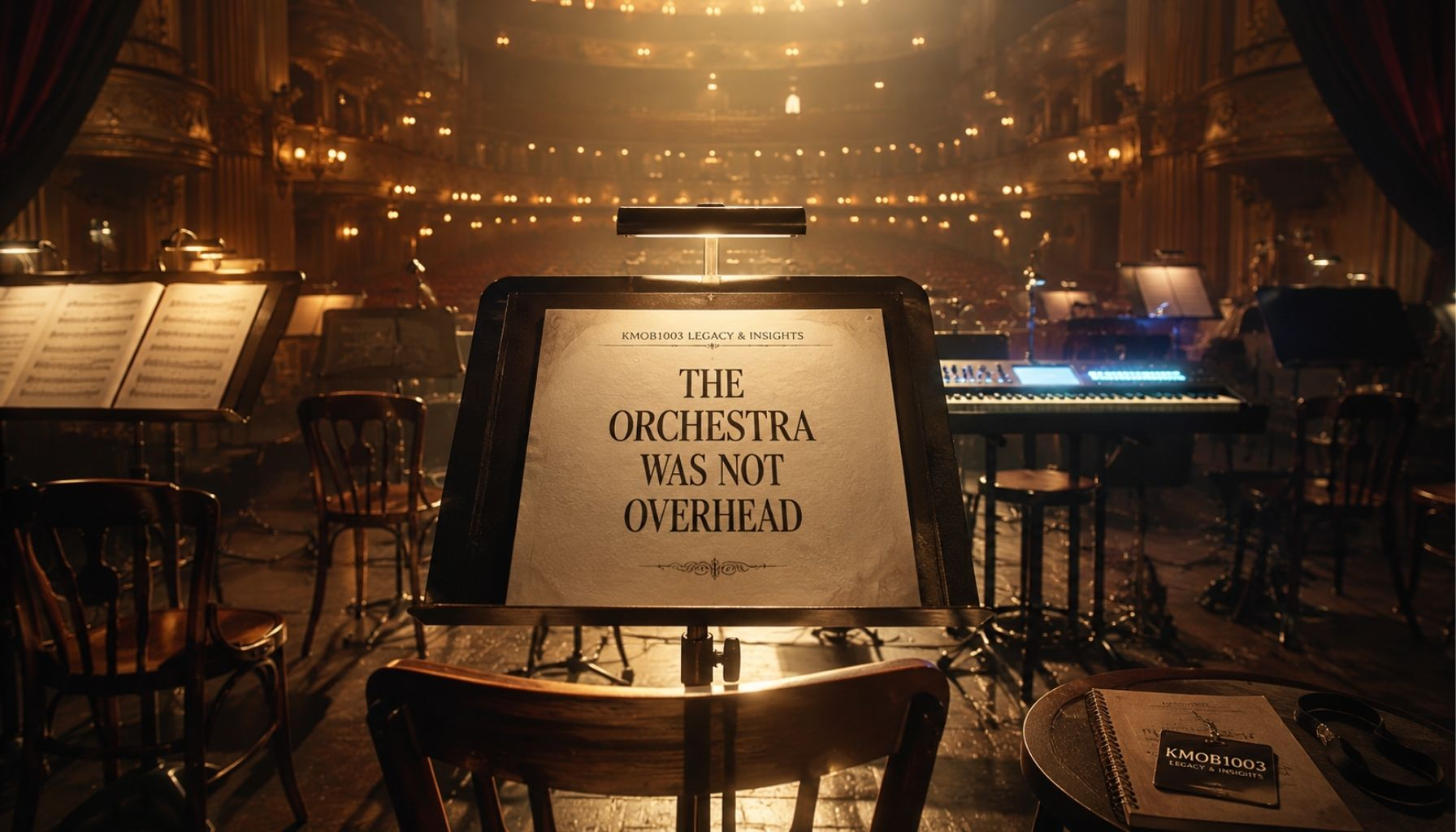
The Orchestra Was
Not Overhead
Technology can shrink the pit. It cannot replace what live musicians teach a room to feel.
Most people who buy a ticket to a Disney musical are not thinking about the eleven or seventeen people sitting beneath the stage. They are thinking about the lights, the puppets, the choreography, the spectacle of the thing. But in Sydney, where The Lion King‘s pit orchestra has gone from seventeen musicians at its 2003 debut to eleven today, the show above the stage is quietly being carried by what has disappeared below it.
What This Article Is Actually About
This is not an anti-technology article. It is not a story about whether KeyComp can sound convincing — it can. This is about what gets called efficiency when labor is expensive, what live musicians give a room that software cannot fully replace, and why a pit most audiences never look into is still part of what they came to feel.
Signal One
Seventeen became eleven
The Lion King‘s Sydney pit has lost six musicians since its 2003 debut — and all four string parts were cut for the 2026 season alone.
Signal Two
One keyboard, many players
KeyComp lets a single keyboardist trigger prerecorded orchestral parts that respond to touch and tempo — built to sound live with fewer humans in the room.
Signal Three
Already restricted elsewhere
New York, Washington DC, and Hamburg already ban or restrict KeyComp. Australian musicians are asking why their stages should accept what those cities did not.
I. The Pit Was Never Empty Space
Most audiences never look over the railing. The pit is the part of the theatre built to be heard and not seen, which is exactly why its shrinking has gone unnoticed for so long. It is where timing, breath, tension, and emotional lift get negotiated in real time, performance after performance, by people responding to a room that is never quite the same twice. A pit orchestra is not a backing track. It is a group of musicians making thousands of small decisions a night, decisions an audience absorbs without ever naming them.
That is the context for what The Guardian reported is happening to The Lion King in Sydney. All four string parts have been cut from the production’s 2026 season, replaced by KeyComp, a German-developed system that lets a single keyboardist trigger custom, prerecorded orchestral parts that respond dynamically to touch and tempo. The technology is sophisticated. It is also, according to Australian musicians and their union, a quiet redrawing of what counts as essential to a live show.
II. Efficiency Has a Sound
On paper, the math is simple. Fewer musicians means a smaller payroll, and a single keyboardist covering what once took four players looks, to a production budget, like pure efficiency. KeyComp was built by Christoph Buskies, a former Apple software engineer, specifically to close the gap between recorded convenience and live feel, letting prerecorded parts bend to a keyboardist’s touch rather than play back on rails. It is a genuinely impressive piece of engineering, and that is precisely what makes it harder to argue against on cost grounds alone.
But live performance has never been measured only in coverage. It is measured in response — to a singer who takes a breath half a beat later than rehearsal, to a scene that runs hot one night and slow the next, to a packed Saturday matinee that simply feels different from a quiet Tuesday. A pit full of musicians adjusts to all of that without anyone backstage sending a note. Software can be exquisitely engineered to sound alive. It cannot improvise consent with a room the way a string section listening to a singer can.
That distinction may not show up on a balance sheet. It shows up in the seats.
III. What the Audience Does Not See, It Still Feels
A ticket holder at the Capitol Theatre is not counting musicians. But audiences have always been more perceptive than producers credit them for. A show that breathes differently registers as a show that feels different, even when nobody in the seats could explain why. This is the quiet risk of treating the pit as overhead: the savings are visible to the people approving budgets, while the cost is felt, diffusely, by everyone who paid for a ticket expecting something alive.
Musicians and academics studying the shift describe it less as a single bad decision than as a slow erosion of expectation. Once an audience accepts a thinner sound as normal, the bar for what counts as a live event quietly moves. The show still looks expensive. Whether it still sounds like the thing people came for is a separate question, and one fewer productions are being asked to answer.
There is also a slower, second-order effect worth naming. Junior musicians have traditionally learned a score’s hardest passages inside a full section, where one missed entrance is covered by five other players and a conductor who can adjust in real time. Strip the section down to one or two players locked to a click track, and that margin for learning disappears along with the jobs. The pipeline that used to produce a theatre’s next generation of working musicians gets thinner at the exact moment the industry needs it to stay open.
IV. The Worker Inside the Magic
Musicians occupy an unusual position in commercial theatre: central to the experience, invisible to the audience, and now, increasingly, optional to the production. Their labor disappears twice — once physically, beneath the stage where no one looks, and again economically, when a software license replaces four union contracts. Australian musicians have testified to a parliamentary inquiry into live music that the cuts are not abstract. A violinist and violist who has performed with Opera Australia and Orchestra Victoria, and who spent nearly a thousand performances on the Australian run of Hamilton, told the inquiry he found himself largely unemployed in part because of the decision — work he might reasonably have expected on The Lion King, given his history with the same production team, evaporated before the casting call.
The concern from the union is not only about one production. Musicians who lose commercial theatre work also lose footing across opera, ballet, recording, and education — the wider ecosystem that a steady pit gig has historically helped sustain. KeyComp is already restricted on Broadway, in Washington DC, and in Hamburg, where it was built. Australian musicians are now asking their own industry, and their own government, to decide whether they want the same floor.
V. The Question Is Not Whether Technology Belongs
Theatre has never been precious about technology. Lighting, amplification, projection, automation — the stage has absorbed every major innovation of the last century and is generally better for it. KeyComp is not an aberration in that lineage; it is a continuation of it. The question it raises is not whether software belongs near a score.
The real question is what the technology is being asked to do. Used to extend what a small ensemble can achieve, software supports the room. Used to make four musicians’ jobs disappear without changing the price of a ticket, it becomes something else — a way of making the ensemble vanish while keeping the appearance of fullness on stage. The same tool can sit on either side of that line, and right now in Sydney, it is sitting on the side that costs jobs.
VI. What We Keep Alive
There is a version of this story where the orchestra is simply a line item, and a thinner one is just good business. KMOB1003 does not buy that framing. An orchestra is not overhead sitting beneath a production. It is part of the emotional contract a show makes with the people who paid to feel something for two and a half hours. When that labor is treated as the easiest place to cut, what gets lost is not only a paycheck.
It is a piece of the living architecture that made the show worth seeing live in the first place.
What Gets Cut When the Pit Shrinks
The Visible Saving
Fewer players, smaller payroll, technical coverage of full orchestral parts by one keyboardist.
The Hidden Cost
Fewer jobs, a thinner training pipeline for junior musicians, less real-time response to the room.
The Cultural Question
What kind of live event remains when the live labor inside it is treated as optional.
Signal Breakdown
The savings from cutting a string section are easy to put in a spreadsheet. The cost is harder to itemize — it shows up as a junior musician who never gets the gig that used to teach the craft, and as an audience that quietly recalibrates what “live” is allowed to mean.



KMOB1003 Global Media
Cultural infrastructure analysis. Operator intelligence. Human signal reporting.
