
Legacy & Insights · Operator Intelligence · June 2026
The Receipt Needs a Witness Now
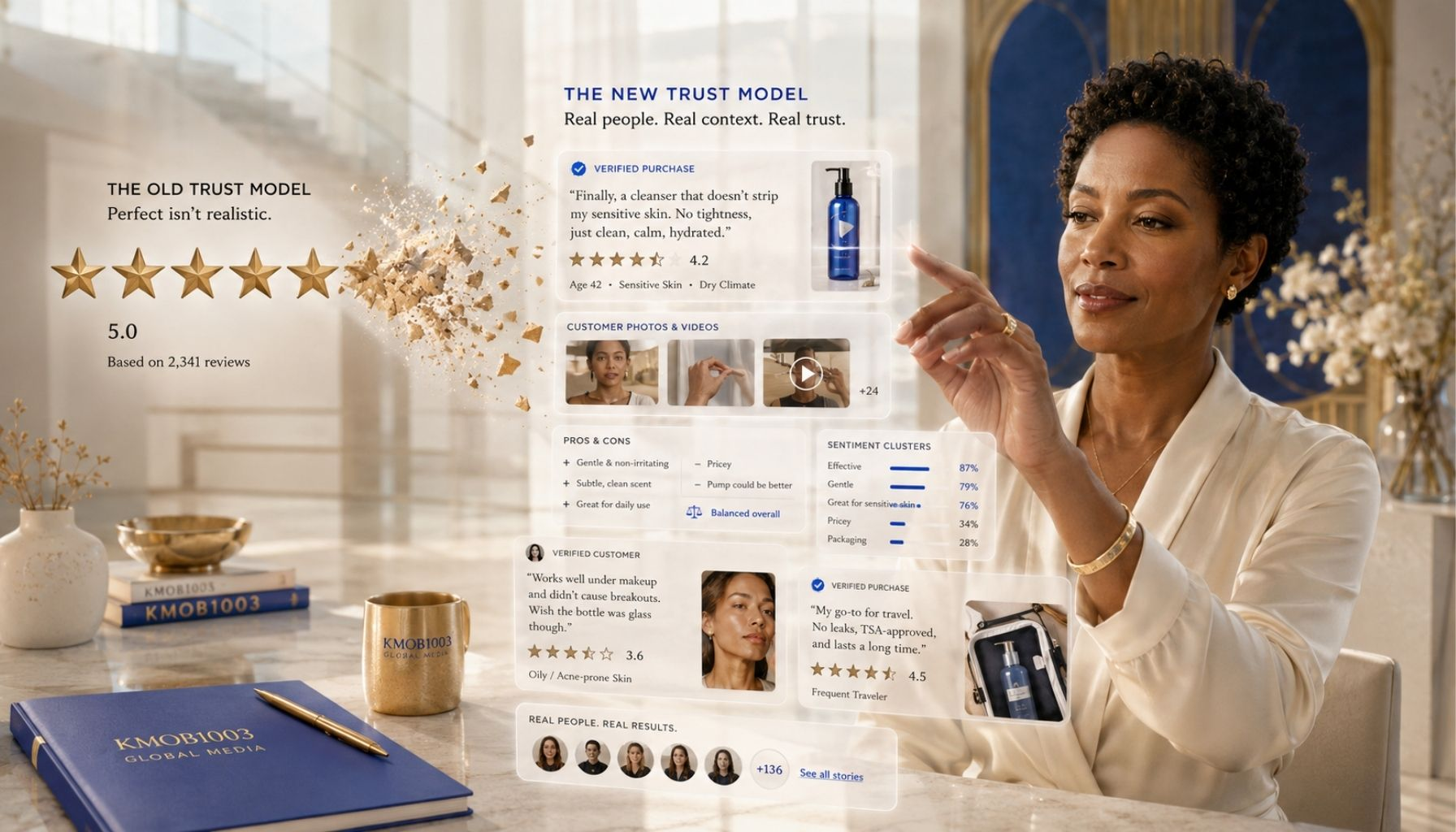
A perfect score no longer feels like proof. It feels like polish.
There was a time when five stars felt like relief. Someone had gone first — opened the box, tried the tool, booked the room, played the record — and lived to tell you whether it was worth your money. Now five stars can feel like a costume.
What This Article Is Actually About
This is not an article about product reviews. It’s about why public trust is harder to earn now, why proof has to be visible instead of implied, and why every recommendation a media brand makes — affiliate, editorial, or otherwise — has to be able to show its work.
Signal One
The crowd stopped feeling human
When every product has thousands of reviews and every score looks the same, the review wall stops functioning as proof.
Signal Two
AI didn’t start the fire
It accelerated a trust crisis that review fatigue and mobile scrolling had already begun.
Signal Three
The room is the proof now
When review walls weaken, trusted media brands matter more — but only if they keep receipts.
I. The Crowd Used to Mean Safety
There was a kind of comfort in numbers that nobody had to think about twice.
A review section was never just data. It was a room full of strangers quietly saying, I tried it. That feeling — a real crowd standing behind a decision — is what made the old system work at all. People look for safety in numbers; a product page lined with strangers’ approval lowered the risk of being the only one who said yes.
It worked the same way a crowded restaurant works. Nobody reads the menu first. They read the line outside the door. If a hundred strangers were willing to wait, the food is probably good — that’s the entire calculation, and it asks nothing of the person making it. A star rating did the same job for a product page: it let a stranger borrow somebody else’s risk-taking instead of doing the research themselves. That borrowed confidence was never really about the product. It was about the size of the crowd standing behind it.
But a crowd only reassures you if it feels real. The moment it stops feeling real, the whole mechanism reverses — the same crowd that once lowered risk starts raising suspicion instead.
II. Then Approval Became Too Easy to Manufacture
A recent Inc. piece named the moment plainly: AI is now manufacturing reviews fast enough that a perfect score has stopped being reassuring. That’s the trigger. Here’s the part that actually matters.
Writing a fake glowing review used to take effort — somebody had to sit down and lie convincingly, more than once, for it to add up to anything. Now it takes none. A machine can produce a thousand five-star paragraphs before lunch, all of them grammatically flawless, all of them saying nothing a real person would actually say out loud. AI didn’t invent the lie. It just removed the labor that used to keep liars rare.
The result is a strange kind of inversion. A flawless score, once the goal, is now itself a warning sign. Shoppers have learned to read “5.0, 4,000 reviews, zero complaints” the way they’d read a contract with no fine print — not as proof of quality, but as proof that something isn’t being shown. The absence of any friction has become the tell. Nobody’s that good. Not your favorite restaurant, not your favorite person, and certainly not a blender.
III. The Modern Buyer Wants Traceable Belief
The question shoppers ask today isn’t is it good. It’s sharper than that: who said this, why did they say it, what did they actually experience, what did it solve and what did it not solve, who is this for, and who benefits if I believe it.
None of those questions get answered by a number at the bottom of a page. They get answered by context — and context is exactly what the old review wall never had to provide.
A star rating is a verdict with no transcript. It tells you the outcome of someone’s experience without showing any of the reasoning that produced it. Traceable belief is the opposite: it shows the reasoning first and lets the verdict follow. That’s a slower kind of trust to build, and it can’t be manufactured at scale the way a five-star average can — which is precisely why it still works, and precisely why it’s worth the extra effort it costs.
IV. This Is Why Media Brands Matter Again
When review walls weaken, the people who actually built a relationship with their audience start to matter more. Creators, editors, radio communities, niche operators who’ve been showing up in the same room for years — none of that can be faked the way a thousand identical five-star paragraphs can. But that only holds if they don’t sell the room too cheaply.
A media brand that turns every recommendation into a generic exit link is just running a smaller, friendlier version of the same review wall nobody trusts anymore. The platform is different, but the failure is identical: approval with no visible reasoning behind it, asking to be believed on authority alone.
The opportunity in that failure is real. A reader who no longer trusts a stranger’s five stars might still trust an editor whose track record they’ve watched for months. But that trust is conditional, not automatic — it has to be re-earned on every single recommendation, not coasted on once it’s been granted. A media brand that gets this right once and stops paying attention will lose the room just as fast as the review wall did.

V. KMOB1003’s Standard: Receipts, Not Permission
This is the standard KMOB1003 is building toward across every layer of the platform, not just the affiliate ones. Ticket Desk Live routes a reader toward a real event, not a generic ticket search. Artist Services has a visible pathway — Simone Green didn’t arrive at a BET Soul premiere by accident; the rotation, the editorial coverage, and the infrastructure that got her there are traceable, not implied.
The Spoken Word archive doesn’t just embed a video and walk away — it names the poet, the room, and why the piece belongs there. The Media Kit doesn’t claim an audience; it shows the platform-by-platform numbers, dated and sourced, down to the percentage of senior decision-makers reading on LinkedIn. Even the radio ad services KMOB1003 runs for affiliate partners are built on the same idea: a recommendation only works if the room behind it can be checked.
None of this is incidental to growth. It’s the actual mechanism of it. TikTok growth, paid distribution, a podcast launching with Simone Green, a rebuilt Spoken Word archive — every one of those is a new surface where a reader can either find a guided door or find an exit. The infrastructure is the same whether the audience is 800 people or 800,000; what changes is how much damage a single broken receipt can do.
Affiliate links cannot function like exits. They have to function like guided doors — and a guided door only earns trust if the person walking through it can see why it was opened in the first place.
None of this is a call to abandon scale. KMOB1003 isn’t asking to shrink back to a single trusted voice in a single room. It’s asking for the opposite — to grow the audience without diluting the receipt, so that a platform reaching hundreds of thousands of people still behaves, in every recommendation, like the smaller room it started as. Scale without a receipt is just a bigger version of the same review wall nobody trusts anymore.
Proof Architecture
Old Trust System
- Five-star score
- Review count
- Generic praise
- Long comment wall
- Hidden negatives
- “Best product” claims
New Trust System
- Verified use
- Visible context
- Real tradeoffs
- Human explanation
- Creator/customer evidence
- Source clarity
Signal Breakdown
Trust is no longer a number at the bottom of a product page. It is the architecture around the decision. For KMOB1003, that means every commerce layer — affiliate, ticketing, artist services, media kit, radio ads, and product recommendations — has to prove why it belongs in the room.
The future of commerce — and the future of media credibility — will not belong to the brand with the most stars. It will belong to the room people trust enough to believe, because they can see the receipt, and the receipt has a witness.



KMOB1003 Global Media
Cultural infrastructure analysis. Operator intelligence. Human signal reporting.
