KMOB1003
KMOB1003 Global · Sports Culture · Thursday AM · June 11, 2026
The match begins today. But the real media system has been moving since before the opening whistle — in group chats, travel routes, streaming decisions, watch-party rooms, and creator feeds already live.
Build the room before the event arrives.
Today is kickoff day. The 2026 FIFA World Cup opens at 3 PM ET as Mexico hosts South Africa at Estadio Azteca in Mexico City — the first match of the largest World Cup in history, with 48 teams, 104 matches, and three host countries running simultaneously for 39 days across 16 cities. But the first signal did not go out at 3 PM. It went out last night, when the group chats started moving. When the streaming logins were checked. When travel plans were confirmed and watch-party rooms were organized and creator clips started building the cultural frame that the match would eventually play inside. By the time the ball moved today, the media system had already been running for hours. The first kickoff is not the first signal. The audience organized itself long before the referee’s whistle.
What This Article Is Actually About
Why the first kickoff is not the first signal — and what it means for media operators, creators, brands, and anyone trying to understand how global events actually move through culture. The World Cup is not only a sports competition. It is a live global media infrastructure event, and it began before today’s opening match.
Signal One
The Room
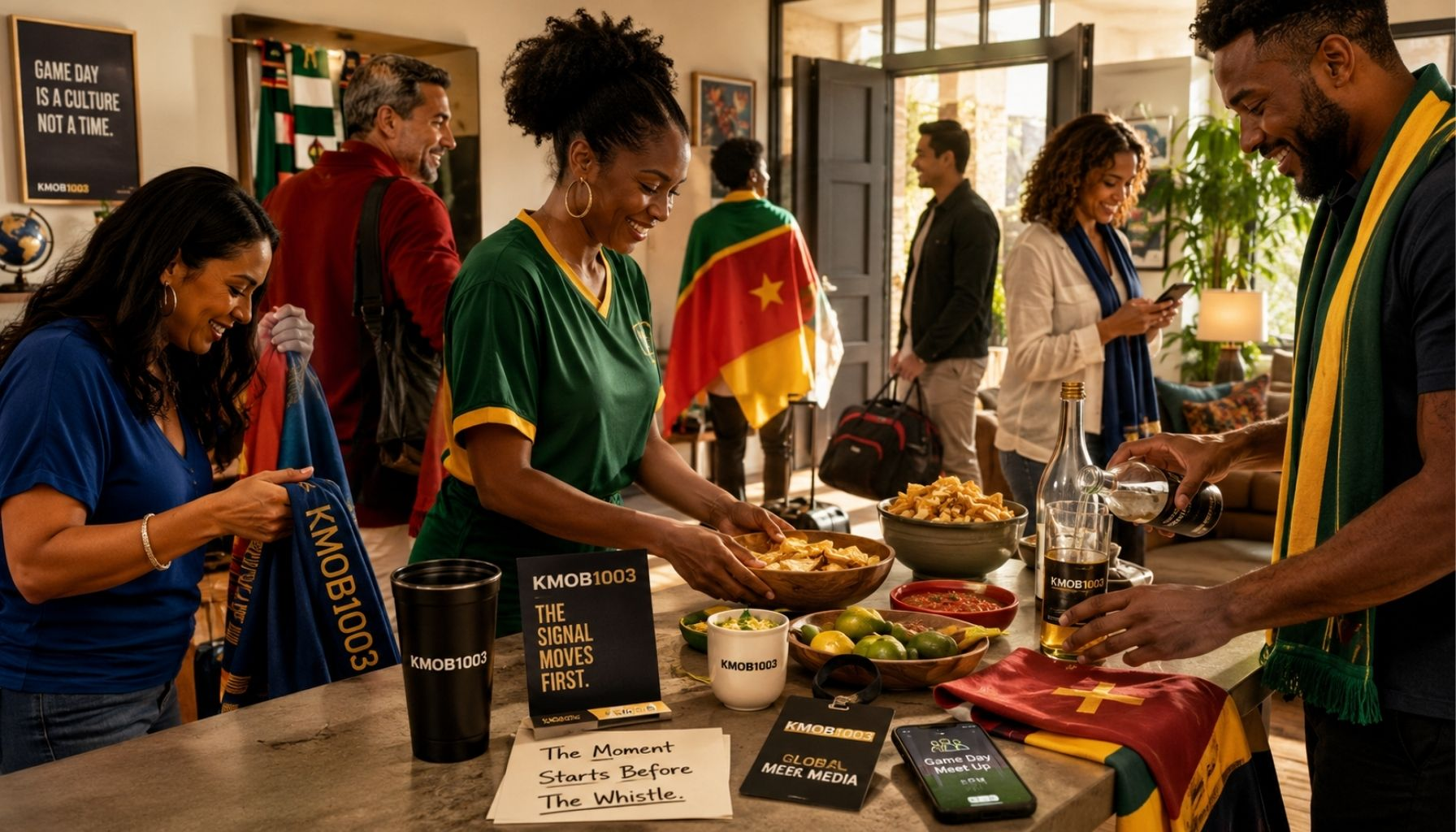
Watch parties, homes, bars, hotel lobbies, fan zones. The room is not where the game plays. It is where the culture of the game gets made — through shared reaction, commentary, food, style, and memory.
Signal Two
The Stream
FOX, Tubi, Telemundo, Peacock, Fubo, Fox One. The streaming decision is a media infrastructure decision — who controls access, who gets the audience, and what they see before and after the match.
Signal Three
The Second Screen
Creator clips, reaction videos, group chats, fan pages, cultural commentary, real-time sharing. The second screen is not a distraction from the event. It is where the event’s cultural meaning is produced.
Signal Four
The Memory
Photos, clips, posts, outfits, playlists, ticket stubs, shared screenshots. The archive of a global event is built before, during, and after the match — by the audience that was always the real media system.
The first kickoff is not the first signal. The audience organizing itself is the signal. — KMOB1003 Global Media · June 2026
The opening match of any global event is the moment the broadcast signals that the cultural moment has officially arrived. But the cultural moment does not begin with the broadcast. It begins with the behavior that precedes it — the planning, the coordination, the streaming setup, the social content, and the movement that happens before any whistle blows. Mexico City declared June 11 a public holiday, closing schools and encouraging remote work as the city opened stadium gates at 9AM local time — six hours before kickoff — and restricted surrounding access to ticket holders and accredited media. That is not a sports logistics decision. That is an infrastructure acknowledgment that the event had already begun in the streets, the transport systems, the local businesses, and the audience behavior of an entire city before the match started.
The same pattern was playing out in living rooms, bars, and group chats across three countries and dozens of time zones. The streaming decision had already been made. FOX Sports is delivering 340 hours of first-run World Cup programming — a hundred-hour increase over 2022 — with all 104 matches streaming live and on-demand in 4K across FOX, FS1, and the Fox One app, while Tubi simulcasts the opening match and the US opener for free. Those are not just broadcast numbers. They are a distribution infrastructure decision about who gets the audience and what format they receive it in. The audience that figured out how to access the stream before today was already inside the signal system before kickoff.
“The first signal is not the ball moving. The first signal is the audience organizing itself — in rooms, on feeds, in travel behavior, and in streaming decisions made before the match begins.”
— KMOB1003 Global Media · Sports Culture · June 2026
The global World Cup audience does not watch the way the broadcast assumes it watches. 78% of millennials say they are at least somewhat likely to use a second screen during 2026 World Cup matches — making millennials more likely than Gen Z to split their attention during the games, according to ThinkNow Research survey data from 2025. The second screen is not a sign of distraction. It is the primary engagement layer for a majority of the global audience — the place where the cultural conversation around the event happens in real time, where creator clips circulate before the official highlight packages are assembled, and where the meaning of what just happened on the field gets made and shared before the next match begins.
OTT and connected TV viewership has climbed 27% since the 2022 World Cup, with TV still anchoring the experience for 80% of viewers — but the difference in 2026 is not where people stop watching, it is where and how they enter and re-enter the tournament through creator content, AI-curated highlights, and short-form moments designed for on-the-go consumption, according to Nexxen forecasting data cited by Marketing Interactive. The audience is not moving away from the match. It is surrounding the match with a distributed media ecosystem that the broadcast alone cannot reach. The creator who builds the reaction clip during the opening match is not competing with the broadcast. The creator is extending it — into feeds, into group chats, into the second screen that is running alongside every television in every watch-party room.
Security Layer · Protect the Signal Wherever You Watch
A global event watched across 16 host cities, three countries, and dozens of streaming platforms means public Wi-Fi, hotel networks, airport connections, and open access points carrying the signal in every direction. NordVPN Complete protects the device and the stream wherever the World Cup takes you — hotel lobby, fan zone, travel layover, or home office with a VPN-required stream.

The official opening ceremony for the 2026 World Cup ran simultaneously in Mexico City, Toronto, and Los Angeles — a first in tournament history. But the unofficial opening ceremony had been running for weeks in the form of creator content: preview videos, prediction clips, historical documentaries, fan commentary, kit reveals, and cultural analysis that built the context in which today’s match would land. Tubular Labs research drawing on platform-level data from Instagram, YouTube, and TikTok between July 2025 and March 2026 found that World Cup-related YouTube audiences engaged more heavily with content outside the sports category than within it — with Family and Parenting content averaging 1.4 million views and Food and Drink averaging 859,000 — and that creators generated 1.3 billion Super Bowl-related YouTube views compared to 740 million for brands. The creator is not supplementing the event. The creator is producing the cultural meaning of the event in the format the audience actually consumes.
This is the infrastructure argument that KMOB1003 has been making since before the tournament began. The World Cup does not happen only in stadiums. It happens in the rooms where people watch it, on the feeds where they discuss it, in the creator clips that circulate the moments before the official highlight packages are built, and in the group chats that run alongside the broadcast from the opening whistle to the final post. The brands and media operators that understand this — that position themselves inside the distributed media ecosystem rather than buying adjacency to the broadcast — are the ones that will be talked about long after the tournament ends. Adlook research across six markets found that casual viewers — who represent 64% of all tournament viewers — are 32% more likely to browse or shop online during matches than core fans, confirming that the in-match window is a real-time commerce and media activation opportunity that runs parallel to the broadcast.
Creator Layer · Edit at the Speed of Culture
The creator who builds the World Cup second screen does not have time to edit slowly. The reaction clip, the opening ceremony moment, the cultural commentary on the first goal — these have a shelf life measured in minutes during a global event. CapCut gives creators the editing infrastructure to move at the speed the moment demands.
The media operators who understood what today’s opening match actually was — not a sports moment but a global media infrastructure event — began building for it before the first whistle. They built the watch-party rooms. They confirmed the streaming access. They built the creator content strategy. They positioned the affiliate commerce layer. They set up the second-screen engagement plan. They understood that the audience was going to organize itself around the event whether or not any particular platform was ready for it — and that the infrastructure around the event was going to generate more durable value than any single piece of content produced during it.
Lotame’s World Cup 2026 strategic analysis identifies the behavioral signals generated by a global tournament — second-screen browsing, social chatter, real-time purchasing, and location shifts — as the real data asset of the event, and concludes that the brands that win are not the ones that simply show up during the matches but the ones that understand the audience before the audience becomes a number. KMOB1003 has been operating on this logic since before the tournament opened. The signal does not begin with the kickoff. It begins when the audience starts organizing itself — in rooms, on feeds, in travel behavior, in streaming decisions, and in the creator clips that build the cultural frame before the referee lifts the whistle. Build the room before the event arrives. The signal is already live.
KMOB1003 connects that signal system to 933K+ audience footprint, 39.2M+ annual video views, radio across 50+ countries, and 35+ affiliate and monetization partners already operating in the room the event creates. The first kickoff is not the first signal. The audience organized itself before the match began — in watch-party rooms, streaming decisions, creator clips, group chats, and travel behavior that were already live before 3 PM. The infrastructure that understood that is the infrastructure that will still be relevant when the tournament ends. Build the room before the event arrives. The signal does not wait for the whistle.
Some links in this article are affiliate links. KMOB1003 may earn a commission from qualifying purchases at no additional cost to you. All affiliate partnerships are editorially independent.
