
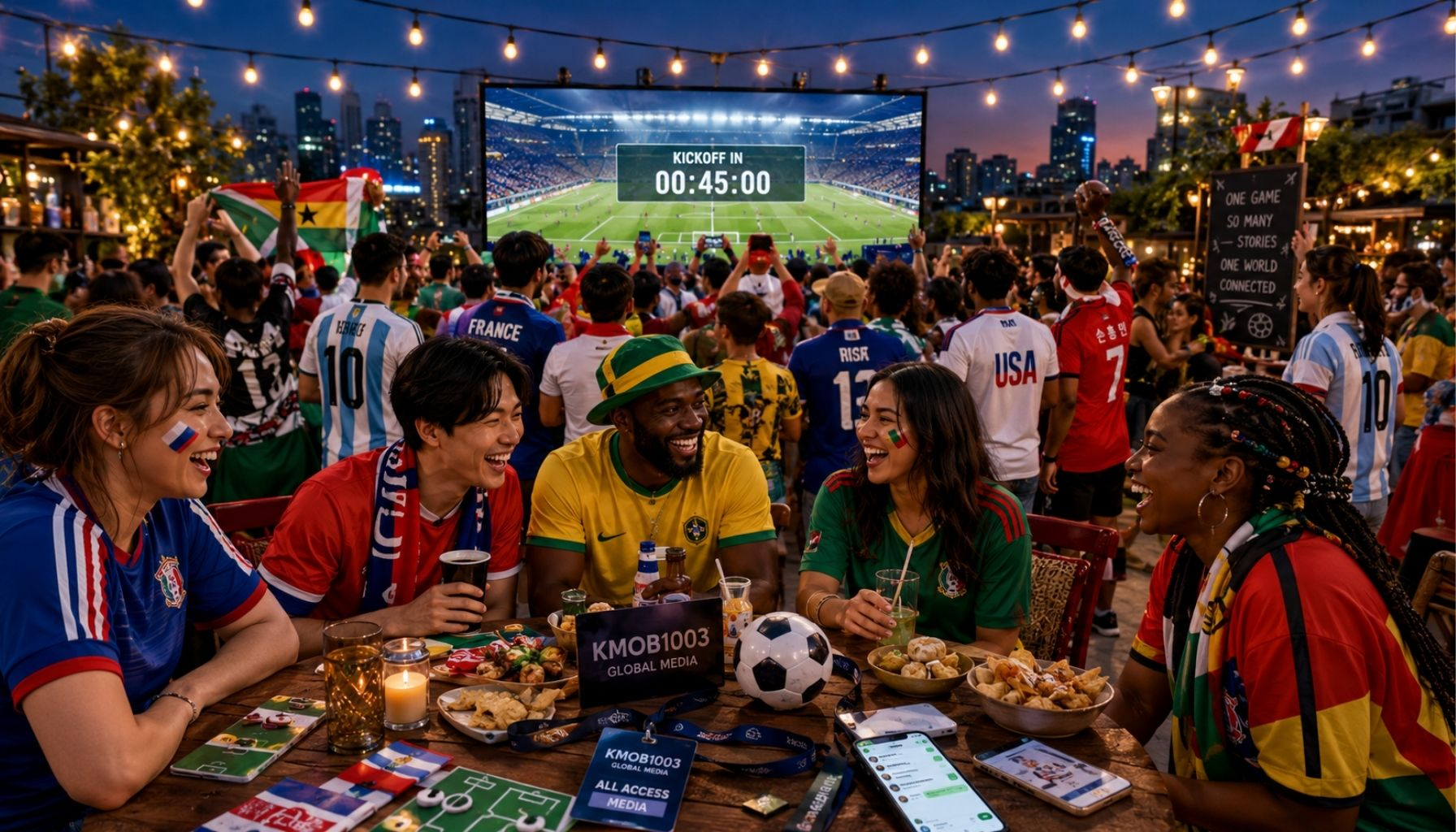
KMOB1003
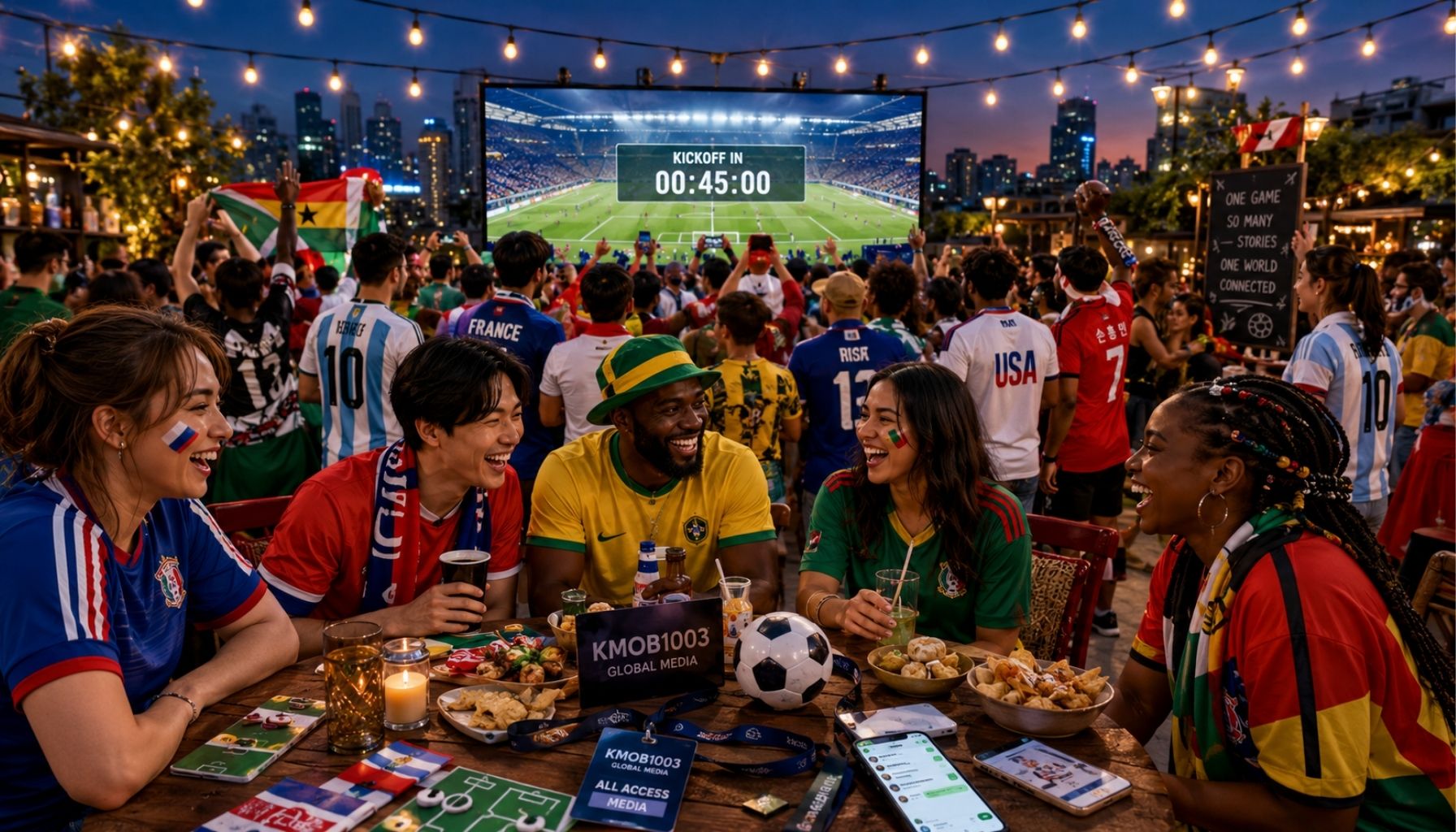
KMOB1003 Global · Sports Culture · Wednesday PM · June 10, 2026
The World Cup is not only a sports event. It is a global feed, a travel signal, a creator runway, a watch-party economy, and a live-culture infrastructure moment.
Build the week around the signal.
Tonight the phones are charged. The group chats are moving. Tickets are being checked, flights confirmed, hotels looked up, watch parties organized, outfits decided, streaming logins shared, and social feeds already filling with anticipation content before a single whistle has blown. The 2026 FIFA World Cup opens Thursday, June 11 with Mexico hosting South Africa at Estadio Azteca in Mexico City — the first match of the largest World Cup in history, with 48 teams, 104 matches, and 16 host cities across three countries. But the event did not start with kickoff. It started in the planning behavior — and tonight, the night before, is when the culture finishes organizing itself around what comes next.
What This Article Is Actually About
Why the night before a global event is not empty time — it is a media runway. The World Cup is not only a sports competition. It is a travel signal, a watch-party economy, a second-screen ecosystem, and a creator infrastructure moment. KMOB1003 reads the room before the whistle blows.
Layer One
The Room
Watch parties, bars, homes, lounges, fan zones, hotel lobbies, and group chats. The room is where sports, culture, fashion, food, travel, and commentary merge into one temporary media environment.
Layer Two
The Movement
Tickets, travel, rideshares, hotels, restaurants, routes, safety, and timing. Global events turn attention into physical movement — and movement into spending, infrastructure, and memory.
Layer Three
The Second Screen
Creator clips, live commentary, reels, captions, sports radio, podcasts, reaction videos, and cultural context. The second screen is not a distraction from the event. It is an extension of the event’s media footprint.
Layer Four
The Memory
Photos, outfits, posts, saved clips, ticket stubs, playlists, articles, and archives that make the event last beyond the match. The archive is what turns a live moment into cultural infrastructure.
The event is not only what happens on the field. It is the infrastructure of attention, movement, rooms, commerce, safety, and memory around it. — KMOB1003 Global Media · June 2026
Global events have always had a before. But the before has grown into something structurally different from what it was a decade ago — it is no longer just anticipation, it is media production. Tonight, in cities across North America and around the world, people are creating content about an event that has not yet started. They are filming outfit reveals, recording group-chat reactions, posting watch-party invitations, reviewing travel logistics, and building the social context that the match will eventually play inside. The night before is not a pause before the event. It is the opening act of a distributed media ecosystem that will run for 39 days across three countries and 16 cities.
The infrastructure of anticipation is real and measurable. International visitors attending the 2026 World Cup are projected to spend an average of more than $5,000 per person over a 12-day stay — with accommodation, food and dining, match tickets, and transport as the four largest spending categories, according to FIFA-WTO and Tourism Economics data. That spending does not begin at kickoff. It begins with the planning behavior: the hotel booking, the rideshare download, the restaurant reservation, the jersey purchase, the watch-party supply run. The night before is when that spending accelerates — and when the media moment around it is at its most generative.
“A global event begins in planning behavior. The night before is when culture finishes organizing itself around what comes next.”
— KMOB1003 Global Media · Sports Culture · June 2026
The watch party is one of the most underanalyzed media environments in culture right now. It is not passive viewing. It is a temporary media room where sports, commentary, fashion, food, group dynamics, social video, and shared memory converge around a shared screen. The home that becomes a fan zone, the bar that turns into a broadcast hub, the hotel lobby that fills with jerseys and phones and commentary — these are not just places to watch a match. They are the rooms where the cultural meaning of the event gets made. What people wear, what they eat, what they film, what they post, and who they gather with during a World Cup match is as much a part of the event as the match itself.
The spending data confirms the room as an economic layer. Restaurant and bar spending in stadium-area zip codes rose approximately 7% year over year during the 2025 FIFA Club World Cup, according to William Blair analysis — and sports bars and restaurants in host cities are projecting 25 to 40% revenue increases on match days during the 2026 tournament. The 2026 World Cup is expected to provide a meaningful boost to leisure, hospitality, and tourism-related businesses across North America, with spending on spectator sports remaining strong since the pandemic supporting demand ahead of the tournament. The room is an economy. And the night before the room fills is when the economy begins to activate.
Global events do not stay in stadiums. They travel. They move through airports, hotels, rideshares, restaurants, fan zones, and neighborhood streets in ways that reshape the urban media environment around them. The 1.2 million international visitors expected to attend the 2026 World Cup are not just spectators — they are participants in a travel economy that generates content, cultural contact, and media behavior at every step of the journey. The fan filming a taxi ride through Mexico City, the supporter posting from a Toronto hotel lobby, the group documenting a pre-match street scene in Los Angeles — all of that is the event, distributed across the infrastructure of movement rather than contained inside a stadium. Around $4.3 billion in event-related tourism expenditure is forecast for the 2026 World Cup, with more than 80% of it concentrated in hospitality — and the distribution of those benefits will depend heavily on how well destinations interpret and act on real-time demand signals, according to Euronews travel analysis.
For the audience that is not traveling to the stadium — which is most of the global audience — the travel layer is still a signal layer. What cities look like during the World Cup, what neighborhoods fans are staying in, what restaurants are getting documented, what hotels are serving as community hubs — all of that becomes content that the global second-screen audience follows, shares, and uses to build their own sense of participation in an event they are watching from home. Travel is not separate from the media moment. It is part of the media infrastructure around it.
The event is not only what happens on the field. It is the infrastructure of attention, movement, rooms, commerce, safety, and memory that forms around the field. The night before is when that infrastructure activates — and the operators who understand that build differently for it.
Travel Layer · Stay Where the Signal Travels
Global events do not stay in stadiums. They move through hotels, lobbies, lounges, restaurants, travel routes, and the rooms where people gather before and after the match. Where the audience stays becomes part of the media moment — the lobby that turns into a fan zone, the hotel bar that becomes a broadcast room, the suite that becomes a watch party. Marriott Bonvoy puts the signal where it needs to be.
The 2022 World Cup generated 112 billion social media interactions — views, engagements, and shares that made the event one of the most distributed media moments in history. The 2026 tournament, with 48 teams instead of 32 and 104 matches instead of 64, will almost certainly surpass that. But the structure of that media distribution has changed. It is no longer primarily driven by broadcasters and official rights holders. It is driven by creators — commentators, fan accounts, cultural editors, sports radio hosts, podcasters, react-video producers, and clip-makers — who build the second screen that runs alongside the official broadcast and often captures more audience attention than the match itself. IBM’s 2025 global sports fan study found that multi-device usage to follow sporting events increased from 27% to 29% year over year, with 74% of fans who follow sports influencers saying storytelling is important to how they experience and connect with sports. The creator is not supplementing the event. The creator is producing the cultural frame through which most of the global audience experiences it.
The second screen is becoming a strategic media layer — with highlights, stats, social clips, fan conversations, commerce prompts, and creator commentary all extending the value of the core live content beyond what the broadcast stream alone can capture, according to PubNub’s analysis of second-screen strategy in sports. That second layer is where most of the World Cup’s cultural meaning will be made. The outfits, the commentary, the reactions, the group-chat screenshots, the halftime hot takes, the postgame cultural analysis — these are not peripheral to the event. They are the event’s media infrastructure, distributed across millions of second screens in real time.
The KMOB1003 argument about global events is not about the match. It is about the infrastructure of attention that forms around the match — the rooms, the travel, the second screens, the creator ecosystem, the commerce, the safety decisions, the memory-making behavior — that begins before kickoff and continues long after the final whistle. The night before the World Cup is not empty time between the announcement and the event. It is the media runway: the moment when the global audience finishes organizing itself around the event, when planning behavior becomes content, when anticipation becomes a distributed media ecosystem that will run for five weeks across three countries.
For media operators, creators, brands, and cultural intelligence platforms, the night before is the most important moment to pay attention to — because it reveals how the audience is going to behave for the entire duration of the event. What rooms they are building. How they are moving. What second screens they are loading. What content they are creating. What they are going to remember. EMarketer forecasts that nearly two-thirds of US social network users will watch TV or streaming while scrolling on second screens in 2026 — behavior that has moved from trend to normalized infrastructure baked into how audiences consume video and social media simultaneously. The World Cup does not happen in a stadium and then get distributed to the world. It happens everywhere at once — in the rooms, on the screens, in the travel behavior, in the creator clips, and in the cultural memory that forms around it. Build the week around the signal. The event starts before the whistle.
The night before is not a pause. It is when the global audience finishes organizing itself around the event. The rooms are being built. The travel is moving. The second screens are loading. The creators are ready. The signal is already live — and the match has not started yet.
Some links in this article are affiliate links. KMOB1003 may earn a commission from qualifying purchases at no additional cost to you. All affiliate partnerships are editorially independent.
