
KMOB1003
KMOB1003 Global · Media Infrastructure · Monday PM · June 8, 2026
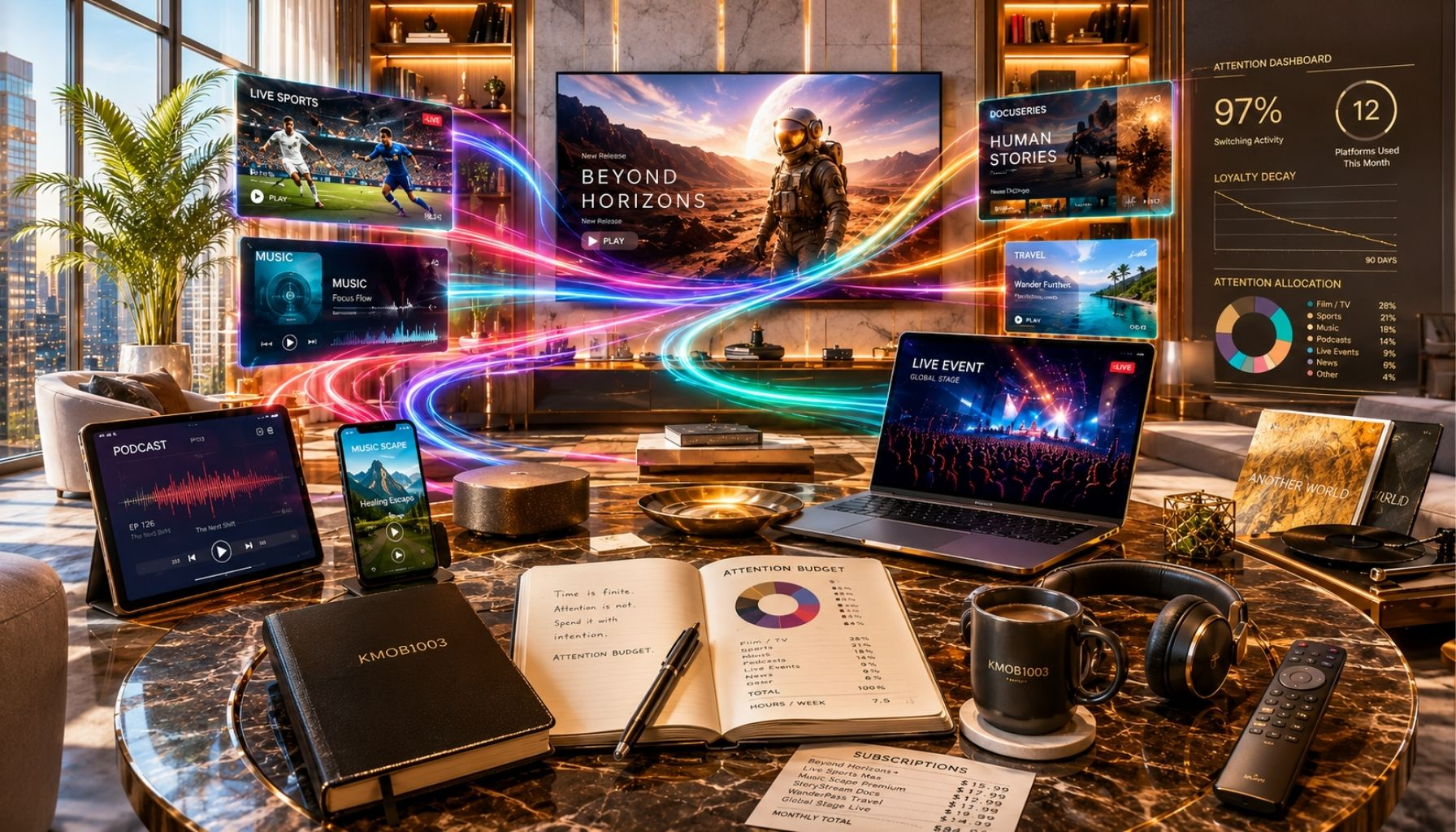
People are no longer just watching. They are allocating attention like money — subscribing, pausing, cancelling, and rotating platforms based on what feels worth the time.
Protect the signal wherever you watch.
The streaming industry spent a decade selling subscriptions. It is now discovering that selling subscriptions and keeping audiences are fundamentally different problems. Serial churners — subscribers who rotate between platforms to follow specific content — now make up 23% of the streaming audience, up from 6% just three years ago. These are not customers who cannot afford the services. They are customers who have decided that attention is a budget, and they are allocating it accordingly. The platform that does not earn the return visit does not get one.
What This Article Is Actually About
Why streaming churn is not a subscription pricing problem — it is an audience behavior signal. People are treating their entertainment, sports, news, and culture spending like a monthly portfolio. They are deciding what deserves the room, what gets paused, and what no longer earns the cost. Every media operator needs to understand what this means for return behavior, not just first-month signups.
Subscribe
The Moment
A show drops. A sport season starts. A documentary lands. A cultural moment pulls the audience in. They subscribe for the signal, not the platform.
Pause
The Drift
The signal weakens. The season ends. The content library feels familiar. The audience does not leave angry — they simply stop finding a reason to return.
Cancel
The Decision
The audience makes a portfolio decision. This platform no longer earns a line in the monthly budget. The cancellation is not emotional — it is a reallocation.
Return
The Signal
A new moment appears. A new season. A live event. The audience returns — not because of loyalty, but because the platform earned the room again.
Streaming churn is not a pricing problem. It is an attention-budget signal. — KMOB1003 Global Media · June 2026
The frame that streaming companies have used to explain churn — rising prices, too much competition, password sharing crackdowns — is not wrong, but it is incomplete. Roughly 35% of subscribers who cancel cite value-related concerns — not cost — as the primary reason. That distinction matters. A subscriber who leaves because the price went up is reacting to economics. A subscriber who leaves because the content no longer feels worth their time is making a judgment about value — and that judgment is far harder to reverse with a discount.
Younger audiences have made subscription fluidity the norm, with nearly half of Gen Z and millennial viewers having recently canceled a streaming service, according to Deloitte research. This is not a generation that cannot afford subscriptions — it is a generation that has internalized the logic of allocation. They subscribe for specific moments: a show their social network is watching, a sports season, a documentary they heard discussed in a podcast. When the moment passes, the subscription does not automatically persist. It has to earn renewal — or it gets reallocated.
“Streaming churn is not a subscription problem. It is an audience behavior signal. People are treating attention like money — and allocating it the same way.”
— KMOB1003 Global Media · Media Infrastructure · June 2026
42% of U.S. streaming users regularly cancel and resubscribe to platforms, according to Ampere Analysis research. That figure represents something more significant than subscriber instability — it represents a structural change in the relationship between audiences and media platforms. The loyalty model that cable television ran on for decades — you sign up, you stay, the bill auto-renews — has been replaced by a portfolio model. Subscribers curate their entertainment spending the way they curate their investment portfolio: actively, intentionally, and with regular rebalancing.
Serial churning tripled between 2020 and 2023, growing from 6% to 22% of all streaming subscribers. The audience is not broken. The audience has learned. They have discovered that canceling is easy, resubscribing is instant, and the content will still be there when they return. The platform that depends on inertia to retain subscribers is building on a foundation that has already shifted under its feet.
Security Layer · Protect the Signal Wherever You Watch
The attention budget moves across devices, networks, hotel rooms, airports, and public spaces. NordVPN Complete gives the operator, traveler, and serious media consumer the security layer that protects streaming access, device identity, and the media layer wherever the signal travels — without sacrificing speed or quality.

In a streaming environment defined by content-specific subscriptions and rapid churn, live events are functioning differently. Sports, concerts, award shows, live news, and cultural events create a category of viewing that cannot be time-shifted, replayed at convenience, or accessed after cancellation. The audience has to be subscribed at the moment the event occurs — which means live programming is one of the few remaining anchors that forces real-time subscription commitment. Platforms that hold sports rights understand this. They are not selling access to a library. They are selling access to the moment.
The fragmentation of sports rights has created its own version of the attention-budget problem. Fans who want to follow a single team across a season may now need to subscribe to multiple services depending on which games fall under which broadcast agreements. That forced multi-platform spending is itself a form of attention budgeting — the audience calculates whether the total cost of following the team is worth the total cost of the subscriptions required. When it is not, they choose which games to watch and let the others go. The platform that holds the most-watched games in any given sport holds the most durable subscription anchor.
Publishing Layer · Turn the Signal Into Something Permanent
Streaming platforms rotate. Algorithms shift. But the content the operator owns outright — the book, the archive, the published work — does not churn. Spines gives creators, media operators, and cultural voices the infrastructure to turn their signal into a permanent, owned publishing asset that exists beyond the platform cycle.
The streaming churn pattern is not only a problem for Netflix or Disney or Apple TV+. It is a signal about how audiences are now relating to all media — not just subscription video. A blog that publishes once and never gives the reader a reason to return is experiencing its own version of churn. A radio stream that runs without cultural programming that builds listener loyalty is experiencing the same. A creator channel that generates viral moments but no consistent voice the audience trusts is getting subscribed for the moment and forgotten when it passes. The attention-budget logic applies to every platform, every format, and every operator building audience infrastructure.
The operator who understands this does not optimize for first-month signups. They optimize for the second visit, the third, the return after a pause, the subscription renewal that happens not because of inertia but because the audience consciously decided the signal is still worth the room. That is a different editorial posture, a different content rhythm, and a different measurement framework than the one that counts impressions and calls it reach. Return behavior is the metric that compounds. Everything else is the acquisition cost of renting attention that does not stay.
Streaming churn is not a subscription problem. It is an attention-budget signal. Every platform, brand, blog, radio stream, and creator channel that does not create a reason to return will experience its own version of churn — quietly, continuously, and without announcement.
The platforms that hold subscriber loyalty in a churn-defined environment share common characteristics. They have content that creates appointment behavior — live events, returning series, exclusive documentaries, sports rights, or cultural programming that the audience plans around. They have a voice or editorial identity the subscriber associates with a specific kind of value — not just content volume, but signal quality. And they create enough friction in the cancellation experience — not dark patterns, but genuine reasons to stay — that the subscriber pauses before pulling the trigger and finds a reason to remain.
For the media operator watching this pattern from the outside, the lesson is the same as the one KMOB1003 applies to its own editorial rhythm: the audience will protect the room that earns protection. Radio listeners in 50 countries return to KMOB1003 not because it is the only signal available but because the programming creates a reason to come back. Blog readers save the content not because an algorithm pushed it but because the editorial voice earned the bookmark. Ticket buyers return to live culture not because they have no other options but because the room gave them something they could not get from a screen. Attention has become a budget. The rooms that earn a line in it will compound. The ones that do not will keep calling churn a mystery.
The scarcity is not accidental. It is the architecture. Every month, audiences decide which rooms deserve a line in the budget and which ones get reallocated. Build the room worth protecting — or watch the audience quietly close the tab.
Listening Layer · Streaming Culture · Media Business · Audible
The business of streaming, the attention economy, the culture of entertainment, and the media infrastructure behind what gets made and who gets paid — the listening layer is where those arguments are being built. Audible carries the books, investigations, and long-form journalism that explains the era we are inside.

Some links in this article are affiliate links. KMOB1003 may earn a commission from qualifying purchases at no additional cost to you. All affiliate partnerships are editorially independent.
