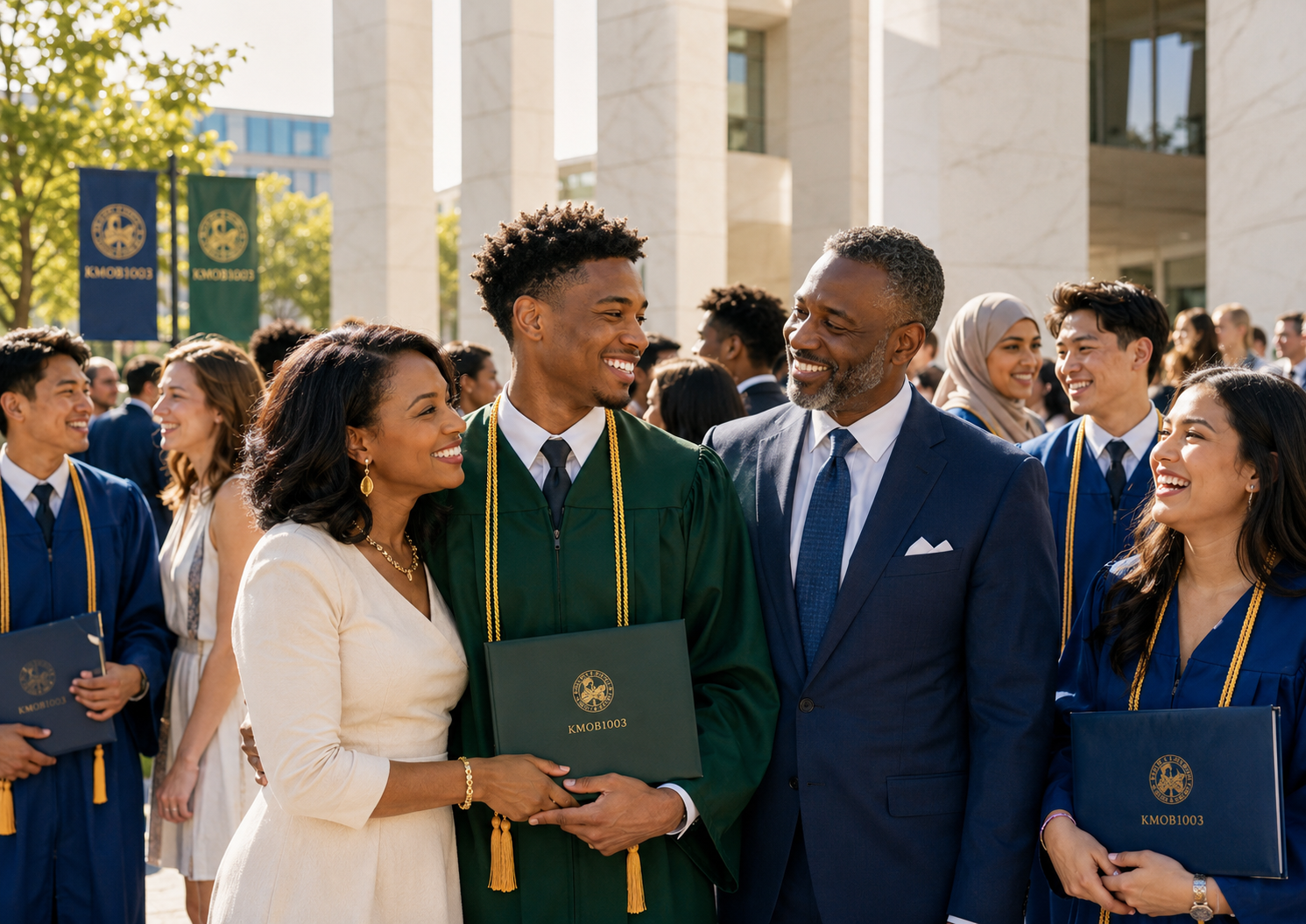
This is the first graduating class to have spent their entire college experience inside the AI expansion. They arrived on campus shortly after ChatGPT launched. They wrote papers under policies that were rewritten mid-semester. They watched entry-level job postings — the very jobs degrees are supposed to unlock — shrink in real time. They were warned not to use AI to do their work. Now they are being told to embrace it to find any.
That is not a contradiction they invented. That is a contradiction the institutions handed them. And on graduation day, in a room they paid to be in, they said so.
“They were told not to use it for their work. Then told to embrace it to find any. The contradiction did not belong to them.”
— KMOB1003 Global Media · The Culture Docent · May 2026
Eric Schmidt told graduates at Arizona that AI’s impact would be “larger, faster, and more consequential than anything before.” Scott Borchetta at Middle Tennessee State said “AI is rewriting production as we sit here” and, when booed, responded: “Deal with it.” Gloria Caulfield at the University of Central Florida described AI as “the next industrial revolution” and was met with immediate, sustained pushback.
Sources: AP News · NBC News · NPR
None of them said anything factually wrong. That is almost the point. The boos were not about accuracy. They were about address. Who gets to walk into a room, describe the machinery that may displace the people in it, and then ask for a round of applause on the way out?
The graduates who booed had, in many cases, already internalized the reality. They were not shocked by the information. They were responding to the tone — to the confidence with which the disruption was being narrated by people whose income does not depend on surviving it.
The information was not wrong. The address was. Disruption described by someone who absorbs none of it lands differently than disruption described by someone who absorbs all of it.
Entry-level job postings made up only 38.6 percent of overall listings on ZipRecruiter in early 2026 — the lowest share in at least three years. Competition for those jobs increased by 21.7 percent year over year.
The unemployment rate for recent college graduates aged 22 to 27 sits at 5.6 percent, near levels not seen since 2013 outside the pandemic. Nearly nine in ten graduates in this class say they are concerned AI could replace entry-level roles — up sharply from 64 percent the year before.
These numbers are not abstract. They are the architecture the Class of 2026 is being handed at the moment the stage is supposed to represent arrival. The degree cost real money. The job market it was supposed to open is narrowing. And the people on stage are telling them the tool that is narrowing it is a gift.
Entry-level share of job postings
38.6%
Lowest share in at least 3 years. Source: ZipRecruiter, 2026 Grad Report.
Graduates concerned AI will replace entry-level roles
89%
Up from 64% in 2025. Source: Monster, Class of 2026 Survey.
Operator Intelligence · Research What the System Missed
The infrastructure shift is already moving. Genspark gives operators the research layer to track what is changing — before the industry names it and before the headlines catch up.
Calling it fear is easier than calling it what it is: a trust signal. A room full of people, in a ritual moment, telling the institution on stage that the framing does not match the room. That the speaker is not wrong about the facts but is wrong about who the audience is.
This is not Luddism. Many of these graduates use AI daily. They used it throughout school — carefully, nervously, within rules that kept shifting. They are not against the technology. They are against the theater of being told it is their opportunity by people who have already been on the right side of every previous industrial transition.
“The boo is not fear. It is a room telling a speaker: you are not describing our situation. You are describing yours.”
— KMOB1003 Global Media · The Culture Docent · May 2026
There is a structural question underneath all of this that the commencement season is raising without quite naming. Every previous technological disruption created a new class of infrastructure owners — people who did not just adapt to the technology but built their income on top of it.
The industrial revolution created factory owners. The internet created platform owners. AI is creating a new ownership layer right now.
The graduates in those rooms are not being trained for ownership. They are being trained for adaptation. That is a different conversation — and the people giving the speeches are, almost uniformly, on the ownership side of that line. The boos are the sound of a room noticing the gap between where the speaker is standing and where the audience is.
The Class of 2026 is not anti-AI. They are anti-gaslight. They know what the technology does. What they are pushing back on is the framing that its arrival is a gift for everyone equally — when the evidence in front of them says otherwise. That is not anxiety. That is intelligence.
Every major technology transition creates a new ownership class. The graduates in those rooms are not being prepared for ownership. They are being prepared for adaptation. They noticed the difference.
Continue Reading · KMOB1003 Culture Docent
The ownership argument does not stop at graduation. KMOB1003 tracks the infrastructure shift across culture, media, and the creator economy — who builds the next room, and who just rents a seat in it.
