
KMOB1003 Global Protection Partner

KMOB1003 Global | The Signal
Why the Next Stage Requires a Different Kind of Thinking
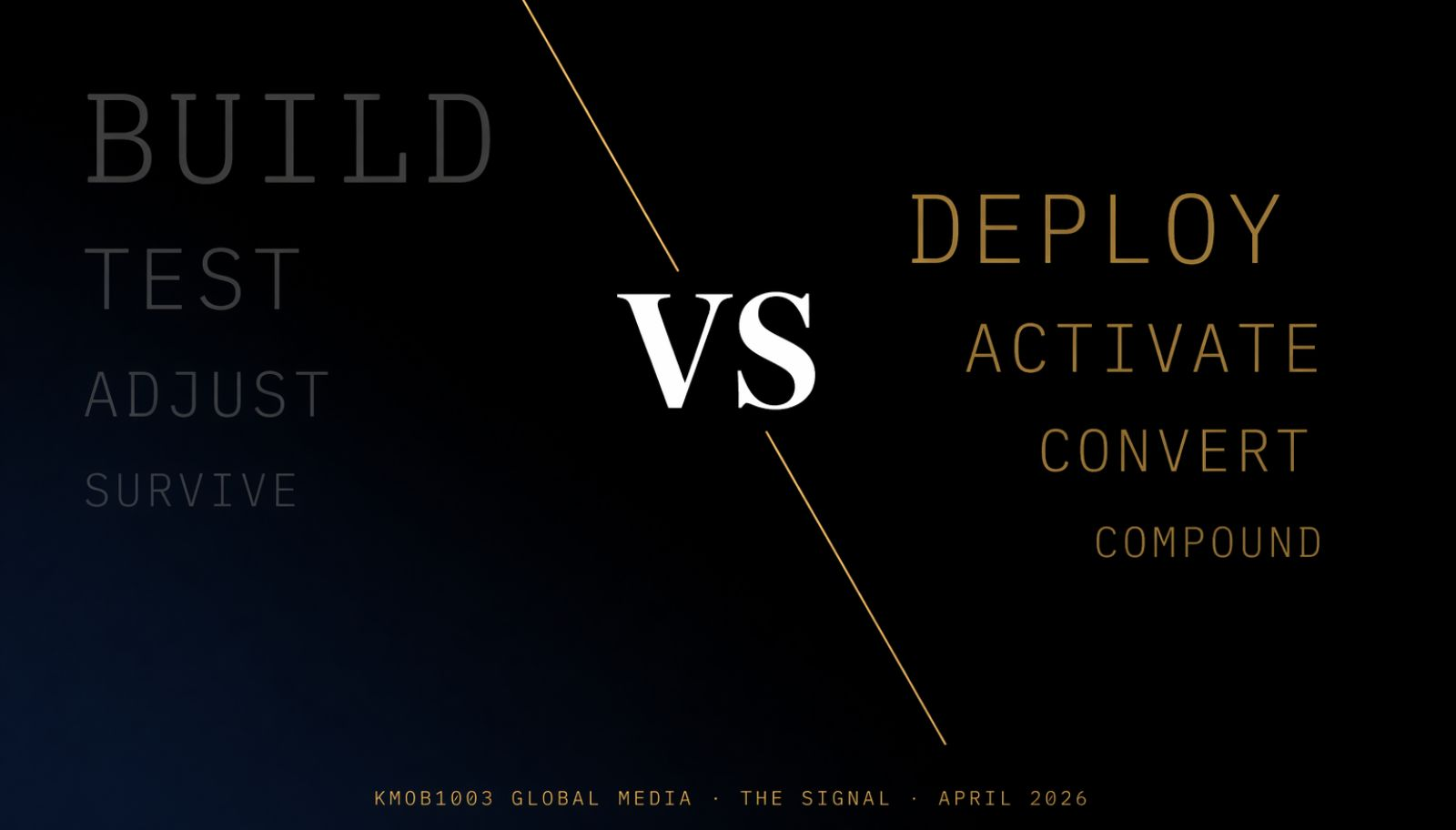
Most founders treat every stage of growth like construction — always building, always starting. The operators who scale understand that the next stage is not about building. It is about deploying what is already there.
There is a specific moment in the life of any platform when the primary challenge shifts. Before that moment, the question is: can we build something that works? After it, the question becomes entirely different — and the thinking required to answer it is nothing like what got you there.
Building from scratch is a survival exercise. Every decision is about existence — does this work, does anyone care, can we sustain it long enough to find out. The mindset is necessarily experimental. You are testing assumptions, adjusting quickly, accepting that most early directions will require correction. That mindset is exactly right for the early stage. It becomes a liability the moment the platform is proven.
“The founder who built the first version is not always the right person to scale it — unless they recognize that scaling requires a different set of decisions entirely.”
I.
What Changes When the Infrastructure Is Already There
When the infrastructure is proven — when the audience is real, the content model is working, and the revenue pathways are established — the constraint is no longer capability. It is capacity. The system works. The question is how quickly and efficiently you can deploy it at a larger scale without breaking what made it work in the first place.
This is where most founders make the same mistake. They apply build-phase thinking to a scale-phase problem. They add new channels before the existing ones are fully optimized. They launch new content verticals before the current ones have been fully monetized. They hire for capability gaps that do not yet exist instead of hiring for capacity gaps that are actively limiting growth.
Scaling is not building more of the same thing. It is taking what already works and removing the constraints that prevent it from working at a larger volume. The distinction sounds subtle. The operational difference is enormous.
“Scaling is not building more of the same thing. It is removing the constraints that prevent what already works from working at a larger volume.”
— Pamela F. Nichols · KMOB1003 Global Media
II.
The Three Constraints That Stop Proven Systems From Scaling
Once the infrastructure is in place, growth stalls for predictable reasons. Understanding those reasons in advance is the difference between a platform that compounds and one that plateaus.
01
Distribution capacity — you know what works but cannot deploy it fast enough.
The content performs. The audience responds. But the team producing and distributing it is at maximum capacity. Every new piece of content requires the same effort as the first one. The constraint is not quality — it is throughput. This is a systems and resourcing problem, not a creative one.
02
Measurement gaps — you know the audience is converting but cannot quantify it precisely.
Revenue is happening but the attribution is incomplete. You know the affiliate partnerships are working but not which content is driving conversions. You know the audience is engaged but not exactly which segments are most valuable. Without precise measurement, capital cannot be deployed efficiently — because you are optimizing on instinct rather than data.
03
Partnership activation — strategic relationships exist but are not fully monetized.
The partnerships are contracted. The affiliate agreements are signed. But the monetization infrastructure to fully activate them — structured funnels, conversion tracking, content pipelines specifically designed around each partner — is not yet in place. The partnerships are real. The revenue they should be generating is not yet proportional to their potential.
Operator Intelligence · KMOB1003 Institutional Tools
Scaling requires better intelligence at every decision point. Genspark gives operators the research depth and synthesis speed to make accurate decisions faster — so capital and attention go where they compound, not where they feel right.
KMOB1003 may earn a commission from qualifying purchases.
III.
Why Capital Deploys Differently at the Scale Stage
Capital at the build stage funds existence. Capital at the scale stage funds acceleration. The risk profile is completely different — and the way investors think about it is completely different. A company raising capital to prove a concept is asking investors to bet on an idea. A company raising capital to scale a proven system is asking investors to bet on the efficiency of deployment.
This distinction changes the entire conversation about what capital is for and how it should be structured. Build-stage capital is patient — it accepts that the path to return is long and uncertain. Scale-stage capital is targeted — it expects to see specific constraints removed and specific revenue increases as a direct result. The founder who understands this distinction walks into a capital conversation with a fundamentally different posture than the one who is still thinking in build-stage terms.
The question is not “what do you need money for?” The question is “which specific constraints, when removed, produce the most predictable increase in revenue?” That is a scale-stage question. It requires knowing your system well enough to identify its limits precisely — and being able to articulate what happens when those limits are lifted.
Build-stage capital funds existence. Scale-stage capital funds acceleration. The thinking required to raise each one is completely different.
KMOB1003 | Strategic Publishing Partner
You built the thinking. Now scale its reach.
Spines gives operators the infrastructure to publish their frameworks, strategies, and insights — taking what works inside your organization and distributing it globally.

IV.
What Stays the Same — and What You Protect
The shift from building to scaling does not mean abandoning what made the platform work. It means identifying what is non-negotiable — the brand positioning, the editorial voice, the quality standard, the audience trust — and building the scale infrastructure around those constants, not through them.
This is where scaling platforms most commonly fail. Capital arrives and the impulse is to move fast — add channels, add content, add partnerships, add headcount. But scale that moves faster than the brand can absorb it produces dilution, not growth. The audience that trusted the platform trusted it because of specific qualities. When those qualities get compromised in pursuit of scale, the audience does not follow you into the next version of the platform. They disengage.
The discipline of scaling correctly is the discipline of knowing which constraints to lift and which ones to keep. Not every limit is a problem to solve. Some limits are the product. The ones worth removing are the operational ones — throughput, measurement, activation. The ones worth protecting are the identity ones — voice, positioning, standard. The operator who can tell the difference is the one who builds something that compounds rather than something that expands and dilutes.
KMOB1003 | Creator Infrastructure
Scale your voice without losing it.
ElevenLabs gives operators and creators the infrastructure to extend their voice across every format — at scale, without sacrificing the quality that built the audience in the first place.

V.
The Replication Advantage
The most powerful aspect of proven infrastructure is not its current output. It is its replicability. A system that has been built, tested, and validated across one vertical can be deployed into a second vertical without rebuilding from zero. The audience development model, the content architecture, the monetization structure, the partnership approach — all of it transfers.
This is what separates a media company from a content creator. A content creator builds one thing for one audience. A media company builds a system that can be applied to multiple audiences in multiple markets. The system is the asset — not any single piece of content, any single platform, or any single partnership.
When you can look at what you have built and say clearly — this works, and I can deploy it again in a new channel with a new audience without starting over — that is when you have crossed from building to infrastructure. That crossing is the inflection point. Everything after it is a different kind of work. And it requires a different kind of thinking.
KMOB1003 Global Signal
The question is no longer whether it works. The question is how fast you can deploy it — and how much of what made it work you can protect while you do.
Where Legends Break and Underdogs Rise.
The Signal | Related Reading
The Operator’s Filter: Opportunity vs. Funnel in 60 Seconds
Scaling requires knowing what to bring in — and what to keep out. The five questions every operator applies before saying yes to any partnership, capital offer, or collaboration.
