
She Checked Him Out. The Internet Said He Was Real.
The Daejon Love romance scam allegedly relied on a fake NFL career convincing enough that search results echoed it back as fact — exposing a flaw in the exact advice women are given before trusting a stranger online.
The lie didn’t just evade verification. It manufactured its own.
August 31, 2026
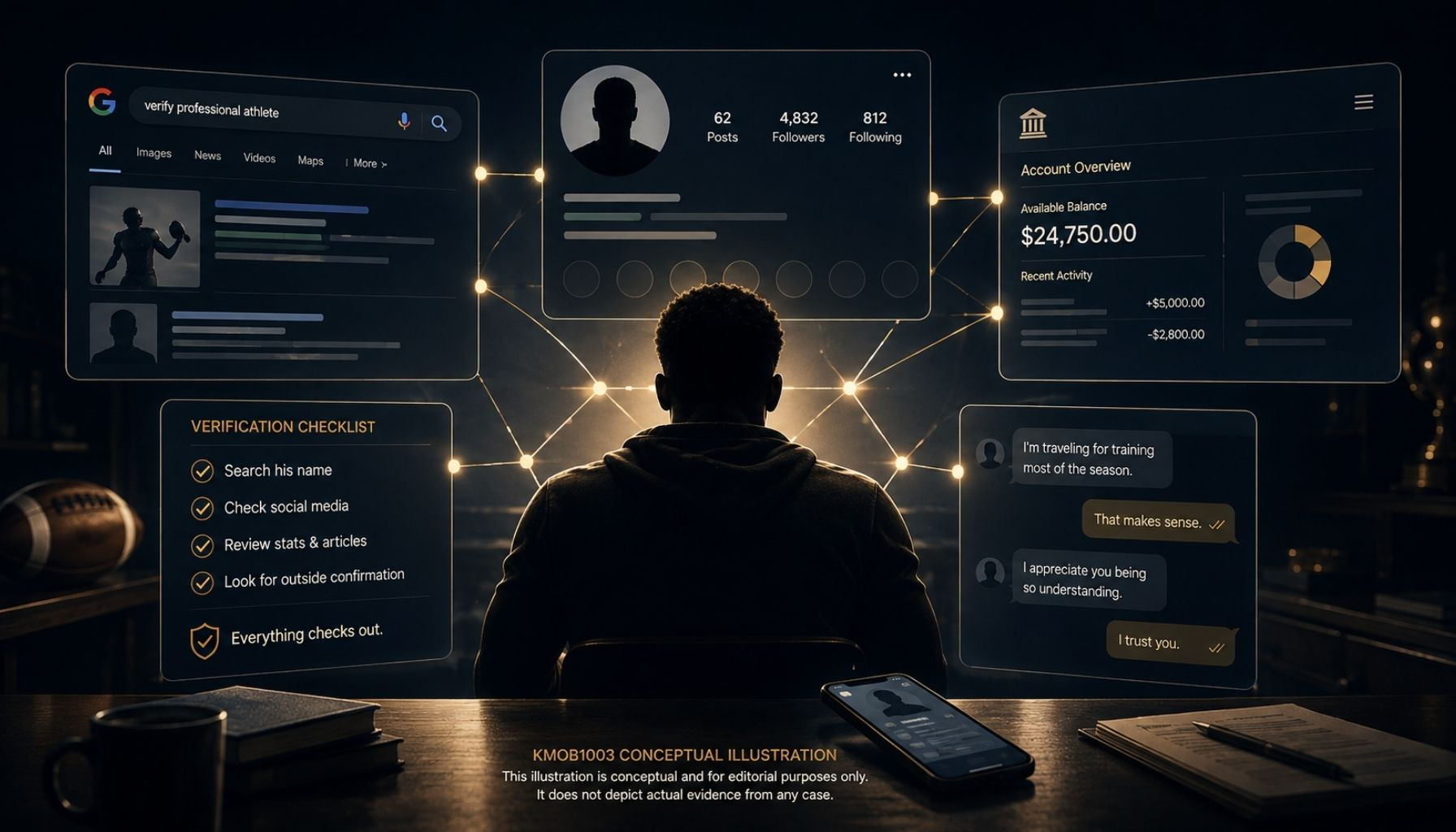
For years, the standard advice for meeting a stranger online has been simple: search his name, check his social media, see whether his job actually exists. Federal prosecutors say some of the women who encountered Daejon Love did exactly that. According to court documents, they found a digital world confirming his story. It wasn’t true.
What This Article Is Actually About
This isn’t a story about how 26 women failed to protect themselves. Federal prosecutors allege Daejon Love built an unusually complete false identity: a real social-media presence, staged NFL footage, a second person posing as his financial adviser, and fabricated bank-app balances. It was detailed enough that when investigators searched his name as part of their own inquiry, the results still echoed his fiction back. The uncomfortable question that leaves: what does “do your research” mean once the research can be built to confirm the lie?
Signal One
The Checks Worked Backward
Standard dating-safety advice is designed to catch a lie. Prosecutors allege Love built a persona detailed enough that those same checks sometimes confirmed it instead.
Signal Two
Verification Had Layers
Court documents describe romantic trust, NFL branding, staged photos, a fake financial adviser, and fabricated bank-app screens — each layer making the next easier to believe.
Signal Three
Investigators Hit the Same Wall
According to court-document reporting, federal investigators searching Love’s name in January 2026 encountered results echoing the same false 49ers identity his alleged victims had been shown.
Inside the Daejon Love Romance Scam
According to a criminal complaint filed by the U.S. Attorney’s Office for the District of Oregon, Daejon Labrayae Love, 35, and Taylor Jamie Chan, 18, ran a fraud scheme from February 2022 until their arrest on August 24, 2026. Prosecutors allege Love met most of his victims through dating apps, portraying himself as a San Francisco 49ers player or a wealthy real estate investor, while Chan posed as his financial adviser to help legitimize the scheme. Investigators say the two defrauded at least 26 women across Oregon, Washington, Idaho, and California out of roughly $1.3 million — and the FBI believes there may be more victims it hasn’t identified yet.
The complaint describes a scheme built on real relationships, not just a fake profile. Prosecutors say Love cultivated sincere romantic relationships with many of the women, telling them he wanted to build a future and a fortune together. He then allegedly used Chan’s fabricated credentials to steer them toward investment vehicles that didn’t exist. Some victims reportedly took out personal loans on Love’s direction after he promised quick repayment.
Love allegedly used phone apps to fake bank and investment balances he’d show victims as proof the money was growing. He is also accused of operating under multiple aliases, including Jon Love, Avril Lyto Love, and Jordan Love. He traveled through six Western states between mid-July and his arrest. Both men were taken into custody at the Boise Airport and appeared in court in Boise on August 27. Prosecutors are now arguing to keep Love detained pending trial. They cite his travel pattern, use of aliases, and lack of a fixed address as flight risks — a request still before the court as of this weekend.
How a Lie Builds Its Own Evidence
None of the standard dating-safety advice is bad advice. Search his name. Check his job. Look for inconsistencies in his story. The problem prosecutors’ allegations point to isn’t that this advice is wrong — it’s that a sufficiently constructed false identity can pass every one of those checks and still be false. Court documents describe what amounts to a manufactured credibility system, not a single lie. A real relationship supplied trust. NFL branding supplied status. An active Instagram presence supplied visual evidence. A lavish lifestyle supplied wealth cues. A second person posing as a financial adviser supplied third-party validation, and fabricated banking-app screens supplied numerical proof. According to reporting on the case, Love and Chan even hosted three-way FaceTime calls showing victims fake gains in real time.
Each layer made the next one easier to believe, which is precisely why this isn’t a story about victims who failed to look closely enough. It’s a story about what due diligence is worth against an identity built specifically to survive it.
When Search Confirms the Fiction
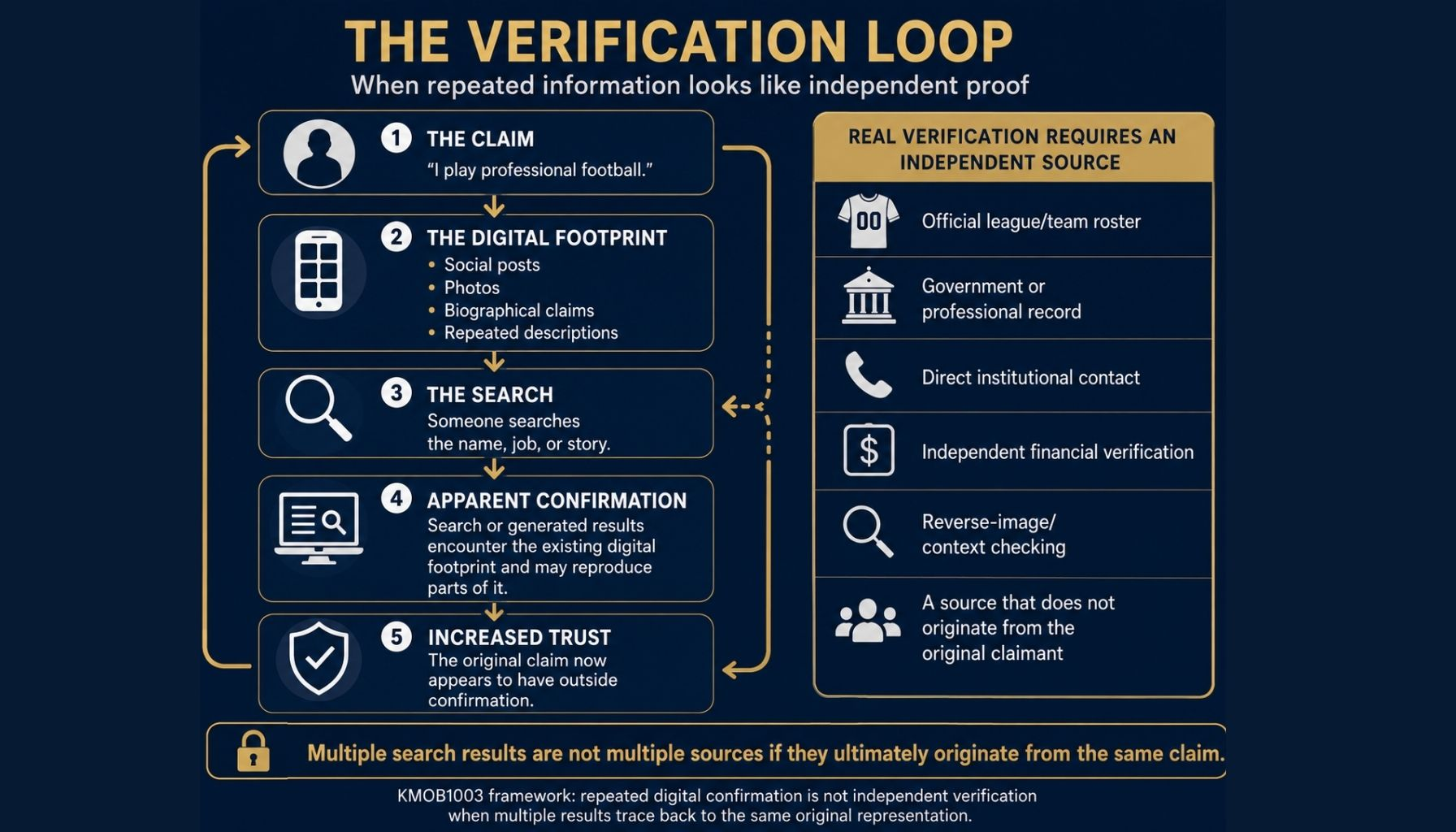
The detail that separates this case from an ordinary romance scam is what happened when the people trained to catch it tried the same move the victims did. According to court-document reporting, federal investigators searched Love’s name in January 2026 as part of their own inquiry — and found search results that echoed his false 49ers identity rather than exposing it. That’s not a story about artificial intelligence going wrong. It’s a story about what happens when a false identity accumulates enough digital signal — social posts, staged imagery, an active online presence. The tools people use to verify a stranger’s story can end up repeating the fiction back as fact, because that’s what the available evidence actually shows once someone has built enough of it.
What This Leaves Us With
A stranger can now build enough digital corroboration that checking his story doesn’t reliably surface the truth. That doesn’t mean the checking was pointless — it means the standard for what counts as verification has to catch up to how convincingly a lie can be staged. The real question this case leaves behind isn’t whether to keep Googling someone before trusting them. It’s what evidence should be trusted to mean, once it can be manufactured as easily as found.
What’s Confirmed
Love and Chan face federal charges of conspiracy to commit wire fraud and wire fraud, filed by criminal complaint in the U.S. District of Oregon — they have been charged, not convicted, and are presumed innocent unless proven otherwise. The DOJ’s own release confirms the February 2022–August 2026 timeframe, the $1.3 million/26-victim figures, and the four-state victim geography. It also confirms Chan’s alleged role as a financial adviser and the phone apps used to fabricate bank balances. Multiple aliases, the August 24 arrest at Boise Airport, and a first court appearance on August 27 round out the confirmed record.
The claim that investigators’ own searches echoed Love’s false identity comes from court-document reporting on the case, not the DOJ press release directly. The FBI has said it believes additional victims exist beyond the 26 identified so far. A detention hearing on whether Love should be held as a flight risk pending trial was still active as of this weekend’s reporting, and no trial date has been set.
KMOB1003 Framework
The layers a manufactured identity relies on
Relationship
A real, sustained romantic connection supplied the emotional trust everything else was built on.
Visual Proof
Staged NFL imagery and a lavish lifestyle presented both in person and across social media.
Third-Party Validation
A second person, prosecutors allege, posing as a financial adviser to corroborate the story independently.
Numerical Proof
Fabricated banking-app balances gave the illusion of real, growing returns.
No single layer had to fool anyone completely. Each one just had to make the next layer easier to believe.
Signal Breakdown
Signal: Prosecutors allege a manufactured identity built enough digital corroboration to defeat standard verification checks — including, according to court-document reporting, the ones federal investigators ran themselves.
Impact: The common advice to “check him out online” can no longer be assumed reliable once a fabricated identity can accumulate enough evidence to confirm itself back to the person checking.
Watch: The outcome of Love’s detention hearing, whether additional victims come forward as the case gets wider attention, and whether dating platforms face renewed pressure over identity verification.

Read Deeper
Duped
Abby Ellin
Why It Matters Here
The hardest deceptions are rarely built from one impossible story. They’re built from believable details that reinforce one another until doubt starts to feel unreasonable. Ellin examines the emotional reality of discovering that the person behind a relationship wasn’t who he claimed to be.
KMOB1003 Partner Spotlight
NordVPN
Protect What You Can Control
Someone else’s online identity can be difficult to verify. Your own connection, devices, and digital exposure are a different problem. NordVPN provides privacy and security tools designed to help protect your online activity and personal data. It doesn’t verify whether someone you meet online is who they claim to be.
Protect Your Digital Routine →
Sponsored partner placement. KMOB1003 may earn a commission.
KMOB1003 After the Article
Continue the Signal
Choose what comes next — build your career, find something live, shop the KMOB1003 edit, or let the Culture Docent guide you.

KMOB1003 Artist Services
Artist Services
Visibility, strategy and media infrastructure for artists ready to move beyond the release link.
Put Your Release in Motion →

KMOB1003 Live Culture
Ticket Desk
Find concerts, sports, theater and live events through KMOB1003 access to Ticketmaster and StubHub.
See What’s Happening Live →

KMOB1003 Collection
The Global Collection
Curated tools, services, experiences and global partners selected for the way creators and culture builders move.
Shop What We’re Curating →

KMOB1003 Culture Docent
Culture Docent
Not sure where to go next? Start here. Tell the Culture Docent what brought you into the room and choose from six doors.
Tell Us What You’re Looking For →
Global Reach. Powerful Stories. Lasting Impact.
That’s the part worth sitting with, past the specifics of this one case. We spend a lot of energy teaching people how to spot a fake profile, a stolen photo, a story that doesn’t add up. Prosecutors’ allegations here describe someone who reportedly cleared that bar — not by avoiding scrutiny, but by giving scrutiny something convincing to find.
Checking someone out will still catch most lies. It’s worth being honest that it won’t catch all of them — and that the ones it misses are, by design, the ones built well enough to look like proof.
More From Legacy & Insights



Creator & Institutional Infrastructure
Resources for the questions this story raises
None of these verify a romantic partner’s identity or would have necessarily prevented the alleged scheme described in this article.
HelloPrenup
Financial Boundaries
Serious relationships can eventually involve shared property, debt, and long-term financial decisions. HelloPrenup provides a structured path for couples considering a prenuptial agreement and the conversations around financial expectations.
Genspark
Research Workflows
Research tools can help organize questions and surface information quickly. But when identity, money, or personal safety is involved, generated results should be checked against independent primary records rather than treated as proof.
ClearCRM
Recordkeeping
For operators and small organizations, consequential conversations shouldn’t live only in memory, texts, or scattered inboxes. ClearCRM provides a structured place to organize contacts, follow-ups, and business records.
Amazon Books
Reader Education
For readers who want the fuller picture: Abby Ellin’s Duped, on discovering a partner’s constructed false identity from the inside.
Disclosure: KMOB1003 may earn a commission from qualifying purchases through these partner links. Editorial coverage is produced independently.
The Operator’s Bookshelf
KMOB1003 READS

As an Amazon Associate, KMOB1003 may earn from qualifying purchases.
