
Penn State Already Knew It Wasn’t Watching.
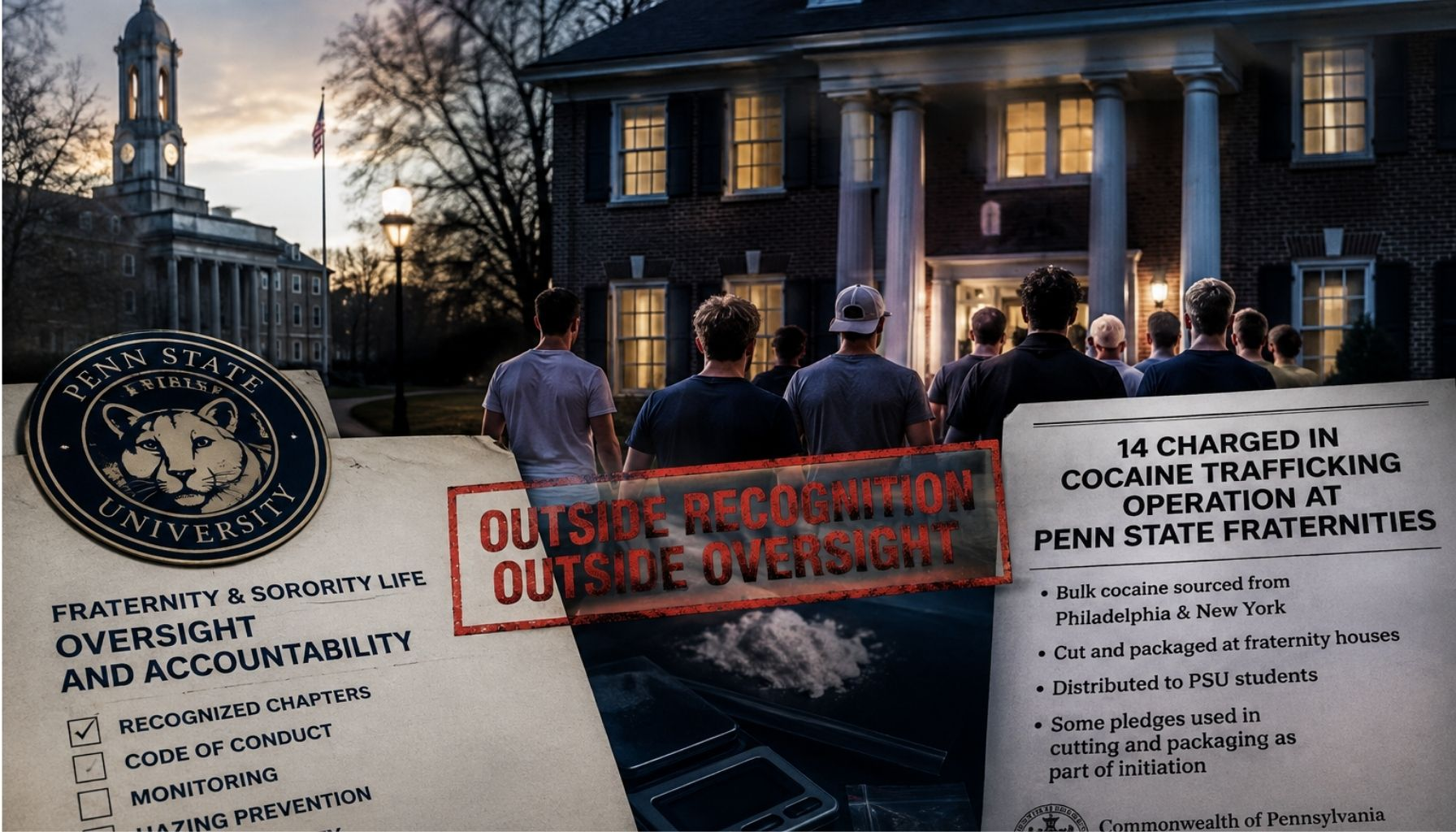
Prosecutors say cocaine came into State College from Philadelphia and New York, was cut and packaged inside two fraternity houses, and moved through a network that included fraternity brothers, pledges and a parent now accused of hiding evidence.
Penn State could withdraw recognition. It could not withdraw the house, the hierarchy, or the influence.
Fourteen people were charged on August 17 after a statewide grand jury investigation into what Pennsylvania Attorney General Dave Sunday called a coordinated, highly profitable cocaine-trafficking crew. Prosecutors say Agostino Abbatiello and Thomas Robinson were the principal suppliers, bringing large quantities of cocaine back from Philadelphia and New York, where it was allegedly cut and packaged primarily at the Delta Upsilon and Sigma Chi fraternity houses before being sold mainly to Penn State students. Some pledges, prosecutors say, were pulled into the packaging work as part of fraternity indoctrination. The alleged network did not stay inside one regulatory category: Delta Upsilon remained recognized by Penn State; Sigma Chi did not.
What This Article Is Actually About
This is the case: who prosecutors say ran it, who else is charged, how it allegedly came apart, what the money looked like, and where it stands in court. It’s also the institutional story underneath — a recognized fraternity and an unrecognized one, allegedly running the same operation, and what that says about what “university oversight” actually controls.
Signal One
The Charge
14 people charged Aug. 17 in an alleged cocaine-trafficking operation running through Delta Upsilon and Sigma Chi, per Pennsylvania’s Attorney General.
Signal Two
The Status Gap
Delta Upsilon was recognized throughout the alleged 2023–2024 operation. Sigma Chi had already lost recognition in 2021 and never sought it back.
Signal Three
The Policy Memo
An internal 2023 Penn State memo documents the university reconsidering how much direct Greek-life oversight to retain.
I. The Operation
The state says this was not a few fraternity brothers passing cocaine around at parties. According to the Pennsylvania Attorney General and a statewide grand jury presentment, Agostino Abbatiello and Thomas Robinson were the main suppliers in an organization that moved cocaine into State College from Philadelphia and New York during 2023 and 2024. Investigators say the drugs were cut and packaged primarily at the Delta Upsilon and Sigma Chi fraternity houses and then sold mainly to Penn State students. Cash and payment apps were used to move the money.
Court-record reporting fills in the scale. Witnesses described Abbatiello moving from smaller purchases to bulk quantities after finding a New York source in 2023. One account says he was bringing roughly 100 grams back every three to six weeks during part of the operation. Other alleged transactions grew into the hundreds of grams, including a reported half-kilogram purchase valued at about $20,000. The Attorney General has not published a verified total volume for the entire operation, so KMOB1003 is not estimating one.
The most consequential allegation is about labor. Attorney General Sunday said cutting and packaging cocaine became, for some pledges, part of their fraternity “indoctrination.” That turns the case from a familiar college-drug story into something structurally different: prosecutors are alleging that the same hierarchy used to initiate new members was also used to help prepare a commercial drug supply.
II. The Fourteen
Agostino Abbatiello, 24, of Westbury, New York, and Thomas Robinson, 23, of Churchill, Pennsylvania, are accused of sitting at the top of the organization. Abbatiello is a former Sigma Chi member; Robinson is tied to Delta Upsilon. Attorney General Sunday described Abbatiello as being at the top of the chain, with Robinson below him. Both were Penn State graduates by the time the charges were announced.
Mohammed Huraibi and Lars Zeepvat, 24, of Mendham, New Jersey, also face felony corrupt-organizations, conspiracy, dealing-in-proceeds and related charges. Robert Zanolla, 24, of Manhasset, New York, faces felony conspiracy and criminal-use-of-a-communication-facility charges along with misdemeanors. Eight others — Liam Smith, Michael Brogno, Kaden Howe, Connor Hurleigh, Seth Beardsley, Kyle Ridpath, Daniel Price and Charles Wiseman — face misdemeanor possession and paraphernalia counts. Public reporting identifies several of them as fraternity members or pledges alleged to have helped package, deliver or purchase cocaine, but the individual allegations differ and should not be collapsed into one role.
The fourteenth defendant is Paul Robinson, 59, of Pittsburgh, Thomas Robinson’s father and a practicing attorney. Prosecutors do not accuse him of selling cocaine. They charge him with felony tampering and hindering apprehension, alleging that he took steps to conceal evidence, including a safe containing drugs and cash, and obstructed the investigation. His lawyer has publicly disputed the state’s characterization. That distinction matters: the father is part of the obstruction case, not the alleged trafficking hierarchy.
III. Six Buys, a Fraternity Bedroom, and the Break in the Case
The investigation did not begin with Penn State discovering a fraternity problem. It began with police following Thomas Robinson. Court-document reporting says confidential informants bought cocaine from Robinson six times between September and December 2024. State College police arrested him inside the Delta Upsilon house on December 13, 2024. WPSU reports investigators had also traced Venmo payments connected to the alleged sales.
The arrest scene sounds almost absurd until the consequences come into focus: Robinson reportedly thought the officers entering his room were fraternity brothers playing a prank. Police say they searched the room and found marijuana, a bong, pills, a handgun and a safe containing $1,862. After his arrest, Robinson identified Abbatiello as a cocaine source, according to grand-jury and court-document reporting. Investigators then worked outward through suppliers, buyers, payment records, fraternity relationships and testimony until the statewide grand jury produced the case announced this month.
IV. The Money
The Attorney General calls the crew “highly profitable,” but the public charging announcement does not put one final revenue number on the entire network. The grand-jury record offers a clearer floor. Onward State’s review identified more than $123,500 in specific alleged drug payments to Abbatiello, including five priced purchases totaling $73,500 and another witness who said he paid Abbatiello more than $50,000 over time. That is not a verified total for the operation; it is the amount specifically described in the presentment and reported by the outlet.
The allegations also show how money could become leverage. Lars Zeepvat told investigators that Abbatiello pressed him into making cocaine deliveries after Zeepvat fell behind on a $1,500 spring-break debt. Zeepvat said he made three New York supply runs and was paid between $500 and $1,000 per trip. Separately, witnesses described Cash App, Venmo, Snapchat and cash being woven into purchases and distribution. The technology was ordinary. The alleged business was not.
V. Jail, Bail, and What Happens Next
Abbatiello did not appear for his scheduled August 17 arraignment. He surrendered the next morning and was denied bail by Magisterial District Judge Kelley Gillette-Walker. He remains the defendant publicly identified by prosecutors as the alleged leader and is being held while the case proceeds.
Robinson was released after posting $1.5 million bail, according to WPSU and court-document reporting. Huraibi and Zeepvat were each set at $500,000 unsecured bail, Zanolla at $250,000 unsecured bail, and Paul Robinson at $1 million unsecured bail. Zeepvat has already waived his preliminary hearing and formal arraignment and has indicated through a court filing that he intends to plead not guilty and seek a jury trial. Court status for the remaining misdemeanor defendants is moving on separate schedules and should not be treated as uniform.
All fourteen defendants are presumed innocent unless and until proven guilty. The Attorney General says the investigation remains serious and the next procedural stages include preliminary hearings. That legal posture matters throughout this article: the trafficking network described here is the state’s allegation, not a verdict.
What’s Confirmed
Pennsylvania’s attorney general charged 14 people on August 17. Penn State placed Delta Upsilon on interim suspension immediately after the charges became public, and confirmed Sigma Chi is not a recognized university organization. Sigma Chi has been unrecognized since a suspension issued in January 2021.
VI. The Question Underneath the Case
How does an alleged trafficking network operate for roughly two years through two fraternity houses — one recognized by Penn State, one outside its recognition entirely — while using the social hierarchy of fraternity life itself to do part of the work? That’s the question the criminal case leaves sitting on the table once the arraignments are done.
Prosecutors say the cocaine wasn’t merely consumed at fraternity parties. It was allegedly sourced, processed, packaged, and distributed through the houses themselves — and some of the youngest men in the hierarchy were allegedly put to work doing it.
VII. The Fraternity Penn State Could No Longer Sanction
Sigma Chi’s path out of the university’s formal system didn’t happen quietly, and it didn’t happen once. Penn State suspended the chapter in January 2021 for COVID-era gathering violations, layered on top of a two-year run of alcohol and drug infractions the university had already flagged. The suspension ran through the summer of 2024. Sigma Chi never returned to the table to discuss reinstatement, and Penn State’s own tracking shows the chapter continued to accumulate documented hazing incidents during the 2023–2024 school year — the same window prosecutors say the alleged trafficking was active.
Separately, in the spring of 2025 — after that window — Sigma Chi joined two other unrecognized fraternities to form an independent governing body outside the university entirely: the State College Interfraternity Council. Penn State called it a rogue independent council attempting to provide its own oversight in place of the university’s. That development is worth noting as evidence Sigma Chi continued operating outside recognition afterward — it isn’t offered here as an explanation for what allegedly happened in 2023–2024, which predates it.
VIII. The Fraternity Still Inside the System
Delta Upsilon is the harder case for a clean narrative, and it deserves to stay hard. DU was fully recognized for the entire period prosecutors say the trafficking ran — still inside Penn State’s formal organizational conduct structure. It wasn’t an unknown quantity to the university, either: DU was already carrying prior sanctions tied to unauthorized distribution violations, including a period of disciplinary probation and social restrictions on hosting alcohol events that extended into the same academic year prosecutors say the cocaine operation was active. Penn State only moved to place DU on interim suspension after the criminal charges became public on August 17 — after the conduct in question, not during it.
So the comfortable version of this story — recognized good, unrecognized bad — doesn’t survive contact with the facts. Recognition status existed at Delta Upsilon. Prior disciplinary sanctions existed at Delta Upsilon. By itself, none of it prevented what prosecutors allege happened there. That doesn’t undercut the accountability question; it sharpens it into two separate limits instead of one: what a university’s formal tools can reach, and what they can actually see.
IX. What “Outside Oversight” Actually Means
Penn State’s own policy language is specific about what recognition loss costs the university, not just the fraternity. Once a chapter is unrecognized, it no longer appears in the university’s organizational system. Penn State describes its ability to respond to concerns at these groups as incredibly limited, and says it cannot sanction an unrecognized organization collectively — though individual students remain subject to the Student Code of Conduct regardless of a chapter’s recognition status.
There’s a scene from 2017 that captures the limit better than any policy document. Weeks after Timothy Piazza’s death, Penn State began sending staff teams to physically monitor fraternity parties. At one house that had already lost recognition, the monitors couldn’t go in. The university’s own vice president for student affairs, watching from outside, called the house “beyond our reach.” That sentence is nearly a decade old, and the limit it describes hasn’t changed. A revoked charter changes what a university can formally require of a fraternity. It doesn’t relocate the house, dissolve the pledge hierarchy inside it, or remove the influence senior members hold over the incoming class — none of which has ever required a university’s permission to keep operating.
X. A Policy Shift, Documented in the University’s Own Words
The 2017 reforms that followed Piazza’s death were specific: university staff monitoring social events, a signed relationship statement for every member, funded spot-checkers, and a stated commitment to swift, permanent recognition loss for hazing involving alcohol or physical risk. By 2023, Penn State was explicitly reconsidering how much direct monitoring it should retain. An internal memo obtained by Spotlight PA described the shift plainly: moving the balance back toward chapter self-governance and away from university monitoring and intervention. A university-commissioned review the following year found the 2017 reforms had improved event logistics but had not meaningfully reduced the underlying risks tied to hazing and high-risk alcohol use.
The current criminal case raises a real question about the limits of that self-governance model — not a claim that the 2023 policy shift caused what prosecutors now allege. What the record shows is a university that documented, in its own internal planning, a deliberate move toward less oversight, three years before fourteen people were charged in connection with fraternities operating in exactly the space that model relies on chapters to govern themselves.
XI. Recognition Was Never the Whole Story
Every oversight system eventually meets the limits of what it can actually enforce. Penn State’s post-Piazza reforms were real, but the current case exposes two different limits at once: a recognized fraternity remained inside the university’s conduct structure while serious alleged activity went undetected, and an unrecognized fraternity continued operating after the university lost the ability to sanction it collectively. Recognition changed the university’s tools. It did not guarantee visibility into either house.
Penn State already knew it wasn’t watching. Not because it knew about cocaine moving through two fraternity houses — nothing here suggests that. Because it had already documented, on its own, exactly how limited what it could see and control actually was.
KMOB1003 Framework
The KMOB1003 Recognition Test
Recognition
Does the university formally acknowledge the organization?
Authority
Can the university sanction the organization collectively?
Visibility
Can the university see what actually happens inside the house?
Consequence
What actually follows once misconduct is confirmed?
A university can hold the paperwork without holding the room, and hold the room without ever seeing it.
Signal Breakdown
Signal: The case exposes how recognition status creates different oversight tools for a university without guaranteeing visibility into what actually happens inside fraternity life — at a recognized house or an unrecognized one.
Impact: Recognition status determines what Penn State can formally do to an organization. It does not, by itself, tell us what the university can actually see or prevent.
Watch: Whether the criminal case produces institutional or legislative pressure to close the authority gap unrecognized fraternities currently occupy, and whether Delta Upsilon’s case shows recognition status meaningfully changes what happens next.
Oversight Is Never Just a Policy.
Legacy & Insights follows the structures beneath institutions, power and accountability — where the headline ends and the operating system begins.
The Operator’s Bookshelf
KMOB1003 READS

As an Amazon Associate, KMOB1003 may earn from qualifying purchases.
KMOB1003 After the Article
Continue the Signal
Move from the story into the KMOB1003 rooms built for artists, live culture, discovery and global tools.

KMOB1003 Artist Services
Artist Services
Visibility, strategy and media infrastructure for artists ready to move beyond the release link.
Explore Packages →

KMOB1003 Live Culture
Ticket Desk
Find concerts, sports, theater and live events through KMOB1003 access to Ticketmaster and StubHub. The best seats move fast — check availability and lock in your tickets while they are there.
Get Your Tickets →

KMOB1003 Collection
The Global Collection
Curated tools, services, experiences and global partners selected for the way creators and culture builders move.
Explore the Collection →

KMOB1003 Culture Docent
Culture Docent
Not sure where to go next? Start here. Tell the Culture Docent what brought you into the room and choose from six doors — listen, read, find an event, build your creative career, discover products and tools, or see what’s moving now.
Find Your Door →
Global Reach. Powerful Stories. Lasting Impact.
