
AI · Discovery · Power · Legacy & Insights · July 2026
The New Gatekeepers
What Happens When AI Decides What the World Sees?
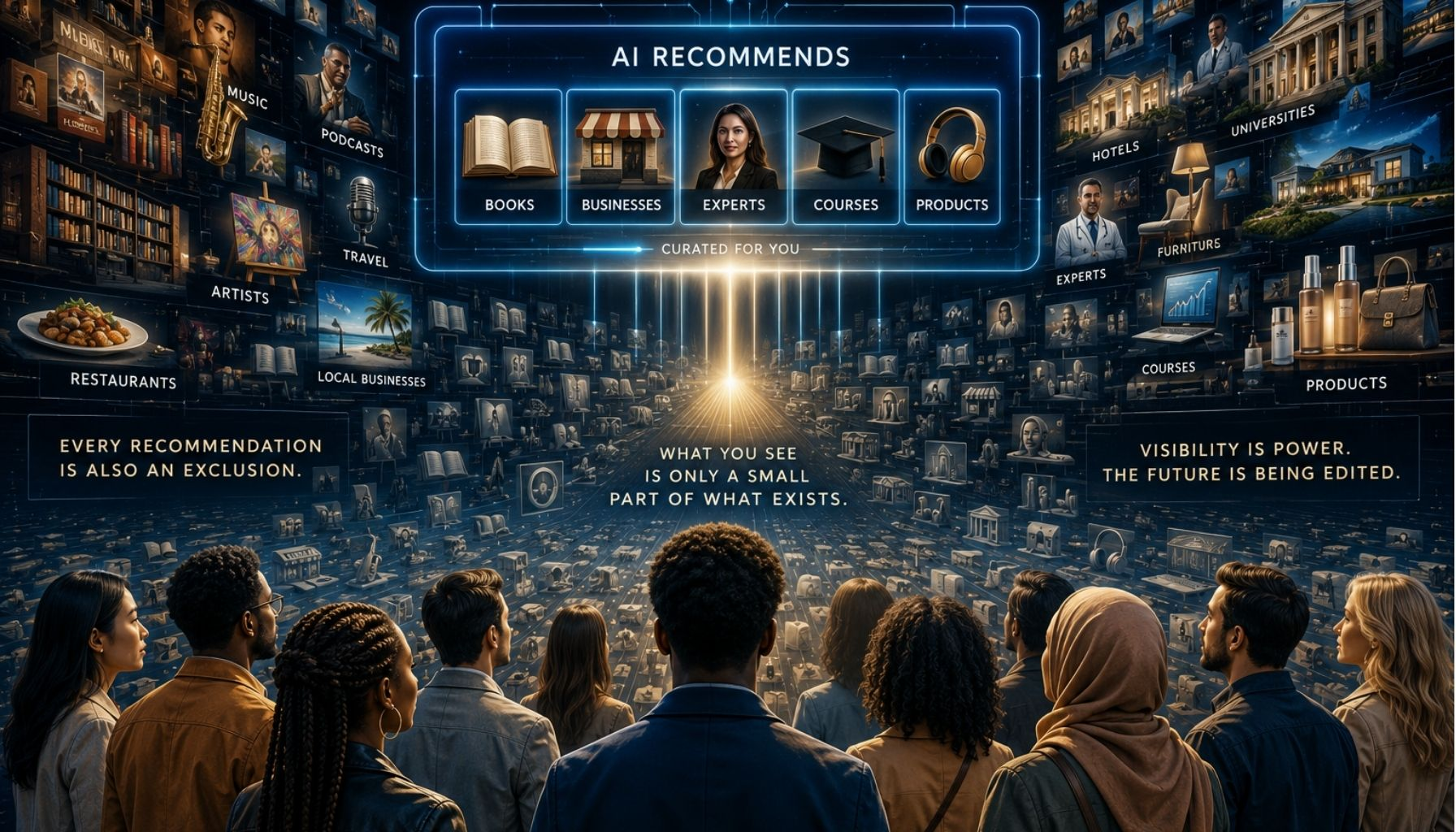
Artificial intelligence is becoming the world’s newest editor. It is influencing which businesses, books, experts, artists, products, universities, restaurants, and ideas people discover first—and which ones they may never encounter at all.
A parent asks an AI assistant for the best pediatric dentist nearby. The answer contains four names, short explanations, and an air of finality. The parent doesn’t see the full local market. They don’t know which practices were missing, whether the information was current, or why one office appeared while another didn’t. The recommendation feels like discovery. In practice, the field was narrowed before the search truly began.
What This Article Is Actually About
This is about visibility, power, trust, and discovery — and the institutions increasingly shaping what people encounter. Search once invited people to compare possibilities. AI increasingly presents a conclusion. That conclusion creates winners, omissions, and consequences before the consumer realizes a selection has occurred at all.
Signal One
The Shift
Search presented choices. AI increasingly presents answers.
Signal Two
The Power
The organizations repeatedly described, cited, and recommended by AI systems gain a new form of visibility.
Signal Three
The Omission
Consumers see the recommendations. They rarely see who or what was excluded.
I. The Answer Arrives Before the Search
For two decades, a search engine returned a field of possibilities and let the person compare them. Ten blue links became a hundred, became a scroll, became a genuine range of options a person could weigh against their own judgment. Increasingly, AI returns a conclusion instead. The shift isn’t that search is disappearing — it remains essential infrastructure, and search engine optimization is not dead. What’s changing is the layer sitting on top of it: synthesized answers, short recommendation lists, conversational summaries that compress an entire category down to a handful of names before the person has done any comparing at all. The scale of that shift is no longer speculative. Forrester’s Buyers’ Journey Survey found that 94 percent of business buyers now use AI somewhere in their purchasing process, up from 89 percent the year before. Forrester also reported that twice as many buyers as in the prior year named generative AI or conversational search as a more meaningful or important source of information than any other single source, outpacing vendor websites, product experts, and sales. Traditional search still shows its work, in a sense — a results page. An AI-generated answer usually doesn’t, at least not clearly enough for most people to notice they’re only seeing a fraction of the field.
II. AI Performs an Editor-Like Function
That compression is a form of editorial judgment, even when no person makes it consciously. AI is not an editor in the human, accountable sense — no byline, no masthead, no one to call when the answer is wrong. But it increasingly performs one of editing’s most powerful functions: deciding what reaches the audience and what remains outside the frame. An AI-generated answer reflects decisions about relevance, authority, trust, and popularity, built from the sources and patterns available to the system at the moment of the query. Naming five options is simultaneously a decision, however unintentional, not to name the other thousand — and that decision now happens by default, at scale, every time someone asks.
III. The Missing Name Is the Story
Ask an AI system to recommend a divorce attorney, a wedding florist, a museum, or a Black-owned or veteran-owned business in a given category, and the same mechanism runs: a small set of names surfaces, shaped by whatever the model could find well-documented and frequently cited. A hospital system with decades of press coverage may surface before a smaller practice with better outcomes but thinner online documentation. This isn’t evenly distributed, and it isn’t new. Organizations that received less press coverage, fewer institutional citations, weaker directory representation, or fragmented public records over decades may enter the AI era with less machine-readable authority — even when their real-world work is excellent. That gap tracks closely with which communities historically had the money, connections, or media access to be written about consistently in the first place. AI did not create that documentation gap. It may, however, scale its consequences, repeating and reinforcing whatever version of the record it inherited, at a speed and volume no single directory or press cycle ever operated at before.
IV. The Compression Is Already Here
Yelp’s new AI assistant is designed to sort through its reservoir of 330 million local business reviews and answer a question directly — asked for a good coffee shop that allows dogs, it returns a short recommendation, not a results page. Yelp CEO Jeremy Stoppelman described the appeal in direct terms: the assistant can read hundreds of reviews in the time it takes a person to skim the first five and decide that’s good enough. But Yelp built the tool to show its work: recommendations appear alongside the specific reviews that produced them, rather than a confident answer with nothing underneath it. “People want AI chatbots to be transparent about where they are getting the data from,” said Yelp’s chief product officer, Craig Saldanha, after the company found that most consumers worry the technology fabricates information. That design choice concedes the article’s central point without meaning to: a recommendation is only as trustworthy as the evidence a person can still inspect behind it.
V. The Economic Stakes
In a TechRadar Pro Perspectives article, Josip Begić, founder and CEO of ecommerce analytics company Lebesgue, reported findings from web-traffic and conversion data across more than 35,000 Shopify brands: visitors referred by AI tools such as ChatGPT converted at an average rate of 3.6 percent, compared with 1.23 percent for traditional Google search traffic, and generated roughly 30 percent more revenue per session. A visitor who arrives already having asked an AI system to narrow the field arrives closer to a decision than one still comparing search results. Being the name an AI system says, or the name it never mentions, is no longer just a matter of reputation. It’s a measurable difference in whether someone ever reaches the point of buying at all.
VI. What Can Actually Be Controlled
None of this means visibility can be engineered on command. A small but growing group of platforms now exists specifically to measure how often a brand gets cited inside AI-generated answers — a discipline sometimes called generative engine optimization or answer engine optimization, though the industry hasn’t settled on one name and neither term should be treated as a fixed standard yet. The clearest finding from that emerging research is an uncomfortable one for anyone hoping for a simple fix: AI visibility isn’t a stable ranking the way a search position is. A 2026 academic study on measuring visibility in AI search found that answers vary across runs, prompts, and time, making any single check unreliable — the researchers argue visibility has to be understood as a distribution of outcomes, checked repeatedly, rather than a fixed score confirmed once and trusted indefinitely. That sets a real limit on what any organization can honestly promise. Improving the accuracy and consistency of public information is achievable. Increasing the odds that credible, independent sources exist and get found is achievable. Measuring a pattern of visibility across repeated checks over time is achievable. Guaranteeing inclusion in any specific AI answer, on any specific day, is not — and no responsible practice claims otherwise yet.
Can AI Find Your Business?
The KMOB1003 AI Visibility Audit
Test your organization directly across ChatGPT, Gemini, Claude, Perplexity, and Google’s AI-assisted search experience. Ask each system:
- What does my company do?
- What companies provide this service?
- What are the best brands in this category?
- Recommend Black-owned businesses in this field.
- Recommend veteran-owned businesses in this field.
- Recommend local or independent companies in this category.
- Who are the leaders in this industry?
- What sources are you using?
- Does the company appear to be credible?
- Does the answer confuse the company with another organization?
For each system, record: whether the company appears; whether the description is accurate; which competitors appear; which sources are cited; whether your own website is cited; whether a third-party publication is cited; whether no source is shown at all; and whether ownership, leadership, location, and services are described correctly.
AI responses vary by system, prompt, date, location, and available sources — one prompt does not produce a definitive visibility score. Repeat this audit monthly or quarterly to track real change over time.
Learn the System
Free Courses to Better Understand AI
For Founders and Nontechnical Leaders
Introduction to Generative AI
Google Skills
Free introductory course · Sign-in required
For People Ready to Build
CS50’s Intro to AI with Python
Harvard University, via edX
Free to audit / Certificate costs extra
Programming for Everybody
University of Michigan, via Coursera
Free to audit / Certificate costs extra
For Media and Creative Professionals
Prompt Engineering for ChatGPT
Vanderbilt University, via Coursera
Free to audit / Certificate costs extra
AI for Everyone
DeepLearning.AI
Free learning content · Graded work and certificate require paid access
Access models verified as of this writing and subject to change by the provider. Confirm current terms directly on each platform before enrolling. A longer, dedicated course guide is planned as its own KMOB1003 resource.
KMOB1003 Framework
The Visibility Gap
What Is True
What the organization actually does, owns, serves, and represents.
What Is Documented
What its website, profiles, directories, reporting, and public records clearly establish.
What Is Retrieved
What an AI system can find and bring into the answer at that moment.
What Is Repeated
What the system ultimately says often enough to shape public perception.
The gap between what is true and what is repeated is where an organization’s visibility is actually won or lost.
The task isn’t to manipulate the answer. It’s to reduce the distance between what an organization truly is and what the public record allows a machine to see. In the next era of discovery, credibility will depend not only on being excellent, but on being accurately documented, independently recognized, and repeatedly findable. The new gatekeepers are already here. The work now is to make sure the record they inherit is broader, fairer, and more truthful than the one we built before them.
Signal Breakdown
Signal: AI is becoming one of the first places people ask for recommendations, explanations, comparisons, and direction.
Impact: Businesses, creators, educators, journalists, and institutions must think beyond search rankings and consider how AI systems discover, describe, and cite them.
Watch: Organizations that build clear identity, credible authority, consistent information, and useful original knowledge may gain an advantage as AI-assisted discovery grows.
Run the AI Visibility Audit on your own organization this week. What you find will tell you more than any ranking report.
Creator & Business Infrastructure
Build the Identity AI Systems Can Find
Becoming visible to AI-assisted discovery starts with the same raw materials as any credible identity: organized research, distinctive assets, and content that travels across languages and formats.
Organize the Research
Genspark
Use for research organization, source comparison, and developing structured business intelligence about how your category is described online.
Build Distinctive Visual Identity
OpenArt
Use for producing distinctive, clearly disclosed visual assets that strengthen brand identity and recognition across platforms.
Let the Description Travel
ElevenLabs
Use for creating clearly disclosed multilingual narration and accessible versions of business or editorial content.
The Operator’s Bookshelf
KMOB1003 READS
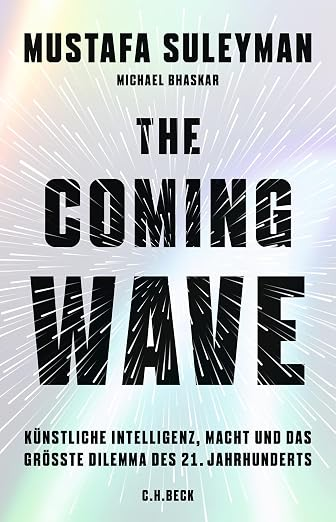
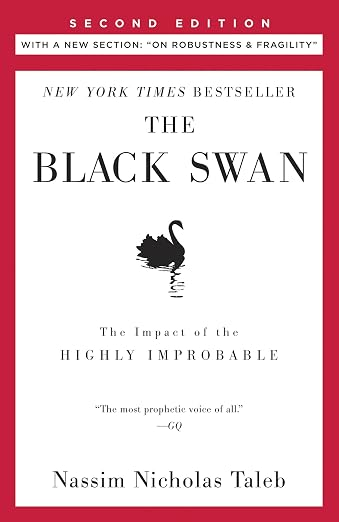
As an Amazon Associate, KMOB1003 may earn from qualifying purchases.
Disclosure: KMOB1003 may earn a commission from qualifying purchases through select partner links. Editorial coverage is produced independently.
KMOB1003 After the Article
Check Who’s Visible
One article is a signal. Here’s where the pattern keeps building.
Test Your Own Visibility
KMOB1003 AI Visibility Audit
Test whether major AI systems can accurately identify, describe, source, and recommend your organization.
Start the Audit →
Understand the System Yourself
Free Courses for Learning AI
Explore six carefully selected courses from Harvard, Michigan, Vanderbilt, Helsinki, Google, and DeepLearning.AI for building practical AI literacy.
Explore the Courses →

Trust Doesn’t End With the Machine
Human After AI
Explore KMOB1003 reporting on trust, credibility, human judgment, and the systems shaping public life after AI.
Enter Legacy & Insights →

Use Technology Deliberately
The Global Collection
Explore tools, books, and technology selected for creators and business leaders navigating the AI economy.
Enter the Collection →
Global Reach. Powerful Stories. Lasting Impact.
