
Technology · Culture · Operator Intelligence · June 2026
When Self-Service Becomes
the Only Door
Technology can make life easier. But when companies remove the human option, customers inherit the labor, the risk, and the blame.
Self-service is not the enemy. The problem is no-service disguised as self-service — when a company removes the human option, hands the labor to the customer, and then charges a fee, assigns blame, or denies support when that customer cannot navigate the system alone.
What This Article Is Actually About
This is not an anti-technology article. Self-service can give people more control. It becomes harmful when it stops being a choice — when it becomes the only door, the labor quietly transfers to the customer, and the company calls the result efficiency.
Signal One
The fee attached to the missing step
When a return process depends on an app, the physical return may not be enough. The system still has to recognize the transaction — and human verification may carry a cost.
Signal Two
The job that didn’t disappear
Scanning, troubleshooting, uploading, and appealing used to be paid work. The tasks remain. The paycheck attached to them does not.
Signal Three
The dashboard with no door
Creators inside platform dashboards can lose reach, income, or years of archive through automated decisions, with no human reachable on the other side.
I. The Fee Is Not the Whole Story
A recent WorldStar Instagram post about a U-Haul return made a private service frustration public: the customer had physically returned the truck, but the system still required the digital return process to recognize it.
Picture a familiar modern service moment: a moving truck returned after hours, a phone in one hand, a key drop nearby, and a company process asking the customer to finish the transaction alone. U-Haul’s own guidance says after-hours self-return through the app can help customers avoid a $20 convenience fee when a representative verifies equipment after store hours. The detail matters less because of the dollar amount than because of the structure. Once the service path is built around the app, human verification becomes the exception — and the exception may carry a cost.
The customer returned the truck. The system had not returned the transaction.
This is not a story about one company or one fee. It is a proof object for a larger pattern: businesses build app-first systems, reduce the human layer behind them, and then make customers carry more of the work when the process does not fit real life.
II. Self-Service Was Supposed to Mean Control
None of this makes self-service the villain. Done well, it is one of the genuine upgrades of the last decade. Faster checkout. Easier booking. Instant payments. Mobile deposits. Online scheduling that doesn’t require sitting on hold during a lunch break. Creator dashboards that let a small business see its own numbers in real time.
But convenience is only convenience if it remains a choice. The moment self-service stops being an option and becomes the only door, it stops being a tool and starts being a transfer.
The distinction is not abstract. It is the difference between a customer who chose the faster lane and a customer who was never shown another lane at all.
III. When the Door Disappears
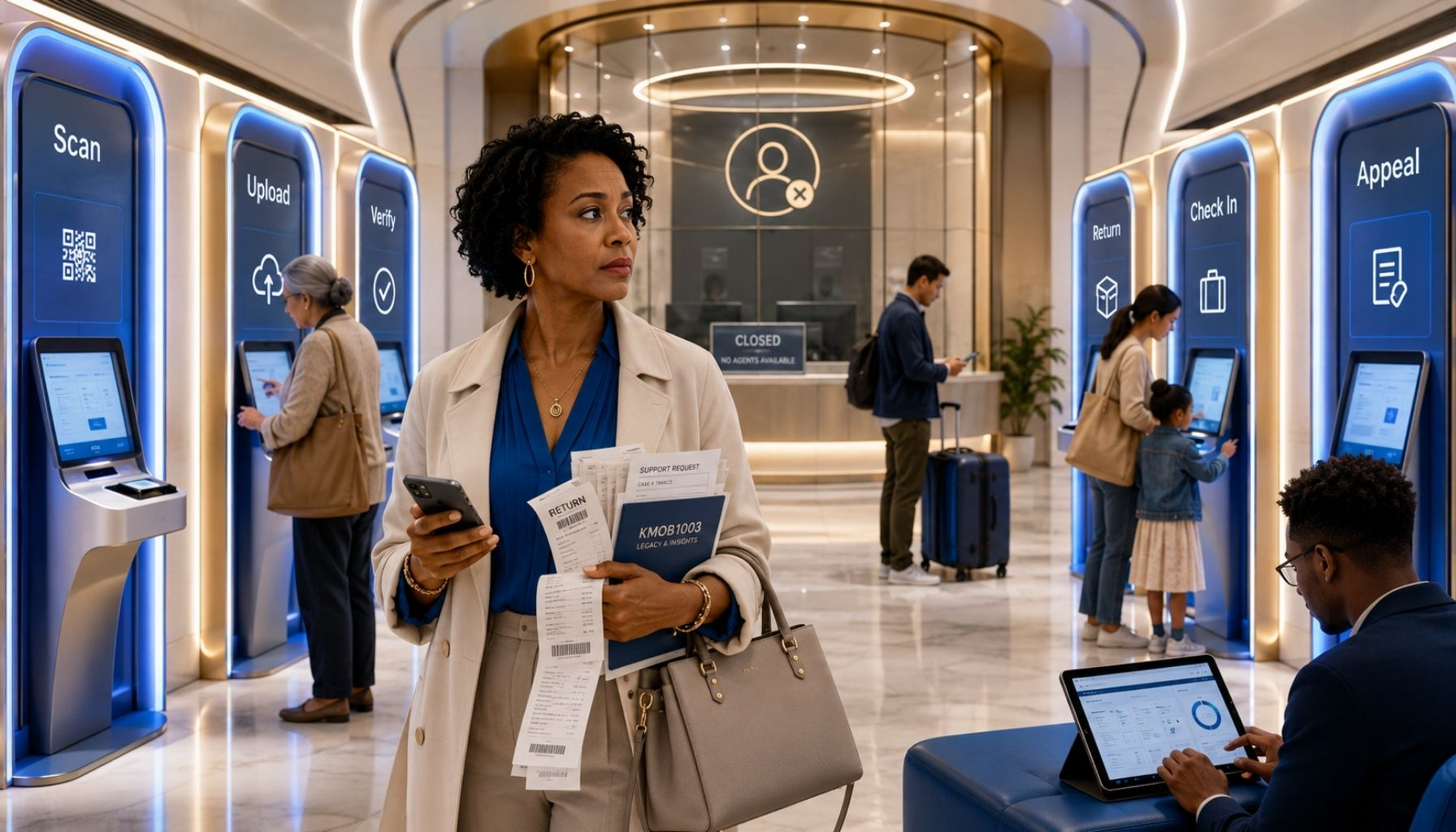
There is a quiet, specific moment when self-service turns into no-service. It is the moment there is no human backup — when the app fails and there is no one to call, when the phone tree loops back to its own beginning, when the chatbot can answer the easy question but not the real one, when an appeal process simply does not exist, when confusion is treated as noncompliance instead of what it actually is.
Notice how rarely any of this is framed as a design failure. A dropped connection becomes the customer’s problem to solve again from the beginning. A misread photo upload becomes a dispute the customer must now document and re-submit. A password reset that loops without resolving becomes an afternoon lost, not a system flaw logged. The system rarely apologizes for its own malfunction. It simply waits for the customer to find another way through.
The company calls it efficiency. The customer experiences it as abandonment.
That gap — between what a system was designed to do and what a person actually experiences when it breaks — is where this entire conversation lives. It is not a gap that shows up in a quarterly efficiency report. It shows up in a parking lot at 11 p.m., on hold for the fourth time, in a chat window that keeps suggesting the same unhelpful article.
IV. The Customer Becomes the Employee
Walk through an ordinary week and count the unpaid shifts. The grocery self-checkout, where the customer now scans, bags, and weighs their own produce. The restaurant kiosk, where ordering is now data entry. The security system shipped to the door for the customer to install, wire, and troubleshoot alone. The healthcare portal that replaces a phone call with a login, a password reset, and a video visit that drops at minute four. The airline app that reroutes a flight and expects the traveler to rebook, document, and dispute it themselves.
Every one of these used to be a job. A cashier did it. A clerk did it. A technician, an agent, an account representative did it. The work has not disappeared — it has simply changed who performs it, without changing who gets paid for it.
Add up the small tasks and the shape of the shift becomes clear. The customer now does the data entry. The customer now does the quality check. The customer now does the troubleshooting that used to require a technician’s visit. The customer now keeps the paper trail that used to live in a company’s own records. None of this shows up on an invoice as labor, because on paper, it isn’t labor at all. It is simply called using the app.
The customer did not become more empowered. The customer became unpaid labor.
V. Creators Already Know This System
This pattern is not limited to checkout lines and rental counters. It is the daily operating reality for anyone building a business inside a platform dashboard. A creator on TikTok, Instagram, Meta, or YouTube can lose reach, monetization, account access, or years of archived work through an automated decision — with no human reachable on the other side of it.
For a consumer, no-service is an inconvenience. For a creator or small business whose income lives inside that dashboard, it is lost revenue, lost audience, and lost proof of work that may never be recovered. This is the same structure wearing a different uniform: self-service marketed as empowerment, functioning as exposure.

VI. A System Is Not Convenient If It Excludes the People Who Need Help
A system is not convenient if it only works for the people least likely to need help.
Think about who is standing at that door when it locks: an elderly customer unfamiliar with the app. A disabled customer navigating an interface that wasn’t built with them in mind. A parent managing a return between school pickup and a work call. A rural customer without reliable broadband. Someone whose first language isn’t the one the chatbot was trained in. None of these people are edge cases. They are the actual population the system is supposedly serving — and they are precisely the people it tends to fail first.
A system designed only for the fastest, most fluent, most digitally fluent customer is not designed for the average customer at all. It is designed for the easiest case, then quietly asked to carry everyone else.
KMOB1003 is not arguing for a return to the past. Nostalgia is not a strategy. The standard worth building toward is simpler than that: self-service as one door, not the only door. Clear paths to a human being when the automated one fails. No penalty charged to a customer for a system’s bad day. Design that assumes a real person, not a perfect one, on the other end. Records that can actually be found when something goes wrong.
That standard is not expensive idealism. It is the difference between a company that built a tool and a company that built an exit.
Labor Transfer Intelligence Module
Pattern One
Convenience requires choice. The moment the human option disappears, self-service becomes the only door.
Pattern Two
The work shifted from paid staff to unpaid customers. The task list did not shrink — the payroll line did.
Pattern Three
Platform dashboards run the same pattern at scale — for creators, the missing human door means missing income.
Signal Breakdown
Technology should reduce friction without erasing responsibility. Efficiency is not the same as service — and the companies that understand the difference are the ones customers will still trust the next time the app doesn’t load.


KMOB1003 Global Media
Cultural infrastructure analysis. Operator intelligence. Human signal reporting.
