
KMOB1003
KMOB1003 Global · AI · Labor · Operators · Work Economics · June 2026
AI was sold as frictionless productivity and free labor. In practice it behaves like a new utility — subscriptions, tokens, usage caps, oversight, human review, and a meter that runs whether anyone is watching or not.
Some companies thought they were replacing payroll. They may have been creating a meter.
In December 2025, Uber gave 5,000 engineers access to Claude Code. By April 2026, the company had burned through its entire annual AI budget — not 50% of it, not 75% — every dollar. Gone in four months. Uber’s experience is not an outlier. The FinOps Foundation’s 2026 State of FinOps report found that 73% of enterprises reported their AI costs exceeded original projections. Token-based consumption grew 13x since January 2025, far outpacing budget planning cycles built around predictable seat-license logic. The meter was running before most people knew there was a meter. That is the story underneath the promise of AI as free labor.
The meter was running before most people knew there was a meter.
What This Article Is Actually About
AI was not free labor. It was a deferred bill. The subscription looked cheap. The token cost looked small. The governance, verification, security, and human-review layers were invisible until the invoice arrived. KMOB1003 reads the full cost structure of AI — and what operators need to understand before they sign the next contract.
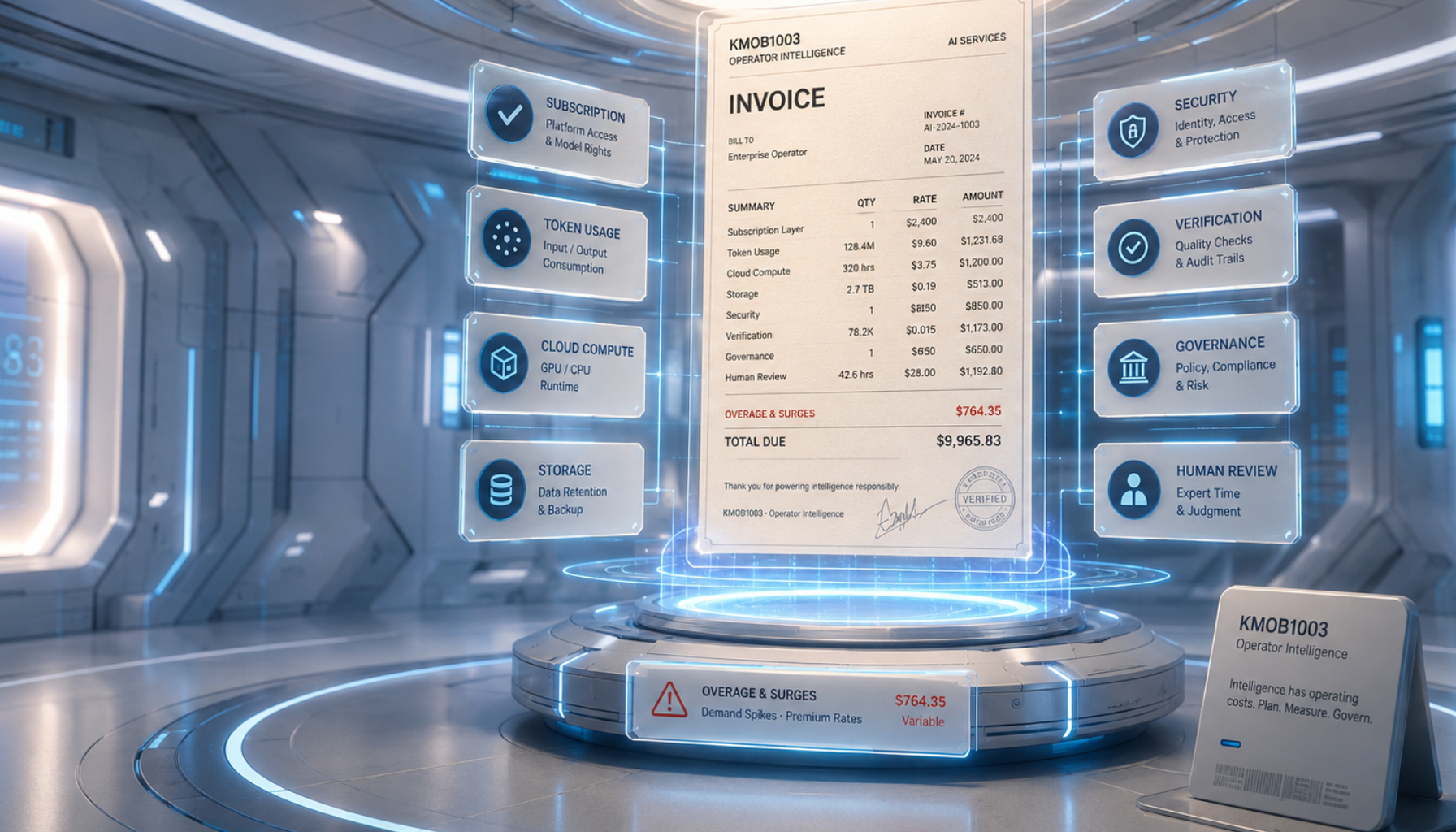
KMOB1003 Operator Layer · The AI Utility Stack
AI does not erase the bill. It rearranges it. The new work layer includes tools, verification, storage, oversight, and human review — and the best operators know how to see the meter before the invoice arrives.
Affiliate link · KMOB1003 may earn a commission from qualifying purchases.
Uber is not the only company that found out this way. The story is the same across industries, organization sizes, and AI tools — the budget model that made sense in January looked nothing like the invoice that arrived in April. The pitch was clean: AI would write the first draft, summarize the research, generate the code, answer the support ticket, and do it fast enough that the human work hours would shrink and the cost savings would be immediate and obvious. The pitch was not wrong about what AI could do. It was wrong about what AI would cost to do it at scale. Per-token prices have fallen roughly 99.7% since GPT-3 era rates — and yet enterprise AI bills tripled over the same period. Agentic workflows multiply token usage 50 to 500 times per task, and 72% of production AI cost sits outside the model invoice entirely, in orchestration, retrieval, retries, and observability. The price of AI fell. The bill for AI rose. Those two facts are both true, and the gap between them is where most enterprise AI budgets broke.
The misunderstanding was structural. AI was evaluated against the per-seat logic of traditional software — a flat monthly cost that scaled predictably with headcount. But AI pricing is not linear. It is consumption-driven and variable: one user might consume 10,000 tokens per day, another 10 million, on the same license. Hybrid pricing — a base subscription combined with variable usage charges — surged from 27% to 41% of B2B AI companies in just twelve months. The budget model that made sense for a SaaS tool with a fixed monthly price became wrong by an order of magnitude the moment agents replaced chatbots and workflows replaced conversations.
Think about what happens inside a single AI-assisted workflow. The prompt is sent. The model processes input tokens. It retrieves relevant context from a knowledge base. It generates output tokens. If the output is unsatisfactory, the workflow retries — consuming more compute. Each step has a cost, and in agentic systems where AI is making decisions and taking actions autonomously in the background, the compounding happens without anyone watching the meter. EY analysis shows that a simple 2023 AI workflow cost $0.04 per interaction. A more complex orchestrated agentic system in 2026 costs $1.20 per interaction — roughly 30 times higher. The same task, more capable execution, thirty times the cost. That is not a pricing anomaly. That is the new operating reality.
Enterprise AI deployment audits reveal that hidden costs — retry logic, retrieval augmentation, context window management, and embedding generation — increase the actual bill by 40 to 60% on top of what most teams are tracking. A healthcare enterprise consumed one trillion tokens over six months, translating into more than $6 million in unplanned costs. Google recently restructured its entire AI subscription model — introducing tiered pricing and an AI Credits mechanism that meters usage rather than offering unlimited access — because even a company with Google’s infrastructure and margins could not sustain flat-rate pricing across hundreds of millions of users at the rate of actual consumption. When Google installs a meter, the era of free labor is formally over.
The most persistent myth in the AI productivity conversation is that the labor disappeared. It did not. It moved. The work that used to happen in writing the first draft now happens in writing the prompt, reviewing the output, catching the hallucination, editing the result, and deciding which version is actually usable. The work that used to happen in research now happens in verifying whether the AI’s research is accurate. The work that used to happen in quality assurance now happens every time a human has to stand between the AI output and the decision it informs. None of that is free. None of it is frictionless. It is labor that changed shape, not labor that disappeared.
There is a particular kind of organizational delusion that sets in during the early stages of AI adoption — where the tool feels so fast that the human cost becomes invisible. The prompt takes two seconds. The output arrives in five. The meeting summary is done before the meeting ends. It looks free. But behind every one of those outputs is a human who chose the right prompt, evaluated the result, corrected the errors, made the judgment call about what was usable, and carried the accountability for whether the final product was right. That human cost does not appear on the AI invoice. It appears on the payroll — or on the overtime, or on the burnout, or on the quality failure that surfaces six months later when nobody remembers which paragraph the model wrote and which one the team verified.
Alphabet’s capital expenditure was projected at $75 billion for 2025 and is expected to reach $175 to $185 billion in 2026 — nearly doubling in a single year. Jensen Huang of NVIDIA told the GTC audience that “What is your OpenClaw strategy?” is now a boardroom question. The infrastructure required to run AI at enterprise scale is not a plug-in. It is a capital commitment. The companies that understood this early are building governance teams, FinOps functions, and oversight infrastructure. The companies that treated AI as a free layer on top of existing operations are the ones currently explaining to their CFOs why the AI budget is twice what was approved.
The real operator skill is not accumulating tools. It is understanding the total bill — financial, procedural, and human. That means asking the right questions before the contract is signed. What is the full cost architecture, not just the subscription price? Which tasks generate high token consumption versus low? What governance layer is required to deploy this responsibly? What human review is built into the workflow, and what is the labor cost of that review? What happens to the budget when usage scales by 10x because an agent is running autonomously in the background?
The operators who will build durable advantage with AI are not the ones who adopted it fastest. They are the ones who understood what they were actually buying — a tool with a meter, a productivity layer with an operating cost, a capability that requires governance, verification, and human judgment to deliver value safely. The FinOps Foundation found that in 2025, 31% of FinOps practitioners were responsible for managing AI spend. By 2026 that figure is 98%. The function that spent a decade governing cloud infrastructure is now being handed a cost structure it has no established playbook for. Do not mistake automation for the end of the bill. Automation is the beginning of a different one — and the operators who read that bill clearly are already building the systems that last.
AI is not free labor. It is a new utility. And like every utility before it — electricity, cloud storage, bandwidth — the operators who understand the full cost structure early will build the systems that last. The ones who treated it as free will eventually open an invoice that explains the difference.
Some links in this article are affiliate links. KMOB1003 may earn a commission from qualifying purchases at no additional cost to you. All affiliate partnerships are editorially independent.
