
KMOB1003
KMOB1003 Global · Travel · Sports Culture · Local Economy · Friday AM · June 12, 2026
The visitor is no longer just a traveler. They are a moving media channel — carrying the city’s signal into every network they enter.
Prepare the local room before the audience arrives.
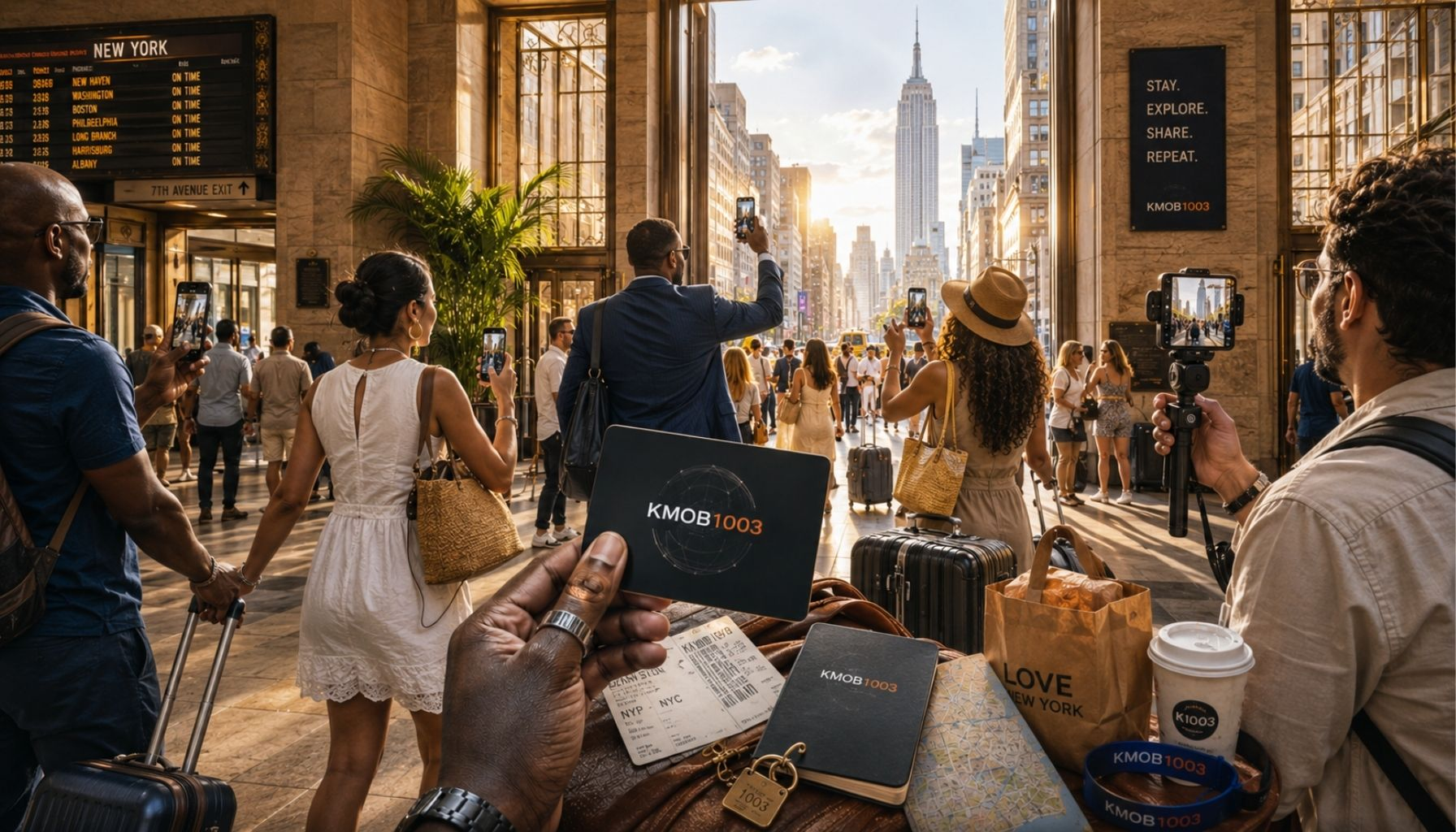
She comes up through Penn Station and steps into Manhattan. Rolls her bag across the concourse. Films a thirty-second clip of the crowd spilling onto Seventh Avenue. Tags a bodega she passes on the next block. Reviews the hotel lobby at check-in. Posts a story from the restaurant at dinner. Sends a voice note home about the neighborhood. By the time she reaches her room, she has produced four pieces of content, two reviews, three location tags, and a dozen messages — each carrying the city’s signal into a network the city’s tourism board has never touched. The 2026 World Cup is projected to draw 1.24 million international visitors to the United States alone — visitors expected to spend more than $5,000 per person, 1.7 times more than the typical international traveler. But the dollar spend is not the only thing they are carrying. They are carrying distribution. And most of the cities hosting them have not yet built the infrastructure to capture it.
What This Article Is Actually About
The visitor economy has a second layer most operators miss. Visitors are not only customers — they are moving media channels who film, post, review, tag, share, and carry a city’s signal into networks it cannot reach on its own. Cities and operators who understand this are not only hosting people. They are hosting distribution. This is the infrastructure argument KMOB1003 makes about what happens when 1.24 million people travel with cameras and audiences.
Signal Layer One
The Arrival
The visitor enters the city carrying an audience. Their first posts — terminal selfie, hotel lobby, neighborhood street — go to networks the city cannot directly reach. The arrival is the first distribution event.
Signal Layer Two
The Movement
Every transaction the visitor makes — café receipt, transit tap, museum ticket, bodega stop, restaurant check — is a location signal that flows into review platforms, social feeds, and recommendation engines.
Signal Layer Three
The Broadcast
The visitor films the event, clips the reaction, posts the moment, tags the venue. A single visitor with 10,000 followers who posts six times during a five-day trip is a micro-broadcast unit operating inside your city’s geography.
Signal Layer Four
The Return Signal
The visitor leaves, but the content stays. Reviews outlast the visit by months. Tags drive search discovery for years. The visitor’s signal has a longer life than the visitor’s stay — and operators who build for that return loop own the distribution long after checkout.
The visitor is not a customer who leaves. The visitor is a broadcast unit that keeps transmitting. — KMOB1003 Global Media · June 2026
Tourism boards count heads and hotel nights. Economists count dollars. But neither metric fully captures what the visitor is carrying through the city that cannot be measured by a receipt. Every visitor who enters a World Cup host city in June 2026 is also carrying a phone, a following, a set of preferences, and a social network that extends beyond the city’s borders into communities the local hospitality industry has never directly reached. When that visitor films a street taco stand on the way to the stadium, that thirty-second clip goes to their audience — not to the city’s marketing database. When they post a hotel lobby photo and tag the property, that image enters a recommendation stream the hotel could not have purchased for any amount of ad spend. Data Appeal and Mabrian analysis of World Cup travel intent shows international demand clustering around key host cities, with success defined not only by visibility but by a destination’s ability to interpret and act on real-time demand signals. The cities that understand the second layer — distribution, not just spending — are the ones positioned to convert the World Cup into lasting infrastructure rather than a one-summer revenue event.
The scale makes this matter beyond theory. Tourism Economics projects that 60% of World Cup visitors to the US represent incremental trips — visits that would not have occurred without the tournament — meaning 742,000 people are arriving in cities they have never entered before, carrying audiences those cities have never previously accessed. A first-time visitor is not a returning customer. They are a new broadcaster discovering the room in real time and sharing what they find with networks that have never seen it. The signal value of that discovery lives in the content they produce, the reviews they leave, and the audiences they carry home.
“The city is not only hosting visitors. It is hosting distribution. Every arrival is a broadcast event the city did not have to pay for — if the room is built to receive it.”
— KMOB1003 Global Media · Travel Infrastructure · June 2026
The visitor does not move through the city the way a camera crew covers an assignment. They move through it the way a signal moves through a network — unpredictably, organically, in response to what they find rather than what they were told to find. A transit tap at a subway station becomes a check-in. A bodega stop becomes a review. A restaurant wait becomes a thirty-second video. A hotel hallway becomes a backdrop. None of these distribution moments were planned by a tourism board or a marketing department. They emerged from the visitor’s natural behavior as a connected person moving through a physical environment with a camera. Research on visitor behavior in 2026 finds that consumers are 2.5 times more likely to trust user-generated content over brand-created content — making the visitor’s organic post more persuasive than any ad the destination could place in the same feed. The medium is the movement. The city is the studio. The visitor is the broadcaster.
This changes what operators should be building for around a mega-event. The question is not only how to fill hotel rooms and restaurant seats during tournament week. It is how to make the room worth broadcasting. A café that has a clean, well-lit corner with good natural light and a legible identity will be filmed more than one that does not. A hotel that creates a recognizable threshold — a lobby detail, a welcome moment, a visual cue that reads well on a phone — will appear in more visitor posts than one that treats the arrival as purely transactional. A neighborhood that is walkable, distinct, and photographically interesting will generate more organic distribution than one that looks like every other block in every other host city. These are infrastructure decisions disguised as aesthetic ones. They determine whether the visitor’s signal carries your room into their network — or bypasses it entirely.
Visitor Signal Kit · Tools for the Moving Media Channel
The visitor’s phone is now a camera, map, ticket desk, review station, translator, payment rail, and broadcast tool. These two tools support the person carrying the signal — one protects the movement, the other helps capture it.
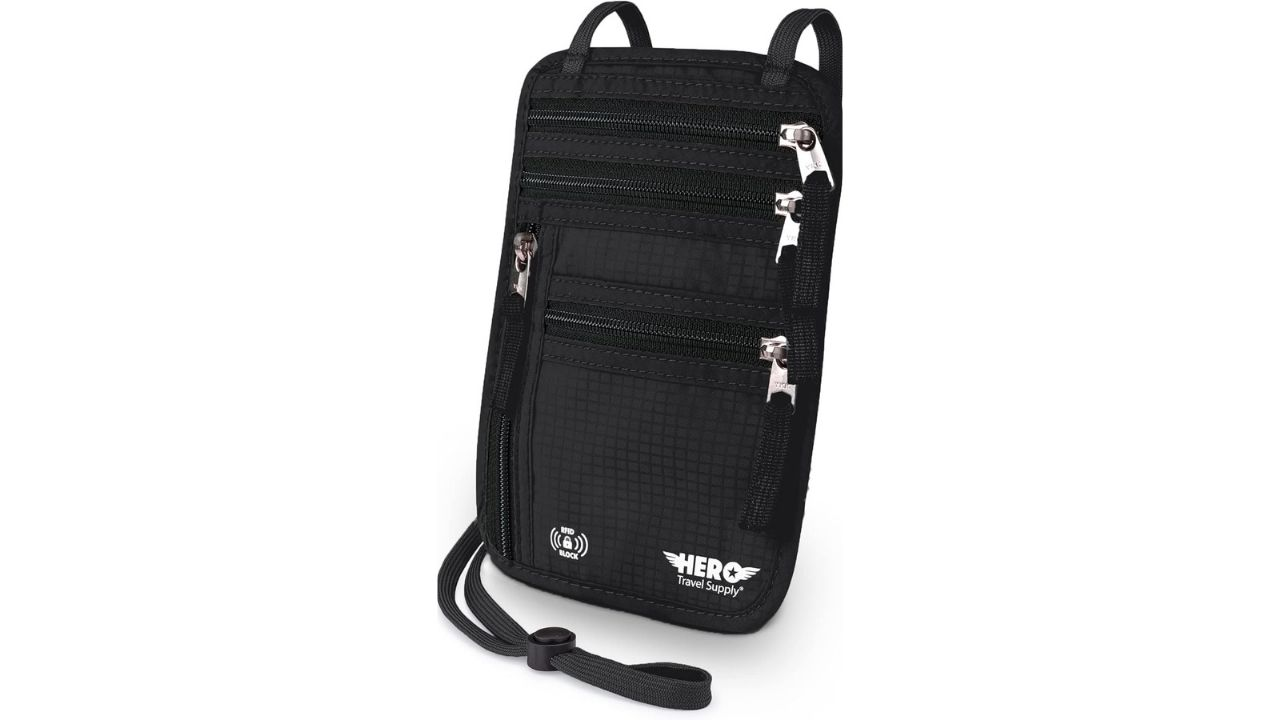
Travel Layer
HERO Neck Wallet · RFID Blocking Passport Holder
Passports, cards, hotel keys, tickets, and IDs move through the same crowded infrastructure as the visitor’s phone. A concealed RFID-blocking neck wallet keeps the access points protected through terminals, venues, and city corridors.

Capture Layer
UBeesize 12” Ring Light · 62” Tripod Stand
The broadcast happens in the room, the lobby, after dinner, before the next move. A ring light and tripod turn any phone into a steadier capture station for reviews, reactions, creator clips, and travel notes.
Affiliate links · KMOB1003 may earn a commission from qualifying Amazon purchases at no additional cost to you.
Travel Layer · Stay Where the Signal Travels
The room you choose during a global event is part of the signal you carry. Marriott Bonvoy properties put you inside the city’s hospitality infrastructure — close to the venues, the neighborhoods, the restaurants, and the street-level culture that makes the visit worth broadcasting. Points travel. The signal does too.
Stay Where the Signal Travels →
Affiliate link · KMOB1003 may earn a commission from qualifying purchases.
The operators who benefit most from a mega-event are not always the ones closest to the stadium. They are the ones who built rooms worth entering — and worth sharing. A restaurant three neighborhoods from the venue that has a distinct identity, a photographable dish, and a staff that makes visitors feel like cultural insiders will generate more organic distribution than a sports-bar chain one block from the gate that treats every customer as an interchangeable transaction. The visitor’s media channel does not operate on proximity. It operates on signal quality. What is the room communicating? Is it worth carrying into another network? Does it have an identity strong enough to travel? FIU finance professor Deanne Butchey notes that the longer-term value of hosting the World Cup is in how cities use the moment to strengthen their brand, infrastructure, and visitor economy — not just in short-term event spending. The short-term event is the attention. The infrastructure is what converts attention into return.
The infrastructure decision is not made on game day. It is made in the months before the visitor arrives — in what gets built, what gets named, what gets a visual identity strong enough to travel, and what gets left as a generic transaction waiting to be forgotten. The World Cup brings 1.24 million people to American cities for a few weeks. What those cities have built for the visit will determine how much of the signal stays after the visitors go home.
The visitor does not consume the city and leave. The visitor broadcasts the city into networks it cannot reach on its own. The room that is worth entering is worth broadcasting. Build accordingly.
The practical infrastructure question for operators around any major live event is the same: what does the visitor find when they arrive, and what do they carry when they leave? Hotels that create a recognizable visual moment — a lobby detail, a welcome amenity, a brand mark that photographs clearly — will appear in visitor content for months after the event ends. Restaurants that have a dish worth filming, a corner worth sitting in, and a staff that treats the visit as a cultural exchange rather than a transaction will accumulate the kind of organic endorsement that no advertising budget can replicate. Neighborhoods that are distinct, walkable, and locally rooted will generate recommendation content that outlasts the tournament schedule by years. None of this requires a World Cup partnership or an official sponsorship. It requires building a room with enough signal quality that the visitor’s natural broadcast behavior does the distribution work.
The same logic applies to digital operators. Euronews and Data Appeal note that success in the World Cup visitor economy will not be defined by visibility alone, but by a destination’s ability to interpret and act on real-time demand signals — optimizing connectivity, pricing, and capacity management to capture value as it shifts. That is an infrastructure argument dressed in tourism language. The operators who capture the visitor’s signal are not the ones with the loudest promotional presence. They are the ones who built the room the visitor wanted to be in — and built it well enough that the visitor’s own broadcast becomes the most effective distribution the room will ever have.
Security Layer · Protect the Signal Wherever You Travel
Hotel Wi-Fi, stadium networks, transit hotspots, café connections — the visitor’s media channel runs on public infrastructure that is not built for security. NordVPN Complete keeps the signal protected across every network the visitor enters, so the distribution keeps moving without exposing what is behind it.
Protect the Signal Wherever You Watch →
Affiliate link · KMOB1003 may earn a commission from qualifying purchases.
The cities that will benefit most from the 2026 World Cup are not necessarily the ones with the most matches. They are the ones that understood a global event is not only a spending opportunity — it is a distribution event. 1.24 million international visitors moving through 11 American cities, each carrying phones and audiences and social proof, constitute a broadcast infrastructure the city could not have purchased. The question is whether the rooms those visitors enter are worth the signal.
KMOB1003 was built on exactly this premise — a 933K+ combined audience footprint across 50+ radio countries, built as owned infrastructure rather than platform dependency. The visitor economy is not different from the media economy in any fundamental way. Both are systems of attention, distribution, signal quality, and return behavior. The visitor is the media channel. The city is the room. The infrastructure question is the same one it always is: what have you built that is worth carrying?
The visitor is not a customer who leaves. They are a broadcast unit that keeps transmitting. What the city puts inside that broadcast — the room, the identity, the signal — is the infrastructure decision that outlasts every tournament schedule.
Some links in this article are affiliate links, including Amazon affiliate links. KMOB1003 may earn a commission from qualifying purchases at no additional cost to you. All affiliate partnerships are editorially independent.
