
KMOB1003
KMOB1003 Global · Sports Culture · Live Media · Public Memory · Monday AM · June 15, 2026
When a live event becomes large enough, the city stops acting like a backdrop. It becomes the room, the broadcast, the market, and the memory.
The game was the trigger. The city was the story. The arena was never large enough to contain it.
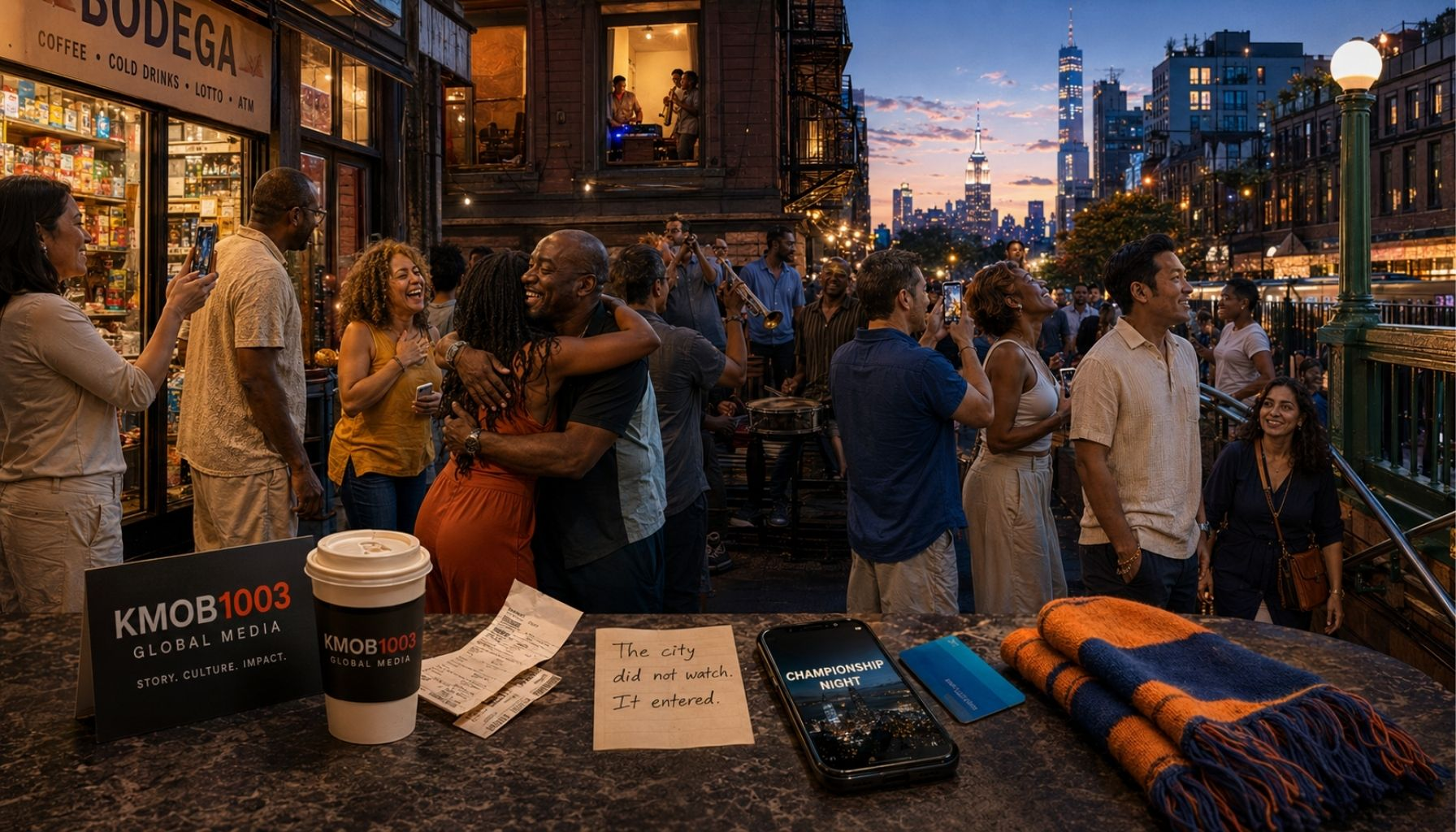
The game was played in San Antonio. The championship happened in New York. By the time the final buzzer sounded — Knicks 94, Spurs 90, the 53-year drought broken — the city had already entered the event — through bodega windows, packed bars, subway steps, phones held above the crowd, brass bands in the street, and 53 years of belief finally given somewhere to go. This was not a sports recap waiting to be written. It was a city-scale media event forming in real time.
What This Article Is Actually About
This is not a sports recap. It is an argument about what cities become when a major live event gets large enough to exceed its venue. When that happens, the city stops being a backdrop and becomes the broadcast — its streets, bars, bodegas, phones, screens, and civic pride all functioning as live media infrastructure in real time.
Layer One
The Belief
A city does not enter a live event because the team wins. It enters because the city has decided, collectively, to organize its public life around a shared outcome. The belief arrives before the result. The streets fill before the final buzzer.
Layer Two
The Commerce
When a city enters a live event, local commerce moves with it. Bars at capacity. Bodegas selling out. Hotels sold through. Restaurants booked on game nights. The event economy extends to every block within reach of the belief.
Layer Three
The Broadcast
Every phone raised in a Brooklyn street corner, every bodega television visible through a window, every group chat processing the moment in real time — all of it is broadcast infrastructure that the city itself built without being asked.
Layer Four
The Memory
The championship is the trigger. The memory is what the city carries after. 53 years of waiting becomes a story. The story becomes civic identity. The identity becomes the thing the city uses to explain itself to the world.
New York did not watch the game. It entered it. — KMOB1003 Global Media · June 2026
The Knicks’ 2026 championship did not begin on June 13. It began weeks earlier, when New York collectively decided that this was the year — and organized its public life accordingly. After Game 4, New York City erupted: fans flooded bars, bodegas, and streets across the five boroughs, the Central Park watch party spilled beyond its boundaries, and the crowd outside Madison Square Garden refused to leave — too thrilled to let the night end. This was not post-game celebration. This was a city that had already entered the event before the result was confirmed. The streets knew before the box score did. The belief arrived first, and the commerce, the broadcast, and the public memory organized themselves around it.
What New York did in 2026 was not unique to basketball. It is what cities do when a live event becomes large enough to exceed its venue. The arena holds 19,812 people. The city holds 8.5 million. When the moment gets big enough, those 8.5 million people do not stay home and watch on a screen — they move toward each other, find the nearest collective experience, and become part of the event whether or not they hold a ticket. Mayor Zohran Mamdani announced the championship parade in a three-word post — “Parade. Thursday. Manhattan.” — and noted that New Yorkers had cheered from packed living rooms in the Bronx to watch parties in Brooklyn, from bars in Queens to Staten Island to Madison Square Garden itself. The geography of the celebration was the geography of the city. Not the arena. The city.
“A city does not become an arena because a team wins. It becomes an arena when 53 years of stored belief finally has somewhere to go.”
— KMOB1003 Global Media · Sports Culture · June 2026
Madison Square Garden is the symbolic center of Knicks culture. But the actual arena of this championship was larger — and it did not require a ticket. It required a bodega television, a bar stool, a phone with a working stream, or a street corner with enough people carrying the same shared emotional stake in the outcome. Every bar and many bodegas were showing the game — and even that was not enough. In Fort Greene, Brooklyn, when the NYPD turned off projectors at public watch parties, crowds stayed anyway, gathering around propped-up phones and laptops, building impromptu broadcast infrastructure out of whatever they had. The city was not waiting for permission to be part of the event. It built its own version of the arena on every block that cared.
The economic footprint of the Knicks’ run extended well beyond ticket revenue. Mayor Mamdani and the NYC Economic Development Corporation announced the Knicks’ 2026 postseason generated $202 million in economic activity from home games — with the potential to reach $465 million if all Finals home games were played, and each additional home game generating approximately $90 million in local spending on tickets, concessions, merchandise, transportation, and lodging. Bars at capacity. Hotel rooms sold through for game nights. Restaurants in the blocks surrounding MSG booked through the series. The event economy did not stay inside the arena — it moved through the city’s commercial layer the way electricity moves through a circuit, activating every connected node. The bodega on 34th Street selling out of orange-and-blue merchandise at midnight was part of the same economic event as the $7,683 average ticket price inside MSG.
Live Events Layer · Be in the Room Before the City Enters It
The next major live moment is already building its economy before you can see it. KMOB1003 routes its audience to the official ticket layer — the room before the city enters it, the seat before the overflow begins.
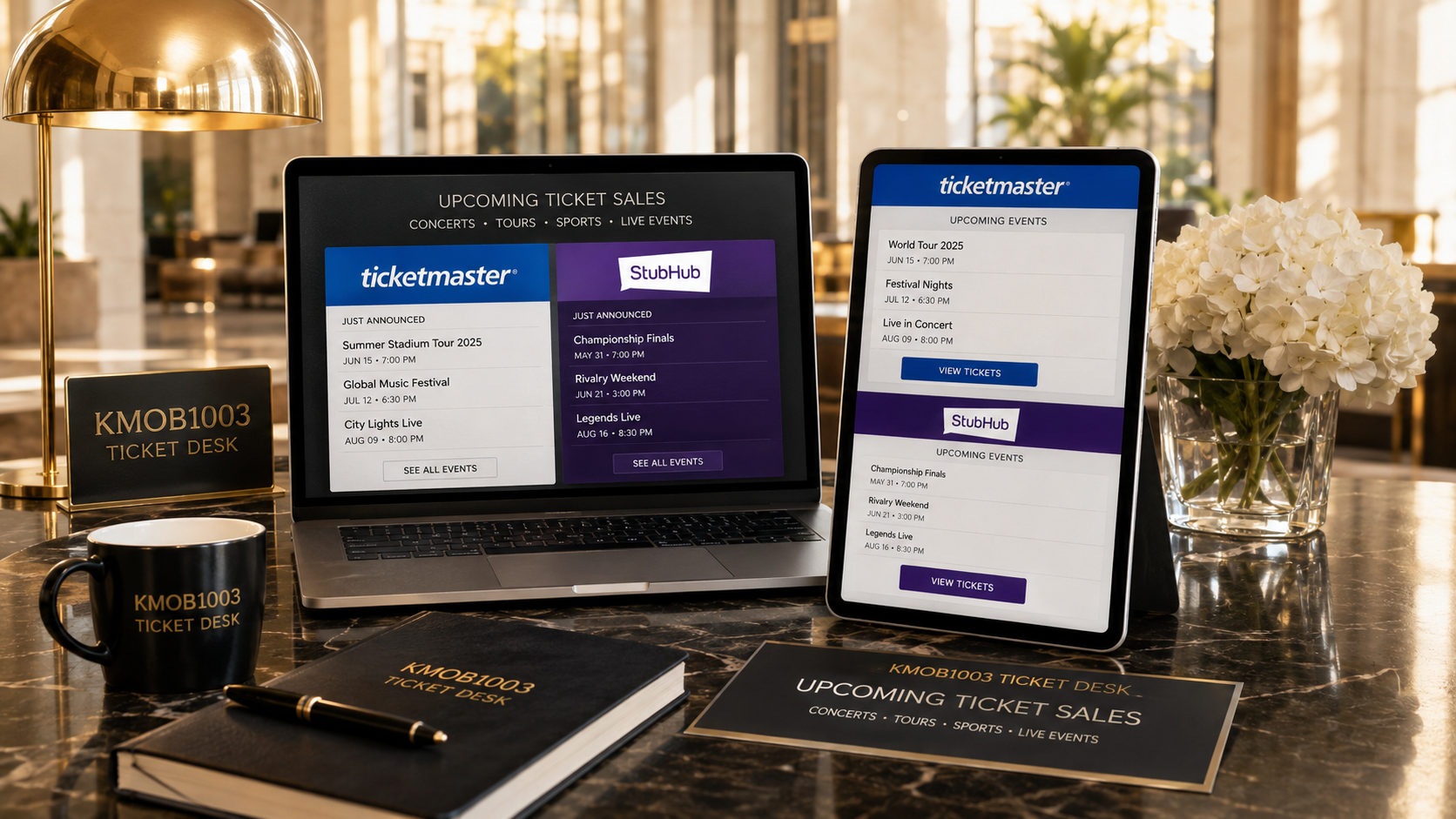
Affiliate link · KMOB1003 may earn a commission from qualifying purchases.
The Knicks’ championship produced something that no broadcast rights deal could have manufactured: a city-sized media event built entirely from organic public behavior. Every phone raised in a Brooklyn street was a camera. Every group chat processing the final buzzer was a live commentary feed. Every social post from a bodega owner, a cab driver, a schoolteacher, a lifelong fan who was three years old the last time the Knicks won — all of it was content, distribution, and cultural documentation produced simultaneously by 8.5 million people who did not need to coordinate, because they already shared the same emotional stake in the outcome. A brass band and a samba-reggae drumline appeared in Fort Greene as cars honked in solidarity and “Empire State of Mind” blasted from open windows — a multigenerational, multiborough celebration that built itself without a production company or a broadcast crew.
This is what KMOB1003 means when it reads a major live event as media infrastructure rather than sports news. The Knicks’ championship was a cultural production event that activated every distribution layer available to a city of this scale simultaneously: television, radio, social video, second-screen commentary, physical public gatherings, and the oral tradition of people telling each other what they witnessed. The 2026 NBA Finals averaged 19.6 million viewers per game through four games — the most-watched Finals since 1998 and ABC and ESPN’s most-watched ever — but the actual audience for the Knicks’ championship, measured by everyone who participated in it in any form, was orders of magnitude larger. New York City became the broadcast. The city did not watch the game. It entered it.
The arena held 19,812 people. The city held 8.5 million. When the moment is large enough, all 8.5 million are inside the event whether they hold a ticket or not. The city is the broadcast nobody had to pay for.
The lesson for media operators and brand partners is not about basketball. It is about what happens to public attention when a sufficiently large live moment activates the civic layer of a major city. New York’s response to the Knicks’ championship was not manufactured by any marketing department. It was built from 53 years of stored belief, activated by a result, and expressed through every available channel simultaneously. The operators who benefited were not the ones with the official partnership or the courtside placement. They were the ones who had already positioned themselves inside the geography of the moment — the bar with the game on, the bodega with the merchandise, the restaurant with the reservation, the hotel with the room, the platform with the audience already paying attention.
KMOB1003 operates with a 933K+ combined audience footprint across 50+ radio countries specifically because the platform was built for this layer — the cultural infrastructure that activates when a major live event exceeds its venue and begins moving through the public. When Brooklyn’s streets filled and the bodegas ran out and the group chats overflowed, KMOB1003’s audience was already inside that conversation. Not because the platform anticipated the championship. Because it had spent three years building the room that cultural moments want to travel through when they get large enough to need more space than the arena can provide.
The parade is Thursday. Manhattan. And when it moves down the canyon of buildings, the crowd lining the route will not be there because they watched the game. They will be there because they were already inside it — in the bar, on the street corner, in the group chat, on the phone propped against a fire hydrant in Fort Greene. The trophy will travel through a city that never needed to see the inside of the arena to feel like it was in the room. That is the infrastructure lesson. The room was never only where the game was played. It was everywhere the belief had been building for 53 years, waiting for a final buzzer to give it somewhere to go.
New York did not watch the Knicks win a championship. New York became the championship — its streets, its screens, its bodegas, its brass bands, and its 53 years of stored belief all entering the event simultaneously when the final buzzer gave them somewhere to go. The city was the room. The room was always large enough.
Some links in this article are affiliate links. KMOB1003 may earn a commission from qualifying purchases at no additional cost to you. All affiliate partnerships are editorially independent.
