KMOB1003
KMOB1003 Global · Creator Economy · Thursday PM · June 11, 2026
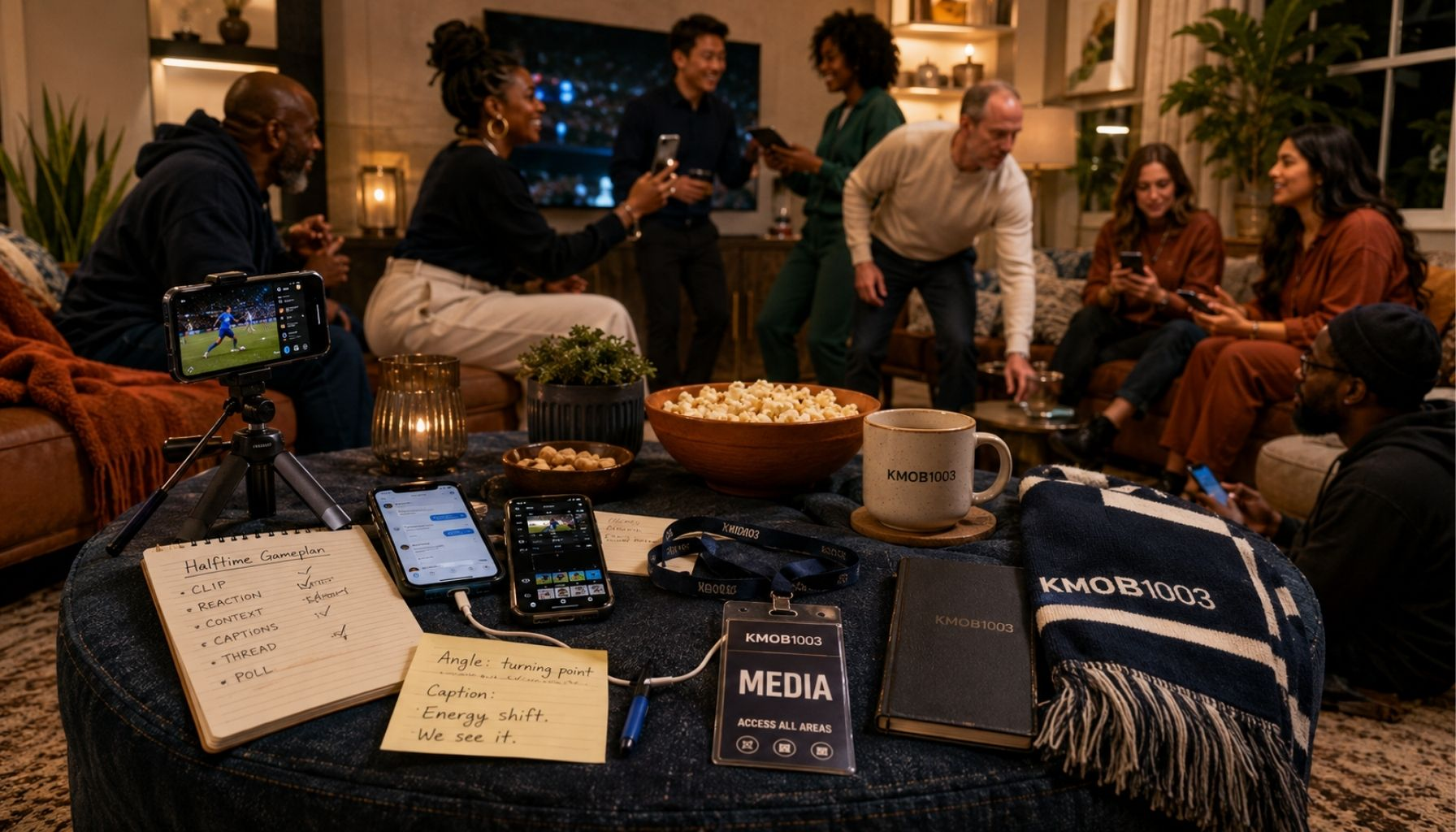
The audience no longer waits for halftime commercials. The second screen is now where the story is clipped, argued, dramatized, and monetized in real time.
Edit at the speed of culture. The pause belongs to the second screen.
The whistle blows. Fifteen minutes open. And in living rooms, hotel lobbies, bars, and watch-party apartments across three countries, millions of phones come up simultaneously — not to rest, but to produce. Clips pulled. Reactions recorded. Group chats already processing what just happened while the official broadcast sells insurance. TikTok and HOORAE’s partnership — which launched Screen Time as the first creator-led micro-series distributed free and ad-supported across TikTok and PineDrama — was engineered precisely for this window: the pause inside the live event where mobile attention fills the gap the broadcast left open. Halftime is a production window. The creators who understand that are building the parallel media system the broadcast cannot follow them into.
What This Article Is Actually About
Why halftime, downtime, pregame, and post-whistle windows are now production windows — and how the second screen has become a parallel entertainment system. The audience does not wait for the broadcast to resume. It clips, argues, dramatizes, and monetizes the pause. KMOB1003 reads the infrastructure behind the scroll.
Layer One
The Pause
Halftime, stoppages, pregame, post-match, and replay gaps are no longer dead air. They are attention windows where the audience switches from passive viewer to active producer — clipping, reacting, and distributing before the broadcast resumes.
Layer Two
The Clip
The creator compresses the moment into reaction, context, humor, identity, and shareable proof. The clip is not a summary. It is a reframe — the creator’s interpretation of what the broadcast showed and what it meant.
Layer Three
The Frame
The visual packaging — title card, cover image, caption, thumbnail, and first second — decides whether the clip travels. The frame is not decoration. It is the distribution mechanism that moves the moment beyond the room where it was made.
Layer Four
The Return
The audience does not simply watch and leave. It comments, saves, sends, watches the next episode, joins the room, or buys the tool. Return behavior is what separates a viral moment from a media system with durable value.
The broadcast may own the match clock. The second screen owns the cultural afterlife. — KMOB1003 Global Media · June 2026
What happens in those fifteen minutes is not passive scrolling. Fans clip the best moments from the first half and share them before the broadcast has finished its commercial block. Creators record rapid-fire reactions while the emotion is still live in the room. Group chats argue calls, rank performances, share memes, and predict second-half outcomes — processing the match in real time, at a pace the broadcast cannot match. The halftime window is fifteen minutes of unstructured attention at the peak of a global live event. Not for the broadcaster. For the creator. ThinkNow Research found that 78% of millennials are at least somewhat likely to use a second screen during 2026 World Cup matches — which means the halftime break is not dead air. It is when the second screen ecosystem runs at its highest velocity.
Pregame, post-whistle, commute, and night-scroll windows follow the same structure. The audience does not stop producing when the broadcast resumes — it shifts posture. Halftime audiences want reaction and humor. Post-match audiences want analysis and archive. The morning-after audience wants the cultural frame that makes the match mean something beyond the score. Each window is a different media environment with a different content need. EMarketer forecasts that 216.8 million US adults will use a smartphone as a second screen in 2026 — representing more than 80% of the population — making second-screen behavior normalized infrastructure, not an emerging trend. The pause is not a gap. It is a shift in the direction of attention — from the broadcast to the phone, from passive watching to active production.
“Halftime is not a commercial break for the audience. It is a production window. The second screen is already running before the broadcast resumes.”
— KMOB1003 Global Media · Creator Economy · June 2026
Vertical storytelling did not emerge because audiences have short attention spans. It emerged because audiences have precise attention spans — they know exactly how much time they have and exactly how they want to spend it. The micro-drama format is not a compressed version of long-form television. It is a format engineered for the in-between: the halftime window, the commute, the waiting room, the post-match scroll, the night-before build-up. Each episode is sixty to ninety seconds — long enough to advance a plot, short enough to fit inside the exact attention gap a live event creates. Screen Time — the debut HOORAE micro-series on TikTok and PineDrama — became the top-performing vertical series on both platforms, approaching 75 million views in its first week and achieving the highest seven-day watch time of any series on PineDrama to date. That is not a niche result. That is proof that audiences will consume serialized narrative in the same windows where live sports capture their primary attention.
The structure of Screen Time — 27 episodes in its first act, each roughly one minute long — maps almost perfectly onto the rhythm of a live sporting event. A fan watching a World Cup match can consume an entire episode between a stoppage and the next set piece. They can watch three episodes during halftime. They can finish an act during a rain delay. The micro-drama is not competing with the live event. It is filling the structural gaps that the live event creates — and doing so with content that is emotionally resonant, culturally intelligent, and designed to travel through the same group chats and social feeds that are already processing the match. TikTok’s Global Head of Entertainment Partnerships noted the platform is building a new model for micro-series — one that pairs creator-led storytelling with scaled distribution to reach audiences faster than traditional broadcast channels can manage.
Creator Layer · Edit at the Speed of Culture
The creator who understands halftime cannot afford to edit slowly. When the second half kicks off, the moment has moved on. The clip, the reaction, the reframe — all of it needs to be cut, captioned, and published inside the same attention window the event opened. CapCut is built for that pace: mobile-first editing, vertical templates, caption tools, and a workflow that keeps the creator moving at the speed the feed demands.
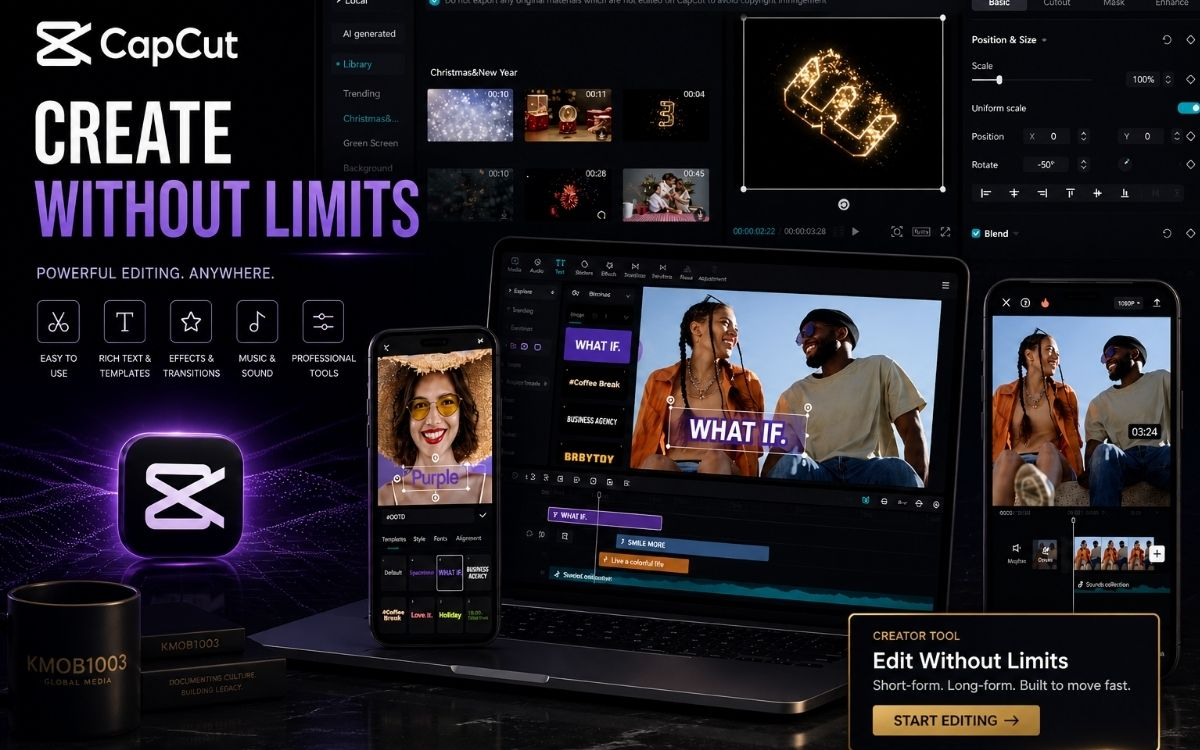
Edit at the Speed of Culture →
Affiliate link · KMOB1003 may earn a commission from qualifying purchases.
The creator does not compete with the match. The creator extends it. The broadcast supplies the event. The creator supplies the interpretation — the emotional frame, the cultural context, the humor, the argument, the identity signal, and the shareable proof that the moment actually happened and meant something. The 2026 World Cup runs 48 teams, 104 matches, across three countries and six weeks — the largest tournament in history. The distribution of that attention is no longer centered on official rights holders and broadcast partners. It runs through creators: commentators, fan accounts, cultural editors, sports radio hosts, podcasters, react-video producers, and clip-makers who build the second screen that runs alongside the official broadcast and frequently captures more of the audience’s active attention.
The creator-as-second-broadcast model changes the infrastructure question entirely. It is no longer which platform carries the match. It is which creators are building the cultural frame through which the match gets experienced — and whether the operator has the distribution, the audience relationship, and the production speed to be inside that frame when it forms. The broadcast is given. The frame around it is built. Most of what people will remember about the 2026 World Cup will not be the official broadcast cut. It will be the creator clip, the reaction video, the group-chat moment, and the cultural argument that formed in the pause. That is not peripheral to the event. It is the event’s media infrastructure — distributed across second screens in real time, without waiting for a rights holder to authorize it.
The creator does not replace the broadcast. The creator builds the room the broadcast cannot enter — the group chat, the reaction feed, the cultural argument that forms around the match and outlasts it.
The smartest operators in the current media environment are not waiting for the main event. They are building for the pauses around it — the pregame, the halftime, the post-match, the commute home, the next-morning recap, the night-before build-up. Each of those windows has a different audience posture and a different content need. Pregame audiences want context, prediction, and identity signals. Halftime audiences want reaction, humor, and fast takes. Post-match audiences want analysis, archive, and emotional processing. The night-before and morning-after windows are where longer-form content, newsletters, and editorial voices find their highest engagement — because the audience has settled into reflection rather than real-time reaction.
TikTok’s investment in the HOORAE micro-series partnership is a direct acknowledgment of this structure. The platform is building a new model for micro-series that pairs creator-led storytelling with scaled distribution — explicitly designed to live natively inside the platform’s ecosystem and reach audiences across genres including comedy, thriller, action, and fantasy. The genre range is not accidental. It maps onto the emotional range of the pause windows that live events create: audiences in a halftime window want something different from audiences in a post-match window or a pregame scroll. Operators who build content strategies that treat these windows as distinct media environments — rather than as undifferentiated downtime — are building the infrastructure that converts live-event attention into durable audience relationships rather than one-time traffic spikes.
Visual Layer · Make the Moment Visible
The second screen runs on visuals. Thumbnails, title cards, story frames, event covers, and branded image assets are what make a clip travel beyond the room where it was made. OpenArt gives creators and operators the tools to produce campaign-grade visual packaging at the speed the halftime window demands — before the second half starts and the moment moves on.
Affiliate link · KMOB1003 may earn a commission from qualifying purchases.
The World Cup will be watched on screens large and small, in stadiums and living rooms, in hotel lobbies and sports bars, across time zones and languages and generations. But the media system that forms around it — the clips, the reactions, the micro-dramas, the creator commentary, the group-chat arguments, the next-morning analysis — is not secondary to the broadcast. It is the cultural infrastructure through which most of the world will actually process what happened. The broadcast gets the first impression. The second screen builds the memory.
For media operators, this is an infrastructure question, not a content strategy question. Who is building for the pause? Who has the production tools to move at halftime speed? Who has the audience relationship deep enough that their second-screen presence is sought rather than stumbled upon? KMOB1003 was built for exactly that layer — 933K+ combined audience footprint, 39.2M+ annual TikTok video views, 50+ radio countries — a signal that runs alongside live culture rather than waiting for a broadcast window to open. The broadcast may own the match clock. The second screen owns what the match becomes.
The broadcast pauses. The audience does not. Halftime belongs to the creators who understand that the room does not go silent when the commercial block starts — it moves to the phone, opens the second screen, and starts building the story the broadcast did not tell.
Some links in this article are affiliate links. KMOB1003 may earn a commission from qualifying purchases at no additional cost to you. All affiliate partnerships are editorially independent.
