KMOB1003
KMOB1003 Global · Media Infrastructure · Friday AM · June 5, 2026
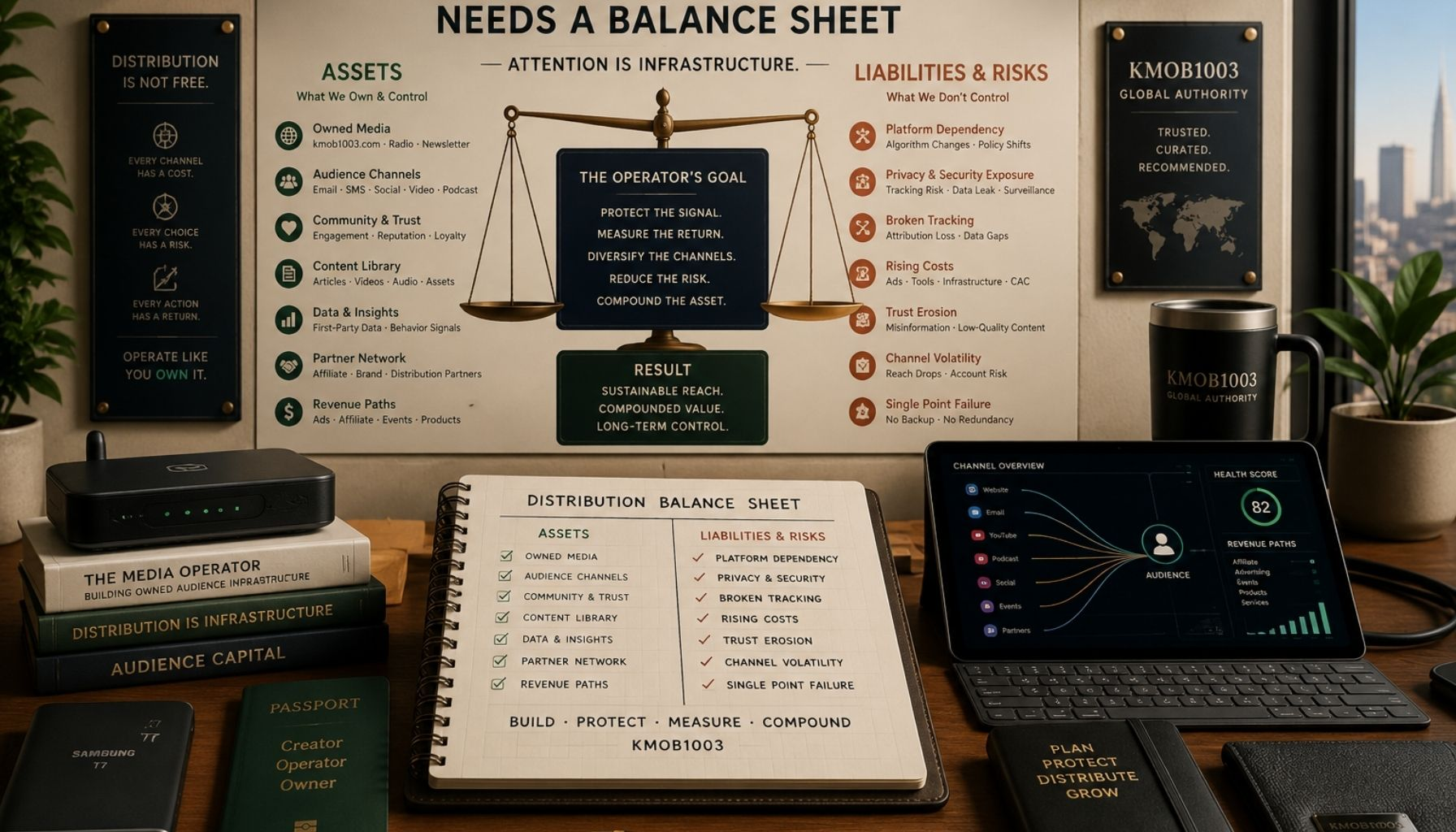
Distribution is not free attention. It has costs, dependencies, risk, revenue paths, and security exposure. Treat it like infrastructure — because that is what it is.
Attention is not an asset until the operator knows the cost of moving it.
Most operators track audience. Far fewer track what it costs to reach that audience, what it costs when the channel breaks, what it costs when the platform shifts the algorithm, and what the liability looks like when a distribution dependency goes dark. Dash Social’s 2026 social media trends research frames the distribution landscape as one where no single playbook holds across platforms or audiences — the signal moves, the channel shifts, and the operator who has not mapped the risk pays the cost without a plan. Distribution needs a balance sheet. Not a follower count.
What This Article Is Actually About
Why every media operator needs to treat distribution like infrastructure — with assets, liabilities, costs, reserves, and risk. Not as free attention, not as a platform gift, and not as a metric that only counts when it goes up.
Assets
Owned channels. Earned audience. Protected access.
Email list. Radio signal. Owned domain. Podcast feed. Direct subscriber relationship. These are yours when the platform changes.
Liabilities
Platform dependency. Algorithm exposure. Trust risk.
Every channel you do not own is a liability. A feed you cannot control. An algorithm you cannot read. A trust signal you cannot rebuild overnight.
Costs
Time. Attention. Security. Broken tracking.
Every post costs production time. Every affiliate link costs tracking integrity. Every public network costs privacy. Distribution is not free — it is priced in time, exposure, and risk.
Reserves
Archive. Signal memory. Backup distribution.
The operator with no reserve has no fallback when the primary channel breaks. Archive, backup, and owned media are the reserve layer of the distribution strategy.
The operator who cannot read the balance sheet cannot manage the risk. — KMOB1003 Global Media · June 2026
The framing that social media and digital distribution represent free reach has always been incomplete. Free to post is not the same as free to reach. The algorithm decides how far a post travels, when it travels, and which audience segment it reaches — and that decision is made by a platform whose interests do not necessarily align with the operator’s. The cost is not always monetary. Sometimes it is time. Sometimes it is privacy exposure. Sometimes it is the invisible cost of building an audience on a foundation that can shift without notice.
The 2026 distribution landscape reflects this tension at scale. Research published by Dash Social on social media trends for 2026 points to a distribution environment where no single platform or content format sustains reliable reach across all audience segments. The operator who treats distribution as a tap that can be turned on and off is building on a model that has already broken for enough media companies to be a warning, not an outlier.
“Distribution is not free attention. It is a system with assets, liabilities, costs, and risk — and operators who do not account for it will pay the price when it breaks.”
— KMOB1003 Global Media · Media Infrastructure · June 2026
Platform volatility is the most visible distribution risk — an algorithm change, a policy shift, a reach suppression — but it is not the only one. Tracking gaps are a distribution risk. An affiliate link that routes attribution incorrectly for eleven of fifteen clicks is a distribution risk. A public page with broken placeholder CTAs that is still indexed and live is a distribution risk. A newsletter list of 3,400 subscribers that has never received a single email is a distribution risk of a different kind — not exposure, but atrophy.
The trust layer is a distribution risk that compounds slowly and breaks suddenly. Research published in 2026 examining affiliate marketing and FTC compliance in creator economies found that affiliate links are widespread but disclosure and trust infrastructure vary significantly across creator categories. For a media operator, trust is part of the distribution asset. An audience that does not trust the source will not follow the signal — and rebuilding that trust costs more than protecting it did.
Security Layer · Secure the Distribution Layer
Every public network, hotel lobby, airport connection, and co-working space is a point of exposure in the distribution stack. NordVPN Complete gives media operators, creators, and distributed teams the security layer that protects the signal — access, identity, tracking integrity, and privacy — wherever the work travels.

A media operator who approaches distribution the way a finance operator approaches a balance sheet will make different decisions than one who treats reach as a vanity metric. On the asset side: owned domain, email list, radio signal, podcast feed, direct audience relationships, archive, and any channel where the operator controls access. These are the distribution assets — the things that hold value when the platform changes the rules.
On the liability side: every channel the operator does not control is a dependency, and every dependency is a liability. The social platform that drives 80 percent of referral traffic is also an 80 percent single-point-of-failure. The affiliate link that routes through three layers of attribution before it credits the publisher is a liability in the revenue layer. The public-facing page that was never properly set to draft after it became obsolete is a liability in the trust layer. Knowing the liability side of the distribution balance sheet is the prerequisite for managing it.
The scarcity is not accidental. It is the architecture. Every platform that gives free reach builds a dependency — and dependencies are liabilities on the balance sheet of the operator who does not own the channel.
The operator who reads the distribution shift before the platform names it as a trend has a material advantage. That advantage does not come from watching the feed. It comes from research infrastructure — tools that find patterns in audience behavior, source credibility, platform movement, and content performance before the consensus has formed. The operator who is still reading yesterday’s top-ten list when the distribution environment has already moved is not behind the trend. They are behind the last trend, which is a different problem.
Building the research layer is not about having more data. It is about having the right questions before the data is publicly available. Which platforms are gaining distribution share in which audience segments? Which content formats are earning genuine follow-through versus surface-level impressions? Which affiliate categories are building real trust with audiences and which ones are generating clicks without relationship? These are the questions the balance-sheet operator asks — and the answers require a research layer, not a dashboard.
Operator Intelligence · Research the Operating Pattern
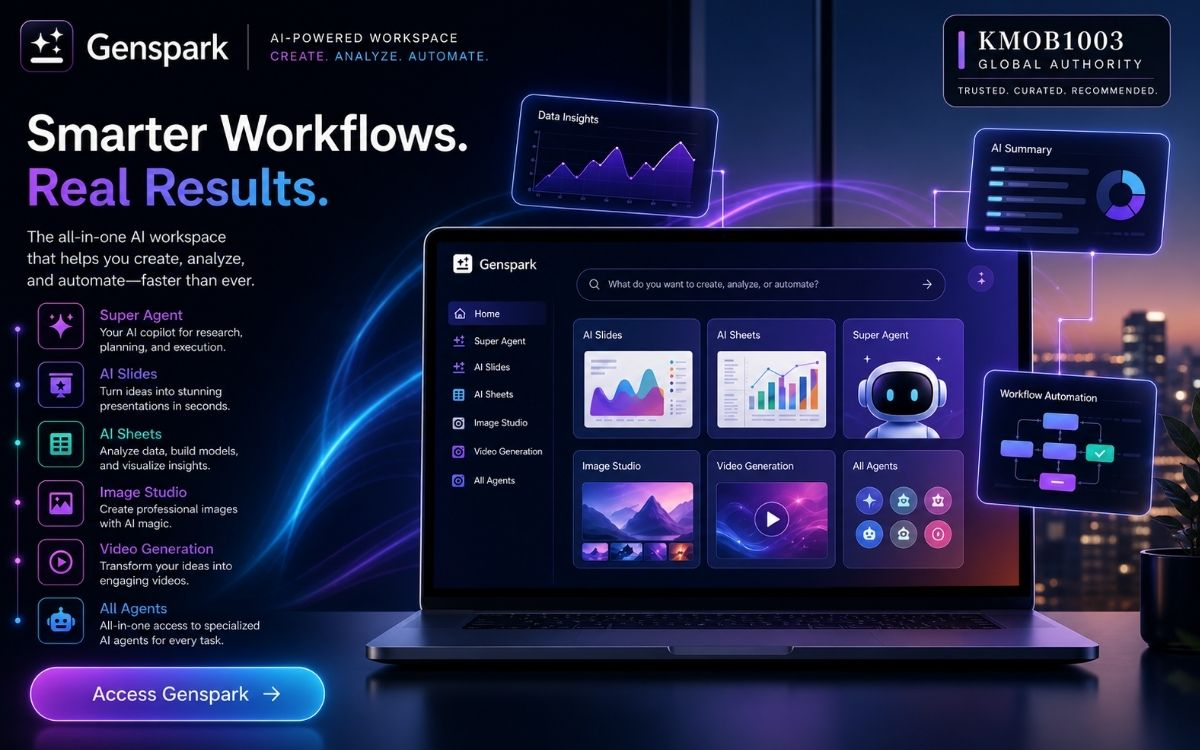
Distribution patterns shift before platforms announce them. Genspark gives media operators the research and pattern-recognition layer to find the signal before it becomes consensus — source discovery, trend mapping, and audience behavior intelligence before the headline catches up.
The final column on the distribution balance sheet is the reserve layer — the infrastructure that exists so the operator has a fallback when the primary channel breaks. Archive is a reserve. A newsletter list is a reserve. A radio signal in 50 countries is a reserve. An owned domain with five years of indexed content is a reserve. The operator who has built reserves does not panic when a platform changes its algorithm. They shift weight from the liability column to the asset column and keep moving.
KMOB1003 operates across culture, media, radio, creator tools, live events, and owned distribution in more than 50 countries. The distribution question is not abstract here. It shows up in which channels drive genuine audience behavior versus which ones generate surface impressions with no follow-through. It shows up in which affiliate pathways preserve attribution and which ones leak. It shows up in which owned assets hold value when the platform environment shifts and which ones are entirely platform-dependent. The balance sheet is not a theoretical framework. It is the operating document of any media company serious about building beyond the algorithm.
Build the room the system cannot enter. Own the channel. Protect the signal. Measure the cost. The operator who accounts for distribution like infrastructure will still be standing when the platform recalculates the reach.
The distribution operator needs a physical layer that matches the work — focused reading, clean audio, and tools that travel. These are the operator tools that support the research and production layer.

Kindle Paperwhite 16GB — Newest Model
7″ glare-free display. The research layer starts with reading the right sources before the platform names the trend.

OneOdio Studio Monitor Headphones
Wired over-ear, 50mm neodymium drivers. Focused listening for the operator building the distribution intelligence layer.
Some links in this article are affiliate links. KMOB1003 may earn a commission from qualifying purchases at no additional cost to you. All affiliate partnerships are editorially independent.
