
The Promise Was Written Down: Inside the UnitedHealthcare Medicare Advantage Lawsuit Over Who Decides When Care Ends
UnitedHealthcare’s Medicare Advantage plans promised that clinical staff and physicians would decide when a patient’s recovery was over. A federal judge let a case testing that promise survive. Discovery has since opened into how the decision actually got made.
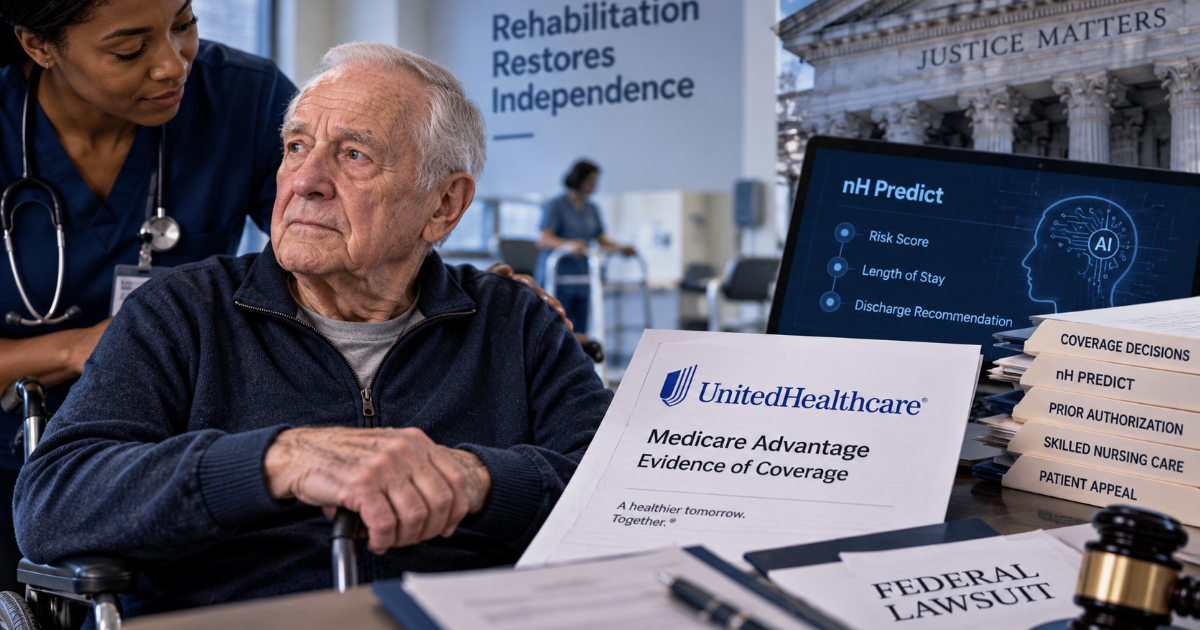
Gene Lokken was 91 when he fell at home and fractured his leg and ankle. His case would eventually become central to the UnitedHealthcare Medicare Advantage lawsuit, a federal case examining who actually made coverage decisions when patients needed post-hospital care. His plan made him a promise: if he needed care after leaving the hospital, clinical staff and physicians would decide how much he needed.
His doctor recommended physical therapy. Lokken received nineteen days of it before UnitedHealthcare and its subsidiary naviHealth cut off coverage, citing a “safe discharge plan.” His physical therapist’s notes at the time described “paralysis” and “weakness.” His family paid roughly $150,000 out of pocket over the following year, until he died in July 2023.
He never saw how his case turned out. His estate now leads the UnitedHealthcare Medicare Advantage lawsuit — a federal class action that asks a narrower question than “did an algorithm deny care.” It asks who was actually exercising the judgment UnitedHealthcare promised.
Dale Tetzloff, 74, tells a similar story. A stroke in October 2022 left his doctors projecting up to 100 days of skilled nursing care. UnitedHealthcare denied coverage at day 20. His family appealed and won — then were denied again at day 40. Ten months and roughly $70,000 out of pocket later, the pattern was clear: a treating physician says more time is needed, and a denial arrives on a timeline that tracks a projection, not a diagnosis.
When Recovery Became a Number
The tool at the center of the case, nH Predict, was built by naviHealth, acquired by UnitedHealth’s Optum division in 2020. Plaintiffs allege naviHealth case managers fed a patient’s diagnosis, age and living situation into the tool, which compared that profile against millions of prior patients to output a projected recovery timeline — and pressured case managers to keep actual stays within a narrow margin of that number.
UnitedHealthcare disputes this. A spokesperson told Minnesota Lawyer that “the naviHealth Predict tool is not used to make coverage determinations,” calling it a guide to “help inform providers, families and other caregivers.” In the company’s account, licensed clinicians made the coverage calls; the tool only informed the conversation.
The accounts materially conflict, and that’s what the UnitedHealthcare Medicare Advantage lawsuit exists to sort out. What isn’t established is that software itself made a legally binding decision. What is established: a federal judge has already ruled the contractual promise about who decides is a live legal question.

The UnitedHealthcare Medicare Advantage Lawsuit: Claims the Judge Would Not Dismiss
On February 13, 2025, Judge John R. Tunheim of the U.S. District Court for the District of Minnesota dismissed most of the case — claims like unjust enrichment and bad faith were preempted by the Medicare Act. Two claims survived: breach of contract, and breach of the implied covenant of good faith and fair dealing.
His reasoning is the whole story. Tunheim found these claims arise directly from UnitedHealthcare’s own Evidence of Coverage documents, because the real question is whether the company complied with its own statement that claim decisions would be made by “clinical services staff” and “physicians.” He also waived the requirement that patients exhaust Medicare’s appeals process first, calling it effectively futile.
What’s left is what a court can actually rule on: did UnitedHealthcare do what its own coverage documents said it would do.
Then the Court Opened the Door
On March 9, 2026, Magistrate Judge Shannon Elkins ruled on the plaintiffs’ motion to compel discovery, mostly in their favor. UnitedHealthcare must produce records on how nH Predict was built, what it was designed to do, who trained staff to use it, and whether it was built to replace a physician’s judgment.
One boundary matters: the court did not order UnitedHealthcare to hand over nH Predict’s source code, underlying rules or training data, and declined to compel broad financial records. A court can require a company to open up how a system was governed without requiring the system itself.

What Congress and Federal Investigators Found
In October 2024, the Senate Permanent Subcommittee on Investigations, drawing on more than 280,000 pages of internal company documents, found UnitedHealthcare’s Medicare Advantage prior authorization denial rate for post-acute care surged from 10.9% in 2020 to 22.7% in 2022 while the company rolled out automation — and that its skilled nursing facility coverage denials ran roughly nine times higher in 2022 than in 2019.
The incentive isn’t subtle. Medicare Advantage insurers are paid a fixed amount per member, so a day of care they don’t approve is money they keep, as Medicare Rights Center has noted, citing federal investigators.
In June 2026, HHS’s Office of Inspector General reviewed the 19 largest Medicare Advantage organizations’ skilled nursing facility admissions. In the June 2024 window studied, those organizations denied 12% of requests, with company rates ranging from 0.4% to 23%. Members appealed 18% of denials; when they did, 95% were overturned in their favor. For naviHealth-processed requests specifically, the denial rate was 14%, and 97% of its appealed denials were overturned. OIG’s own words: that overturn rate “indicates that some enrollees were initially denied medically necessary care.”
The People Who Never Appeal
If 18% of denials got appealed, 82% didn’t. That’s the reality underneath the overturn rate: appealing takes time, medical literacy and often a lawyer, and the people denied post-acute care are, by definition, sick, elderly and recovering. A 95% or 97% overturn rate describes what happened to the few with the capacity to fight. It says nothing about everyone else.
What the UnitedHealthcare Medicare Advantage Lawsuit Could Establish
No jury has ruled on the breach of contract claim, and UnitedHealthcare’s account — that clinicians made the real decisions, with nH Predict as one input — hasn’t been disproven.
What’s no longer in dispute is that the promise was specific. UnitedHealthcare told members that clinical staff and physicians would decide their coverage. A federal judge has ruled that whether the company kept that promise is a question a court can answer — and discovery is underway to find out.
That’s a smaller claim than “AI denied care to elderly patients.” It’s also more durable, because it doesn’t hinge on how the technology worked. That’s the real stake in the UnitedHealthcare Medicare Advantage lawsuit: whether a company did what it told a 91-year-old man, and everyone who signed the same paperwork, that it would do.

Signal Breakdown
Confirmed
A federal class action — Estate of Gene B. Lokken v. UnitedHealth Group, Inc. (D. Minn., No. 0:23-cv-03514) — is proceeding on breach of contract and breach of the implied covenant of good faith and fair dealing, following Judge John Tunheim’s February 13, 2025 ruling. A March 9, 2026 discovery order compelled UnitedHealthcare to produce records on nH Predict’s development, implementation and oversight, while denying requests for its source code, underlying data and broad financial records. HHS-OIG’s June 2026 report found a 12% SNF denial rate across 19 Medicare Advantage organizations, an 18% appeal rate, a 95% overturn rate on appeal, and a 14% denial / 97% overturn rate specifically for naviHealth-processed requests. The Senate Permanent Subcommittee on Investigations’ October 2024 report found UnitedHealthcare’s post-acute denial rate rose from 10.9% (2020) to 22.7% (2022).
Reported / Attributed
Plaintiffs allege nH Predict’s projections functioned as a ceiling on covered post-acute care, overriding treating physicians’ judgment. UnitedHealthcare states that licensed clinicians made all coverage decisions and that nH Predict served only as an informational guide.
Not Established
That nH Predict itself made a legally operative coverage decision. That UnitedHealthcare breached its contractual obligations — that is the question the surviving claims exist to resolve, not a settled fact. Any causal link between a specific denial and a specific patient’s death.

KMOB1003 SELECTS
Music, style, tools, art and objects worth your attention.