
May 2026
KMOB1003
KMOB1003 Global · The Culture Docent
AI Made Content Infinite. That Made Trust Scarce. The Operators With Real Audiences Are Now the Verified Sources of Culture.
The counterintuitive shift happening right now: as AI content becomes infinite, human-made content becomes more valuable. The scarcity won’t be production anymore. The scarcity will be trust. And the operators with real audiences, real opinions, and real communities are becoming the new verified sources of culture.
AI is going to dramatically increase the supply of content. That much is obvious — and it is already happening. What is less obvious, and more important, is what happens to the demand side of that equation. When content is infinite, the variable that determines what gets consumed is no longer quality. It is trust. The operator who built a real audience, expressed real opinions, and developed a real editorial point of view before the flood is not competing with AI content. They are the filter through which their audience navigates it.
Questions This Article Answers
Why does infinite AI content make human-made content more valuable, not less? What is the trust infrastructure that separates operators from content producers in 2026? How does KMOB1003’s editorial voice function as a trust signal in a content-saturated market? What does SXSW 2026’s programming reveal about where the creator economy is heading? How do operators build the trust layer that AI cannot replicate?
The discussion at SXSW 2026 that nobody was prepared for was not about what AI can produce. It was about what AI cannot provide. As AI content becomes very good — and it already is — the problem is not production quality. The problem is discovery. When every piece of content is generated at a professional level, the feed fills with content that carries no signal of authenticity, no accumulated trust, no earned perspective. The operator who spent years developing a real point of view and a real audience relationship is now the filter that makes the feed navigable. That is a structural advantage AI cannot replicate.
“Creators with real audiences, real opinions, and real communities will become the new verified sources of culture. The scarcity won’t be production anymore. The scarcity will be trust.”
— Fast Company · SXSW 2026 Creator Economy Coverage · April 2026
The Trust Economy · What Becomes Scarce When Content Is Infinite · 2026
Sources: Fast Company · SXSW 2026 · Billion Dollar Boy AI Creator Economy Report · Digiday · 2026
Signal Layer
For the first decade of the creator economy, the scarce resource was production quality. The creator with access to professional camera equipment, editing software, and distribution infrastructure had a structural advantage. AI eliminated that scarcity. The production floor is now effectively zero — professional-quality content is available to anyone who can write a prompt. What AI did not eliminate is the trust relationship between a specific operator and a specific audience. That relationship is built over time, through consistent editorial perspective, authentic engagement, and accumulated credibility. It cannot be generated. It can only be earned.
KMOB1003 has been building that trust relationship since June 2021 — through radio, editorial, social, and the editorial voice of The Culture Docent. The 902K+ audience across 50+ countries is not a follower count. It is a trust account. Every piece of content published under that editorial standard is a deposit into the account that makes the operator worth following when the feed fills with content that looks identical but carries no earned trust.
AI eliminated the production scarcity. It did not eliminate the trust scarcity. The operator who built a real editorial perspective and a real audience relationship before the flood is now the filter their audience uses to navigate the infinite feed. That is not a content advantage. It is an infrastructure advantage.
Operator Intelligence Layer
Map the System Before You Build Inside It.
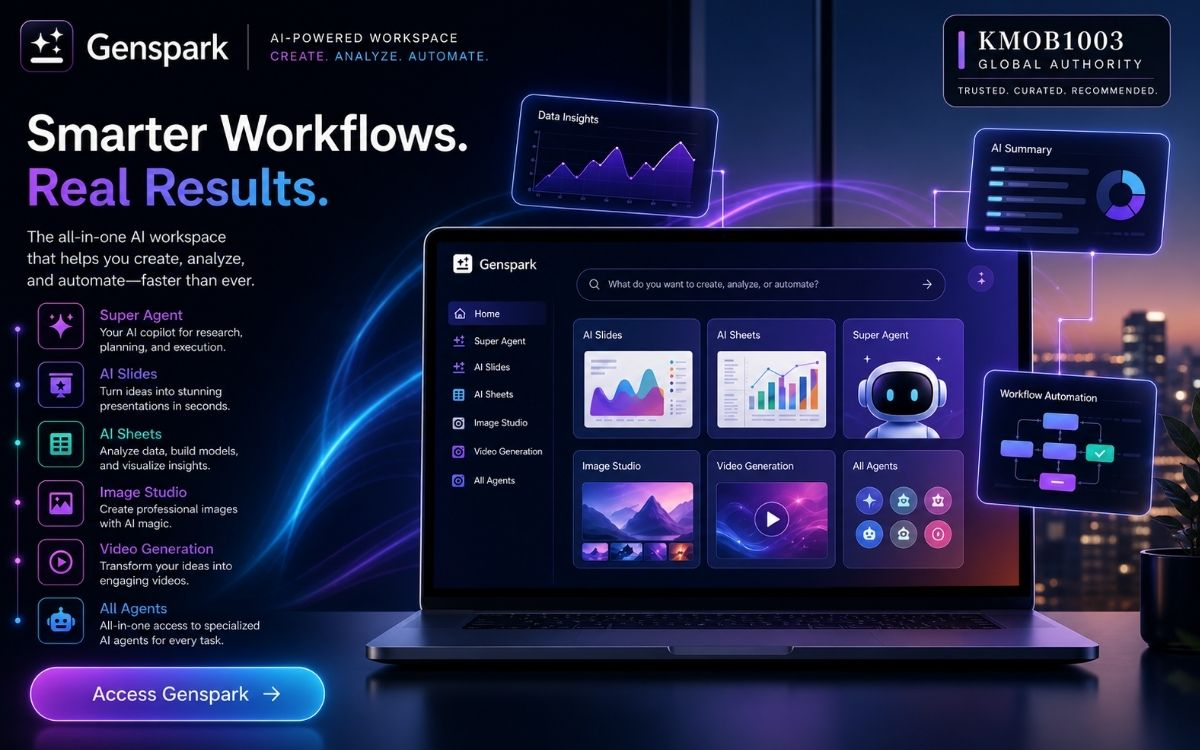
Genspark gives operators the intelligence infrastructure to understand which platforms, which markets, and which decisions compound — and which ones extract. Know the landscape before you commit to it.
Amazon · Operator Intelligence
Ownership Layer
The trust layer is not a tone. It is not a brand voice guideline. It is the accumulated result of consistent editorial decisions made over time — what the operator chooses to cover, how they frame it, what they refuse to publish, and what perspective they bring to every piece of content that carries their name. KMOB1003’s editorial voice is the accumulated result of five years of decisions about what Where Legends Break and Underdogs Rise means when a specific story appears in front of a specific audience in 50+ countries.
The trust layer is also the reason the operator who publishes consistently compounds while the operator who publishes virally does not. The viral post reaches the most people in the shortest time — and then dissipates. The consistent editorial voice builds the audience relationship that makes every subsequent post reach people who are already primed to receive it. The feed full of AI content is not threatening to the operator who has spent years building a real audience. It is an environment in which that audience needs the operator’s filter more, not less.
AI made content infinite. That made the operator with a real editorial voice the scarcest thing in the feed. Build the trust layer that no model can generate.
The trust layer is built through consistency, not volume. The operator who publishes with a real editorial perspective over time becomes the filter their audience uses when the feed becomes unnavigable. AI cannot build that relationship. Only time and editorial discipline can.
Amazon · Cultural Intelligence
Ownership Active
The operator who enters 2026 with a real editorial voice, a real audience relationship, and owned distribution infrastructure is not threatened by AI content. They are advantaged by it. When AI floods the feed with professional-quality content that carries no trust signal, the operator who carries a trust signal becomes more valuable to their audience, not less. The audience that has learned to rely on a specific editorial voice to navigate culture does not abandon that voice when the feed gets harder to navigate. They need it more.
KMOB1003’s 902K+ audience built over five years is the trust infrastructure that makes every piece of content the platform publishes more valuable in a world of infinite AI content. The Culture Docent is not a content product. It is a trust product — the editorial authority of a platform that has spent five years developing a real perspective on culture, technology, and the operator mindset. That is the infrastructure AI cannot replicate and the algorithm cannot manufacture.
The Signal Breakdown
The Shift
AI made content infinite. When content is infinite, the variable that determines what gets consumed is not quality — it is trust. The production floor went to zero. The trust floor did not move.
The Advantage
The operator with a real editorial voice and a real audience is the filter their audience uses when the feed becomes unnavigable. AI flooding the feed increases demand for that filter, not competition against it.
The Infrastructure
Build the editorial voice consistently. Own the distribution. The trust account compounds. The AI content does not. The operator with five years of trust cannot be replicated by a prompt.
AI made content infinite. That made the operator with a real editorial voice the scarcest thing in the feed. Build the trust layer that no model can generate.
Publishing Infrastructure Layer
From Idea to Global Distribution.
Spines turns the operator’s intellectual property into a published, distributed asset — from manuscript to global bookstores without the traditional gatekeepers. The operator who publishes owns the relationship the algorithm cannot revoke.
Ownership is the mechanism by which that audience becomes a durable asset. These two things are not the same — and the platform is designed to provide the first while preventing the second. The platform gives creators distribution because distribution brings creators onto the platform, and creators on the platform generate the content that keeps the audience engaged. The platform does not give creators ownership because ownership would allow creators to leave — taking their audience with them.
“Distribution is what the platform gives you to keep you dependent. Ownership is what you build to make the platform optional.”
— KMOB1003 Operator Intelligence · 2026
Distribution vs Ownership · The Value Gap
Average time before algorithmic reach returns to baseline after a spike
Compensation paid to creators when platform algorithm changes eliminate their reach
Compounding value of owned distribution infrastructure built in parallel
Sources: Platform analytics · KMOB1003 Operator Intelligence · 2026
Platform Layer
The illusion works because platform distribution produces real results. Content reaches real people. Followers accumulate. Revenue flows. The business appears to be working. And it is working — on the platform’s terms, at the platform’s discretion, for as long as the platform decides to maintain the current distribution arrangement. The creator’s experience of success and the platform’s structural control over that success are not in conflict. They are simultaneous. The distribution feels like ownership because it produces ownership-level results while the arrangement holds.
The arrangement ends when the platform’s business model requires it to end. Algorithm changes that reduce organic reach are not accidents. They are business decisions — designed to shift creator distribution from free to paid, from organic to sponsored, from the platform’s cost to the creator’s. The creator who built entirely on organic platform distribution discovers that the distribution they relied on was always conditional. The platform was always going to change the terms. The only question was when.
Platform distribution is a business arrangement the platform can change unilaterally. Treat it as what it is — a temporary, conditional mechanism — and build the owned distribution layer while it is still working, not after it stops.
Infrastructure Layer
Owned distribution is distribution that does not require platform permission to operate. An email list is owned distribution. You send an email and it arrives — regardless of what any algorithm decides to surface, suppress, or deprioritize. A radio network is owned distribution. A podcast feed on owned hosting is owned distribution. A website with an engaged readership is owned distribution. These channels share one property: the creator controls the delivery mechanism. The platform does not.
The economic difference between platform distribution and owned distribution compounds over time. Platform distribution produces results proportional to the algorithm’s current favorability toward the creator’s content. When the algorithm is favorable, the results are strong. When the algorithm is unfavorable, the results disappear. Owned distribution produces results proportional to the relationship that has been built — and the relationship compounds regardless of what the algorithm is doing. (Read: Your Audience Is Not Following You. They Are Borrowing You.)
KMOB1003 operates on this principle across every station and every format. The radio network distributes to 50+ countries without requiring any social platform to surface it. The editorial platform distributes to readers through direct traffic and search — not through algorithmic feeds. The email architecture reaches subscribers directly. None of these distribution channels require the platform’s permission. All of them compound. That is the design.
Distribution is what the platform gives you. Ownership is what you build so the platform becomes optional.
Build owned distribution in parallel with platform distribution — not instead of it. The platform distribution drives discovery. The owned distribution captures the relationship. Only one of them is permanent.
Ownership Active
The operator’s distribution stack has two layers. The first layer is platform distribution — TikTok, Instagram, YouTube, LinkedIn, Facebook. This layer is borrowed, conditional, and subject to change. It is also the most powerful discovery mechanism available. The operator uses it aggressively for discovery — because the audience is already there and the reach is real. But the operator does not build the business on this layer. It is the top of the funnel, not the foundation.
The second layer is owned distribution — email, owned website, radio, podcast, published intellectual property. This layer is permanent, unconditional, and immune to platform algorithm changes. It is also slower to build than the platform layer. The audience is not already there. The reach has to be earned. But once built, it compounds. Every email subscriber added is an owned relationship that generates predictable, platform-independent reach for as long as the relationship holds.
The operator’s strategy is to run both layers simultaneously — using the platform layer to drive discovery and the owned layer to capture relationship. Every piece of content that performs on the platform routes traffic toward the owned destination. The platform generates the attention. The owned infrastructure captures the value. The distribution is temporary. The ownership compounds.
Run both layers simultaneously. Use the platform for discovery. Use the owned infrastructure for relationship. The distribution is the mechanism. The ownership is the asset. Do not confuse the two.
The Signal Breakdown
The Problem
Creators build their entire distribution on platform algorithms they do not control. When the algorithm changes, the distribution disappears — and there is no owned layer to fall back on.
Why It Happens
Platform distribution works so well in the early stages that it creates the illusion of infrastructure. The distribution is performing, so the ownership layer feels unnecessary — until the platform changes its terms.
What Operators Build
Email lists. Radio networks. Podcast feeds. Owned websites. Distribution channels that do not require platform permission — and compound regardless of what any algorithm does this week.
Distribution without ownership is a temporary advantage. Build the ownership layer while the distribution is still running.
Some links in this article are affiliate links. KMOB1003 may earn a commission from qualifying purchases at no additional cost to you. All affiliate partnerships are editorially independent.
Your voice. Deployed at scale. ElevenLabs turns spoken content into professional audio — podcasts, narration, and radio-ready production.
