

KMOB1003 Global Protection Partner
KMOB1003 Global · The Culture Docent
On April 15, 2026, a federal jury found Live Nation and Ticketmaster liable on every antitrust count submitted. The verdict is historic. The remedy is still being written. And the operators who understand what comes next are already building the infrastructure that wins regardless of how the breakup lands.
For decades, one company controlled 78% of large amphitheaters, 86% of primary ticketing at major venues, and effectively every point of leverage in the live music ecosystem. Artists couldn’t tour without them. Venues couldn’t survive without them. Fans had no alternative.
The jury called it what it was: a monopoly.
The verdict doesn’t end the fight — appeals, remedy phases, and Tunney Act proceedings ensure this will run for years. But the direction is set. The live event industry is being restructured. The operator who positions now builds the infrastructure that compounds when the restructuring completes.
Questions This Article Answers
What did the Live Nation antitrust verdict actually find? What does $1.72 per ticket mean for fans and artists? How does the DOJ settlement differ from what the states won? What happens next in the remedy phase? What does the verdict mean for independent operators and platforms like KMOB1003’s Ticket Desk?
The Live Nation verdict is not a consumer story. It is an infrastructure story.
When one company controls the venues, the promotion, the ticketing, and the artist management simultaneously, the market does not function as a market — it functions as a toll road with one operator collecting fees at every checkpoint. The jury found that Live Nation had monopolized the primary ticketing market and illegally bundled its amphitheater and promotion businesses in ways that shut out competition.
Every count submitted was decided in the states’ favor. That is not a partial win. That is a clean sweep.
“The jury’s clean sweep on liability gives the states significant leverage — and the concert-focused market definition leaves the door open for a parallel wave of sports-ticketing litigation.”
— Crowell & Moring LLP · Post-Verdict Analysis · April 2026
Live Nation Verdict · The Numbers · April 2026
Overcharge per ticket found by jury — applies to 20% of total tickets sold, subject to trebling under Clayton Act
Primary ticketing market controlled by Ticketmaster at major concert venues — the scale of the monopoly
States plus DC that rejected the DOJ settlement and took the case to full jury trial — and won every count
Sources: Music Business Worldwide · Crowell & Moring · CNN · April 2026
Signal Layer
The Department of Justice settled early — a $280 million fund, a fee cap at 15%, divestiture of 13 amphitheater booking agreements. The majority of states called it insufficient and took the case to trial. They were right. The jury returned a clean sweep on every antitrust claim: monopolization of primary ticketing markets, illegal bundling of promotion and venue services, and anticompetitive conduct that overcharged fans by $1.72 per ticket across 20% of total tickets sold. Under the Clayton Act, those damages are trebled. The financial exposure is significant — but the structural implications are larger.
What the verdict does not do is immediately break up Live Nation and Ticketmaster. The remedy phase — where the court will determine what structural or behavioral relief is required — has not yet begun. The states have asked for monetary damages and structural relief. Live Nation has said it will appeal. The Tunney Act review of the DOJ’s separate settlement continues separately.
This will run for years. But the direction is unambiguous: the structure that allowed one company to control the entire live event ecosystem has been found illegal.
The verdict is not the end of Live Nation’s legal battle — it is the beginning of the remedy phase. But the jury’s clean sweep on every count gives independent operators, competing platforms, and artists more leverage than they have had in decades. The infrastructure is shifting.
Operator Intelligence Layer
Map the Post-Verdict Landscape Before Your Competitors Do.
The verdict changed the infrastructure map of the live event industry. Genspark gives operators the intelligence layer to understand which platforms, which markets, and which infrastructure decisions compound in the post-verdict environment — before the market prices them in.
KMOB1003 may earn a commission from qualifying purchases.

Ownership Layer
Consider what the system looked like from the inside. A mid-level touring artist — one with a real following, real dates, real costs — routes a tour through amphitheaters she did not choose, promoted by a company she cannot negotiate with, ticketed through a platform that sets the service fee structure unilaterally. At the end of the run, the gross revenue is what the posters promised. The net is something else. The fees compound across every checkpoint: the venue cut, the promoter margin, the ticketing service charge applied to both the face value and the convenience fee, the artist management commission taken on the gross. By the time the money arrives, the infrastructure has been paid at every turn. The artist has been paid once — and last.
Ticket prices have reached record levels — and the artists performing those shows are not taking home more money. The infrastructure between the artist and the audience was capturing the value at every point: the venue booking, the promotion fee, the ticketing service charge, the artist management commission. A system that controls all four simultaneously does not need to negotiate fairly with any of them.
This is not a music industry problem. It is the structural condition of every market where one operator controls enough checkpoints to set the terms for everyone else. The streaming platform that controls the playlist controls the royalty. The social platform that controls the feed controls the reach. The label that controls the distribution controls the master. The mechanism varies. The architecture is the same.
The verdict against Live Nation is the most dramatic legal affirmation yet of a principle that applies across every creative industry: the operator who owns none of the infrastructure captures none of the compounding value.
The platform controls the infrastructure. The operator who builds their own is the only one who cannot be overcharged at the gate.
The Live Nation verdict confirmed what every working artist already knew: controlling the infrastructure is controlling the value. The operator who builds owned distribution, owned platforms, and owned event infrastructure does not pay the toll. They collect it.
Ownership Active
The remedy phase will determine whether the court orders a full structural breakup — forcing Live Nation to divest Ticketmaster — or settles for enhanced behavioral constraints. The DOJ’s settlement, reached a week into the trial, requires Live Nation to allow competitors like SeatGeek and StubHub to offer tickets to its events, cap service fees at 15%, and divest exclusive booking agreements with 13 amphitheaters.
Thirty-three states considered that insufficient. They took the case to trial anyway. The jury gave them everything they asked for. The leverage in the remedy phase now belongs to the states — not to the company that settled early and called it resolution.
For the independent operator, the most significant outcome of the verdict is not the damage award — it is the behavioral constraints already in place and the competitive opening they create. When Live Nation must allow StubHub and SeatGeek to compete for ticketing at its venues, the distribution map of the live event industry changes. Not dramatically, and not immediately. But the direction has been set by a federal jury, not by a press release.
That shift is structural. And structural shifts favor the operator who built routing infrastructure before the market opened — not after. The KMOB1003 Ticket Desk was not built in response to the verdict. It was built because the logic was already clear: audiences need access to live culture, and the platform that routes them there without controlling them belongs to the operator who built it. The verdict accelerates the relevance of that position. It does not create it.
Operator Performance Layer
Build the Session That Builds the System.
The operator who maps post-verdict infrastructure, studies the remedy, and positions before the market does — does not do it from a chair that works against the body. The SIHOO Doro C300 Pro is the ergonomic architecture of sustained executive performance: full lumbar articulation, dynamic weight distribution, and the physical support system that keeps the operator at cognitive peak across the sessions that actually matter.
KMOB1003 may earn a commission from qualifying purchases.

The operator’s workspace is the infrastructure behind the infrastructure.

Strategy is documented before it is executed.
Operator Intelligence Layer
The Operator Who Reads the Verdict First Wins the Remedy.
The operator who reads the verdict, studies the remedy, and maps the implications before the market prices them in is not lucky — they are documented. The Kindle Scribe is the knowledge architecture of the serious operator: 64GB of distraction-free reading, AI-assisted notebook summarization, and an annotation system that turns research into decisions.
Amazon · Operator Intelligence
Amazon Kindle Scribe (64GB) — Premium Pen · Tungsten
KMOB1003 may earn a commission from qualifying purchases.
Operator Execution · Post-Verdict Live Event Infrastructure
The Verdict
Every antitrust count — monopolization, illegal bundling, anticompetitive conduct — found against Live Nation. The jury gave the states everything they asked for.
The Opening
Live Nation must now allow StubHub and SeatGeek to compete. Service fees are capped. The market is opening. Independent operators who are already positioned compound when it does.
The Artist Position
Record ticket prices. Artists not taking home more. The operator who owns the infrastructure between themselves and their audience does not share value at every checkpoint.
The Infrastructure Move
Build owned event access now. KMOB1003 Ticket Desk routes audience to live events through platforms legally required to compete — the infrastructure that wins in the post-verdict market.
The Signal Breakdown
The Monopoly
86% of primary ticketing at major venues. 78% of large amphitheaters. Artist management, venue operation, promotion, and ticketing under one roof. The jury found it illegal on every count.
The Artist Reality
Record ticket prices. No corresponding increase in artist earnings. The infrastructure between the artist and the fan was extracting value at every point — and the operator who built it captured it all.
The Operator Move
Build owned event infrastructure now. The post-verdict market requires Live Nation to allow competition. The operator who is already positioned does not wait for the restructuring — they compound through it.
The ticket was never yours. But the infrastructure that routes your audience to the room — that can be. Build it before the market forces everyone else to.
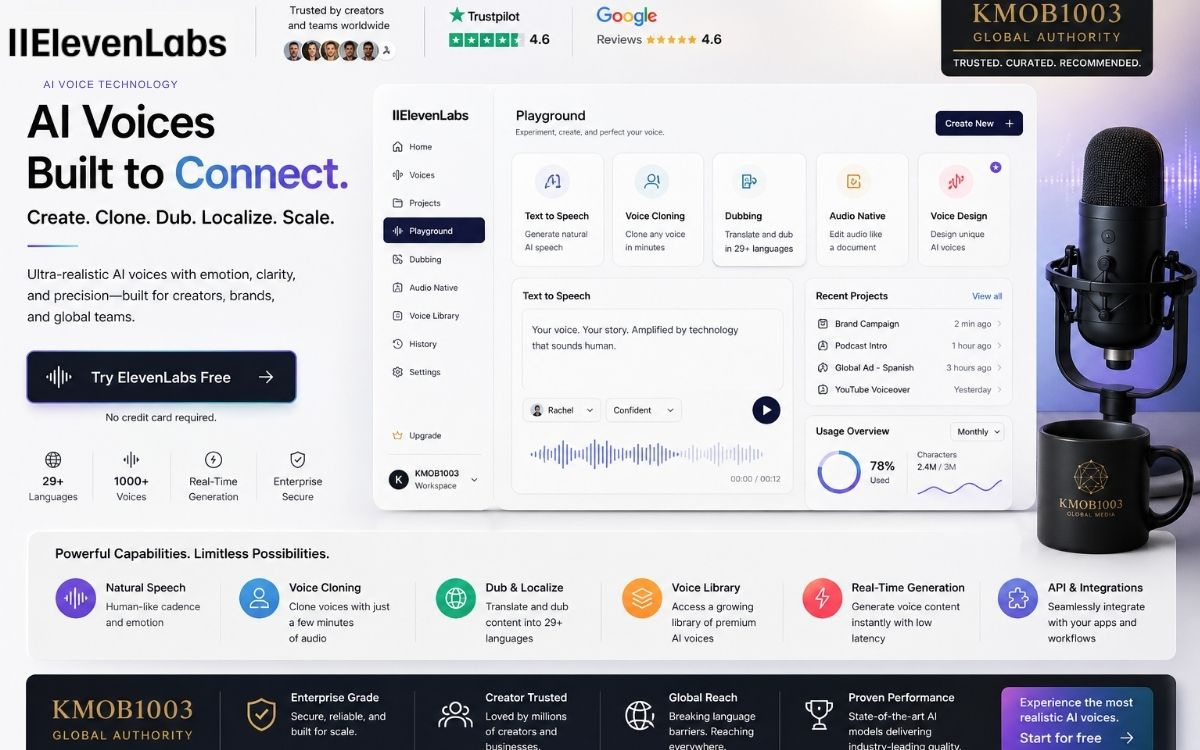
Your voice. Deployed at scale. ElevenLabs turns spoken content into professional audio — podcasts, narration, and radio-ready production.
KMOB1003 may earn a commission from qualifying purchases.
