KMOB1003 Global Protection Partner
KMOB1003 Global · The Culture Docent
The Creators Who Win in 2026 Are Not the Most Talented. They Are the Most Structured. Content Is the Output. Infrastructure Is the Asset.
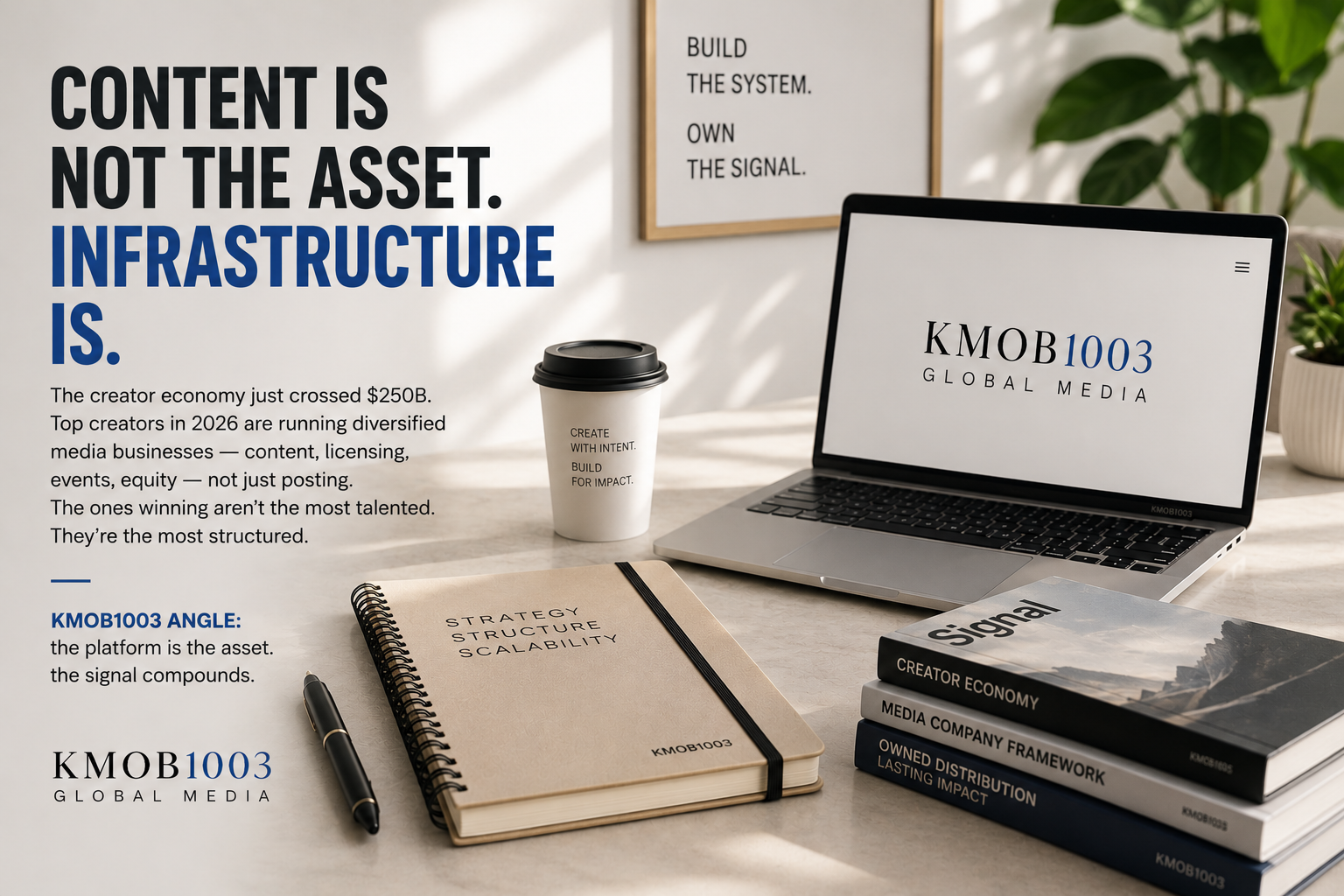
Content Is Not the Asset. Infrastructure Is.
Everyone is producing. Very few are building. The creator economy just crossed $250 billion globally — and the operators extracting the most value from it are not the ones with the most content. They are the ones with the most structure underneath it.
There is a difference between a creator and an operator. The creator produces. The operator builds the system that makes production compound. One scales with effort. The other scales with structure. The creator economy is not rewarding content anymore. It is rewarding the infrastructure underneath the content — and the operators who understand this are building entirely different businesses than the ones chasing the algorithm.
Questions This Article Answers
What separates creators from operators in the 2026 economy? Why does infrastructure outperform content as a long-term asset? How do you build a media system that compounds without requiring more content? What does the $250 billion creator economy actually reward — talent or structure? How is KMOB1003 building infrastructure, not just content?
The creator economy has a visibility problem. The creators who appear to be winning — the ones with the largest followings, the most views, the most cultural presence — are often not the ones with the most durable businesses. Visibility is a distribution metric. It measures how far the content travels. It does not measure how much of that reach the operator actually owns, controls, or can access without platform permission. The operators building durable businesses in 2026 are thinking about a different question entirely: not how do I reach more people, but how do I build a system that reaches people without requiring the platform to cooperate.
“Content is what you make. Infrastructure is what makes content worth making. The operator who confuses the two will always be working harder than the one who doesn’t.”
— KMOB1003 Operator Intelligence · 2026
Creator Economy · The Infrastructure Gap · 2026
Global creator economy 2026
Creators earning under $10K — no infrastructure
Revenue premium for operators who can prove ROI
Infrastructure is everything the audience never sees. It is the publishing system, the distribution stack, the owned platform, the email list, the audio feed, the revenue architecture — the machinery that turns content from a single event into a compounding asset. A piece of content without infrastructure is a post. A piece of content with infrastructure is an entry point into a system — and every new piece of content strengthens the system rather than existing independently of it. The difference between a creator and a media company is not content volume. It is infrastructure density.
KMOB1003 operates across 50+ countries with a 902K+ global audience not because of any single piece of content, but because the infrastructure underneath the content compounds every time new content enters the system. The radio signal routes to the editorial platform. The editorial platform routes to the Global Collection. The Global Collection routes to the affiliate stack. The affiliate stack generates revenue that funds the next layer of infrastructure. Each element strengthens the others. That is not a content strategy. That is a system.
The creator who produces the most content is rarely the one with the most durable business. The operator who builds the best infrastructure around their content is. Content is the front door. Infrastructure is everything behind it.
The platform is designed to give creators distribution. It is not designed to give creators ownership. These are different things, and the distinction matters more in 2026 than it ever has. Distribution is access to an audience — access that the platform controls and can revoke. Ownership is a direct relationship with an audience — a relationship the platform cannot revoke because the platform never controlled it. The operators who are building durable businesses in 2026 are building the ownership layer while the distribution is still running, using the platform’s reach to route audiences toward infrastructure the platform does not control: owned domains, direct audio feeds, email relationships, published IP.
This is not anti-platform thinking. KMOB1003 uses every platform available. The distinction is in what the platform is being used for. The platform is a distribution tool — a mechanism for expanding reach. It is not the infrastructure. The infrastructure is what the audience routes toward after the platform delivers them. If the platform is both the distribution and the destination, the operator owns neither.
Signal Layer · Build the System
The operators building the most durable systems in 2026 are not working from memory. They are working from documentation — structured thinking captured in a format that outlasts the moment it was written in. The system begins on paper before it lives anywhere else.

A system begins before it scales. Structure what you’re building while it’s still small.
Operator Notebook — System Planning Edition
The physical infrastructure layer — where systems get mapped before they get built, and decisions get documented before they get made.
Audible Layer
The operators who move fastest are the ones consuming intelligence while they build — not before, not after. Audible is the knowledge layer that runs parallel to the work.
KMOB1003 may earn a commission from qualifying purchases.
The KMOB1003 infrastructure model is built on four layers, each of which feeds the next. The signal layer — the editorial content, radio broadcasts, and social distribution — creates reach. The ownership layer — the owned domain, Podbean audio feed, and direct email relationships — converts reach into durable audience relationships. The revenue layer — the affiliate stack, media partnerships, and artist services — converts audience relationships into compounding income. The intelligence layer — the tools, systems, and documentation that run the entire operation — makes every other layer more efficient over time.
None of these layers are optional. A media operation without a signal layer has nothing to route. A media operation without an ownership layer has distribution it cannot keep. A media operation without a revenue layer has an audience it cannot monetize. A media operation without an intelligence layer has a system it cannot scale. The operator who understands this builds all four layers simultaneously — not sequentially, not eventually, but now, while the signal is running.
Operator Execution · The Infrastructure Stack
Signal Layer
Editorial content, radio signal, social distribution — the reach engine that routes audiences toward owned infrastructure.
Ownership Layer
Owned domain, audio feed, email list — the infrastructure the platform cannot revoke because the platform never controlled it.
Revenue Layer
Affiliate stack, media partnerships, artist services — the monetization architecture that compounds with infrastructure, not effort.
Intelligence Layer
Systems, tools, and documentation — the operational infrastructure that makes every other layer more efficient over time.
The $250 billion creator economy is not rewarding the most talented creators. It is rewarding the most structured operators. Content is what you make. Infrastructure is what makes it compound. Build the system while the signal is running — because the signal that runs on no infrastructure is always one algorithm change away from silence.
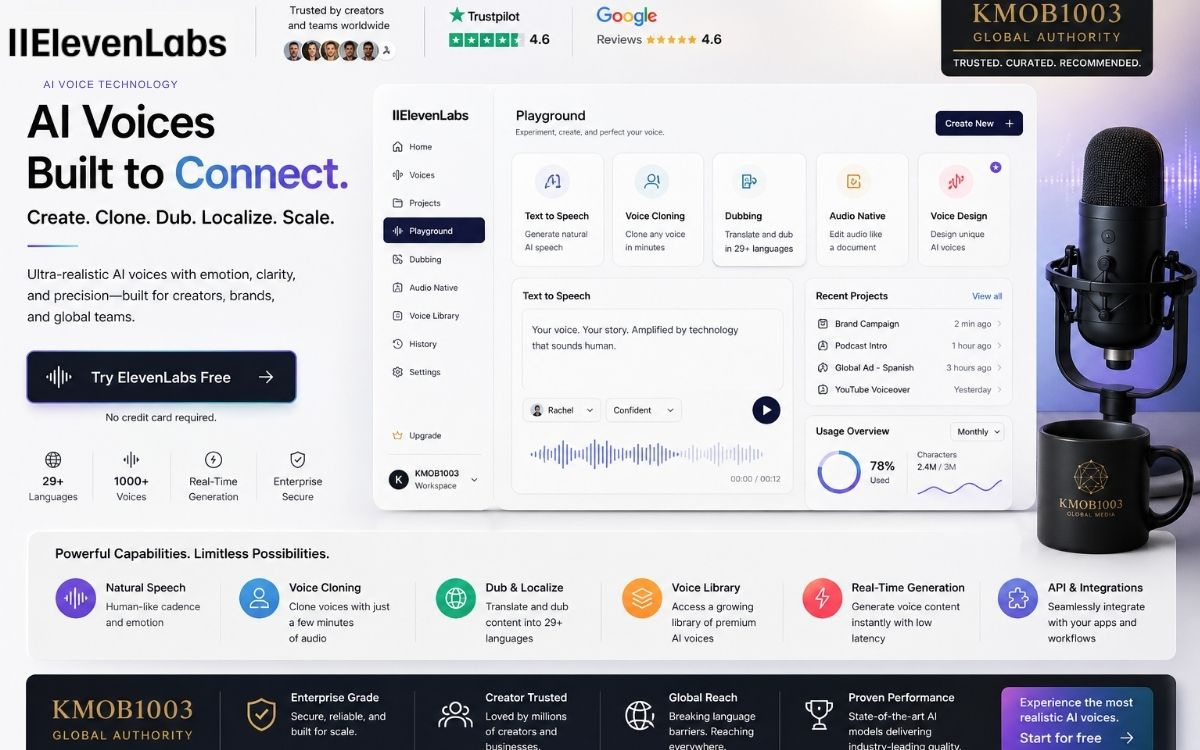
Your voice. Deployed at scale. ElevenLabs turns spoken content into professional audio — podcasts, narration, and radio-ready production.
KMOB1003 may earn a commission from qualifying purchases.
