
KMOB1003 Global Protection Partner
KMOB1003 Global · The Culture Docent
Niantic Did Not Build a Game. It Built the Most Sophisticated Geospatial Data Collection Operation in Consumer History.
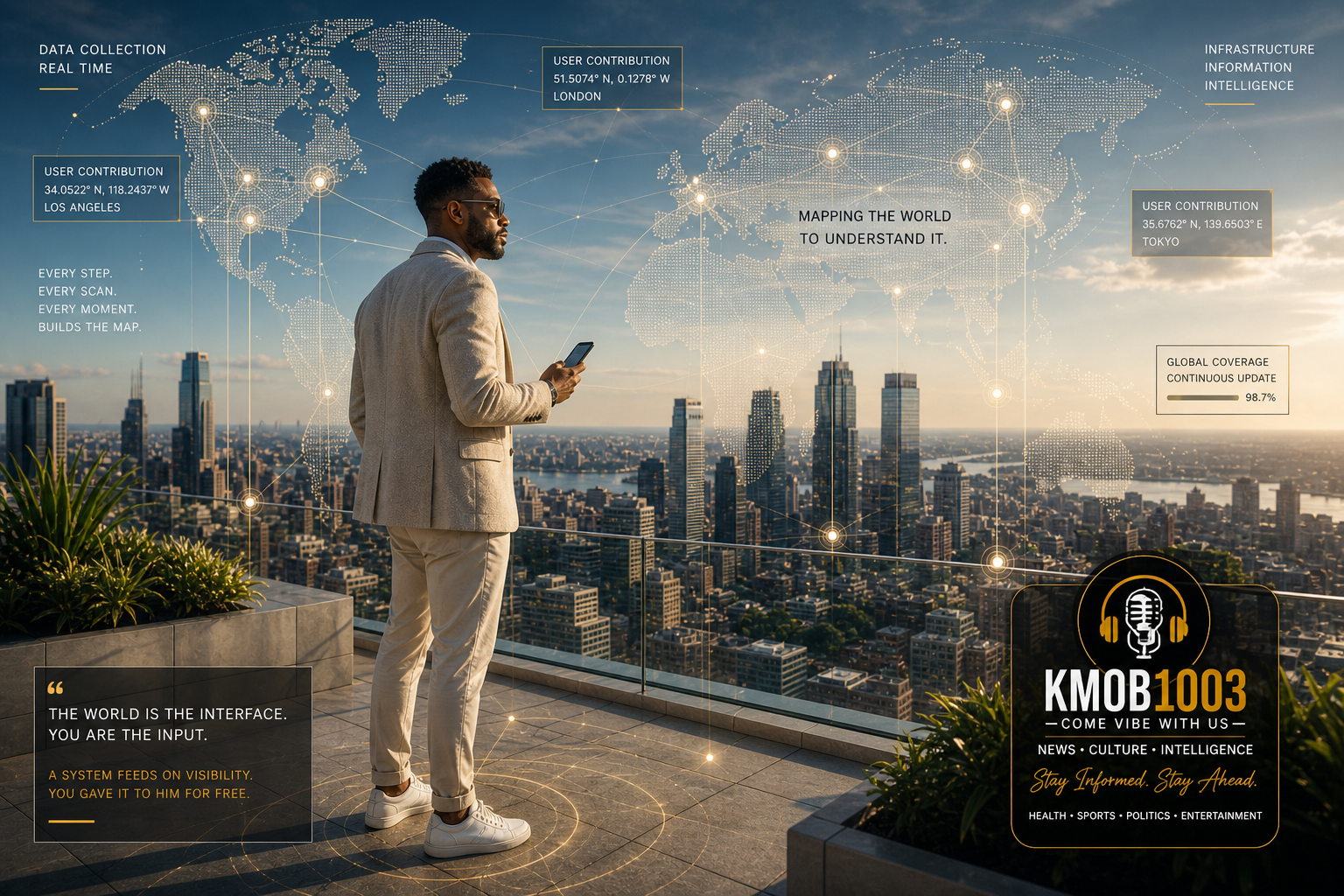
In 2016, 500 million people downloaded Pokémon GO and walked the streets of their cities, their neighborhoods, and their private communities — phones out, screens lit, feeding location data into a system they believed was a game. It was not just a game. It was the largest voluntary geospatial mapping operation ever conducted.
Niantic was spun out of Google. Its founding team built Google Maps and Google Earth. When they launched Pokémon GO, they already knew what they were building — a platform that would pay players in dopamine to do the work of mapping the physical world in granular detail no satellite could capture. The players thought they were catching Pokémon. They were building infrastructure.
By 2023, Niantic had collected more than 100 terabytes of geospatial data from players — precise walkability data, building access points, foot traffic patterns, and real-world anchor points that no government database and no satellite imagery could replicate. That data now powers Niantic’s Visual Positioning System, a spatial computing infrastructure that major enterprise clients pay to access. The game was the data collection mechanism. The data was the product. The players were the workforce.
“The most sophisticated surveillance operations in history do not look like surveillance. They look like entertainment. They look like community. They look like something you chose to participate in.”
— KMOB1003 Tech Signal Analysis 2026
Niantic Data Operation · Key Signals
Downloads in first year of launch
Geospatial data collected from players
Revenue paid to the workforce that built the map
Sources: Niantic · Bloomberg · KMOB1003 Institutional Intelligence · 2026
Data Architecture
Niantic’s origin is not a gaming company story. It is a Google Maps story. The founding team spent years building the tools that allowed Google to understand the physical world at scale — and when they left to build independently, they brought that mission with them. Pokémon GO was the consumer interface for a geospatial data platform. The augmented reality layer was the incentive structure that made people willing to contribute their location, their movement patterns, and their physical environment data voluntarily and enthusiastically.
The PokéStops and Gyms placed throughout cities were not random. They were anchor points designed to route players through specific locations — gathering geospatial calibration data about real-world points of interest that Niantic’s systems needed to build a functional Visual Positioning System. Every time a player approached a PokéStop, their phone’s camera and sensors were gathering environmental data about that location. The gameplay loop was engineered to collect exactly the data Niantic needed.
By 2020, Niantic had pivoted to reveal what had always been the underlying architecture. Its Lightship platform — a developer SDK built on the spatial data collected by its games — allowed other companies to build AR experiences anchored to real-world locations. The data the players generated became the foundation for an enterprise platform serving clients in retail, real estate, logistics, and defense. The game players never received a share of the revenue their data generated.
The most effective data collection operations are the ones participants never recognize as data collection. Before you build on any platform, understand what the platform is building with your contribution.
Operator Intelligence Layer
Genspark
The operators who understand how data extraction actually works are the ones making better decisions about where they build and what they own. Genspark gives you the intelligence infrastructure to research the systems behind the surface — before you become part of someone else’s data asset.
KMOB1003 may earn a commission from qualifying purchases.
Platform Layer
The Pokémon GO model is the perfected version of what every major platform company has been attempting since the social media era began. The extraction model works most effectively when the person being extracted from does not experience it as extraction. When the interface is fun, social, and rewarding, users do not think about what they are giving. They think about what they are getting. The gap between those two things is where the platform business model lives.
What Niantic extracted was not generic behavioral data. It was precision spatial intelligence — the kind that governments and defense contractors pay billions to acquire. The players generated that data voluntarily, at no cost to Niantic, with enthusiasm, and with no awareness that their participation had any value beyond the game. That asymmetry — between what the platform knew and what the user understood — was not accidental. It was the design.
The same architecture exists in every consumer platform that has scaled to hundreds of millions of users. The product is the incentive structure. The data is the asset. The users are the workforce. The only variable is what type of data each platform is optimized to collect — behavioral patterns, social graphs, location intelligence, biometric signatures, or in Niantic’s case, the spatial geometry of the physical world.
Every platform you contribute to is running a version of the Niantic model. The question is never whether extraction is happening. The question is whether you are building anything of your own in parallel.
The lesson of Niantic is not specific to gaming. It is a master class in how to build a data collection operation that participants experience as a gift rather than a transaction. The creators and operators who understand this architecture are better positioned to build systems that work in their favor rather than against them.
Every platform you contribute to is running a version of the Niantic model. The social platform collects your social graph. The streaming platform collects your taste profile. The productivity tool collects your workflow patterns. The fitness app collects your biometric data. The question is never whether the platform is extracting value from your participation. The question is whether you are building anything of your own in parallel.
KMOB1003’s position is clear: every platform is a discovery layer, not a destination. The audience relationships built through TikTok, Instagram, and Facebook route to infrastructure KMOB1003 owns — the radio network, the editorial platform, the affiliate ecosystem, the email architecture. The platforms get the behavioral data. KMOB1003 keeps the audience relationship. That is the only version of the game worth playing.
Every game is a data collection operation. The players who understand this build something of their own before the game changes its rules.
Use every platform as a discovery layer. Route every audience relationship toward infrastructure you own. The platforms get the data. You keep the relationship.
Infrastructure Active
Niantic’s spatial map is now among the most valuable private geospatial datasets in the world — built in granular detail from the ground-level perspective of hundreds of millions of people who walked through their cities with their phones out. That ground-level perspective captures details no satellite can see: which building entrance is actually used, where foot traffic concentrates at different times of day, how people actually navigate through physical space.
The applications of that data extend far beyond gaming and consumer AR. Defense contractors, insurance companies, real estate firms, and urban planners have applications for precision spatial intelligence that the public sector cannot produce at comparable cost or resolution. Niantic’s business model was never primarily a gaming company’s model. It was a defense-adjacent data infrastructure play disguised as entertainment — and executed with a consumer product so compelling that the workforce built it for free.
The power embedded in the map is structural. Whoever controls the most accurate spatial representation of the physical world controls the infrastructure layer for augmented reality, autonomous navigation, and spatial computing. Niantic built that infrastructure with a game. The players who built it received nothing. The company that owned the game owns the map.
Infrastructure compounds. The map Niantic owns today was built for free by players in 2016. What are you building today that will compound for someone else in ten years — and what are you building that will compound for you?

Publishing Infrastructure
Own the Infrastructure the Platform Cannot Map.
Spines publishes your book in weeks with full copyright retained. A published book is infrastructure the algorithm cannot extract from — permanently attributed, globally distributed, owned in full.
KMOB1003 may earn a commission from qualifying purchases.
You thought you were playing a game. You were mapping the world — and the company that owned the game owns the map. The move is not to stop playing. The move is to build something of your own while you do — on infrastructure you own, in formats that carry your name, generating value that compounds for you rather than for whoever happens to own the server your contribution was saved on.
Where Legends Break and Underdogs Rise.
The Culture Docent · Read Next — Part II
What Spotify Knows About You That Your Label Does Not.
This afternoon: the artist data ownership gap the music industry has not resolved — and what the operators who understand it are building instead.
Your voice. Deployed at scale. ElevenLabs turns spoken content into professional audio — podcasts, narration, and radio-ready production.
KMOB1003 may earn a commission from qualifying purchases.
