
KMOB1003 Global Protection Partner
KMOB1003 Global | The Culture Docent
AI is built on your work — even after you leave it. The data extraction model does not end when your employment does. It extends into the archive of every conversation, every decision, every creative process you documented in a digital workplace — and in 2026, there is a thriving market for exactly that data.
A company called SimpleClosure launched a product in 2026 called Asset Hub. It allows defunct startups to sell their Slack archives, email threads, and code libraries to AI developers who need realistic workplace data to train the next generation of AI agents. The founders of failed companies are recovering hundreds of thousands of dollars from the conversations their employees had while the company was still alive. The employees who had those conversations received nothing — and most of them do not know this is happening.
This is not a hypothetical privacy concern. It is a documented, operational market. SimpleClosure’s CEO reported processing nearly 100 deals for defunct companies in the past year, recovering over $1 million for founders. The buyers are AI developers building what are called reinforcement learning gyms — simulated workplace environments that train AI agents to behave like employees. Anthropic is reportedly considering spending $1 billion on these training environments. The data feeding those environments includes your Slack messages, your emails, your internal documents — and you have no legal claim to any of the revenue it generates.
“It would be an outrage if an employer recorded every conversation their employees had in a physical workplace and then sold them for profit. When those conversations are facilitated digitally, selling them is seen as a shrewd bit of business.” — Marc Rotenberg, Center for AI and Digital Policy
I.
What Is Actually Being Sold
The Slack archive of a failed startup is not generic data. It is a detailed record of how a specific group of people thought through problems, made decisions under pressure, communicated across hierarchies, and navigated the tension between what the company said it was doing and what was actually happening. It contains every interpersonal dynamic, every creative process, every strategic pivot, every moment of confusion or clarity that the team documented in writing. It is, in the most literal sense, the intellectual property of the people who produced it — repackaged and sold without their knowledge or consent.
The AI developers buying this data are not interested in the specific content of the messages. They are interested in the behavioral patterns — the linguistic signatures of workplace communication, the decision-making sequences, the way people interact with each other across different contexts within an organization. That behavioral data is what makes the reinforcement learning gyms valuable — and it is exactly what makes the privacy risk substantial.
Bobby Samuels, CEO of data vetting company Protege, explained the risk directly: if anonymization is not done correctly, companies who have access to the data could see the activities of individual organizations and people, and that information could leak into model output. The person who had that Slack conversation in 2022 might not know their communication patterns are now embedded in an AI model that is generating responses in 2026 — but the pattern is in there.
“Getting quality training data is half the battle with building an AI model, and fresh sources are increasingly hard to come by in a post-AI-ransacked internet. The data derived from a digital workplace is particularly valuable because of the industry’s heavy focus on building AI agents that can carry out work tasks.”
— Forbes, April 2026
II.
The Legal Reality — Who Actually Owns Workplace Data
The legal framework governing digital workplace data in most jurisdictions gives employers broad ownership rights over communications conducted on company infrastructure. When you send a Slack message on a company account, on a company-managed workspace, you are using the employer’s infrastructure — and in most employment agreements and jurisdictions, that means the employer owns the communication. Not you.
This legal reality predates AI. Employers have always had the right to monitor and retain workplace communications for business purposes. What changed in 2026 is that workplace communications have acquired a new category of economic value — as training data for AI systems — that the employment agreements governing those communications were not written to address. The employer’s right to retain the data is established. The right to monetize it as AI training data is a new and largely untested legal question.
Marc Rotenberg’s concern is precise: “It’s not generic data. It’s identifiable people.” The anonymization claims made by companies selling this data are contested by experts. The behavioral patterns that make the data valuable to AI developers are also the patterns that make re-identification possible — and no regulatory framework currently requires companies to demonstrate that anonymization has been effective before selling the data.
Operator Intelligence · KMOB1003 Institutional Tools
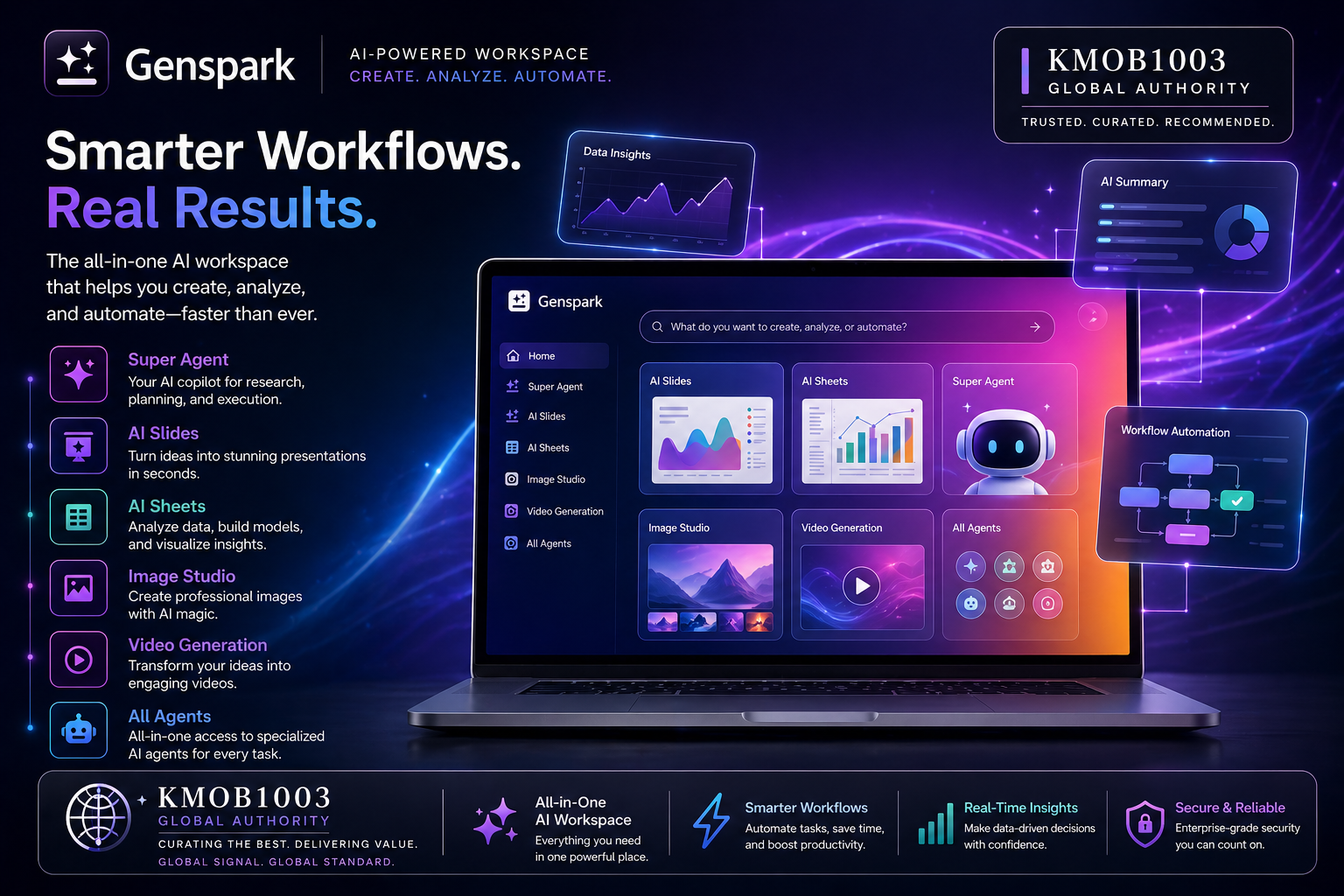
The operators who understand the data extraction landscape are the ones making better decisions about where they work, what they document, and how they protect their intellectual contribution. Genspark gives you the intelligence infrastructure to stay ahead of these developments.
KMOB1003 may earn a commission from qualifying purchases.
III.
What This Means for Every Creator and Operator
The Slack monetization story is one instance of a broader structural reality: every digital communication you produce on infrastructure you do not own is a potential asset for whoever does own that infrastructure. This is not paranoia. It is the documented operating model of the digital economy. The platform you post on owns the engagement data. The employer you work for owns the workplace communication. The service you use owns the behavioral patterns your usage generates.
The creator and operator who understands this builds differently. They are deliberate about where they produce their most valuable thinking — on platforms they own rather than platforms they rent. They are deliberate about what they document in employer-owned systems versus in independently owned infrastructure. They treat their intellectual contribution as an asset that requires the same intentionality they would bring to any other asset class.
The specific irony of the Slack training data story is that it is being used to train AI agents that will do the kind of work those same Slack users were paid to do. The labor produced the training data. The training data is producing the replacement for the labor. The people who did the work receive nothing from either transaction. This is not accidental. It is the logical endpoint of a system that treats digital workplace behavior as corporate data rather than human intellectual contribution.
Your work trained the system. The system will not share the revenue with you. Build on infrastructure you own.
IV.
The Practical Response — What to Do Differently
The practical response to the workplace data extraction reality is not to stop communicating digitally. It is to be deliberate about where your most valuable intellectual contribution lives. The thinking you do in a company Slack is not the thinking you should be doing if that thinking represents your genuine creative or strategic contribution. That thinking belongs in infrastructure you own — a personal knowledge base, an owned editorial platform, a published work that carries your name and your copyright.
The independent creator and operator is structurally better positioned for this reality than the employed worker. Every piece of original thinking published on owned infrastructure — the editorial platform, the newsletter, the book — is intellectual property that belongs to the creator, generates compounding value for the creator, and cannot be sold by a third party without the creator’s consent or compensation. The KMOB1003 content archive is not training someone else’s AI without attribution. It is building KMOB1003’s authority, reach, and revenue — on infrastructure KMOB1003 owns.
The creators and operators who are ahead of this moment are building the habit of publishing their best thinking in formats they own before they share it in formats they do not. The insight that gets drafted in a personal document first, then posted to a platform, belongs to the creator in a way that the insight drafted directly in a company chat or a social platform does not. This is not a technical distinction. It is a strategic one — and the value of that strategic distinction is becoming clearer every quarter as the AI training data market expands.
KMOB1003 Tech Signal
Your old Slack messages are training someone else’s AI. Your former employer sold them. You were not consulted and you will not be compensated. The response to that reality is not anger. It is building — on infrastructure you own, in formats that carry your name, generating value that compounds for you rather than for whoever happens to own the server your thoughts were saved on.
Where Legends Break and Underdogs Rise.
The Culture Docent | Read Part I
AI Did Not Replace Work. It Repriced Time.
This morning’s intelligence report documented what the AI repricing actually means for operators — and why the value moved to judgment, authority, and owned audience relationships rather than production capacity.
KMOB1003 | Publishing Infrastructure
You built the audience. Now write the book.
Spines publishes your book in weeks, not years. KMOB1003 builds the audience before it exists. The operator who owns the content owns the compounding value.