KMOB1003 Global Protection Partner
KMOB1003 Global | The Culture Docent
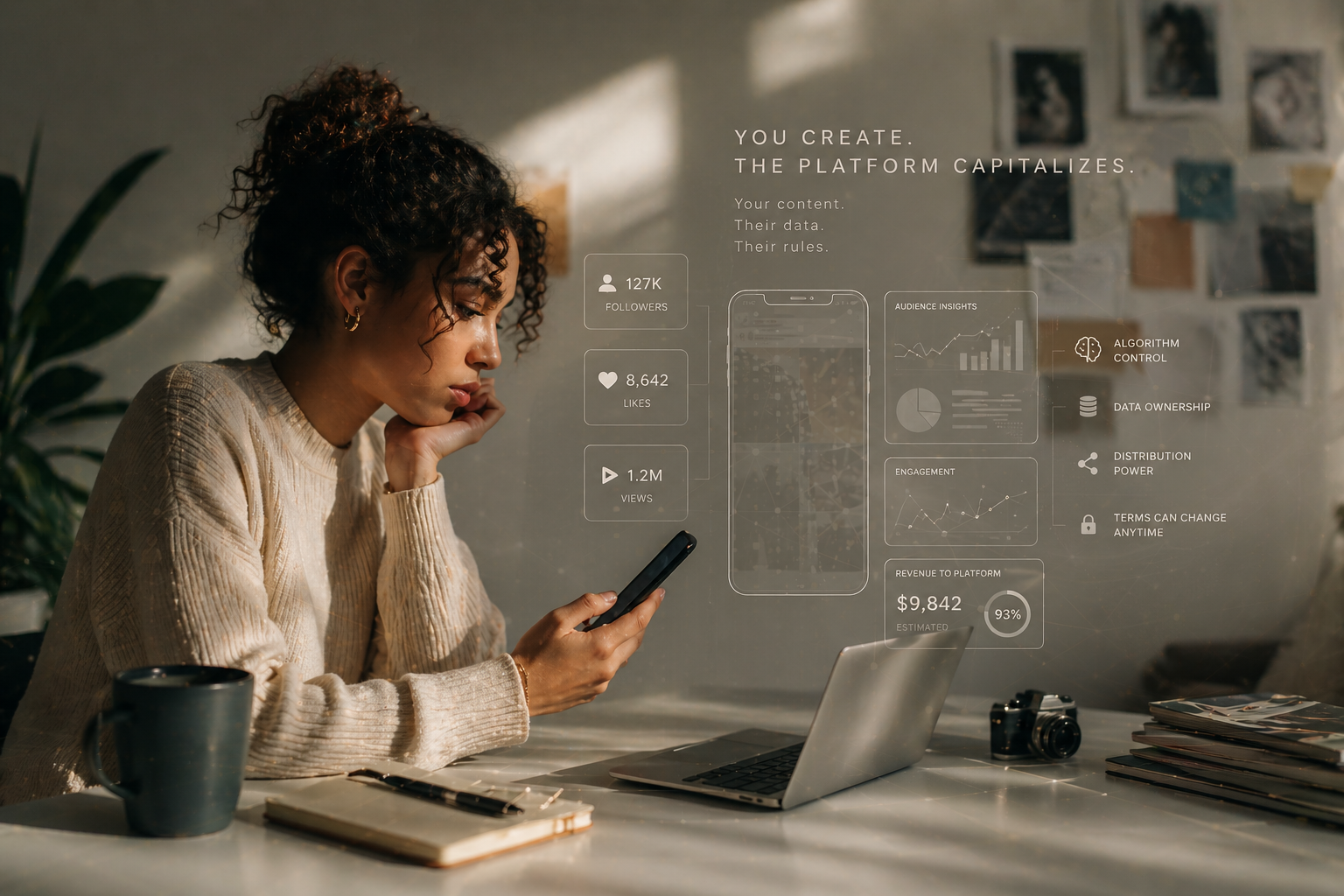
Every platform that offered creators a free way to reach millions built its business model on the assumption that creators would never understand what they were actually giving up. In 2026, that assumption is being tested — and the creators who have figured it out are quietly building something the platforms cannot touch.
The creator economy generated $20.6 billion in revenue in 2026. That number sounds like abundance. What it conceals is the structure underneath it — who owns the audience, who owns the data, who owns the relationship, and who gets to decide whether the creator can still reach their followers tomorrow. The answer to all four questions is almost never the creator.
The creator economy was sold to a generation of builders as democratization. Anyone could create. Anyone could reach an audience. Anyone could build a business without a gatekeeping institution standing between them and the people who wanted to hear from them. That promise was real enough to generate 829K followers, 35 million views, and global distribution across 50 countries for KMOB1003 — all without a major media infrastructure deal. But the promise came with terms that nobody announced. And the terms are the business model.
“Free platforms are not free. They are deferred invoices — and the currency they collect is not money. It is attention, data, audience relationships, and creative leverage.”
I.
What the Platform Actually Owns
When you post on TikTok, Instagram, or YouTube, you do not own what happens to that content next. You own the content in the narrow legal sense of copyright — but you do not own the distribution, the algorithm that determines who sees it, the data about who watched it and for how long, or the relationship between your account and your followers. The platform owns all of that. And the platform can change the terms of that ownership at any moment, with any notice period it chooses to give.
This is not a hypothetical risk. It is the documented operating reality of every major social platform. TikTok has changed its algorithm. Instagram has deprioritized accounts. YouTube has demonetized creators without warning. The pattern is consistent across every platform and every era: the platform optimizes for its own revenue, not the creator’s. When those interests align, the creator benefits. When they diverge, the creator discovers how little of the infrastructure they actually own.
The more sophisticated version of this problem is the data layer. Every view, every share, every comment, every second of watch time — that behavioral data belongs to the platform. The creator sees an engagement rate. The platform sees a behavioral profile of millions of users that it can sell to advertisers, train its recommendation engine on, and use to build products that compete directly with the creators who generated the data in the first place.
“59% of creator economy revenue comes from sponsored content — brand deals that can disappear with a policy change, a cultural moment, or an algorithm shift. The creators who will build lasting wealth are the ones converting that income into owned infrastructure before the dependency becomes a vulnerability.”
— KMOB1003 Creator Economy Analysis 2026
II.
The Three Things Platforms Take That Nobody Talks About
Attention arbitrage. The platform sells your audience’s attention to advertisers. You generate the content that earns the attention. The platform captures the revenue from that attention. You receive a fraction of it — if you qualify for monetization at all — and only under the terms the platform sets, which it can revise at any time.
Behavioral data. Every piece of content you publish trains the platform’s algorithm. Every engagement signal your audience generates becomes training data for a recommendation system that the platform owns. You are not just a creator on the platform. You are an unpaid data labeler helping the platform build the infrastructure that determines whether your content gets seen at all.
Audience relationships. Your followers follow you on a platform — not you directly. If that platform decides to limit your reach, change its recommendation algorithm, or ban your account, it takes the audience relationship with it. You have no direct contact with the people who chose to follow your work. The platform sits between you and them — and it charges for that position every time you want to reach them outside of organic discovery.
Operator Intelligence · KMOB1003 Institutional Tools
The creators who understand the platform extraction model before the rest of the market do are the ones building the infrastructure that compounds. Genspark gives you the intelligence layer to research, analyze, and build your owned system with precision.
KMOB1003 may earn a commission from qualifying purchases.
III.
Why Most Creators Never See It Coming
The extraction model works because it is gradual and because the early stages feel genuinely mutual. A new creator joins a platform and the platform promotes their content aggressively — because new creators bring new audiences and new engagement signals that benefit the platform’s recommendation engine. The creator grows. The creator attributes that growth to the platform’s generosity. The dependency deepens.
Then the platform matures. The growth phase ends. The algorithm shifts to favor content types that maximize advertising revenue rather than content that serves the creator’s audience most effectively. The creator’s reach drops. The platform offers paid promotion tools to recover that reach. The creator pays for access to an audience they built — on infrastructure they do not own.
KMOB1003 has 829K followers on TikTok, 35 million views in the last 365 days, and 911K shares. None of that audience lives in infrastructure KMOB1003 owns. The radio network that streams to 50+ countries without asking any platform for permission — that is owned infrastructure. The editorial platform that builds authority through organic search — that is owned infrastructure. The email architecture that delivers directly to readers — that is owned infrastructure. The TikTok numbers are the discovery layer. The owned infrastructure is the business.
The platform gives you reach. It keeps the relationship. Only one of those things compounds.
KMOB1003 | Performance Infrastructure
Longevity Is Infrastructure.
High-performing systems require sustained energy, clarity, and recovery. The operators building independently in 2026 are treating their physical performance with the same intentionality they bring to their digital infrastructure.
IV.
What the Creators Who Have Figured This Out Are Building
The creators who have correctly understood the platform extraction model are not leaving the platforms. They are using them differently. They treat social platforms as the discovery layer — the top of a funnel that routes high-intent audience members toward owned infrastructure. The viral moment is not the destination. It is the acquisition event that begins a relationship the creator can actually own.
The owned infrastructure looks different for different creators — but the categories are consistent. Direct email relationships that deliver content to an inbox the platform cannot access. Editorial platforms that build authority through organic search that compounds over years. Radio or podcast networks that stream directly to audiences without algorithmic intermediation. Commerce infrastructure that converts audience trust into revenue without a platform taking a percentage of every transaction.
The most important number in the KMOB1003 operation is not the 829K TikTok followers. It is the 16% of radio streams that come through programmatic API pulls — other platforms pulling the KMOB1003 signal automatically, without KMOB1003 having to place it. That is owned infrastructure generating automatic distribution. That is what the platform extraction model cannot replicate — because you cannot extract from infrastructure you do not own.
KMOB1003 | Creative Partner
A book is owned infrastructure the platform cannot reach.
The creators building real ownership publish their thinking in formats that live outside the algorithm. Spines gives you the infrastructure to publish globally with full creative and commercial ownership.
V.
The Decision Every Creator Needs to Make Right Now
The window for building owned infrastructure before the platform dependency becomes irreversible is not permanent. The longer a creator builds exclusively on platform infrastructure, the more their audience relationship, their content archive, their revenue model, and their creative identity become entangled with systems they do not control. The extraction deepens with every piece of content posted without a strategy for routing that audience toward something owned.
The decision is not whether to use the platforms. They are the most powerful discovery infrastructure available to independent creators in 2026. The decision is whether to treat the platform as the destination or the entry point. Destination thinking builds followers. Entry point thinking builds infrastructure. Only one of those compounds into something the platform cannot touch — regardless of what it decides to do with its algorithm tomorrow.
KMOB1003 Global Signal
The creator economy is not free. It never was. The platforms built their business models on the assumption that creators would never understand what they were giving up. The ones who have figured it out are not angry about it. They are building something the platforms cannot reach. That is the move.
Where Legends Break and Underdogs Rise.
The Culture Docent | Related Reading
Viral Is Not Power. Distribution Is.
The platform gives you reach. Distribution gives you leverage. KMOB1003 documented why only one of them compounds — and what building the infrastructure underneath the platform actually looks like.
