KMOB1003 Global Protection Partner

KMOB1003 Global | The Culture Docent
The Organizational Model That Refuses to Die
The technology changed. The infrastructure changed. The economy changed. The tools changed. And most organizations are still running the same operating model they built thirty years ago — and wondering why nothing is working the way it should.
In 1995 the operating model made sense. Fixed hours. Physical presence. Information controlled at the top. Meetings as the primary decision-making mechanism. Annual performance reviews as the primary feedback loop. It was designed for a world where information moved slowly, where coordination required physical proximity, and where the tools available to workers were largely uniform regardless of role. That world does not exist anymore. The model does.
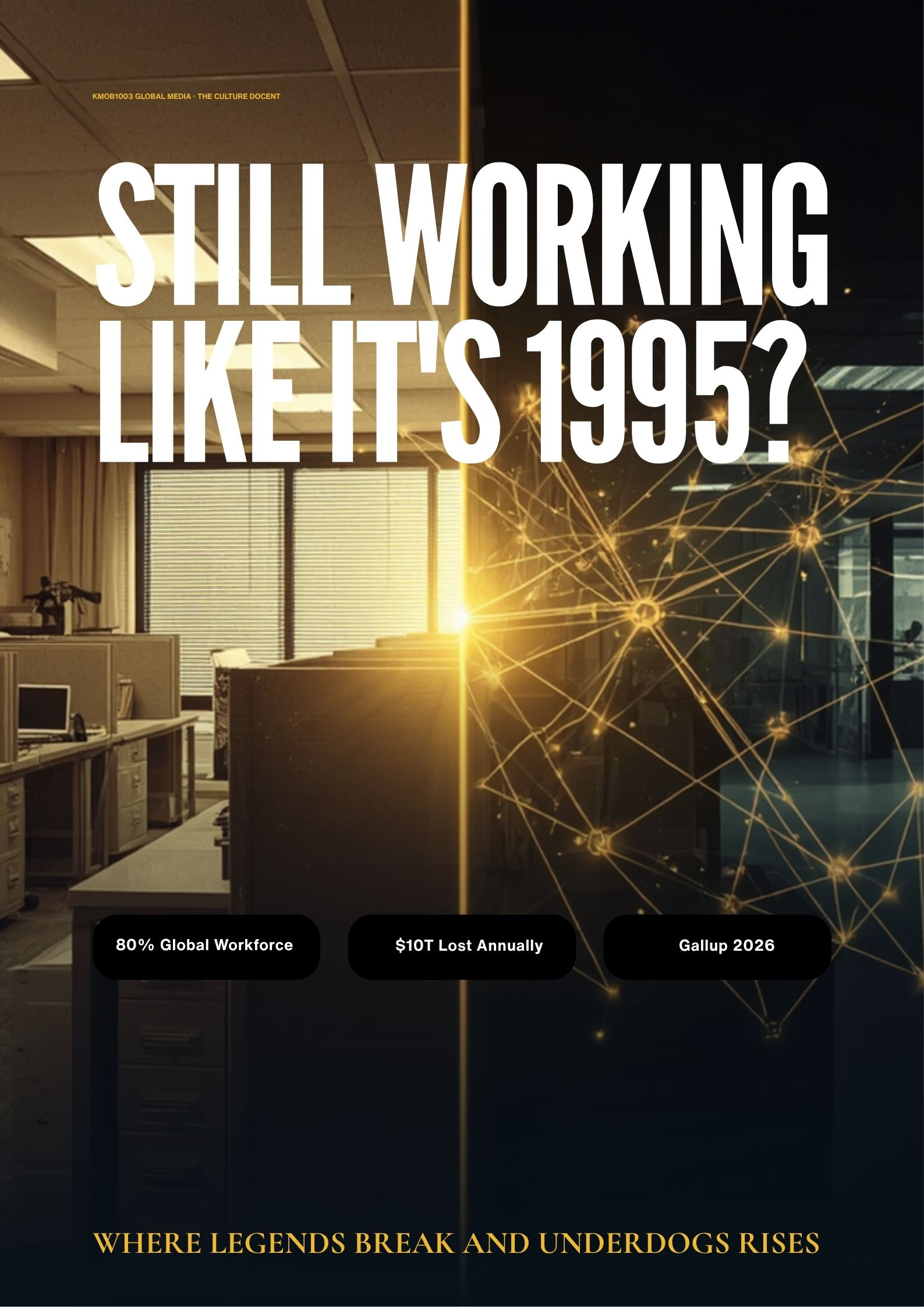
The 2026 Gallup State of the Global Workplace report documents what most leaders already feel but rarely name directly — 80% of the global workforce is either disengaged or actively working against the organization they belong to. The cost is $10 trillion in lost productivity annually. That is not a workforce problem. That is a systems design problem. And it traces directly to an operating model that was architected for a world that ended two decades ago.
“The defining challenge of 2026 is that the systems governing attention, focus, and workforce alignment haven’t kept pace with the acceleration happening around them.”
I.
What the 1995 Model Was Actually Built For
The organizational structure that most companies still operate today was designed around one fundamental constraint — information was expensive to move. When communication required physical presence or written correspondence, when data lived in filing cabinets rather than cloud servers, when coordination required meetings because there was no other mechanism for real-time alignment, the hierarchical model was not bureaucracy for its own sake. It was the most efficient solution available for the problem of the time.
Fixed hours existed because synchronization required it. Physical presence was required because tools were location-dependent. Management layers existed because information had to travel through human relays to move across an organization. Annual reviews existed because the feedback loop required time to gather and process performance data. Every element of the model had a reason. The reasons are gone. The model stayed.
The research is unambiguous on what actually drives performance in 2026. Focus efficiency — the percentage of work time spent in uninterrupted, productive activity — has declined to 60%, a three-year low. Remote-only workers log the highest daily productive time at 7 hours and 1 minute. Office-only workers show the highest focus efficiency. Hybrid workers span the longest workdays but log the lowest productive time of any model. What the data shows is that location itself is neutral — what determines performance is whether the systems around the work are designed intentionally or inherited by default.
“No single work model has a monopoly on performance. What matters more than where employees sit is whether the systems around them are built to support how they actually work.”
— ActivTrak 2026 State of the Workplace
II.
Why Organizations Will Not Let Go
The 1995 model persists not because it works — it demonstrably does not — but because changing it requires confronting something most organizations are not equipped to confront. The model is not just a set of operational practices. It is a power structure. Fixed hours, physical presence, and information hierarchies concentrate control at the top. The model persists because the people with the authority to change it are also the people who benefit most from the version of control it provides.
Deloitte reports that 71% of workers are performing work outside of their formal job descriptions. Job descriptions are becoming outdated within months of a hire. The organization chart shows one thing while the actual work flows in a completely different pattern. The gap between the formal structure and the actual operating reality is widening every year — and the organizations that are managing it honestly are the ones redesigning the structure rather than pretending the gap does not exist.
The PRSA 2026 workplace trends report identifies 2026 as “a time of realignment, consolidation, and disruption.” The organizations that adapt quickly are the ones that treat flexibility as an organizational agreement rather than an individual accommodation. The ones that are failing are the ones that brought people back to the office without redesigning what happens when they get there.
Operator Intelligence · KMOB1003 Institutional Tools
The operators who understand what is actually happening in the workforce — before the reports are published and the headlines are written — are the ones making better decisions faster. Genspark is the intelligence infrastructure built for people who cannot afford to wait for the consensus to form.
KMOB1003 may earn a commission from qualifying purchases.
III.
What the Data Actually Shows About Work in 2026
The productivity paradox of 2026 is this — organizations have adopted more tools, more platforms, more communication channels, and more management frameworks than at any point in history, and focus efficiency is at a three-year low. The problem is not that people are not working. The problem is that the work is not being designed. The systems are not built around how people actually focus and produce — they are built around presence, availability, and responsiveness, which are proxies for work rather than work itself.
Risk of disengagement jumped 23% in 2026. But burnout is actually down — which reveals something important. The workforce is not exhausted. It is under-challenged. More employees than ever are chronically not working to their capacity — not because they cannot, but because the systems around them are not designed to deploy their capacity. The 1995 model was not built to deploy capacity. It was built to ensure presence. Those are completely different design goals.
Only 26% of employees strongly agree that their current workplace helps them do their best work. People have returned to the office — but performance has not fully followed. The most effective work models in 2026 treat flexibility as an organizational agreement built around outcomes rather than an individual accommodation built around preference. The distinction is everything.
The 1995 model was not built to deploy capacity. It was built to ensure presence. Those are completely different design goals.
KMOB1003 | Creative Partner
The operators who understand the system write the system down.
If you have figured out how work actually works in 2026 — how to deploy capacity instead of ensure presence — that is a book. Spines gives you the infrastructure to publish it and distribute it globally.

IV.
What the Operators Who Have Already Moved Look Like
The organizations that are performing well in 2026 share one characteristic — they have separated the questions of where work happens from the questions of how work is designed. They have moved from presence-based management to outcome-based accountability. They have replaced the annual performance review with continuous feedback loops built into the work itself. They have treated the org chart as a starting point for conversation rather than a description of how decisions actually get made.
The independent operator has a structural advantage in this environment that most large organizations cannot replicate quickly. Without legacy infrastructure to protect and without management layers to maintain, the independent operator can design their working system around actual output rather than inherited convention. KMOB1003 has been built as an outcome-based system from day one — the editorial publishes when it is ready, the radio runs 24 hours without requiring anyone to be present, the affiliate infrastructure generates revenue while the founder is focused on something else. The 1995 model was never part of the architecture.
The question every leader needs to answer in 2026 is not how to make their people more productive. It is whether the system they have built is designed to deploy capacity or designed to ensure presence. One of those design goals produces results. The other produces the conditions for chronic under-challenge, disengagement, and the $10 trillion productivity gap the Gallup report documents this year.
V.
The Decision Every Operator Needs to Make Right Now
The 1995 model will not collapse on its own. Large organizations have the inertia to sustain broken systems for decades — the management layer that benefits from it will protect it, the institutional memory that built it will defend it, and the people who have adapted their working lives around it will resist changing it because change is costly. The pressure for the model to evolve is not coming from inside the organization. It is coming from outside — from independent operators who are building without the constraints of the inherited model and outperforming the organizations that are still running it.
The decision is not whether to change the model. The model is already changing — by competitive pressure, by generational expectation, by the demonstrated performance advantage of outcome-based systems over presence-based ones. The decision is whether to design the change intentionally or to have it imposed by the competitive reality. In 2026, the operators who are designing intentionally are the ones building something that compounds. The ones waiting for the consensus are running the system that was already outdated when most of them started their careers.
KMOB1003 | Creator Infrastructure
Build the system that works while you are not in the room.
ElevenLabs gives operators the voice infrastructure to scale their presence across every channel simultaneously — without the 1995 constraint of being physically present to deliver it.

KMOB1003 Global Signal
Most people still work like it is 1995 because the people who benefit from the model are the ones with the authority to change it. The operators who have already moved are not waiting for permission. They built the system that does not need it.
Where Legends Break and Underdogs Rise.
The Culture Docent | Related Reading
The New CEO Skill Is Not Leadership. It Is System Design.
The executives building durable organizations in 2026 are not the most charismatic people in the room. They are the ones who designed systems that work when they are not in the room.
