KMOB1003 Global Protection Partner

KMOB1003 Global | The Culture Docent
The Most Radical Act in the Creator Economy Is Keeping What You Built.
A KMOB1003 institutional intelligence report on why the artists, operators, and creators who will define the next decade are not building followings — they are building ownership structures. And the difference between those two things is the difference between a career and a legacy.
The music industry spent fifty years teaching artists to be grateful for the deal. For the advance. For the label’s infrastructure. For the distribution. What it never taught them was that every contract that traded ownership for access was a transaction designed to benefit exactly one party — and it was never the artist.
The conversation changed when Taylor Swift lost her masters. Not because it was unprecedented — artists had been losing ownership of their work for generations. It changed because it was visible enough, and the artist was prominent enough, and the fight was public enough that millions of people who had never thought about publishing rights or master recordings suddenly understood what was at stake. The audience became literate.
In May 2025, Swift reclaimed her masters from Shamrock Holdings. The full circle of that story — from loss to re-recording to legal reclamation — is the defining ownership narrative of this generation. And it taught the industry something it could not unlearn: ownership is not a negotiating point. It is the foundation.
What Ownership Actually Means in 2026
Ownership in music has two layers. Master rights — who owns the original sound recording. Publishing rights — who owns the underlying composition. For decades, traditional record deals required artists to sign away the masters in exchange for funding, promotion, and distribution. The label owned the recording. The artist received royalties. Those royalties were paid after the label recouped its costs — which, in practice, meant many artists never saw meaningful income from their recordings at all.
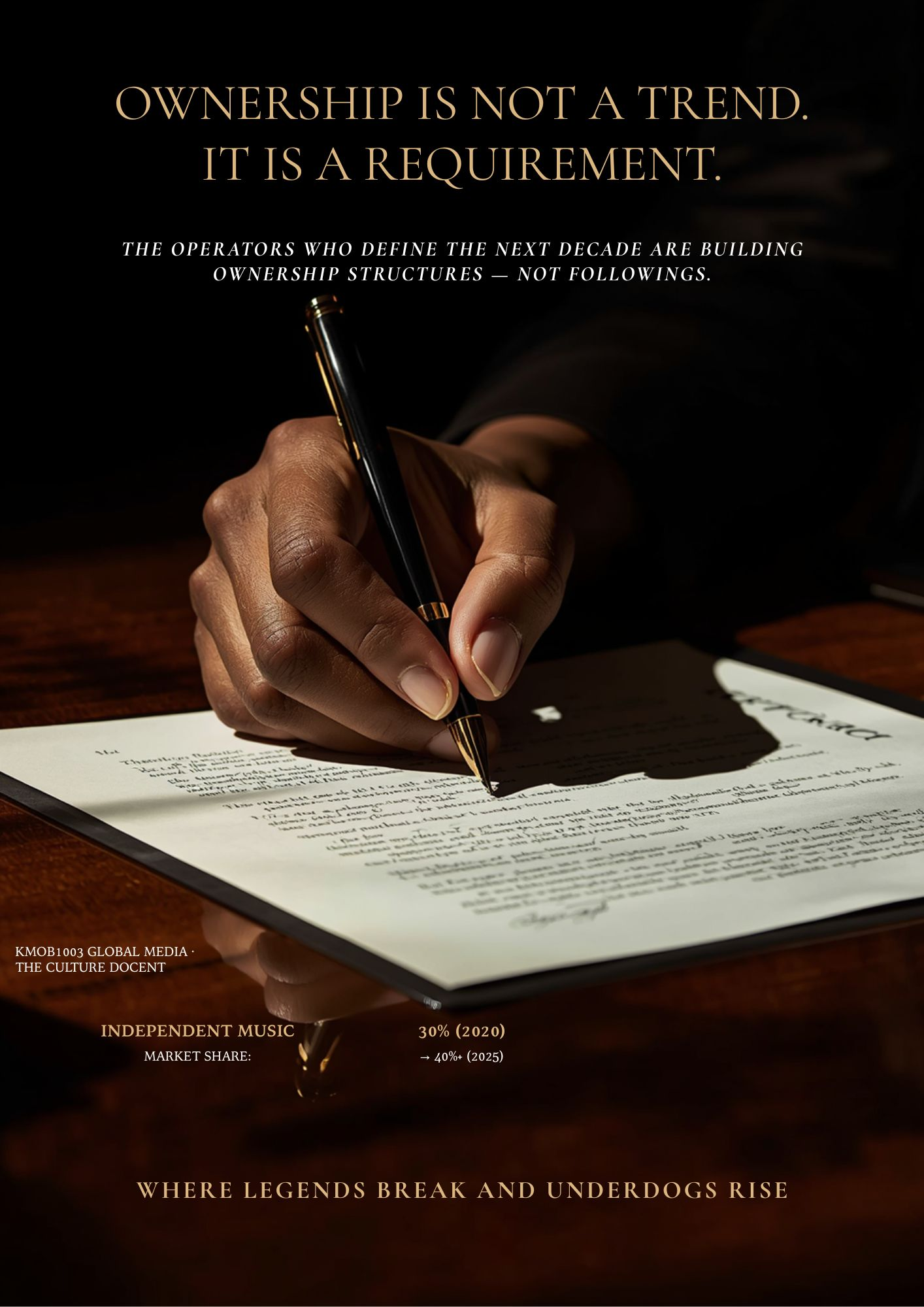
Independent music market share has grown from approximately 30% in 2020 to over 40% in 2025. That growth is not driven by sentiment. It is driven by economics. Distribution platforms have eliminated the barrier that once made label infrastructure mandatory. Any artist can access global streaming platforms for minimal cost. The marketing advantage of major labels has narrowed. And more artists — educated by a decade of public ownership battles — understand the math of what they are trading when they sign.
In 2026 the independent artist who writes and funds their own recordings owns both their master and publishing rights by default. That catalog grows. It compounds. Every stream, every sync license, every live performance that triggers a performance royalty — all of it flows back to the owner. The modern musician’s economic reality is clear: an advance is a debt you pay back. A master is an asset that pays you back forever.
“In 2026, owning your masters is no longer just a badge of creative pride — it is a sophisticated, long-term financial strategy that functions as a private pension.”
— PUSH.fm · Owning Your Masters 2026
The Deal Behind Sinners — And Why It Matters
Ryan Coogler’s deal for Sinners with Warner Bros. is the business template for this generation of Black creators. As we documented in Ownership Is the Real Power. The Deal Behind Sinners. — Coogler did not just direct the film. He negotiated ownership. First-dollar gross participation. IP rights that revert to him. A structure that made him not just a filmmaker but an asset holder.
That deal generated over $2 billion globally. The royalties, the licensing revenue, the sequel rights, the merchandise, the cultural permanence of a film he owns — that is not a career achievement. That is an inheritance. Something that compounds for decades and passes to the next generation.
The creative class that comes after Coogler — the filmmakers, the musicians, the writers, the podcasters, the digital media operators — are watching that deal and learning a different lesson than their predecessors learned. The lesson is not “get famous enough to negotiate.” The lesson is “build the ownership structure first and let everything else follow.”
Operator Intelligence · KMOB1003 Institutional Tools
Building ownership requires intelligence — knowing which platforms protect your rights, which contracts to avoid, and which structures create compounding value. Genspark gives operators the research infrastructure to move with precision before the industry catches up.
KMOB1003 may earn a commission from qualifying purchases.
The Platform Problem — And Why Owned Infrastructure Is Non-Negotiable
Ownership in 2026 is not just about masters and publishing rights. It is about platform sovereignty. The creator economy was built on a promise that turned out to be a lease agreement. TikTok, Instagram, YouTube, Spotify — these platforms gave creators reach. They never gave them ownership. An algorithm change, a policy update, a deplatforming event — and the audience you spent years building is no longer yours to access.
The most successful independent artists and creators in 2026 are treating their email list, their website, and their direct-to-consumer infrastructure as their most valuable assets — more valuable than their follower counts. Social media is the marketing layer. The owned platform is the asset. This is not a philosophical preference. It is an economic survival strategy in an environment where platforms change their terms without notice and creators have no legal recourse.
KMOB1003 has operated on this philosophy since 2021. Our global radio stream, our editorial platform, our email infrastructure, our domain — these are owned assets. The social media presence amplifies what we own. It does not replace it. Operators who cannot be deplatformed are operators who built something the platform cannot take.
An advance is a debt you pay back. A master is an asset that pays you back forever.
KMOB1003 | Creative Partner
Owning your voice starts with owning your words.
The operators and artists building real legacies are doing it in every format. A book is the most permanent asset in the ownership economy — it belongs to you, it compounds in value, and it cannot be deplatformed. Spines gives you the infrastructure to publish with full ownership and global distribution.
Lorde Just Made the Decision Public
In March 2026, Lorde revealed in a series of voice notes shared with fans that her contract with Universal Music Group — first signed in 2009 — expired at the end of 2025. She described her situation as a “blank slate.” An artist at the height of her cultural relevance, choosing independence over the infrastructure of the world’s largest record label.
This is not an isolated decision. It is a pattern. The artists who built real audiences, real catalogs, and real cultural authority are increasingly choosing to own what they build rather than rent their access to it. And as the tools of distribution, production, and promotion become more accessible, the economic argument for trading ownership for label support gets harder to justify.
The music industry has entered what analysts are calling the ecosystem model — where success is defined not by gatekeeper approval but by ownership clarity, economic control, and direct relationships with the people who value your work. The artists building inside that model are not waiting for permission. They are building the infrastructure and issuing the invitation themselves.
How KMOB1003 Applies This Principle
KMOB1003 was built as an ownership-first institution from its founding in June 2021. The editorial platform is owned. The radio network is owned. The domain, the brand, the audience data, the content archive — owned. The social media presence is a distribution mechanism, not the asset. The affiliate partnerships are revenue infrastructure on top of an owned platform, not a replacement for it.
This is why KMOB1003 is positioned as an investable institutional asset — not a content creator account. Investors do not fund follower counts. They fund ownership structures. Revenue infrastructure. Distribution architecture with global reach and institutional credibility. Everything KMOB1003 has built since 2021 was built with that clarity as the foundation.
The artists, operators, and creators who will define the next decade are the ones making this same decision right now. Not building audiences for platforms that own the relationship. Building owned infrastructure that the platform amplifies — and cannot take. That is the requirement. It always was. The only thing that has changed is that enough people have lost enough to finally understand it.
KMOB1003 | Creator Infrastructure
Own your voice. Literally.
Ownership extends to how you sound. ElevenLabs gives independent operators and creators the ability to build a voice infrastructure that scales — without surrendering creative control to a platform or a label.
KMOB1003 Global Signal
Ownership is not the reward at the end of a successful career. It is the structure you build at the beginning — before anyone can offer you something in exchange for it.
Where Legends Break and Underdogs Rise.
The Culture Docent | Related Reading
Ownership Is the Real Power. The Deal Behind Sinners.
Ryan Coogler’s deal with Warner Bros. is the business template for this generation. KMOB1003 broke down every layer of how he structured ownership before the camera rolled.
