
KMOB1003 Global Intelligence | Fashion Archive

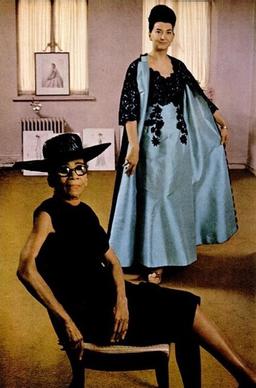
Ann Lowe did not simply make dresses. She engineered the visual identity of American high society while being structurally denied full recognition inside the very world she dressed. Her story is not just fashion history. It is a lesson in aesthetic mastery, institutional erasure, and the cost of excellence.
For the modern observer of style, the name Ann Lowe may not arrive with the instant institutional recognition of Chanel or Dior. Yet for generations of America’s most prominent families, Lowe represented something far more exacting: the couturier trusted to create garments for the most photographed, symbolically loaded moments of elite American life.
Born in 1898 in Clayton, Alabama, Lowe came from generations of Black dressmakers whose work served wealthy Southern families. What she inherited was more than skill. She inherited a language of precision, finish, discipline, and beauty that she would later transform into one of the most remarkable careers in American fashion.
Her story matters because it reveals a recurring pattern in cultural history: Black genius often built the aesthetic architecture of American life while credit flowed elsewhere. Ann Lowe did not merely survive exclusion. She created excellence so undeniable that even institutions designed to separate her still relied on her work as the benchmark.
That same conversation around adornment, polish, and visual identity continues now through contemporary accessories and styling. Readers drawn to the legacy of detail and finish may appreciate Ettika, where modern adornment carries forward the language of statement, presence, and craft.
Motion Audit
Ann Lowe, the Black American couturier behind Jacqueline Kennedy’s iconic wedding gown, helped shape the visual identity of American high society.
♻️: @_inplainsite_ | Ann Lowe
The Signal in the Silence
In 1917, Lowe moved to New York City with her son and enrolled at S. T. Taylor Design School. Because the school was segregated, she was required to attend classes in a room alone. The institution kept her apart, but her artistry would not remain hidden. Her work was shown to white classmates as an example of excellence, and she completed the program in only six months.
That period established one of the central paradoxes of her life. She was excluded from the room, yet the room needed her work as a standard. Her presence was treated as marginal while her craftsmanship functioned as the measure of mastery.
After graduating in 1919, Lowe and her son moved to Tampa, Florida, where she opened her first salon in 1920. The business quickly succeeded among wealthy clients. By the late 1920s she had saved $20,000 and returned to New York City to expand her career. That scale of momentum was extraordinary and reflected both her talent and the market’s appetite for her taste.
KMOB1003 Audio Intelligence Partner

Discover powerful stories, biographies, and cultural archives through Audible’s global audiobook library.
The Institutional Filter
Over the following decades, Lowe designed for generations of the Rockefeller, Roosevelt, Du Pont, Whitney, Post, and Bouvier families. Her work was prized for exacting hand-finishing, floral applications, elegant silhouettes, and trapunto detail. Her garments were not loud. They communicated prestige through structure, discipline, and control.
She was also highly selective about who wore her work. Lowe once described herself as “an awful snob,” explaining that she was particular about who wore her clothes. That line restores something important to the record: she was not simply grateful for elite clients. She was curating who was worthy of her artistry.
To study Lowe’s work is also to study the rooms where culture is preserved and interpreted: salons, ateliers, libraries, and domestic interiors that frame beauty as evidence. That instinct toward aesthetic environment still resonates in contemporary design spaces such as LuxeDecor, where rooms themselves become part of the larger architecture of taste.
The Fifty-Yard Silence
In 1953, Janet Lee Auchincloss commissioned Lowe to create the wedding gown for her daughter, Jacqueline Bouvier, for her marriage to then-Senator John F. Kennedy. Lowe designed a gown in ivory silk taffeta with intricate tucked detailing and a sweeping full skirt. It would become one of the most famous dresses in American cultural memory.
Then disaster struck. Ten days before the wedding, Lowe’s studio flooded. The original wedding gown and bridesmaid dresses were ruined. Lowe and her team rebuilt the garments in time for the wedding. She did not publicize the emergency, did not burden the family with the loss, and absorbed the additional costs herself.
That moment should not be reduced to fashion gossip. It is a study in professional integrity under conditions of structural invisibility. Lowe delivered a national image of elegance while quietly carrying the financial damage behind it.
“Society’s best kept secret,” the Saturday Evening Post later called her. Ebony would name her “The Dean of American Designers.”
The Price of Mastery
Lowe’s career also reveals a harsh truth about artistic labor and class. Even while she dressed some of the wealthiest families in America, she often struggled financially. Clients routinely pushed her to lower her prices. After paying staff and preserving standards, she frequently failed to retain the true value of her work.
At the height of her influence, Lowe later admitted that she was virtually broke. In 1961 she received the Couturier of the Year award, but by 1962 she lost her salon because of tax debt. That same year, her right eye was removed because of glaucoma. An anonymous supporter later paid her debts, allowing her to return to work. In 1968 she opened Ann Lowe Originals on Madison Avenue and continued until retiring in 1972.
KMOB1003 Perspective
Ann Lowe’s legacy belongs far beyond the shorthand of “the designer behind Jackie Kennedy’s wedding dress.” She should be understood as an architect of American formal style, a couturier whose work shaped the visual record of elite society while the systems around her attempted to mute her authorship.
For Women’s History Month, her story functions as correction and reminder. Luxury has always depended on Black craft, Black design intelligence, and Black aesthetic labor, even when mainstream history failed to say the names with equal force.


KMOB1003 Heritage Partner