
LEGACY & INSIGHTS: SCIENCE & TECHNOLOGY
Digital Scent Technology Can Share Smells. Here’s What Really Travels.
Digital scent technology can name a smell in one place and recreate a close match in another. How it does that is the story.
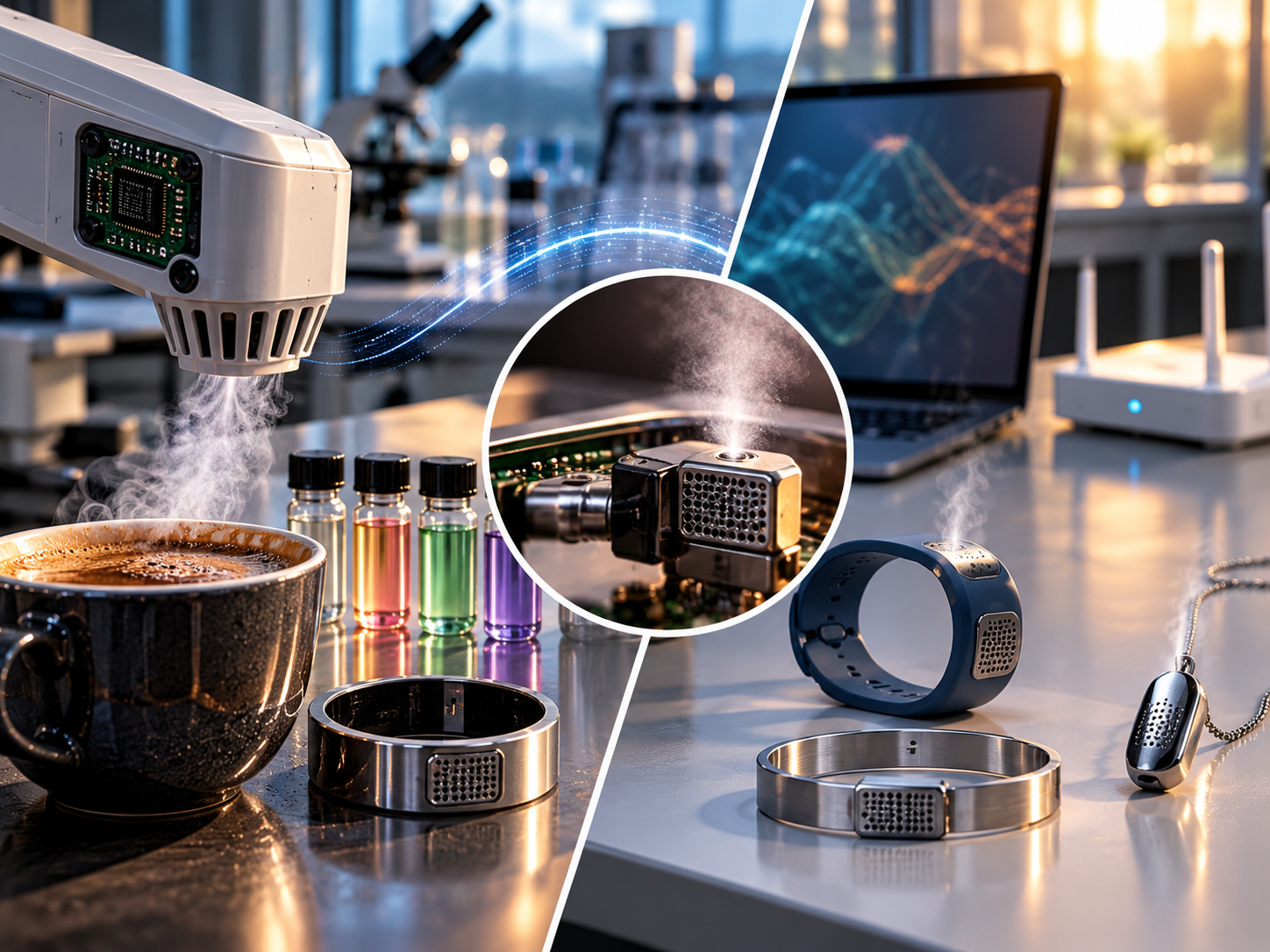
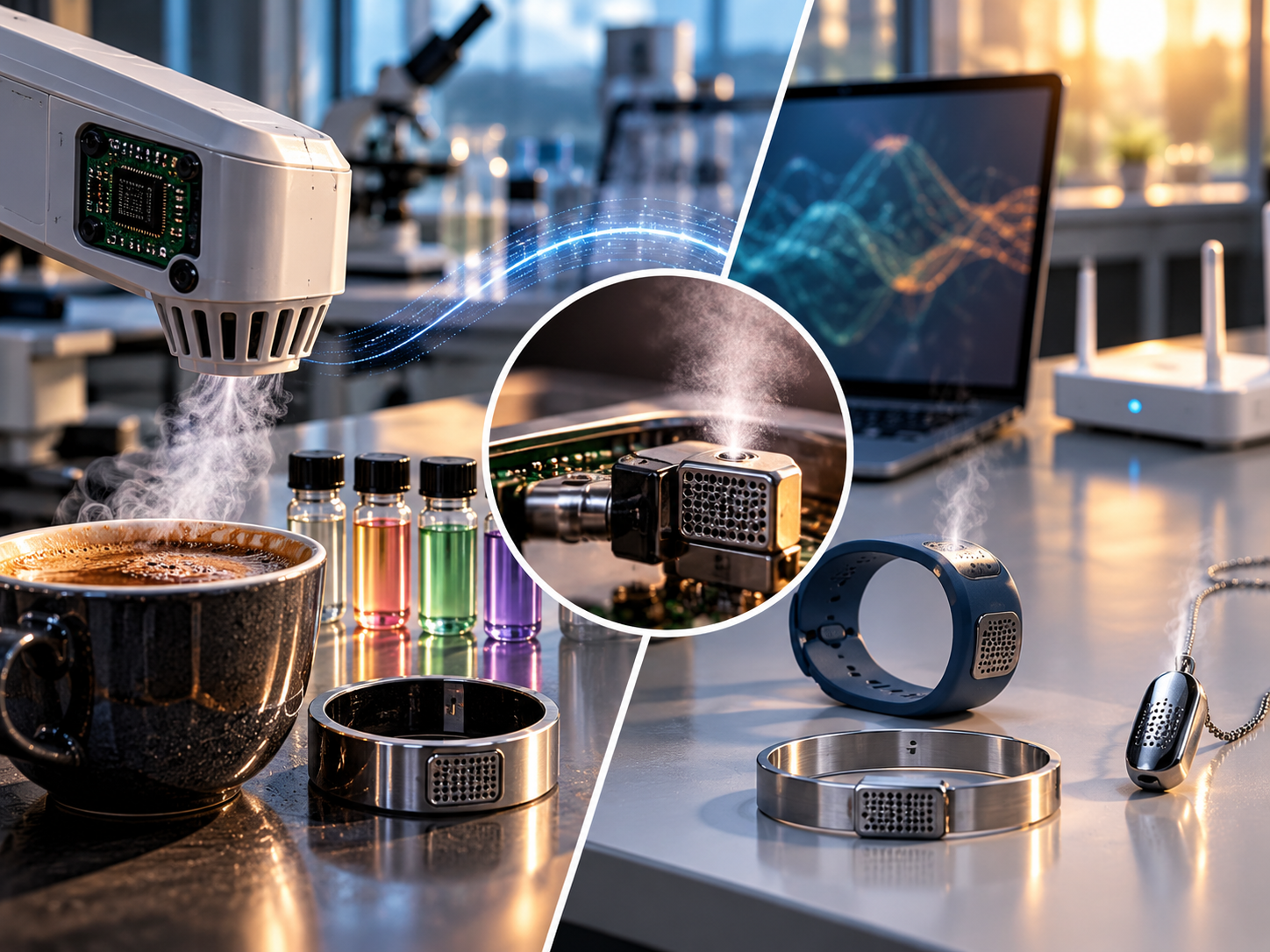
Digital scent technology just took a real step toward something inventors have long promised: smelling something that is not in the room. A team at Ohio State University and Zhejiang Laboratory reports a system called Scentronic in Science Advances. First, one device reads a scent. Then another device, somewhere else, mists a match. Still, what crosses the network is smaller than a smell, and that is where the engineering gets interesting.
How Digital Scent Technology Reads a Smell
The idea is simple to state. A sensor sniffs the air, software names what it found, and a second device recreates something close. Scentronic starts with an electronic nose built on six metal-oxide gas sensors, according to coverage of the paper. A classifier then sorts each sniff into one of five scents: beer, cake, coffee, oranges or red wine. That is a small menu, because each scent has to be learned first. However, Reuters reports the sensor unit is portable but not wearable, at roughly 15 centimeters across.

What Actually Travels in Digital Scent Technology
Because the system sends only a label, the smell itself stays behind. The label reportedly crosses the network over Wi-Fi and a cloud server. Reported network delay was about 65 milliseconds, within a range of 57 to 76. That figure covers the message alone. Meanwhile, a separate demonstration reportedly ran from sensor to spray in about 0.6 seconds, and classification itself can take seconds. These are three different measurements. Therefore, 65 milliseconds is not the speed of smelling, and no headline should say so.
What Volunteers Could Actually Smell
Do people notice the match? In tests with 14 volunteers, people identified single scents correctly 72.86% of the time, according to reports on the paper. Next, pairs of scents reached 71.43%, against a 20% chance level, and ranking intensity reached 58.57%. However, some coverage cites up to 16 volunteers, and we have not confirmed whether that was a separate test. Overall, those scores are strong for a prototype. Still, they mean roughly one attempt in four missed, and judging intensity fell lower still.

Why Bottles Limit Digital Scent Technology
The receiving devices mist preloaded scented liquids with piezoelectric atomizers, and pulse width sets the intensity. Researcher Yang told Reuters the receiver cannot recreate every smell, because each new scent needs fresh training data and a new liquid. Likewise, the paper makes the same point. Odor is classified “at the category level and reconstructed through preloaded odor channels, rather than reproduced with full chemical compositional precision,” as quoted by TechXplore. In short, the bottle sets the limit, not the bandwidth. Because the liquids are loaded in advance, the receiver can only offer what its owner stocked. Instead of rebuilding a smell from chemistry, it recalls one.
WATCH / ABC NEWS REPORT
ABC News looks at Scentronic, the prototype that can recognize five scents. The video’s caption lists “orange wine”; the researchers’ fifth scent is oranges. Source: ABC News.
FROM KMOB1003

Where Digital Scent Technology Could Go Next
Beyond the sensor, the team built receivers as a wristband, a necklace and a handheld device, plus a cup that pairs five scents with five tastes, according to coverage. Healthcare is among the proposed uses, but it is a proposal, not a demonstration. Meanwhile, Reuters describes the work as a research prototype with no company involved. So the wearable story is about form, not proof. Moreover, none of the wearable receivers has been tested outside the authors’ lab in anything we reviewed.
What Digital Scent Technology Still Has to Prove
But the headline numbers will not settle that. Independent testing will. For that, researchers outside the team would need to show that the five-scent menu can grow without losing accuracy, and that receivers can build scents from a wider palette than bottled matches. Until then, this is a clever label system with real engineering behind it. Therefore, the safest reading is a narrow one: a working prototype that proves a label can travel, not a machine that delivers a smell. Network speed was never the hard part. The bottle is.
Signal Breakdown
Not every claim about digital scent technology carries the same weight.
Widely Reported
- The paper. Researchers at Ohio State University and Zhejiang Laboratory published Scentronic in Science Advances.
- The menu. Six metal-oxide sensors classify one of five scents: beer, cake, coffee, oranges or red wine.
- The human tests. Coverage reports 14 volunteers scoring 72.86%, 71.43% and 58.57% on three tasks.
- The receivers. Wristband, necklace and handheld devices mist preloaded liquids with piezoelectric atomizers.
- The status. Reuters describes a research prototype with no company involved.
Attributed Claims and Analysis
- Speed. About 65 milliseconds is reported for the network alone, with about 0.6 seconds sensor to spray in a demonstration.
- The limit. Researcher Yang told Reuters the receiver cannot recreate every smell without new data and a new liquid.
- The paper’s wording. Odor is classified at the category level, per a quote carried by TechXplore.
- Uses. Healthcare is proposed, not demonstrated.
Not Established
- whether the 14-volunteer and up-to-16-volunteer figures come from different experiments, which the paper’s methods would settle
- the paper’s author order and its exact publication date, which sources give as October 21 or 22
- endurance and repeated-split accuracy figures that appear in only one source
- how any receiver performs outside the authors’ lab
- any independent replication
Sourcing: this report draws on coverage of the Science Advances paper from Reuters, AAAS, CNET and TechXplore, as surfaced in search results. science.org and PubMed Central blocked our access, so we did not open the paper itself, and every figure above is attributed to that coverage. We found no independent testing outside the authors’ lab in the sources we reviewed. The Signal Breakdown above separates widely reported records from attributed claims and open questions.

SCENTRONIC / KEY FACTS
RADAR / WHAT TO WATCH

KMOB1003 SELECTS
Music, style, tools, art and objects worth your attention.