
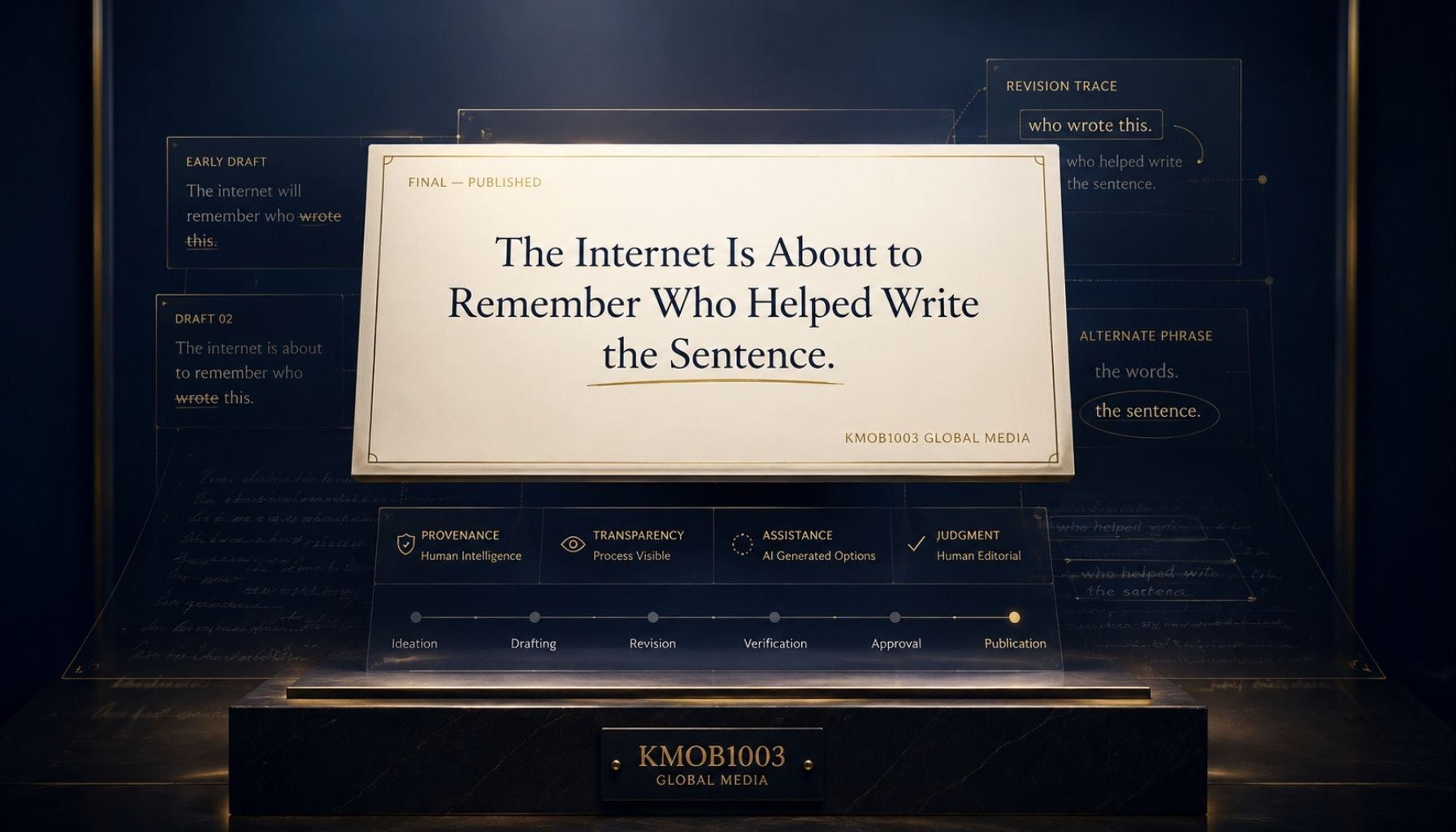
The Internet Is About to Remember Who Helped Write the Sentence
AI content provenance: the emerging ability of machines to leave a detectable, disclosed trace inside a finished sentence — and the cultural question that trace is about to force.
This is not a story about catching a student who used ChatGPT. It is a story about authorship, judgment, and what happens when a finished piece of writing can carry a record of who — or what — helped make it.
AI content provenance was not part of the internet’s original bargain. For most of its life, a sentence arrived alone. You could inspect the grammar, admire the phrasing, distrust the writer, argue with the idea — but the sentence itself never carried a record of who, or what, helped make it. That silence was never really about honesty. It was about the limits of what the page could show. That is beginning to change, and AI content provenance — the emerging ability to detect and disclose that record — is turning the question into something larger than whether a professor can catch a student running an essay through ChatGPT.
What This Article Is Actually About
This is not an argument that AI-assisted writing is dishonest, or that detection technology solves authorship. It is an examination of what AI content provenance does to originality, editing, ownership and trust once creative assistance can leave a machine-detectable trace — and why the more useful question is no longer “did AI write this,” but who supplied the judgment behind it.
Signal One
The Watermark Is Real, Not Absolute
Google’s SynthID Text embeds a statistical signal into AI-generated writing. Detection returns watermarked, not watermarked, or uncertain — never certainty.
Signal Two
The Law Now Has a Date
As of August 2, 2026, EU AI Act Article 50 imposes transparency obligations on AI providers and deployers, with a limited transition on certain marking requirements.
Signal Three
The Vocabulary Hasn’t Caught Up
“AI-generated” and “AI-assisted” are being treated as the same thing. They are not, and the difference is where the real story lives.
I. The Sentence Used to Arrive Without a Production History
A reader trusted a byline without seeing the editor’s redline underneath it. A speech moved a room without anyone mentioning the aide who drafted the second paragraph. A memoir sold in the millions while a ghostwriter’s name sat quietly in the acknowledgments, if it appeared at all. That silence was never really about honesty. It was about the limits of what the page could show.
That is beginning to change — and this is not, at its center, a story about whether a professor can catch a student running an essay through ChatGPT. That question is real, and it is smaller than the one underneath it. The actual question forming underneath every newsroom, publishing house, classroom and boardroom right now is this: who, or what, participated in making this sentence, and does the internet now have a way of remembering?
Authorship has always been more collaborative than a single name suggests. What AI changes is not the presence of assistance. It’s the scale of it, and, for the first time, the possibility that some of that assistance leaves a trace a machine can read.
II. AI Content Provenance Is Becoming Infrastructure
This is not only a student’s problem, or a professor’s. A journalist filing a story on deadline, a marketing team drafting a press release, an executive assistant polishing a founder’s memo, a novelist working through a fourth revision with a chatbot open in another tab — all of them are now writing inside a system that may, in some cases, be able to remember what happened before the sentence reached the page.
Google DeepMind’s SynthID Text embeds a statistical watermark into AI-generated text at the moment of generation, adjusting word-choice probabilities in a pattern too subtle for a human reader to notice. Detection is not a yes-or-no proposition. Google’s own documentation describes three possible outcomes — watermarked, not watermarked, or uncertain — because the signal is probabilistic, not absolute. Light editing may preserve it. Substantial rewriting or translation into another language can meaningfully weaken it.
That distinction matters, because SynthID is often confused with something broader. C2PA, a separate technical standard, focuses on recording and communicating provenance information about a piece of digital content more generally — where it came from, what touched it along the way. The two are not the same system, and one should not be treated as proof of what the other can do.
Law is now catching up to the infrastructure. As of August 2, 2026, Article 50 of the EU AI Act requires providers and deployers of certain AI systems to meet new transparency obligations, including, in relevant cases, machine-readable marking of AI-generated content and disclosure requirements for AI-generated text published on matters of public interest without human review. The obligations are specific, not universal: they distinguish provider responsibilities from deployer responsibilities, and a limited transition period applies to particular marking requirements for systems already on the market. It is not a rule that every AI sentence in Europe must now wear a permanent watermark. It is evidence that provenance is moving from a philosophical debate toward something closer to infrastructure.
III. The Most Interesting Question Isn’t “Did AI Write It?”
The old binary — human or machine — was never built for what’s actually happening on a working writer’s screen. A human writes everything. A human asks AI to organize research. A human dictates ideas rough and lets AI smooth the phrasing. AI drafts, and a human substantially rewrites. Human and machine trade a paragraph back and forth a dozen times before either one is satisfied.
Where does “AI-generated” begin? Where does “human-authored” end? The vocabulary hasn’t caught up to the practice. Film credits solved a version of this problem decades ago — director, writer, editor, cinematographer, producer, each naming a distinct kind of contribution to one finished work. Writing may be heading toward something similar: language like written by, edited by, AI-assisted research, machine translation, human verified, AI-generated draft, substantially revised. None of that exists as a standard yet. But the instinct behind it — naming contribution instead of forcing everything into a single credited author — is the direction the culture is leaning.
What Isn’t in Dispute
SynthID Text detection is probabilistic and returns watermarked, not watermarked, or uncertain — never a certainty. EU AI Act Article 50 transparency obligations became applicable August 2, 2026, with a limited transition through December 2, 2026 that applies only to the marking and detection obligation for generative systems already on the market. C2PA and SynthID are separate provenance systems and are not interchangeable. Detection confidence can drop significantly under heavy rewriting or translation.
IV. Detection Can Become Accountability — Or Surveillance
Machine-detectable provenance genuinely helps in specific places: tracing misinformation, disclosing synthetic content in public-interest reporting, giving publishers and platforms a shared standard, protecting academic integrity. Those are real gains.
But the same infrastructure carries real risk. A probabilistic signal treated as certainty can become a false accusation. Detection systems can be imperfect, and those imperfections matter most when institutions use them to make decisions about students, writers, employees or creators. A student using assistive technology can be misread as cutting corners. An employer can turn a productivity tool into a surveillance system. Uneven standards between platforms, publishers and institutions can leave two writers doing the same work judged by two different rules. And a proprietary detection algorithm can quietly become the de facto judge of who counts as a real author.
A technology built to reveal machines can also become a technology used to judge humans. That tension doesn’t resolve itself. It has to be managed, deliberately, by the people deciding how to use the tool — not assumed away because the tool exists.
V. Writers Need a New Definition of Originality
Originality has never meant isolation. Writers have leaned on editors, dictionaries, research assistants, archives, interviewers, spellcheck and search engines for as long as writing has been a profession. AI is different in capability and in scale, but the deepest question was never really did a tool touch this sentence. It was always: who supplied the judgment? Who verified the facts? Who decided what mattered enough to keep? Who made the final call? And who is willing to stand behind the result if it’s wrong?
That’s the actual center of authorship. It was true before AI, and it will still be true after the watermarks fade from the conversation. A watermark can tell you a machine was involved. It cannot tell you whether anyone stood behind what the machine produced.
VI. The Internet May Remember the Process, Not Just the Product
None of this is inevitable in one direction. Richer AI content provenance language — written by, edited by, AI-assisted research, human verified, original reporting — could give readers real transparency about how a piece of work came to exist. It could also curdle into a bureaucratic badge system nobody trusts and everybody games.
Which outcome we get depends less on the watermarking technology than on whether the culture develops language sophisticated enough to distinguish assistance from authorship — and judgment careful enough not to mistake a signal for a verdict.
The sentence may no longer arrive alone. It may arrive carrying a history. The harder question is whether that history helps us understand the work more honestly — or simply gives institutions another machine for judging the person behind it.
KMOB1003 Doctrine
The Authorship Test
Judgment
Who supplied the judgment behind this sentence?
Verification
Who verified the facts before they were published?
Decision
Who made the final choices about what stayed and what was cut?
Responsibility
Who is willing to take responsibility for the result?
If those questions cannot be answered, the provenance problem is larger than a watermark.
Signal Breakdown
Signal: Watermarking technology and EU transparency law are turning AI content provenance from a philosophical debate into working infrastructure.
Impact: Writers, publishers, employers and institutions will increasingly operate inside systems that can offer probabilistic evidence — not proof — about how a piece of writing was produced.
Watch: Whether platforms and institutions develop language sophisticated enough to distinguish AI-assisted from AI-generated work — or collapse the distinction and treat a probabilistic signal as a verdict.
The Sentence No Longer Arrives Alone.
One article can name the shift. The larger KMOB1003 archive follows how technology, culture, ownership and trust reshape who gets credit — and who gets believed.
Creator & Institutional Infrastructure
Spines
Authorship Means Most When Someone Publishes and Stands Behind It.
Provenance is not only about how a sentence was made. It is about who is willing to put a name behind it, publish it and own it. Spines connects writers to publishing, authorship and intellectual-property infrastructure built for exactly that responsibility.
Disclosure: KMOB1003 may earn a commission from qualifying purchases through select partner links. Editorial coverage is produced independently.
The Operator’s Bookshelf
KMOB1003 READS

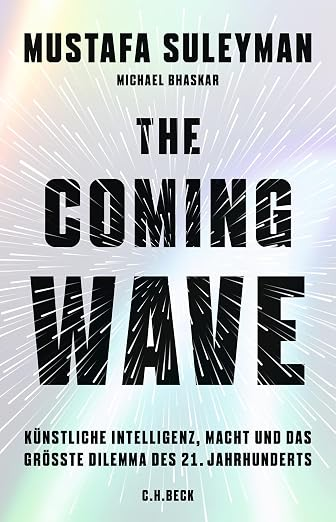
As an Amazon Associate, KMOB1003 may earn from qualifying purchases.
Disclosure: KMOB1003 may earn a commission from qualifying purchases through select partner links. Editorial coverage is produced independently.
KMOB1003 After the Article
Continue the Signal
One sentence learns to carry a history. Here’s where the pattern keeps building.

KMOB1003 Culture Docent
WARM Global Dance Radio Chart Top 20 — En Español
Global dance radio presented in Spanish. Saturdays at 3 PM Eastern on KMOB1003.
Explore Culture Docent →

KMOB1003 Artist Services
The deal no longer guarantees the push.
Artists can no longer assume a record company will build the full marketing machinery around the work. Build the media positioning, audience strategy and campaign infrastructure around the music.
Explore Artist Services →
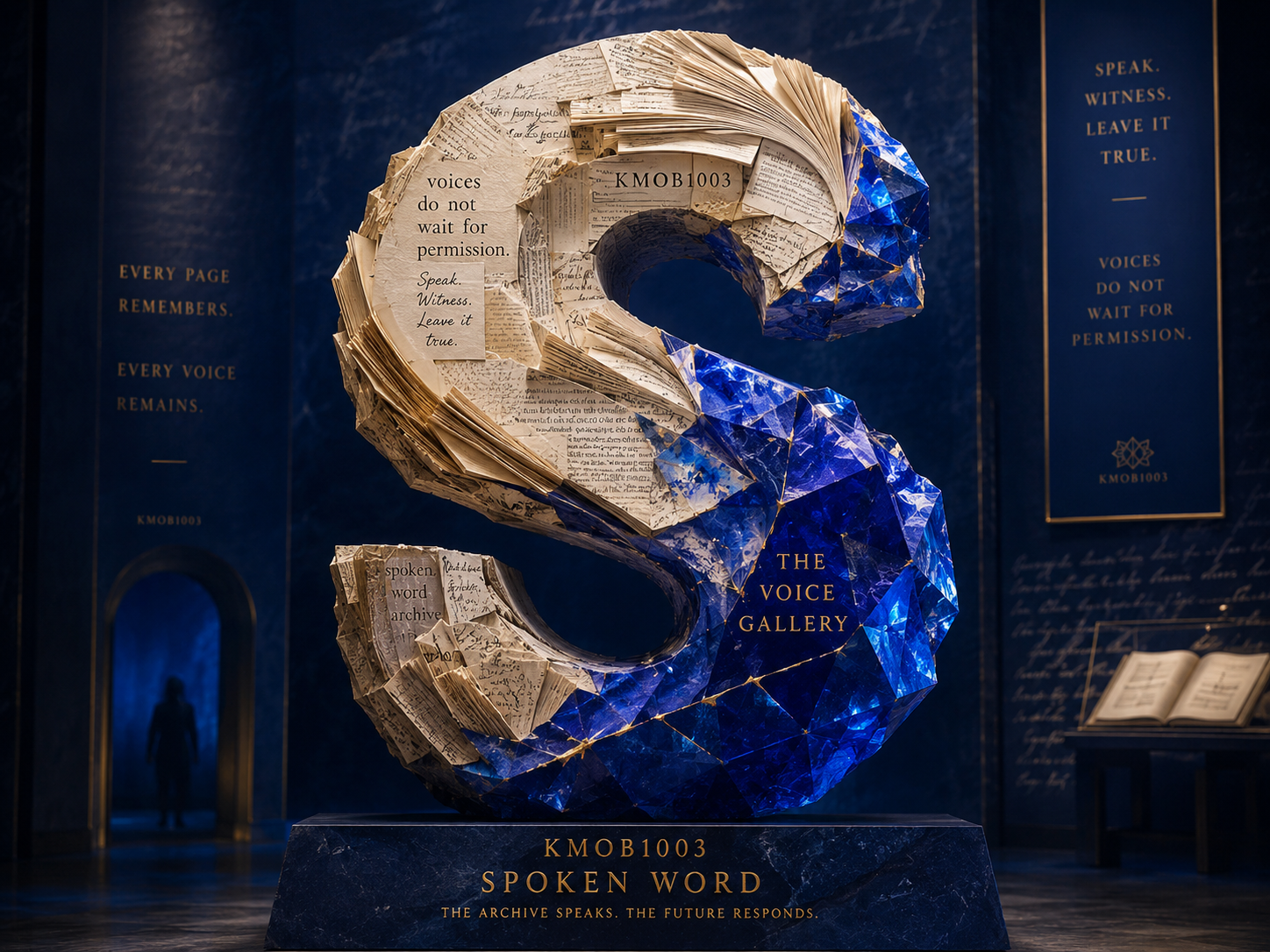
KMOB1003 Spoken Word
The Voice Gallery
Voices that do not wait for permission.
Enter the Voice Gallery →

The Global Collection
Tools. Services. Access. Infrastructure.
Explore the KMOB1003 network of creator tools, publishing, privacy, travel, live culture, style and services built around how people create, move and grow.
Explore the Collection →
Global Reach. Powerful Stories. Lasting Impact.
