
The FCC Made Local Trust Easy to Buy
FCC television ownership cap: the fixed limit that kept one television-station owner from reaching more than 39% of American households. The stations may still look local. The ownership, political pressure and editorial decisions behind them can now become much larger.
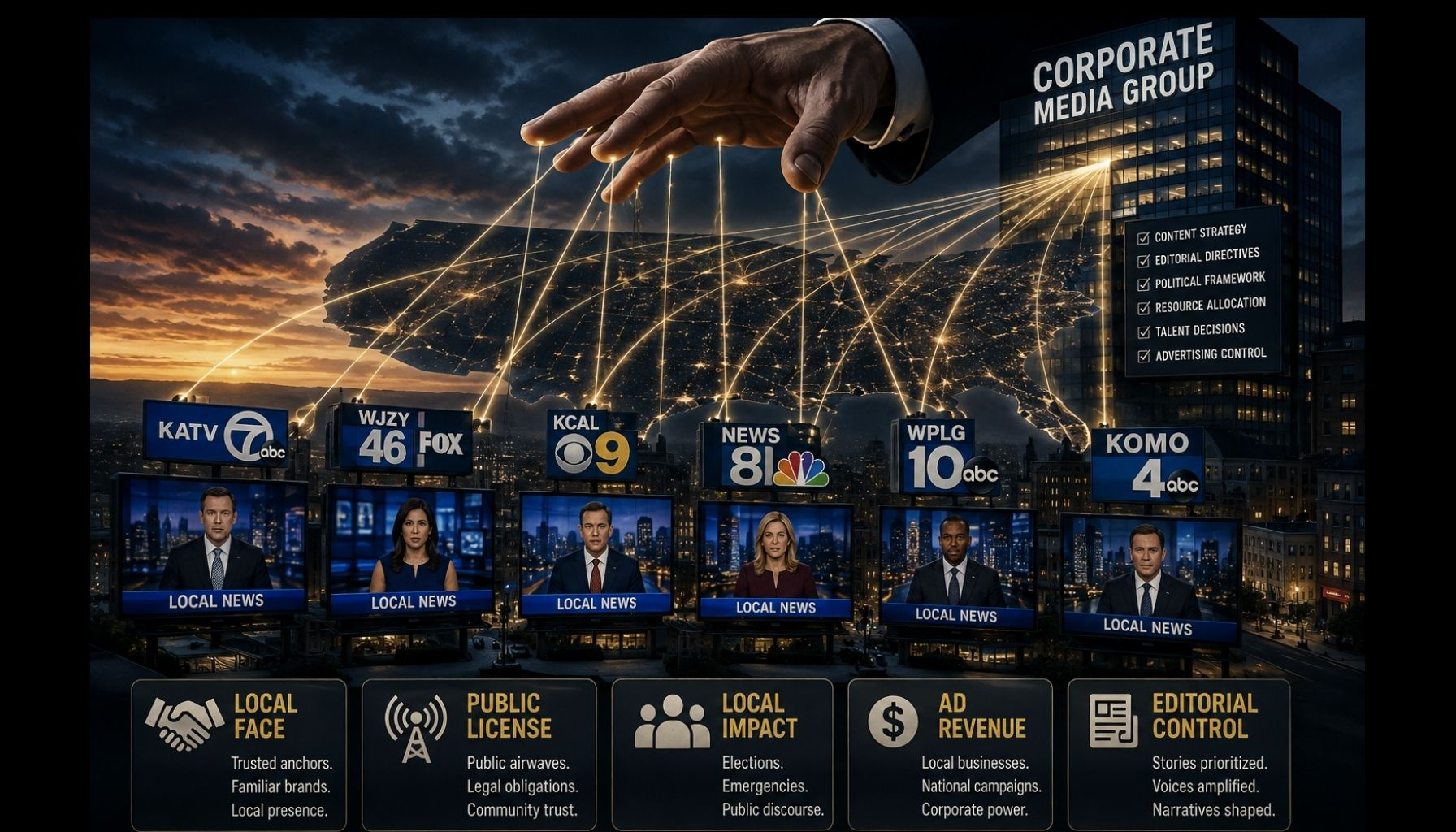
A local station is not only a transmitter. It is a relationship built through storms, elections, school closings, investigations and familiar faces. The FCC changed how much of that infrastructure one company may seek to accumulate — and placed more of the decision inside case-by-case political and regulatory judgment.
The FCC television ownership cap once placed a fixed ceiling between one broadcaster’s expansion and national control of local television infrastructure. A storm rolls toward a small town, and the station that has carried school closings for twenty years cuts in with the warning. An older voter watches the same anchor who explained the last hurricane, the last mayoral race, the factory closing that emptied out Main Street. The logo still says local. The newsroom still carries the city’s name. What changed on August 6, 2026, is how much of what sits above that newsroom — the ownership, the political pressure, the editorial decisions — a single company may now seek to accumulate, subject to transaction-by-transaction review.
What This Article Is Actually About
This is not an argument that every large broadcaster is corrupt or that every merger destroys journalism. Local stations face genuine economic pressure from streamers, technology companies, declining linear audiences and shifting advertising. This article asks a narrower question: when the FCC television ownership cap disappears, what prevents financial scale from acquiring the infrastructure of local trust while moving editorial authority farther away from the community?
Signal One
The Ceiling Is Gone
The FCC repealed the rule that generally prevented one owner’s stations from reaching more than 39% of U.S. television households and replaced it with transaction-by-transaction review.
Signal Two
The Trust Remains Local
Station names, anchors, weather teams and community histories may remain familiar even when ownership, staffing and political programming are increasingly controlled elsewhere.
Signal Three
The Review Becomes Political
A fixed rule constrained every administration. Case-by-case review places more power inside the commission deciding which expansions serve the public interest.
I. The Station Was Trusted Before the Owner Arrived
Long before any acquisition, local trust already existed. It was built by reporters who covered zoning meetings nobody else attended, meteorologists who tracked storms street by street, photographers and anchors who stayed in the same chair through a decade of school-board fights. That trust is inherited, not manufactured on arrival. A company acquiring a station is not creating a relationship with a community — it is acquiring access to one other people spent years building.
II. What the FCC Television Ownership Cap Actually Protected
On August 6, 2026, the Federal Communications Commission voted 2–1 to repeal its 39% national television multiple-ownership rule — the fixed ceiling that generally kept a single owner’s stations from reaching more than 39% of U.S. television households. Chairman Brendan Carr and Commissioner Olivia Trusty voted to approve the repeal; Commissioner Anna Gomez dissented. In its place, the commission adopted case-by-case review: transactions that exceed the old ceiling may now be approved when they satisfy a public-interest standard, and the FCC says it can still deny transactions that fail that test. The old rule was blunt — it didn’t distinguish a careful local operator from a distant conglomerate, it simply stopped both at the same number. That bluntness was also its protection: no administration could quietly raise the ceiling without a rulemaking fight.
III. The Strongest Case for Repeal
The fairest version of the broadcasters’ argument deserves a hearing before it gets an answer. Streaming platforms and technology companies operate with no comparable national reach ceiling, advertising dollars have migrated toward those platforms for a decade, and some local stations are genuinely struggling to fund newsrooms at their current size. Supporters argue that broadcasters need scale to compete and, in some cases, keep the lights on. Scale can preserve a station. But preserving the station does not automatically preserve local editorial authority, newsroom employment or independent judgment. Saving the license is not the same as saving the newsroom.
What Isn’t in Dispute
The FCC repealed the 39% national ownership rule and replaced it with case-by-case review of transactions above the old ceiling. The vote was 2–1, with Carr and Trusty in support and Gomez dissenting. Supporters say the change helps broadcasters compete against unrestricted digital platforms. Opponents question whether the FCC has the statutory authority to make this change unilaterally, and legal challenges are expected. Separately, research on Sinclair-acquired stations has documented increases in national political coverage, decreases in local political coverage and a measurable rightward shift in content following acquisition.
IV. The Buyer Does Not Have to Change the Logo
Consolidation rarely announces itself by replacing what viewers can see. The branding stays. The anchors stay, at least for a while. What moves is upstream: story selection made by a central desk, mandatory national segments, newsroom staff reductions justified as efficiency, guests booked from a centralized list. None of this requires a single visible change to the product a viewer recognizes. That is precisely what makes the shift difficult to see — not every acquisition produces every one of these outcomes, but the mechanism does not depend on the logo changing.
V. We Have Already Seen the Prototype
Sinclair Broadcast Group offers a documented, if partial, preview of the mechanism. Research examining Sinclair-acquired stations has found increases in national political coverage alongside decreases in local political coverage, along with a measurable rightward shift in editorial content. More recent research tracking online content shifts at Sinclair-acquired stations found similar patterns: more polarizing national material appearing at the expense of local topics. Sinclair is evidence of a mechanism, not proof that every consolidated owner behaves identically — but the pattern is not hypothetical. It has already been measured.
VI. What the FCC Television Ownership Cap Changes Under the Current Administration
Timing is part of the story. This repeal happened under an FCC chaired by Brendan Carr during the Trump administration, at a moment when regulatory discretion, executive-branch alignment and media-ownership capital are converging in the same direction. The far right does not need to persuade every local newsroom one reporter at a time; ownership can move the pressure point above the newsroom itself, market by market, without a single national announcement.
This is not a claim of total control. Owning a station creates agenda-setting capacity — it does not guarantee that viewers are persuaded, and it does not erase the professional judgment of the journalists still working inside these buildings. Local journalists can resist, negotiate and continue producing serious work inside consolidated systems. The question is how much institutional protection they retain when the final authority sits somewhere else. Agenda-setting capacity, concentrated at scale, is exactly what the 39% ceiling used to limit.
VII. After the FCC Television Ownership Cap, the Public-Interest Test Has to Mean More Than Scale
Every future transaction reviewed under the new case-by-case standard will pose the same question in different clothing: does this deal serve the public interest, or does it simply serve the buyer’s balance sheet? A meaningful FCC television ownership cap replacement would look past deal size to measure local staffing levels, hours of locally produced news, emergency and severe-weather coverage capacity, independent editorial authority, ownership diversity — including minority and women ownership — newsroom closures, the presence of centralized political programming and whether the community retains any real path to hold decision-makers accountable. Review conditions should also remain enforceable after closing, because promises made to secure approval mean little if local staffing, news hours or editorial independence can be reduced once public attention moves on.
A station is not local because its tower stands nearby. It is local when authority, memory, labor and accountability remain connected to the people watching. The FCC made local trust easier to buy. The public-interest test now has to determine whether the buyer is preserving the relationship — or merely purchasing the room through which it speaks.
KMOB1003 Framework
The Local Trust Test
Ownership
Who owns the license, the newsroom and the company above them?
Authority
Where are story selection, political framing and editorial decisions actually made?
Labor
How many local reporters, producers, photographers and managers remain after consolidation?
Accountability
Can the community identify, reach and challenge the person with real decision-making power?
Local branding is not proof of local authority. Follow the ownership, the labor and the decision.
Signal Breakdown
Signal: The FCC repealed the fixed 39% national television ownership ceiling and replaced it with case-by-case review of transactions exceeding the former limit.
Impact: Large station groups may seek substantially greater national reach while retaining local brands through which communities receive trusted news, emergency information and political coverage.
Watch: Whether future FCC reviews impose measurable protections for local staffing, editorial independence, viewpoint diversity and community accountability — or treat financial scale itself as evidence of public benefit.
Ownership Determines Which Voices Survive the Room.
One article can identify the pressure point. The larger KMOB1003 archive follows how media, technology, culture and ownership shape who gets to speak, scale and remain visible.
Creator & Institutional Infrastructure
ClearCRM
Own the Audience Relationship Before Someone Else Owns the Channel.
Media ownership determines who controls distribution. Independent publishers and creators need a direct, organized relationship with the people who choose to hear from them — one that does not disappear when a platform, station group or intermediary changes the rules.
Riverside
Build the Interview Outside the Gatekeeper’s Studio.
When broadcast ownership becomes more concentrated, independent reporting requires professional production capacity that does not depend on access to a consolidated newsroom. Riverside gives journalists, creators and operators a direct way to record high-quality interviews and conversations.
Genspark
Research the Ownership Before You Trust the Logo.
Media structures are rarely visible on the screen. Genspark can help operators compare regulatory documents, company records, reporting and competing claims before treating the familiar local brand as proof of independent ownership.
Spines
Turn Independent Reporting Into an Asset That Cannot Be Quietly Removed.
Spines connects independent analysis to publishing, authorship and intellectual property — a way to preserve reporting beyond a platform feed or a broadcast schedule that a new owner can reshape at will.
Disclosure: KMOB1003 may earn a commission from qualifying purchases through select partner links. Editorial coverage is produced independently.
The Operator’s Bookshelf
KMOB1003 READS


As an Amazon Associate, KMOB1003 may earn from qualifying purchases.
Disclosure: KMOB1003 may earn a commission from qualifying purchases through select partner links. Editorial coverage is produced independently.
KMOB1003 After the Article
Continue the Signal
One ownership decision changes the ceiling. Here’s where the pattern keeps building.

KMOB1003 Collection
The Global Collection
Explore tools, services and partner infrastructure selected for operators building distribution and audience relationships beyond a single platform or gatekeeper.
Explore the Collection →
KMOB1003 Artist Services
Artist Services
An ownership-centered path for independent artists building visibility, positioning and distribution without surrendering control of the work.
Build Your Signal →
KMOB1003 Culture Docent
Culture Docent
Follow the cultural and institutional connections behind the headline through KMOB1003’s guided global intelligence system.
Ask the Docent →

KMOB1003 Spoken Word
The Voice Gallery
Move from media ownership to the living voices whose authority does not begin or end with a station license.
Enter the Voice Gallery →
Global Reach. Powerful Stories. Lasting Impact.
