
KMOB1003
KMOB1003 Global · Technology · Friday PM · June 5, 2026
Meta’s smart-glasses code and Anthropic’s AI-written code are not separate signals. Together, they show the next phase of platform power — AI leaving the screen and entering the room.
The platform used to ask for your attention. Now it wants the room, the code, and the face.
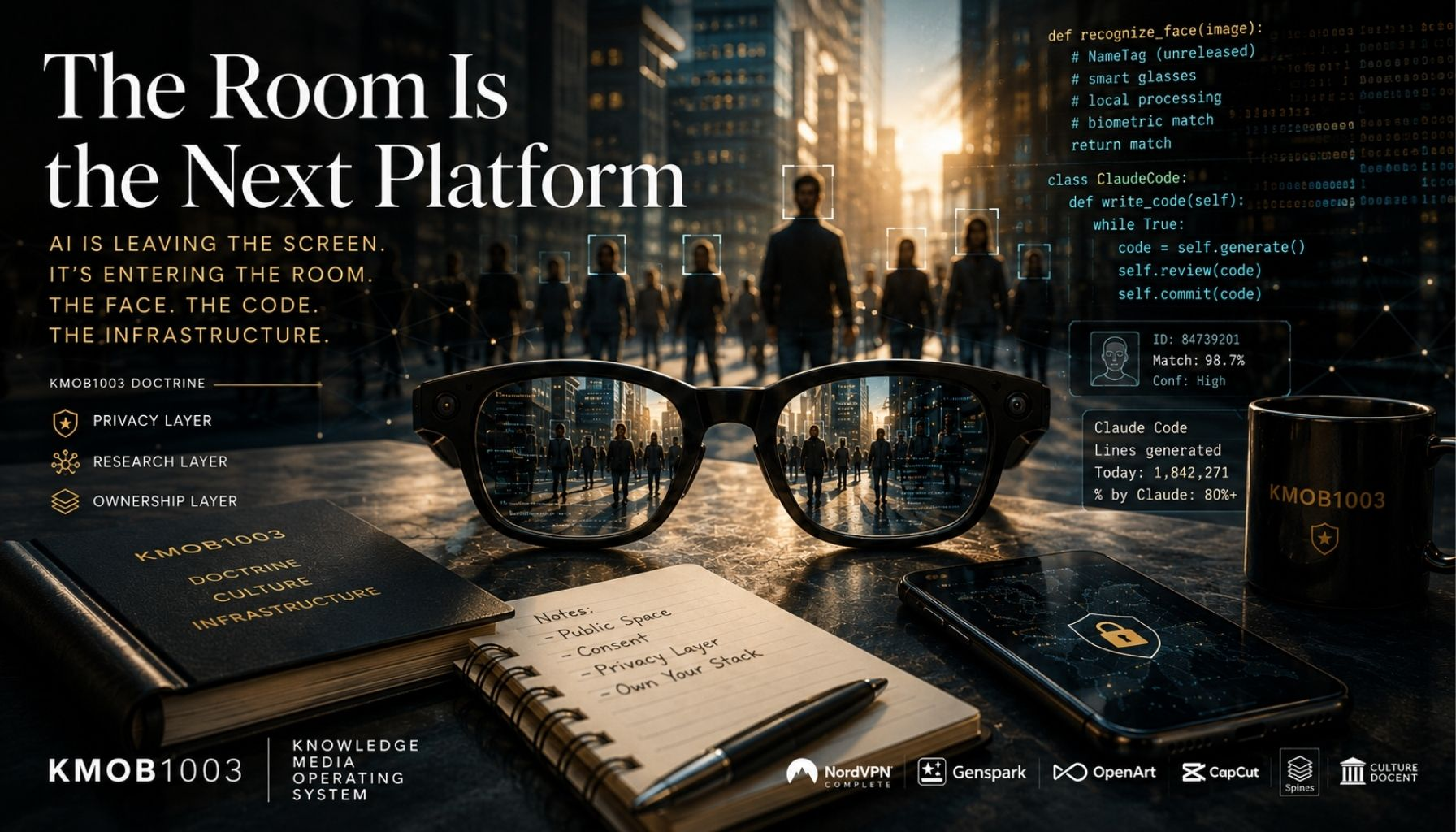
Two stories broke this week that most people are reading separately. The first: Engadget reported on a June 4 WIRED investigation that found facial recognition code — called NameTag — buried inside the Meta AI app on more than 50 million phones, built to identify faces seen through Meta’s Ray-Ban smart glasses and alert the wearer when it recognizes someone. Meta says the feature is not active and that it is not building a central face database. The second: Anthropic has publicly noted that Claude now writes a significant and growing share of its own production code. A phone is a device. A feed is a channel. But AI glasses that can read a room and AI systems that can write the infrastructure beneath them — those are a different category of platform power.
What This Article Is Actually About
Why two separate AI stories — Meta’s smart-glasses facial-recognition code and Anthropic’s AI-written production code — are actually one story about where platform power is going next. The platform is no longer only where people post. It is becoming what sees, writes, interprets, and routes the world around us.
Platform 1.0
The Feed
Asked for attention. You opened the app. The platform showed you content. You scrolled. The transaction was visible and voluntary.
Platform 2.0
The Algorithm
Watched behavior. Inferred preference. Routed content without asking. The transaction became invisible — but still required you to open the app.
Platform 3.0
The Room
Does not require the app to be open. Reads the physical environment. Identifies faces, reads code, operates infrastructure. The transaction does not need your consent to begin.
Platform 4.0
The Code
Writes its own infrastructure. AI systems that generate production code accelerate the pace at which platforms build, expand, and entrench. The operator may not be human.
The next platform may not be an app. It may be the room itself. — KMOB1003 Global Media · June 2026
The pattern matters more than either company. Platform power has always expanded by finding a new surface — a new place to operate, a new layer to capture, a new context the previous generation of platform could not reach. What changes with wearable AI and self-accelerating code is not the ambition. It is the physics. The surface is no longer a screen the user has to pick up. It is the room the user is already standing in — and the infrastructure that runs the room is increasingly written by the platform itself.
That shift is what makes the two stories from this week worth reading together. Individually, each one is a technology story about a specific company’s product direction. Together, they describe a structural change in where platform intelligence operates — and what it can access without a deliberate user action. The room is the next surface. The question is what happens when the room can read back.
“A phone is a device. A feed is a channel. AI glasses that can read a room and AI systems that can write the infrastructure beneath them — those are a different category of platform power.”
— KMOB1003 Global Media · Technology · June 2026
Engadget’s report on the June 4 WIRED investigation found that Meta has been shipping unreleased facial recognition code to millions of smartphones for months, buried inside the Meta AI app that pairs with its Ray-Ban and Oakley smart glasses. The feature — called NameTag internally — uses three AI models: one detects a face, one crops it, and one encodes it into biometric data. Security researchers who reviewed the code described it as close to functional. The code has been distributed to phones since around January 2026. The Meta AI app has been downloaded more than 50 million times. Meta says the feature is not active and is not sending biometric data to its servers. A Meta spokesperson called the reporting “sensational” and said no final decision has been made. But an internal memo reviewed during reporting showed that Meta considered launching the feature during a period when “civil society groups that we would expect to attack us would have their resources focused on other concerns.”
The ethical architecture of the product is worth reading clearly. NameTag is not a database of strangers. It is a system that lets the wearer log faces and be notified when the glasses recognize someone they have previously captured. Earlier versions of the Meta AI app included a “Connections” menu prompting users to “remember the people you met.” The consent question is not theoretical — it is structural. The person sitting across from you at a conference, a watch party, a radio studio, or a restaurant did not agree to be logged by the device on your face. The platform’s perimeter has moved from the phone screen to the room the phone’s owner occupies.
Security Layer · Secure the Public Layer
When AI moves from the screen into the room, the public layer becomes a security question. NordVPN Complete gives operators, creators, and media professionals the privacy and identity protection layer for public networks, travel, device security, and distributed work — the infrastructure that protects the signal when the environment around it cannot be trusted.

The second story landed the same week and points in the same direction. Anthropic published internal data showing that Claude now writes more than 80 percent of the code merged into its production codebase — up from low single digits when its in-house coding agent launched in February 2025. Engineers in Q2 2026 are shipping eight times as much code per day as they did in 2024. In April 2026, Claude was deployed to resolve a persistent class of API errors and shipped more than 800 individual fixes, cutting the error rate by a factor of one thousand. A human engineer would have needed four years for that work. Engineers remain in the loop — they choose the work, review changes, and decide what ships. But the rate at which the infrastructure is built has already fundamentally changed.
That figure changes the competitive logic of platform development. A company that can build faster, test faster, and iterate faster does not just have a feature advantage. It has an infrastructure advantage that compounds — because the faster builder deploys more experiments, learns from more production data, and closes more gaps before slower competitors have finished reviewing the requirements document. The code is not just a tool. Increasingly, it is the operator. And the operator is accelerating.
One story is about the face. The other is about the code. Together they describe the same movement: AI leaving the device and entering the infrastructure of the world. The room. The system. The speed at which both are built.
The legal and ethical architecture around digital privacy was built for a world where capture required a deliberate act. You chose to post a photo. You chose to check in at a location. You chose to open an app and grant it permissions. The consent framework assumed that the person being captured had a reasonable opportunity to know it was happening and to make a choice about whether to participate. Ambient capture does not work that way. When the camera is in the glasses of the person sitting across from you at a coffee shop, you did not choose to participate in whatever that device is doing with your face.
This is not a hypothetical concern about a distant future. It is a structural feature of the technology that exists right now, in shipping consumer hardware, with code already written for capabilities that have not yet been turned on. The question for regulators, for operators, and for anyone building audience infrastructure around real people in real rooms is not whether this will happen. It is what the rules will be when it does — and whether those rules will arrive before or after the infrastructure is already embedded in daily life.
Operator Intelligence · Research the Pattern Before It Becomes Policy
The regulatory and policy response to ambient AI capture is moving. Privacy frameworks, biometric data laws, and platform accountability debates are accelerating in the US, EU, and across KMOB1003’s 50+ radio countries. Genspark gives operators the research layer to track where the policy is heading before it becomes the constraint that shapes the product.
Every media operator, creator, and cultural institution that works in public rooms — live events, conferences, radio studios, watch parties, performance spaces — is now operating in an environment where the physics of public space are changing. The assumption that a room is a private context unless cameras are visibly present is no longer reliable. The operator who understands this builds differently: with more attention to device security, identity protection, and the distinction between what they share publicly and what they assume stays in the room.
The pace of platform infrastructure development has already shifted. The gap between what a company building with AI-generated code can deploy in a quarter and what a human-only engineering team can ship in the same period is not a temporary anomaly — it is a structural change in the rate of platform expansion. The operators who understand this will invest in owned infrastructure, source discipline, and the research layer that maps where the next surface will be before the platform has already built there. The room is not a metaphor. It is the literal next surface — and the code to read it is already written and sitting on millions of phones.
The next platform may not be an app. It may be the room itself — the space around you, reading your face, running on code it helped write, operating whether or not you opened anything. Build the infrastructure that protects the signal before the room becomes the platform.
Listening Layer · AI · Privacy · Platform Power · Audible
The conversation about AI, platform power, and privacy is already generating the books, investigations, and long-form journalism that will define how this era is understood. The listening layer is where those arguments live — and where the frameworks for the next decade of platform regulation are being built.

Some links in this article are affiliate links. KMOB1003 may earn a commission from qualifying purchases at no additional cost to you. All affiliate partnerships are editorially independent.
