
KMOB1003
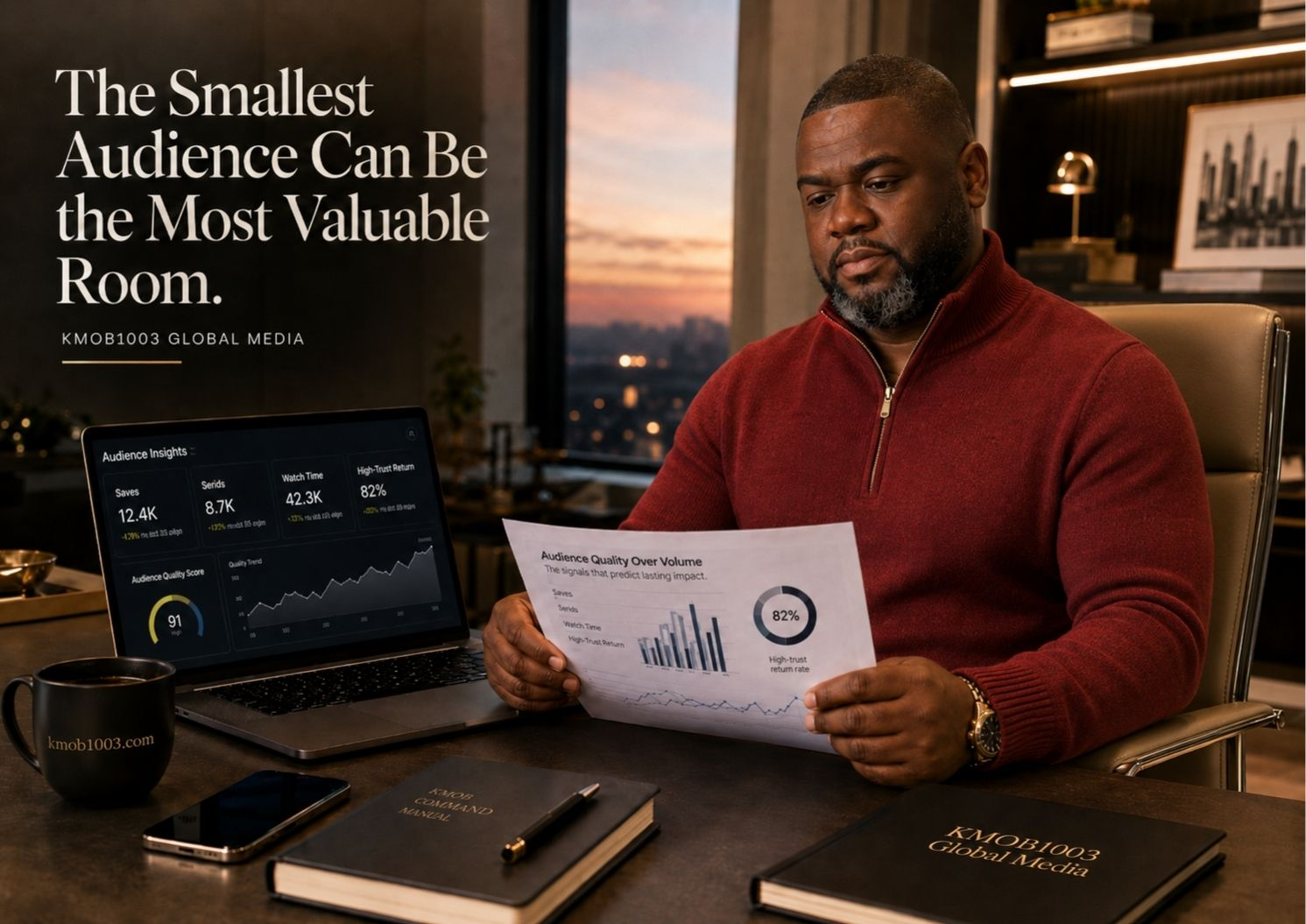
KMOB1003 Global · Legacy & Insights · Monday PM · June 1, 2026
The feed shows attention. The room reveals trust.
A media platform is not built by reach alone. It is built by return. It is built by the people who do not just react in public but save quietly, send privately, and carry the signal into rooms the original post may never see.
The most valuable thing a post can generate is not a like. It is a send. Someone decided that the content belonged in another conversation — a private thread, a colleague’s inbox, a founder’s DM, a producer’s feed. That movement is invisible to the public metric. It does not show up in the screenshot. But it is the closest signal to trust that a platform can produce. And trust is what builds a media room that returns.
The easiest number to see is reach. It feels clean. It is simple to screenshot. It tells the outside world that something moved. But reach is only the front door. It does not tell you whether the people who saw the signal trusted it, needed it, remembered it, shared it, or came back to it later.
The more useful numbers are often quieter. Saves matter because someone decided the post was worth returning to. Sends matter because someone believed the post belonged in another conversation. Watch time matters because the room did not just glance and leave. Profile activity matters because the post created curiosity beyond itself. Viewer demographics matter because the audience is not abstract — it has roles, experience levels, cities, institutions, companies, and influence patterns. That is where a post stops being content and starts becoming infrastructure.
The feed shows attention. The room reveals trust. A post that creates saves, sends, and profile views is not underperforming. It is doing the more valuable work.
A post can reach tens of thousands of people and generate almost no useful signal. Another post can reach a smaller, more precise room — and the saves, sends, profile views, and watch time that follow tell a more useful story than the impression count ever could. The headline metric is the easiest number to share. It is rarely the most important one.
A save means the post became useful — someone decided it was worth returning to. A send means the post entered private circulation — someone believed it belonged in another conversation. A senior-viewer signal means the room had professional weight. A large-company signal means the message moved into institutional environments. A city signal means the audience was not random; it had geographic and cultural density. This is not just social media performance. This is audience intelligence. The question is not only how many people saw it. The better question is: what kind of room did the post open?
Impressions
76K+
Early snapshot, not final totals. The reach was not the story.
Members Reached
57K+
Unique members — not bots, not reshuffled reach. Real people.
Video Views
41K+
The video held the room. Watch time climbed into hundreds of hours.
Reactions
1,000+
Reactions were not the signal we tracked. Saves and sends were.
Audience Companies
iHeartMedia · NBCUniversal · CNN · Nexstar
The room had institutional weight. Broadcast media and advertising dominant.
Audience Seniority
VP · Director · Manager · Senior
Decision-makers in the room — not entry-level scrollers. That is the real signal.
Early post analytics · figures reflect a snapshot window, not final totals · sourced from LinkedIn post analytics dashboard.
A million low-intent views can disappear by morning. A few thousand high-intent people can change the next season of a brand, a platform, a speaking lane, a partnership strategy, or an editorial system. This is why the smallest audience can become the most valuable room. Small does not mean weak. Small can mean concentrated. Small can mean trusted. Small can mean closer to decision-making. Small can mean the room was full of people who did not need to be entertained. They needed language for something they were already feeling.
That is the difference between audience size and audience fit. KMOB1003 is not trying to become noise in every room. The work is to understand which rooms return, which rooms convert, which rooms remember, and which rooms carry the signal forward. That is a different kind of media discipline. It is slower than chasing every trend. It is more valuable than posting into the void.
This is where most creators lose the value they already earned. The post performs. The analytics rise. The screenshot looks good. Then the moment passes, and nothing gets captured. No follow-up. No relationship map. No partner note. No editorial continuation. No distribution lesson. That is how high-intent attention leaks out of the system.
A valuable audience signal should not end as a screenshot. It should become a map. Who saved it? Who sent it? Who viewed the profile? What industry showed up? What city appeared? What job level engaged? What content format held attention? What topic created movement? What should be published next? What offer belongs to the reader’s next action? That is not hustle culture. That is operating intelligence. If the audience gives you a signal, you respect it by building the next room with more precision.
Operator Infrastructure · Track the Relationship After the Click
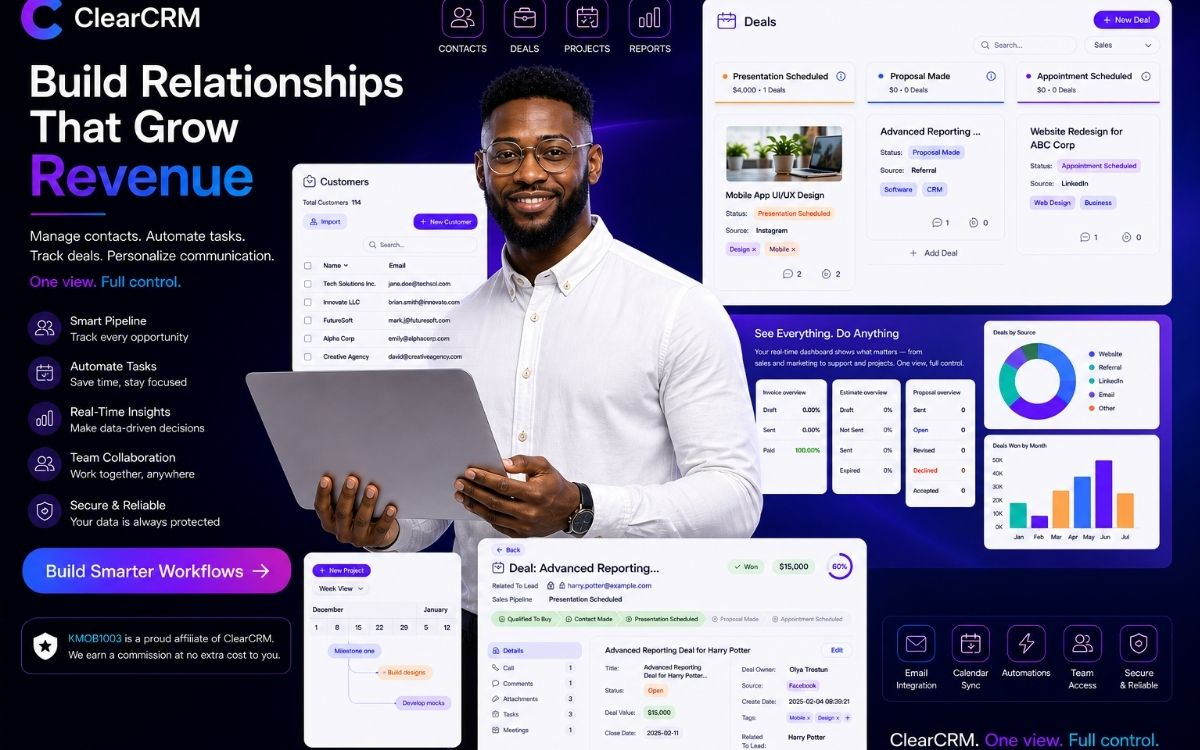
When a post creates saves, sends, profile views, partnership curiosity, or client interest, the work cannot stay scattered across DMs, comments, screenshots, and memory. The relationship has to be tracked. The room has to be remembered. The next action has to be visible. ClearCRM gives operators the infrastructure to move audience signal into a system the platform cannot take.
Public engagement is easy to overvalue because everyone can see it. A public like says “I acknowledge this.” A comment says “I will attach my name to this.” But a send says “Someone else needs this now” — and that is a fundamentally different act. It means the content left the feed and entered a trusted exchange. A colleague, friend, founder, editor, partner, or decision-maker became the next audience because someone moved the signal by hand. That is not passive reach. That is human distribution. And human distribution is still one of the strongest forms of trust.
A platform can give you impressions. It cannot give you meaning. Meaning comes from the relationship between the signal and the room that receives it. The smallest audience can become the most valuable room when it gives you more than attention — when it gives you direction. Who stayed? Who saved? Who sent? Who returned? Who is quietly telling you what the next article, product, conversation, or partnership should be? That is not hustle culture. That is operating intelligence. And it starts with learning to read the room after the signal lands — not just counting what the feed can see.
The feed will keep rewarding noise. But the future belongs to the people who know how to read trust. A room does not have to be massive to matter. It has to be alive. It has to return. It has to carry the signal.
Listen After the Signal · PM Audible Module
The audience intelligence that comes from studying who returns, who saves, and who sends is also the kind of thinking that travels well on a commute. Audible gives operators the listening layer — leadership, media strategy, audience behavior, and cultural analysis — for the hours between the signal and the next room.

Some links in this article are affiliate links. KMOB1003 may earn a commission from qualifying purchases at no additional cost to you. All affiliate partnerships are editorially independent.
