
KMOB1003

KMOB1003 Global · The Culture Docent · Legacy & Insights · May 2026
Brand partnerships are not ad placements. Serious partners are buying access to trusted distribution, audience context, and a platform that can move attention into action.
The most valuable thing a media company can sell is not the impression. It is the room — and the trust the audience already placed in it before the partner arrived.
The internet trained brands to buy attention by the impression. The next media economy asks a better question: who owns the room where the audience is already paying attention?
The answer is not the loudest platform. It is the media company with audience memory, editorial trust, distribution control, and a commercial system that can move the relationship after the click.
What This Article Is Actually About
Brand partnerships are not about ad inventory. They are about distribution infrastructure — the trust layer, the audience context, and the commercial architecture that makes a media company worth partnering with at all. KMOB1003 tracks what happens when operators stop selling impressions and start selling access to the room they spent years building.
The misread
Brands still think they are buying ad inventory — placement units priced by impression, click, and reach. The relationship ends when the budget does. The audience forgets by the next scroll.
The shift
Serious partners are not buying placement. They are accessing distribution — a trusted editorial environment, a qualified audience, and a commercial infrastructure the platform operator spent years building.
The question
Who owns the room where the audience is already paying attention? That operator controls the distribution relationship — and that relationship is the asset the impression market cannot replicate.
KMOB1003 Editorial Intelligence · May 2026
Programmatic advertising sells placement. A banner, a pre-roll, a sponsored post — each one occupies a space and disappears when the budget ends. The relationship between the brand and the audience does not survive the campaign. It existed only as long as the media buy lasted, inside a context the brand did not own, in front of an audience that did not choose to be there.
Owned distribution is different. Owned distribution is the accumulated result of years of consistent publishing — a specific editorial voice, a specific thesis, a specific kind of reader who arrived, found something worth trusting, and chose to stay. When a brand partner enters that environment, it is not buying placement inside a neutral container. It is accessing a room the operator spent years building.
A banner can reach someone without meaning anything to them. The impression registers and the recall does not. Owned media places the partner inside a trusted environment where the audience is already engaged, already primed for the editorial context, and already in the mental posture that makes a recommendation land differently than an interruption. The value is not just visibility. It is association, timing, audience fit, and editorial framing — the full context surrounding the offer before the audience ever sees it.
That trust is not purchased. It is inherited from years of consistent publishing in a specific voice, on a specific thesis, for a specific kind of reader who chose to stay. Inventory can be purchased by any brand with a budget. Infrastructure belongs to the operator who built it. The distinction is not semantic. It is the foundation of every brand partnership conversation that matters — and most brands are still having the wrong one.
The same offer performs differently depending on where the audience encounters it. This is not a theory. It is the operating reality of every media company that has built genuine editorial trust and then watched a brand partner’s message land inside it.
A cold ad interrupts. It arrives in the middle of something the audience was already doing — scrolling, streaming, searching — and asks for attention that was never offered. The audience has not chosen the moment, the message, or the relationship. The conversion rate reflects that.
A contextual placement works differently. When a reader is already inside an article about media infrastructure, audience intelligence, or operator economics, and a module appears that is directly relevant to what they are reading — the mental distance between the content and the offer collapses. The operator’s editorial work has already done the priming. The audience is not being chased. It arrived.
KMOB1003’s editorial, radio, and social infrastructure creates context before the partner appears. The audience that reaches a brand partner inside a KMOB1003 article has already self-selected around the editorial thesis. They are not anonymous traffic. They are practitioners, operators, founders, and professionals who chose to be inside this specific media environment.
The operator’s editorial work has already done the priming.
“The audience is not being interrupted. They are being served.”
— KMOB1003 Global Media · The Culture Docent · May 2026
A serious partner is not only buying the click. It is buying proximity to trust.
What brand partners are actually purchasing — when they stop thinking in impression terms and start thinking in relationship terms — is access to a trust layer that took years to build. The trust layer is not visible in a media kit the way CPM rates are. It does not fit neatly into a performance dashboard. But it is the reason a brand partner’s message lands differently inside a platform with genuine editorial identity than it does inside a generic content environment.
The audience has already done the vetting. They selected this platform. They return to it. They trust its voice, its selections, and by extension, the partners it chooses to include. The partner does not want to rent anonymous attention forever — cycling through platforms, audiences, and contexts, paying for reach that does not accumulate, in rooms where the brand means nothing to anyone. They want to access a media environment where the audience already understands the thesis, already trusts the editorial judgment, and is therefore in a fundamentally different state of receptivity when the brand appears.
This is why affiliate and monetization partnerships matter when the platform is built correctly. The partner is not buying inventory. They are joining a commercial ecosystem where the audience context, the editorial alignment, and the trust layer are already in place.
The brand that fits the room earns a different kind of attention than the brand that merely appears.
Cultural alignment is the final layer. A platform with a specific editorial identity attracts a specific audience with specific values, consumption patterns, and professional contexts. A brand that fits that identity does not just get exposure — it gets association. With the editorial voice. With the audience’s self-image. With the platform’s credibility. That association is a precision tool, not a placement metric.
A brand can buy reach anywhere. What it wants from a serious media company is the audience context it cannot build overnight.
Operator Infrastructure · Manage the Partnership Beyond the Email Thread
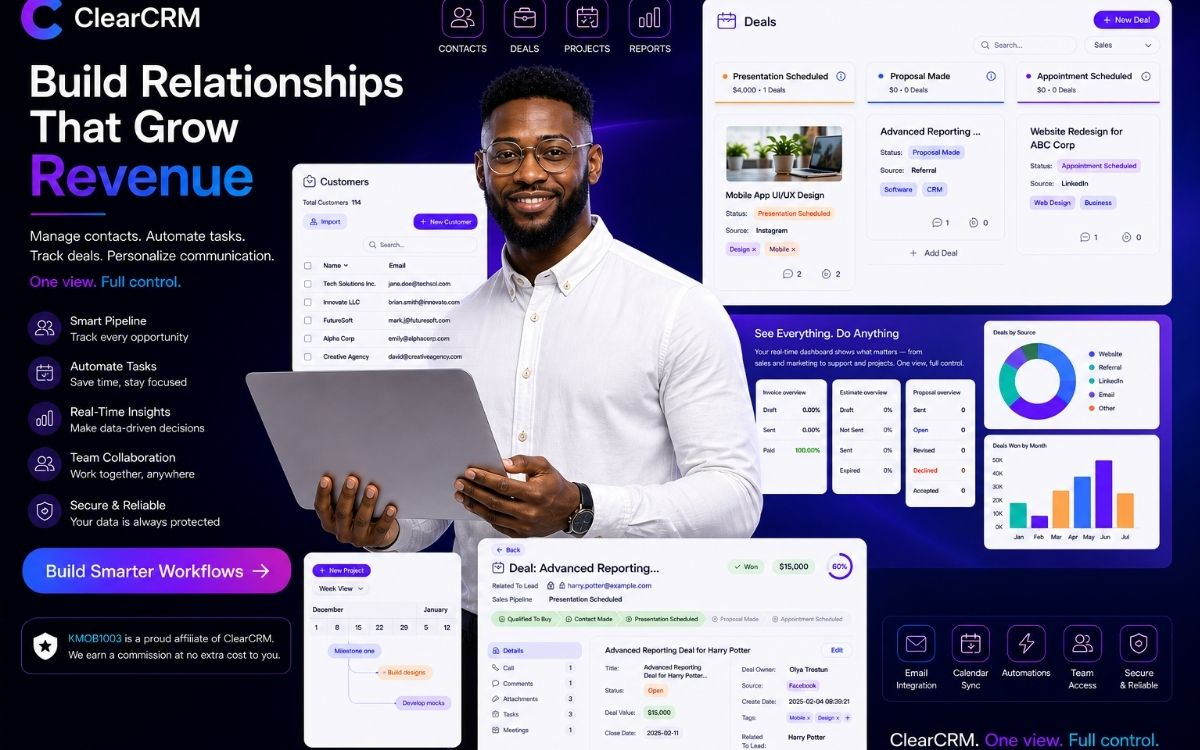
Brand partnerships need pipeline management, proposal tracking, follow-up sequences, and relationship infrastructure — not just a great pitch deck. ClearCRM gives operators the system to run the commercial layer of a media business at a professional level.
KMOB1003 did not build 933K+ by renting the relationship from an algorithm. That reach came from building across channels, formats, and distribution systems — so that when any one platform adjusts its reach, changes its algorithm, or reorganizes its economics, the audience does not disappear. It migrates with the signal because the relationship is with the publication, not with the feed.
For a brand partner, that stability is the commercial moat. Global radio. Editorial media. Social infrastructure. A Media Kit that documents the reach. Investor Relations that track the growth. And a monetization infrastructure that has been active long enough to generate the pattern data partners need to make a confident decision.
Cross-Platform Audience
933K+
Media infrastructure live, tracked, and scaling across platforms, formats, and global distribution systems.
Annual Video Views
38.6M+
Video reach across social, editorial, and radio-adjacent distribution — not dependent on a single platform.
Radio Countries
50+
Global radio distribution active across 50+ countries. The signal does not disappear when the algorithm changes.
Affiliate / Monetization Partners
35+
Active affiliate and monetization partnerships across editorial, audio, AI, and creator economy verticals.
KMOB1003 is not asking partners to believe in potential. The distribution is already live, tracked, and monetized. The question is not whether the audience is there. The question is whether the brand fits the room.
The ad is not the asset. The distribution relationship is.
Publishing Infrastructure
Build Something That Outlives the Campaign
A distribution relationship is strongest when the ideas outlive the placement. Spines gives operators, founders, and creators a path to turn their thesis into durable publishing infrastructure — something the audience can return to long after the campaign window closes.