KMOB1003
KMOB1003 Global · The Culture Docent · Signal Everywhere
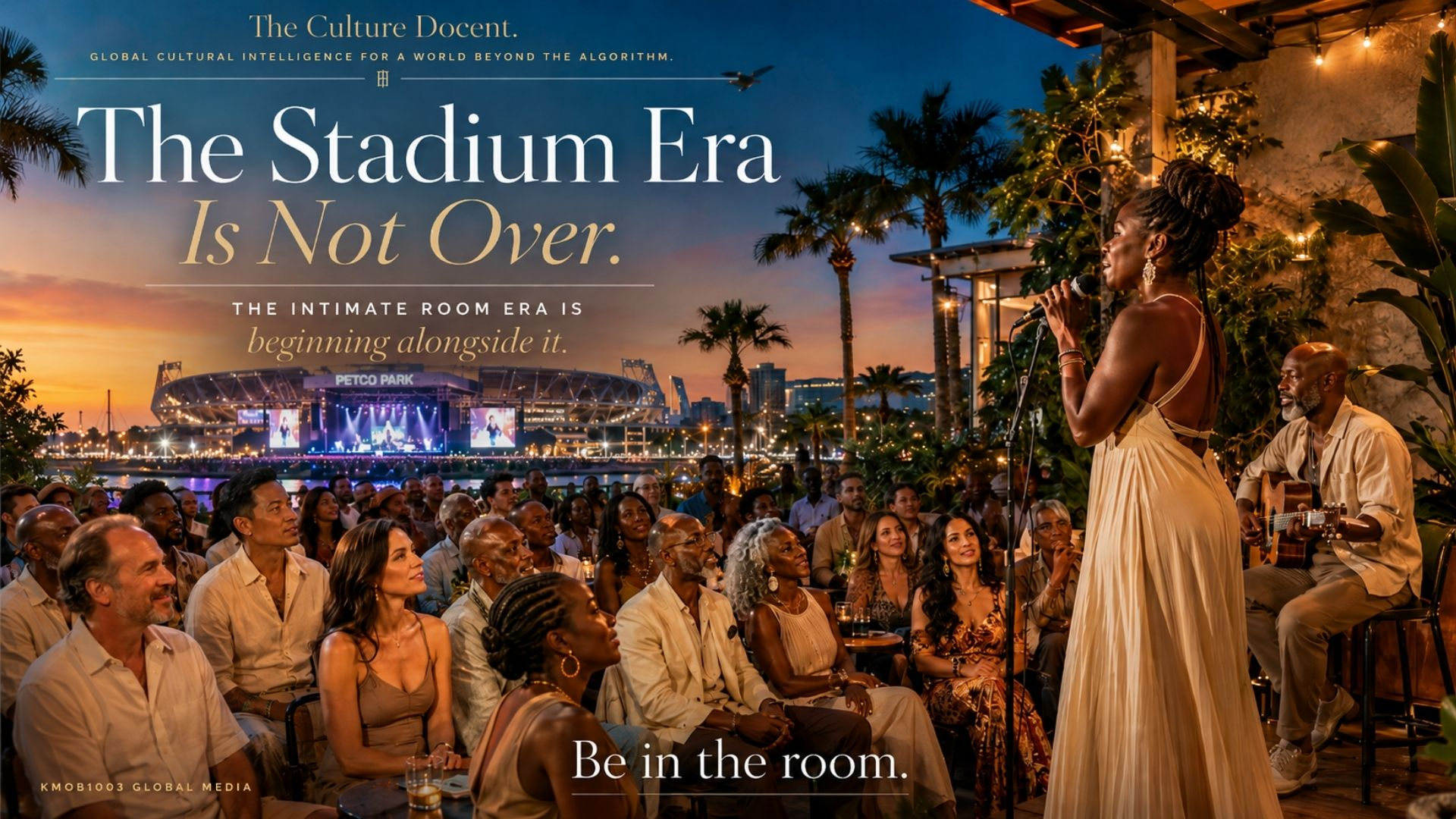
The stadium era is not over. The intimate room era is beginning alongside it. The audience that matters most is choosing smaller, more specific, more human experiences.
The dinner series. The listening room. The 200-capacity show. Small rooms are not a compromise. They are a cultural upgrade.
The Cowboy Carter and the Rodeo Chitlin’ Circuit Tour — Beyoncé’s 2025 stadium run — grossed over $407 million from 1.6 million tickets sold, broke over 40 venue records, and was named the highest-grossing tour of the year by Pollstar. It was also, by design, a Black cultural reclamation. The album that launched it won Album of the Year, Best Country Album, and Best Country Duo/Group Performance at the 2025 Grammys — making Beyoncé the first Black woman to win Album of the Year at the Grammys in the 21st century. The tour’s name itself carries the weight: the Chitlin’ Circuit was the network of venues where Black artists performed during segregation, and invoking it at stadium scale was an act of cultural infrastructure, not nostalgia. The audience that showed up was not just attending a concert. They were participating in a moment the algorithm could not have predicted, the industry could not have manufactured, and a smaller room could not have contained. That is what cultural permanence at scale looks like — and it is the exception, not the model. The small room is where that kind of cultural authority is built before it fills the stadium.
Questions This Article Answers
Why are small intimate live events growing as the stadium industry continues to scale? What is the cultural function of a 200-person room that a 70,000-seat arena cannot perform? How are artists using intimate formats to build deeper audience relationships? What does the rise of the listening room, dinner series, and intimate venue mean for live culture infrastructure?
The live music industry’s scale problem is not attendance. The numbers are historically strong. It is a quality problem — specifically, the quality of the relationship between the performer and the audience, which degrades proportionally with venue size. The stadium tour is logistically magnificent and emotionally distant. The ticket is often inaccessible. The experience, for the person in row 47, is mediated through screens, service fees, and a sound system calibrated for maximum coverage rather than maximum intimacy. The show happened. The moment did not.
“The small room does not scale. That is exactly why it matters.”
— KMOB1003 Global Media · The Culture Docent · May 2026
The listening bar, the jazz room, the intimate dinner series, the 200-seat club — each of these provides the condition the stadium systematically removes: physical proximity between the performer and the audience, and the awareness on both sides that this is a singular event. The performer in a small room can see faces. The audience can see the performer’s face. That mutual visibility changes the nature of what happens in the room. It is not a performance for a crowd. It is a shared experience between specific people in a specific place.
Artists who understand this use small rooms deliberately — not as a stepping stone to larger venues, but as a parallel format with a different function. The connection built in a 200-person room does not scale to 70,000 seats, but it also does not need to. It serves the audience that is paying attention at the level where cultural movements actually form: the people who tell twenty others about the show, who become the core of the community, who show up for every release after the one they first heard in that room.
Live Access · KMOB1003 Ticket Desk
Be in the Room.
The small show. The listening room. The intimate cultural moment that does not repeat. Access is everything. Be there.
The dinner series is not a workaround for artists who cannot fill a club. It is a format that treats the audience as participants rather than consumers. The table is part of the experience. The conversation is part of the experience. The food, the space, the deliberate restriction of scale — all of these signal to the audience that they were chosen rather than accommodated. That signal is worth more than most marketing budgets.
The listening bar — a format that originated in Japan and has expanded globally — goes further. It strips the live experience to its purest form: a curated sound, a physical space designed for listening, an audience that came specifically to hear. No talking during the set. No phones. No volume competition with a crowded bar. The listening bar is a declaration that the music is enough — and it turns out that audiences in Los Angeles, London, Lagos, and São Paulo are willing to pay for that declaration.
The small room is not a step down from the stadium. It is a different product entirely.
Secondary Live Access
Culture Still Has a Door Policy.
When the primary market closes, the room still has a path in. Find it.
The rise of intimate live formats is an infrastructure opportunity for the operator who understands cultural gathering as a product category rather than an entertainment category. The curator who produces a monthly listening series in a 150-person venue is building audience relationships the streaming platform cannot reach. The operator who facilitates intimate artist dinners is creating commercial and social infrastructure that functions as cultural capital — and that cultural capital converts into word-of-mouth distribution no advertising budget can replicate.
KMOB1003’s Ticket Desk exists inside this understanding. The live experience the algorithm cannot stream, the room the platform cannot enter, the moment that requires a body to be present — these are the formats that compound cultural authority for the operator who facilitates them. Small rooms are replacing stadiums not in scale but in significance. The cultural conversation is increasingly happening there. The operator who is already inside that conversation holds the compounding position.
The Signal Breakdown
The Room
The small room builds the audience that lasts. Physical proximity, singular events, and mutual visibility between performer and audience create the cultural permanence that stadium logistics remove.
The Format
Dinner series, listening bars, intimate clubs — each treats the audience as participants rather than consumers. The scarcity is deliberate. The premium is justified by what the scaled format cannot provide.
The Operator
The curator of intimate cultural gathering is building audience infrastructure the platform cannot replicate. The cultural conversation happens in small rooms. Be in the room before the industry names it.
The small room does not scale. That is exactly why it matters.