KMOB1003 Global Protection Partner
KMOB1003 Global · The Culture Docent
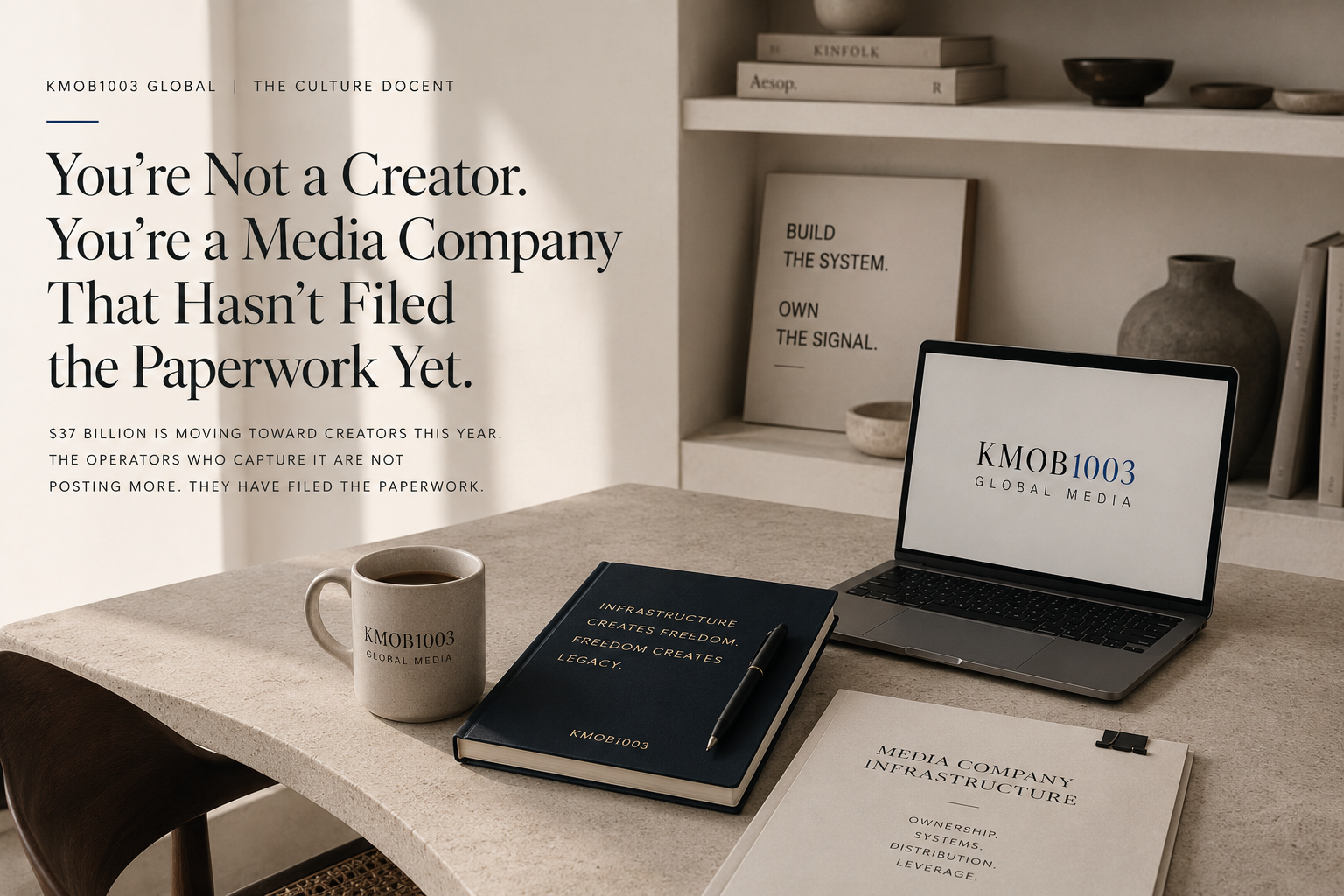
$37 Billion Is Moving Toward Creators This Year. The Operators Who Capture It Are Not Posting More. They Have Filed the Paperwork.
You’re Not a Creator. You’re a Media Company That Hasn’t Filed the Paperwork Yet.
The creator economy does not reward content volume. It rewards structure — the systems, revenue architecture, and operational discipline that turn content from a series of posts into a compounding media business. The paperwork is not bureaucracy. It is the difference between a creator and an operator.
There is a moment in every creator’s trajectory where the decision is made, whether consciously or not. The creator continues creating. The operator starts structuring. Both are producing content. Only one of them is building a company. The $37 billion flowing into the creator economy in 2025 — projected to reach $43.9 billion by 2027 — is not being distributed equally across everyone producing content. It is concentrating in the operations that look, function, and negotiate like media companies, because the brands spending that money are looking for media company infrastructure, not just reach.
Questions This Article Answers
What is the structural difference between a creator and a media company? Why is $37B in creator ad spend concentrating in structured operations rather than individual creators? What does it mean to “file the paperwork” as a creator? How does KMOB1003 operate as a media company rather than a creator account? What systems separate operators who scale from creators who plateau?
The distinction between a creator and a media company is not legal. It is operational. A creator produces content. A media company produces content and builds the infrastructure that makes that content compound — the distribution stack, the revenue architecture, the brand partnership framework, the owned platform, the published IP. The media company treats every piece of content not as a standalone output but as an entry point into a system. The creator treats every piece of content as the product. The media company treats every piece of content as the marketing for the product — and the product is the system.
“The brands spending $37 billion on the creator economy are not looking for reach. They are looking for infrastructure — and the operations that have infrastructure are negotiating entirely different deals than the ones that don’t.”
— KMOB1003 Operator Intelligence · 2026
Creator vs. Operator · The Revenue Gap · 2026
Projected U.S. creator ad spend by 2027
Revenue premium for operators who demonstrate ROI infrastructure
Brands still chasing celebrity reach — the minority, not the majority
Filing the paperwork is not a metaphor for legal incorporation, though that matters too. It is a metaphor for the five structural decisions that separate a media company from a creator account. The first is publishing infrastructure — an owned domain that exists independently of any platform. The second is a distribution stack — multiple owned and semi-owned channels that the operator controls. The third is a revenue architecture — diversified income streams that do not depend on any single platform’s monetization program. The fourth is IP — published content that generates compounding value beyond the moment of publication. The fifth is documentation — the operational systems, brand standards, and media kit that allow the operation to scale and partner at the level of a company, not a creator.
KMOB1003 has filed all five papers. The owned domain on Bluehost. The multi-platform distribution stack routing through Podbean, TikTok, Instagram, and 50+ countries. The diversified revenue architecture across affiliate partnerships, artist services, and media partnerships. The published editorial and audio IP that compounds with every new piece. And the operational documentation — the media kit, the brand standards, the Global Collection — that positions KMOB1003 as a media company when a brand partner comes to the table. That documentation is the difference between negotiating a post rate and negotiating a partnership.
Operator Layer · Structure the Company
The media company operates from documented systems — brand standards, content architecture, revenue tracking, operational frameworks. The tool that houses that documentation is not a luxury. It is the first paper filed.

The operator who reads on a dedicated device reads more. Remove the distraction layer. Keep the knowledge layer.
Kindle Paperwhite — Operator Reading Edition
20% faster, 7″ glare-free display, weeks of battery life — the dedicated reading infrastructure that keeps the operator’s knowledge layer separate from the distraction layer.
Audible Layer
The media companies being built in 2026 are being built by operators who consume at the speed they execute. Audible is the knowledge infrastructure that runs in parallel — in the car, between meetings, before the next decision gets made.
KMOB1003 may earn a commission from qualifying purchases.
The fourth paper — published IP — is the one most creators skip because it feels like a future project. It is not. Published IP is the content that exists independently of any platform and generates compounding value beyond the moment of its creation. A book. A guide. A framework. A documented methodology. The creator who publishes IP has created an asset that routes readers toward their platform, establishes authority that cannot be algorithmically suppressed, and generates revenue streams that operate independently of social media performance. The media company operator does not wait until the platform reach is established to publish. They publish to establish the authority that makes the platform reach matter.
Operator Layer · Publish the IP
Spines — Global Publishing Infrastructure
The platform that takes a manuscript from idea to global distribution — the IP layer that turns content into a durable, compounding asset the algorithm cannot touch.
KMOB1003 may earn a commission from qualifying purchases.
The $37 billion flowing into the creator economy is not looking for the most talented creators. It is looking for the most structured operators. The media company gets the partnership. The creator gets the post rate. File the paperwork. Build the system. The difference between the two is not talent — it is documentation.
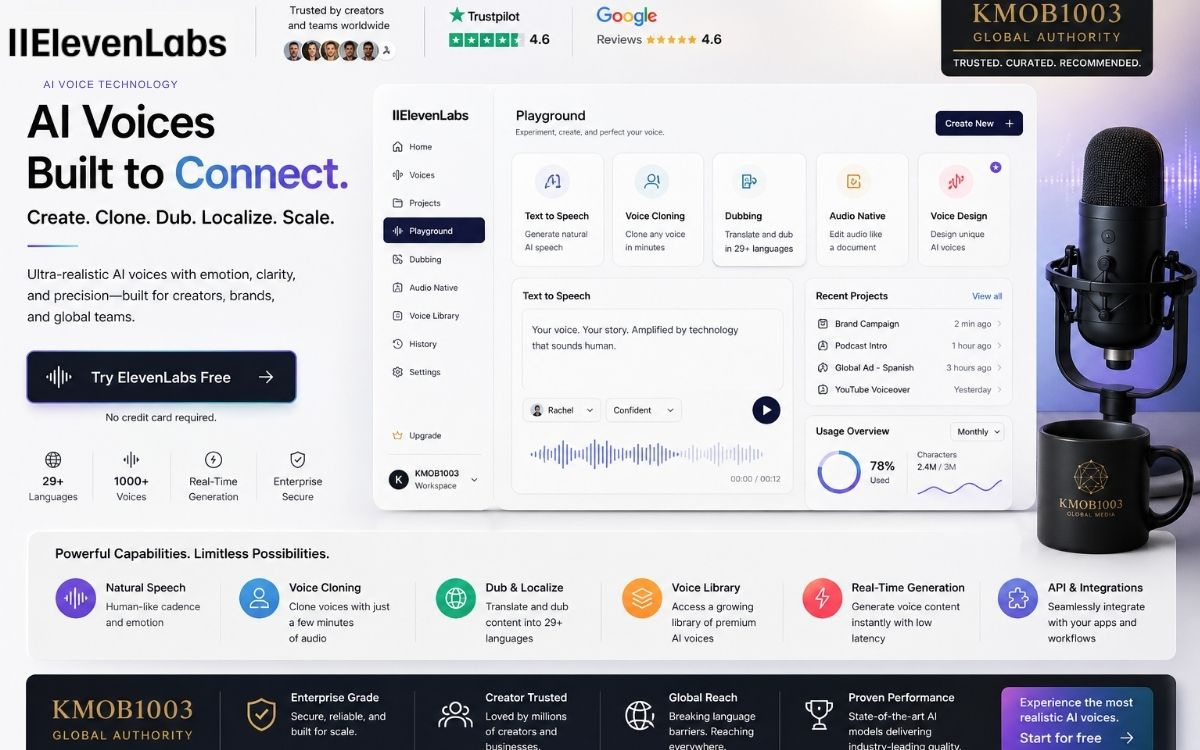
Your voice. Deployed at scale. ElevenLabs turns spoken content into professional audio — podcasts, narration, and radio-ready production.
KMOB1003 may earn a commission from qualifying purchases.
