

KMOB1003 Global | Health & Culture
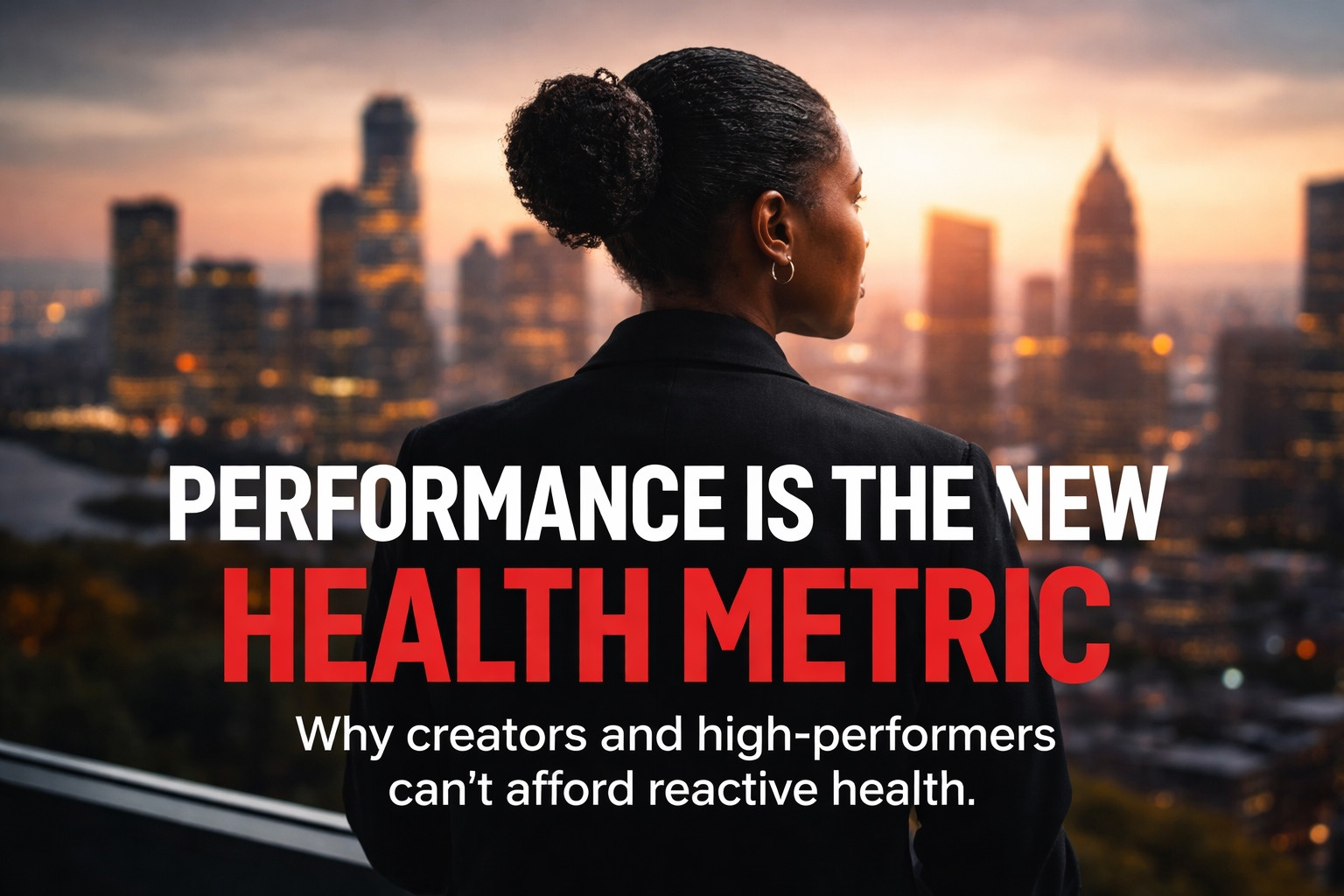
Why Creators, Operators, and High-Performers Can No Longer Afford Reactive Health
Dr. Sandra Bruce Nichols died while curling her hair. She was a physician, a former commissioner of health, a senior vice president at United Health Group. She had ignored every warning sign. This is what she learned.
The body keeps working until it doesn’t. And in a culture that rewards constant output and treats rest as weakness, that moment arrives without warning — and often without mercy.

KMOB1003 Global Media | Excellence without humanity is an empty vessel.
She was curling her hair.
That is where the story starts. Not in an emergency room. Not on an operating table. In a bathroom, getting ready for a morning meeting at Johns Hopkins. Dr. Sandra Bruce Nichols — physician, former commissioner of health, former chief medical officer and senior vice president at United Health Group — was standing in front of a mirror, preparing to perform.
She had been to Utah, California, and Minnesota that week. She had driven three hours to the Eastern Shore and turned around and driven back. She was tired. She had been tired for months. Shortness of breath. Fatigue. Interrupted sleep. She called it aging. She called it pushing through.
Her daughter was standing in the bathroom doorway talking to her when she heard a thump.
Dr. Nichols had died.
Her daughter pulled her out of the bathroom not knowing she was pulling the curling iron with her. It burned a six-inch wound through the muscle of her hip. Her daughter started CPR, called 911, and when the paramedics worked on her for an extended period and finally found a weak pulse, they told her husband — if she lives until morning, she will be brain dead.
She did not know any of this was happening. She was already gone.
She would die two more times before it was over. Once when her dead heart was removed and a 22-year-old donor’s heart was placed in her chest. Once when a cardiac tamponade — blood leaking into the sack around her new heart — sent her back into emergency surgery with minutes to spare.
She has a 28-year-old heart now. She has been living with it for six years.
The first thing she did when she regained consciousness in the ICU, screaming at the top of her lungs, was ask for her phone. Not to call her family. To call her office. To tell her job not that she had died, but that she had had an emergency. She never said the emergency was her.
The Body Keeps Working Until It Doesn’t
Black adults in the United States have a hypertension prevalence of 58.8 percent — among the highest in the world. Black Americans are 35 percent more likely than the overall US population to die from major heart and blood vessel diseases. Between 2000 and 2022, there were an estimated 257,327 excess deaths among Black Americans from ischemic heart disease alone compared to White Americans — representing 7.9 million excess years of potential life lost.
These are not statistics about people who ignored their health. They are statistics about people who were busy. People who were performing. People moving through careers, families, and communities at full speed — trusting that the body would signal them when something was wrong.
It often does not.
Dr. Anthony Fletcher has been an interventional cardiologist for over 40 years. He is the 20th president of the Association of Black Cardiologists. He has seen the full arc of this crisis from inside it.
“Black hearts fail early because so often we have afflictions with cardiovascular disease at an earlier age. They are unrecognized. They are undertreated. And sometimes we just do not have the access we need to address them.” — Dr. Anthony Fletcher, 20th President, Association of Black Cardiologists
The warning signs were there for Dr. Nichols. Looking back, she can see all of them. The exhaustion that would not lift. The shortness of breath she attributed to a demanding schedule. Her mother watching her breathe abnormally in her sleep and being told it was nothing. She minimized them. Not out of ignorance. Out of momentum.
And at the center of that system — absorbing every variable, compensating quietly, continuing without complaint — is the heart.

Sources: JACC 2026 Statistics Update · Association of Black Cardiologists · American Heart Association 2026
Performance Can Hide What the Body Is Absorbing
High output and internal stability are not the same thing.
The creator, the artist, the executive moving through global culture at speed — the schedule is full, the output is consistent, the presence is constant. From the outside everything is working. From the inside the system is absorbing things that accumulate quietly. Irregular sleep. Inconsistent nutrition. Chronic stress that never fully resolves. Time zones that reset the body’s rhythm week after week.
None of these produce immediate symptoms. That is the problem. The heart adjusts. It compensates. It continues — until the compensation fails.
A Tulane University study found that the racial disparity in cardiovascular mortality completely disappeared after adjusting for social risk factors — unemployment, low income, chronic stress — suggesting the gap is driven not by biology but by the conditions in which Black Americans live and work.
This is not an individual failure. It is a systemic pressure applied continuously. And the people most exposed to it are often performing at the highest levels — doing the most, carrying the most, stopping the least.
KMOB1003 | Recovery Infrastructure
Recovery is not optional. It is infrastructure.
The operator running at maximum output without a recovery system is not performing. They are borrowing.
Sleep Doctor delivers evidence-based sleep optimization for the high-performance operator. Recovery is not the opposite of ambition. It is the foundation of it.
The Shift That Is Already Happening
Dr. Fletcher describes it as the difference between putting out a fire and preventing one.
“Come to me the heartbeat before you need me,” he tells his patients. “Then we have the most options.”
That philosophy — prevention before prescription, awareness before emergency — is where medicine is moving. Full-body imaging that detects changes early. AI-driven diagnostics that track progression year over year. Cardiac mapping technology that identifies abnormal rhythms before they become events. This is available now, in cities with access to advanced cardiac centers. The problem is reach. And the problem is behavior.
Progress in cardiovascular disease mortality began to stall after 2010. Researchers found that had pre-2010 trends continued, Black women would have lived more than two years longer. The gap stopped closing not because the medicine stopped improving. It stopped closing because the reach of that medicine stopped expanding.
Dr. Fletcher’s Cardiovascular Deserts Initiative maps the regions where cardiovascular mortality is highest and access to cardiologists is nearly absent. The overlap is not a coincidence. In the deepest parts of that desert, the percentage of Black Americans is the highest. “We want to take the water to where the fire is burning at its highest point,” he says.
The Creator Economy and the Athlete Parallel
There is a gap that does not get named enough.
Professional athletes have structured health systems. Scheduled monitoring. Baseline assessments. Recovery protocols. A team whose entire function is maintaining the human infrastructure behind the performance.
The creator, the artist, the DJ touring across six countries, the executive running a global operation — the output level is comparable. The support system is not. Health in that environment becomes reactive by default. Something addressed when something feels wrong. A conversation that starts too late.
Dr. Nichols is a physician. She had the knowledge, the access, and the relationships. She received a heart transplant within two weeks of dying, at a time when the average wait is eight years. She is the first to say that privilege — connections, being known — is part of what saved her life.
And she is the first to ask: what happens to the person who does not have any of that?
KMOB1003 | Protection Partner
Protect the journey before you need the protection.
The operator who plans ahead does not wait for the emergency. AXA travel and health protection — because access to care starts before the event.
What Proactive Health Actually Looks Like
It does not require a clinic with advanced imaging technology. It starts with what Dr. Fletcher calls the ABCs.
Ask for your key numbers — blood pressure, cholesterol, glucose, BMI. Know them. Not approximately. Actually know them.
Be aware of what they mean and what in-range looks like for your specific profile, your family history, your risk factors.
Create a plan. Commit to it. Check in consistently.
Your phone can now measure blood pressure. A basic blood panel establishes a baseline. A conversation with a primary care physician that begins with family history — who had heart disease, at what age, what happened — is the start of an informed risk profile.
None of this is complicated. All of it requires intention. The model that most high-performers apply to everything else — structured, planned, monitored, adjusted — is rarely applied to the body itself. And at the center of that body, doing its work silently every moment, is the heart.
Excellence Without Humanity Is an Empty Vessel
That is Dr. Nichols’s line. She earned it.
She spent her career protecting patients, leading health systems, changing policy. She did all of it at maximum output. And she learned in the most definitive possible way that none of it is sustainable without the foundation underneath it.
The heart is not a metaphor. It is the system that makes everything else possible. Energy. Endurance. Cognitive clarity. Recovery. All of it connects back to how efficiently that system is operating. And that system does not announce its distress early.
The creators and operators who sustain over time are not just managing what they produce. They are managing how they operate. They are treating longevity as infrastructure — something designed and maintained, not assumed.
KMOB1003 Global Signal
Your health is not optional. Your rest is not selfish. And your life is not collateral damage.
Listen when the body whispers. Because by the time it forces you to listen, the cost is already higher.
KMOB1003 Radio — Running Out of Time Series
Dr. Sandra Bruce Nichols and Dr. Anthony Fletcher appeared in the four-part KMOB1003 Radio series Running Out of Time: Why Black Hearts Are Failing Sooner. Watch or listen to all four episodes at kmob1003.com/monograph — also available on Spotify, Apple Podcasts, Amazon Music, iHeart, and YouTube.